


So, what is client satisfaction measurement? At its core, it's the systematic process of understanding how your clients perceive your products, services, and overall brand. A high score feels good, a win for the team. But from my vantage point—spanning decades in SaaS, marketplaces, and hospitality—that single score rarely tells you the whole story about loyalty, retention, or future EBITDA.
Why High Satisfaction Scores Are Deceiving You
I've seen a dangerous pattern play out more times than I can count, in boardrooms from SaaS scale-ups to global hospitality chains. A team proudly presents a dashboard glowing with high satisfaction scores—maybe a 90% CSAT or a solid 4.5-star average rating. Everyone in the room breathes a collective sigh of relief.
Then, six months later, we’re all scratching our heads, dissecting stagnant retention numbers and trying to figure out why churn is ticking up. This is the great paradox of the modern customer experience.
Relying on a single, top-line satisfaction score is one of the most common—and costly—mistakes a leadership team can make. It creates a false sense of security, masking deeper issues that quietly erode your market share and EBITDA over time. The gap between a customer saying they're "satisfied" and their actual willingness to trust you with their next purchase is precisely where growth stalls.
The Satisfaction Versus Loyalty Gap
Think of it this way: satisfaction is transactional. A customer is satisfied because a support ticket was resolved efficiently. That moment is positive, but it's fleeting. It doesn't automatically translate into trust or advocacy.
Loyalty, on the other hand, is relational and predictive. It's built on a foundation of trust, consistency, and a genuine belief that your organization has their best interests at heart. Loyalty is an asset on the balance sheet; satisfaction is a line item in a report.
This isn't just theory; it's a measurable P&L risk. A recent global study revealed a significant disconnect between what customers report as satisfaction and the actions that truly indicate loyalty. While a respectable 76% of consumer experiences earned high satisfaction ratings, the numbers for loyalty-driven behaviors told a different story.
- Only 73% of those same consumers trusted the organization afterward.
- Just 70% said they would actually recommend the company.
- A mere 69% expressed any intent to purchase more in the future.
This data paints a very clear picture. That 7% gap between a "satisfied" customer and one who is willing to recommend you represents millions in potential lost revenue and advocacy. You can dig into the complete findings from the Qualtrics XM Institute to see how this plays out across different industries.
From Vanity Metric to Strategic Driver
In my experience, especially in the high-stakes B2B and SaaS worlds, this is where departmental silos become truly destructive. The support team might be crushing its CSAT targets, while the product team is unknowingly building features that create friction, and the sales team is setting mismatched expectations from the get-go. Each department looks at its own green dashboard, but nobody is looking at the complete picture of the customer's journey.
The real goal of measuring client satisfaction isn't to chase a high score. It's to understand the subtle signals that predict long-term customer value and drive meaningful, cross-functional action.
True, sustainable growth comes from shifting your company's focus from chasing fleeting satisfaction to building deep-seated, resilient loyalty. This requires a much more nuanced approach—one that moves beyond simple surveys and integrates multiple data points to tell you not just what happened, but why. The following sections will walk you through how to build that exact system.
Building Your Measurement Framework
A powerful client satisfaction measurement system is far more than just another survey that lands in an inbox. It’s a deliberately designed framework—an integrated engine built to give you a multi-dimensional view of the entire client relationship. In my experience, too many leaders fixate on a single metric, completely blind to the underlying issues that score fails to capture. To get this right, you have to build a system that tells you why things are happening, not just what.
This isn't about picking one "best" metric. It’s about strategically layering different data streams to create a holistic picture that actually informs your growth strategy. The right combination for a B2B SaaS platform laser-focused on retention will look completely different from a high-touch marketplace that lives and dies by transaction quality.
This is a great example of how a team can pull various data points onto a single dashboard to spark discussion and drive action.
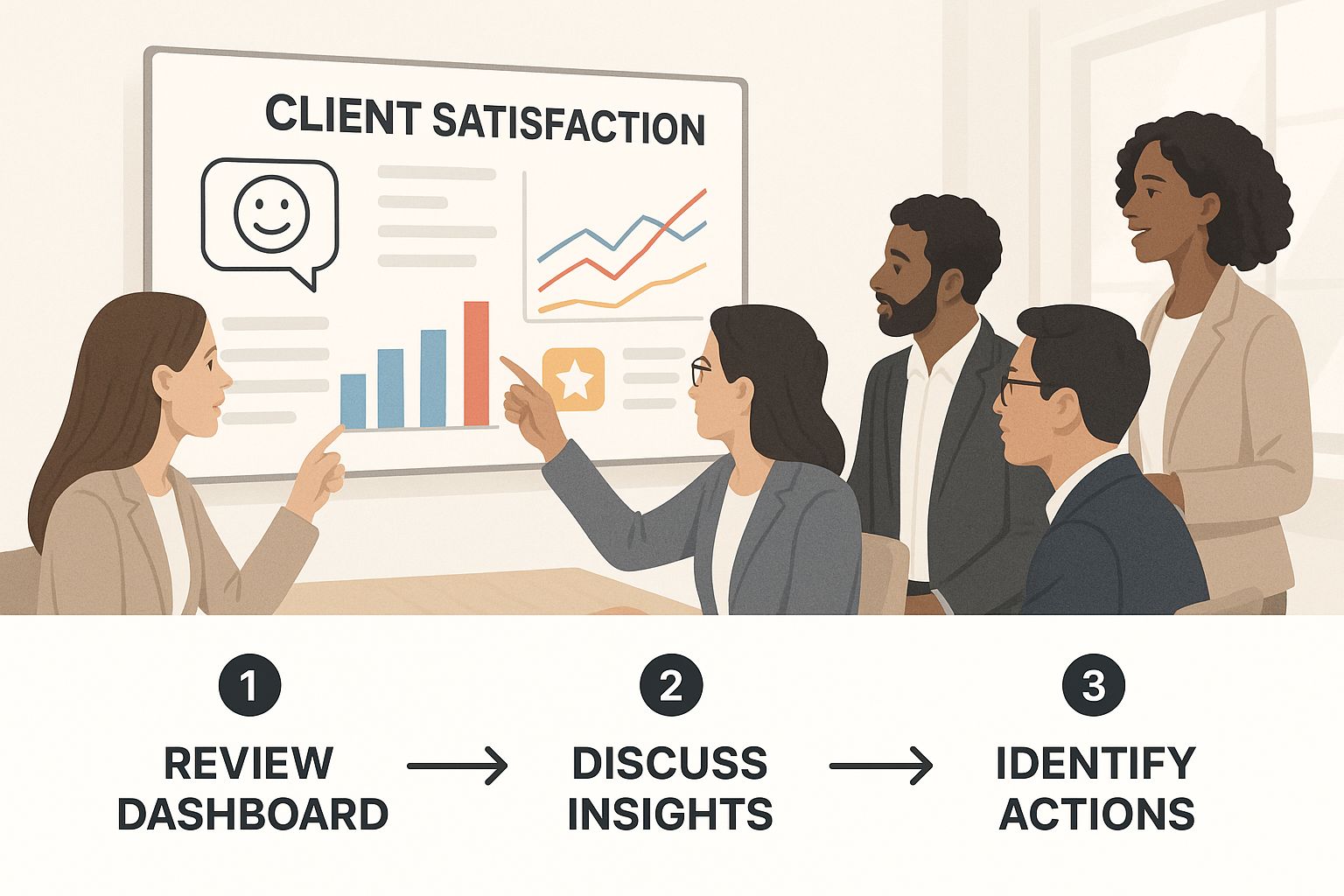
When you visualize data this way, it breaks down the walls between departments. Suddenly, product, support, and sales teams can all see the direct impact of their work on the client experience.
Selecting Your Core Metrics
The foundation of your framework rests on a few core quantitative metrics. Think of these as your high-level indicators, the pulse checks that signal whether you need to dig deeper. The most critical client satisfaction measurement methods are essential tools that let you quantify, analyze, and improve the customer experience in a structured way. As we head into 2025, the most widely adopted metrics remain the Net Promoter Score (NPS), Customer Satisfaction Score (CSAT), and Customer Effort Score (CES).
Choosing the right primary metric really depends on what you want to achieve. Each one tells a different part of the story.
Choosing the Right Satisfaction Metric for Your Business
Selecting a primary satisfaction metric is a strategic decision that should align directly with your business goals. This table breaks down the three most common metrics to help you decide which one best fits your needs.
| Metric | What It Measures | Best For | When to Use It |
|---|---|---|---|
| Net Promoter Score (NPS) | Overall brand loyalty and willingness to recommend. | B2B SaaS, subscription services, and businesses focused on long-term growth and word-of-mouth. | Quarterly or semi-annually to track overall relationship health and predict churn. |
| Customer Satisfaction (CSAT) | In-the-moment happiness with a specific interaction or transaction. | E-commerce, support desks, and service-based businesses where transactional quality is key. | Immediately after a specific touchpoint, like a support ticket resolution or product purchase. |
| Customer Effort Score (CES) | The ease of a customer's experience in getting an issue resolved or a task completed. | Any business with a significant customer support or service component; especially powerful for SaaS. | After a service interaction to pinpoint friction in your processes. |
While you'll likely anchor your program to one of these, remember that the real magic happens when you start combining them with other data sources. A single score is just a number; a score in context is an insight.
Beyond the Scores: Layering Qualitative and Operational Data
Quantitative scores tell you what is happening. But to understand the why, you need to layer in qualitative and operational data. This is how you move from a flat report to a rich, actionable story.
I’ve always advocated for a multi-layered approach that includes:
- Voice of Customer (VoC) Programs: Don't stop at the score. Dig into the open-ended feedback from survey comments, interview transcripts, and online reviews. This is where you’ll uncover the themes and raw emotions behind the numbers and find your most valuable product and service improvement ideas.
- Operational Metrics: You have to connect satisfaction data to what’s happening on the ground. For instance, First Contact Resolution (FCR) is a hugely powerful operational metric. If your FCR is low, you will almost certainly see a corresponding dip in CSAT and CES—clients absolutely hate having to explain their problem over and over.
- Behavioral Data: Don't just listen to what clients say; watch what they do. Are they using key features? Is their product engagement trending up or down? A dip in usage is often a leading indicator of churn, even if their last NPS score was positive.
The most effective measurement frameworks blend what customers say (NPS, CSAT), what they do (product usage, repeat purchases), and how we perform (FCR, response times) into a single, cohesive narrative.
Let’s walk through a real-world scenario. A SaaS company notices its NPS has dropped by five points. On its own, that number is alarming but not helpful.
But by digging into their integrated framework, they see the drop correlates with a spike in support tickets related to a new feature release and a tanking CSAT score specifically for those tickets. The VoC data from those surveys reveals clients find the new UI confusing and clunky.
Suddenly, the problem is crystal clear. The product team knows exactly what to fix, the support team can create better help documentation, and the marketing team can adjust its onboarding messaging. That is the power of a true measurement framework—it connects the dots across the entire organization and turns a vague problem into a precise, solvable issue. This is how you build a system that doesn’t just report on the past but actively shapes a more profitable future.
Weaving Data Together to Break Down Silos
Having a solid client satisfaction measurement system is a great first step, but it's only half the journey. I've seen beautifully designed dashboards become nothing more than expensive corporate wallpaper because the insights they held never left the room. The data just sat there, trapped in the very departmental silos it was meant to tear down.
Client feedback is strategically useless when it’s confined to one department. The game-changing power of your program ignites when you weave this data throughout the entire organization—connecting product and engineering with sales and customer support. This is how you transform data from a passive report into an active catalyst for alignment and growth.
Forging a Single Source of Truth
The objective is to create a unified customer profile, a single source of truth that any team can access to instantly understand the full context of a client relationship. When you integrate CRM data with survey responses, support tickets, and product usage analytics, a complete narrative emerges. You stop reacting to isolated incidents and begin seeing the customer’s entire journey.
A few years ago, I was advising a rapidly scaling SaaS marketplace with a classic silo problem. The support team was hitting record CSAT scores, yet the product team was repeatedly blindsided by negative feedback after every major release.
Our solution was to pipe all support ticket data, tagged by feature, directly into the same analytics platform the product managers were already using. We then layered CSAT and CES scores on top of tickets related to specific features.
The impact was immediate and profound:
- Product Managers could see in near real-time how a new UI element was creating friction, evidenced by a spike in low-effort scores.
- Engineers could connect bug reports to tangible customer frustration, enabling them to prioritize fixes that would deliver the greatest impact on satisfaction.
- The Support Team was elevated from a reactive cost center to a strategic partner, providing qualitative insights backed by hard data.
This simple integration created a shared vocabulary and a common, data-driven understanding of the customer's reality.
It’s About the Tech, But It’s More About the Culture
Achieving this level of integration requires two key components: the right technology and a deliberate cultural shift. On the tech side, you need a stack that is built for interoperability. A modern customer data platform (CDP) can act as the central nervous system, pulling information from your CRM (like Salesforce), your support desk (like Zendesk), your survey tools (like Qualtrics), and your product analytics software (like Amplitude).
But technology alone doesn't break down silos. You can have the most advanced CDP on the market, but if your teams lack the incentive and mandate to collaborate, the data will remain operationally siloed.
The most important integration isn't between software; it's between people. You have to build a culture where cross-functional collaboration using customer data is the default, not the exception.
This cultural transformation must be driven from the top. As a leader, you must champion this integrated view relentlessly. I’ve found that implementing shared KPIs is exceptionally effective. For instance, a portion of the product team's bonus could be tied to improving Customer Effort Score (CES), while the sales team's compensation structure is influenced by the NPS of the accounts they close.
When you align incentives, departmental walls begin to dissolve organically. The sales team becomes invested in setting proper expectations to ensure long-term satisfaction. The product team starts proactively seeking feedback from their frontline colleagues. This is how you build an organization where every employee understands their impact on client satisfaction, turning your measurement system into a powerful engine for durable growth.
Turning Measurement Into Action
Data collection is table stakes. I’ve seen countless companies invest fortunes in sophisticated listening platforms, only to let the insights languish on a dashboard. The real differentiator—the discipline that separates market leaders from the pack—is the relentless operationalization of that measurement into tangible action. This is where you translate client satisfaction insights into a client-obsessed culture.
It's about architecting a system where feedback doesn't just get logged; it triggers a specific, accountable response. This is how you shift from being reactive problem-solvers to proactive value creators, directly fortifying retention and your bottom line.

Building a Closed-Loop Feedback System
The most effective framework I've implemented for operationalizing feedback is a closed-loop feedback system. This is a structured process designed to ensure every piece of client feedback is heard, addressed, and utilized to drive meaningful improvements. It’s a guarantee to your clients that their voice will not disappear into a corporate void.
Consider it a pact: if a client invests time to provide feedback, you owe them acknowledgment and, more critically, resolution. The system I've seen deliver the best results operates on three distinct loops.
- The Inner Loop (Frontline Response): This is the immediate, one-to-one response to individual client feedback. A detractor provides a low NPS score with a comment about a bug? That's the trigger. An account manager or support lead must engage within 24 hours to acknowledge the input, diagnose the problem, and own the path to a solution. This personal intervention is incredibly powerful.
- The Middle Loop (Process Improvement): Here, we zoom out to identify and rectify the root causes of recurring issues. If five different clients complain about the same confusing onboarding step, that’s not an individual problem—it's a process failure. This triggers the formation of a cross-functional team (product, customer success, engineering) to re-architect that part of the journey.
- The Outer Loop (Strategic Decisions): This is where broad, high-level feedback informs major business strategy. If a significant percentage of your high-value clients consistently request a specific integration, that insight must become a primary input for your product roadmap and strategic partnership decisions.
By structuring your response this way, you ensure every piece of feedback is addressed at the appropriate level, transforming individual complaints into opportunities for both immediate recovery and long-term strategic advantage.
Prioritizing Feedback and Assigning Ownership
Let's be pragmatic: not all feedback carries equal weight. A minor suggestion from a freemium user has a different urgency than a critical failure reported by your largest enterprise account. A clear prioritization framework is essential.
I recommend a simple matrix that scores feedback on two axes: business impact (revenue at risk, strategic alignment) and customer impact (severity of the issue, number of clients affected). High-impact, high-severity issues are immediately escalated.
Don’t just resolve customer issues; use the patterns from that feedback to fundamentally improve your products and processes. That’s how you stop fighting fires and start building a fireproof business.
Once an issue is prioritized, assign clear ownership. An individual, not a department, must be accountable for every action item. This is non-negotiable. For example, a bug fix is owned by a specific product manager, while a communication gap is owned by a marketing lead. Track all progress transparently, ideally in a shared system like Jira or Asana where accountability is visible to all stakeholders.
Turning Detractors Into Advocates
One of the most potent growth strategies is an intense focus on your detractors. Yes, they are your most vocal critics, but they are also a goldmine of actionable intelligence. A swift, empathetic, and effective response to their issues can trigger a powerful emotional turnaround.
Here’s a real-world example from a B2B SaaS company I advised. A high-value client gave them a 2 out of 10 on an NPS survey, citing a critical workflow inefficiency. Instead of a templated apology, the Head of Customer Success personally called the client's main contact, listened for 30 minutes, and brought the lead product manager onto the next call. Within two weeks, they had deployed a patch that solved the core problem. That detractor became one of their most vocal advocates, even providing glowing testimonials that helped them close two new enterprise deals later that year.
This proactive approach is financially sound. Forrester's 2024 analysis found that "customer-obsessed" organizations reported retention rates 51% higher than their competitors. Yet, worryingly, only 13% of customer experience leaders feel they have the right tools to act on real-time insights. As you can see from these customer experience statistics on Zendesk, there’s a massive gap between collecting data and acting on it. Acting on feedback isn’t just good service; it’s a powerful engine for revenue growth.
Scaling Your Program for Long-Term Growth
A client satisfaction program is not a one-time project. I've seen it happen too many times: a company launches a great initiative, gets some initial data, and then lets it wither on the vine. The moment you treat it as a static project is the moment it starts losing its value. For this to work as a strategic asset, it must be a living, breathing part of your organization—one that evolves in lockstep with your business, your clients, and the market.
This isn't just about maintenance. It's about building a system that scales and delivers compounding returns. The ultimate goal is to ensure your investment in measurement generates a significant ROI by driving revenue and increasing customer lifetime value for years to come.
From Static Reports to Dynamic Insights
The first critical shift is moving from static, point-in-time reports to dynamic, longitudinal analysis. A single NPS score is a snapshot. A trend line tracking NPS over eight quarters tells a strategic story. It reveals the true trajectory of your client relationships.
You must look for patterns and correlations. Did CSAT scores dip after a major product update? Did the Customer Effort Score improve after a support workflow redesign? This long-term view allows you to finally connect the operational activities of your teams to the strategic outcomes you're trying to achieve.
A word of caution: it is incredibly easy to fall into analysis paralysis. Don't drown in a sea of data. My advice is to anchor your analysis to a few key performance indicators that are directly tied to your primary business goals—like churn rate or net revenue retention—and maintain a relentless focus on those. This keeps your analysis sharp and, most importantly, actionable.
Uncovering Hidden Truths with Segmentation
Averages lie. I cannot stress this enough. Your aggregate satisfaction score might look healthy, but it could be masking critical issues within specific segments of your customer base. As you scale, deep data segmentation becomes non-negotiable.
I always push teams to slice their data from every conceivable angle. You’ll be amazed at what you uncover. Try segmenting your feedback by:
- Customer Cohort: How do clients who signed up this year feel compared to those who've been with you for 5+ years? This can reveal weaknesses in your onboarding process or a failure to deliver long-term value.
- Revenue Tier: Are your highest-paying enterprise accounts as satisfied as your SMB clients? A negative trend here represents a significant financial risk.
- Product Usage: How do your power users feel versus those with low engagement? This can pinpoint opportunities to drive deeper adoption or identify features that are overly complex.
- Geographic Region: Are you seeing different expectations or performance issues in EMEA versus North America?
Segmentation transforms a generic score into a precision instrument. It tells you exactly where to allocate resources for maximum impact.
Averages tell you how you're doing overall, but segments tell you where to win. True growth is unlocked by understanding and acting on the needs of your most valuable customer groups.
Future-Proofing with Automation and AI
As your company grows, manually analyzing thousands of open-text survey comments becomes impossible. To scale this program effectively, you must leverage technology. AI and automation tools are no longer a luxury; they are essential for deriving insights from qualitative feedback at scale.
These systems can automatically tag free-text feedback with themes—like "bug report," "feature request," or "billing issue"—and run sentiment analysis on every single comment. Suddenly, you can quantify qualitative data, spot emerging trends in near real-time, and free up your team to focus on solving problems rather than getting buried in spreadsheets.
This is how you build a client satisfaction measurement program that can scale its intake capacity without a linear increase in headcount. It’s how you create a system that not only endures but becomes smarter and more predictive over time, securing its place as a core driver of your company's growth.
Answering Your Key Questions

After years of sitting in boardrooms and advising leadership teams, I've noticed the same questions about client satisfaction measurement pop up over and over. These aren't just minor details; they cut right to the core of how a company thinks about its customers and its own growth.
So, let's get straight to it. Here are the direct, no-fluff answers I've honed from years in the trenches.
How Often Should We Measure Client Satisfaction?
There is no universal answer. The optimal frequency is dictated by your business model and the cadence of the customer journey. The goal is to capture timely, relevant data without creating survey fatigue.
For high-transaction businesses like e-commerce or hospitality, feedback must be solicited transactionally. A CSAT or CES survey deployed immediately after a purchase or support interaction provides an unvarnished snapshot of that specific touchpoint. This is non-negotiable.
For relationship-based businesses, such as B2B SaaS, a quarterly or bi-annual NPS survey is effective for gauging overall loyalty and relationship health.
My golden rule is simple: never ask for feedback unless you are prepared to act on it.
Supplement these relationship surveys with event-triggered feedback requests at key milestones—for example, after a client completes onboarding or achieves a significant usage threshold. This creates a continuous stream of actionable intelligence without overwhelming your clients.
What Is the Single Most Important Metric to Track?
This question is a trap. I see too many organizations chase a single "magic" metric, which invariably creates significant blind spots. The real strategic power comes from triangulating multiple metrics to form a complete, multi-dimensional view.
However, if forced to choose the one metric that best predicts sustainable growth, it would be the Net Promoter Score (NPS). It is the closest proxy we have for loyalty and word-of-mouth potential, which are the most reliable leading indicators of future revenue.
But NPS in isolation is a blunt instrument. It tells you what clients feel but not why. It must be paired with CSAT to measure the quality of specific interactions and CES to identify and eliminate friction points in your processes.
Ultimately, the most important metric is the one that illuminates your most critical strategic priority at any given time—be it service quality, churn reduction, or product adoption.
How Do I Get Buy-In From Other Departments?
You don't secure buy-in with a dashboard. You secure it by making the data intensely personal and relevant to each department's own objectives and pain points. You must frame client satisfaction not as a "customer support" issue, but as a primary driver of business performance.
Here’s the playbook:
- For the Product Team: Don't show them an aggregate NPS score. Provide the verbatim comments where ten high-value clients are complaining about the exact same feature flaw.
- For the Sales Team: Don't just report that satisfaction is down. Present the data that proves a direct correlation between low CSAT scores and higher churn rates within their book of business. Make it about their commission.
- For Executive Leadership: Tie executive compensation and corporate KPIs directly to customer-centric metrics. Nothing focuses the mind like financial incentives.
When you draw a clear, data-backed line from client satisfaction to revenue, retention, and departmental goals, buy-in ceases to be something you request. It becomes a strategic imperative.
At MGXGrowth, we help companies move past the theory and build measurement programs that actually drive business results. We work directly with executive teams to tear down internal silos, create a culture that's obsessed with data, and align your entire strategy with the voice of your customer.
Discover how we can help you architect the next stage of your growth roadmap.
