


A solid customer segmentation strategy is not a marketing exercise; it's the operational backbone that turns scattershot marketing spend into precision-guided campaigns that deliver measurable ROI. It's about grouping your customers based on shared traits to understand them so deeply that you can anticipate their needs before they do.
Move Beyond Guesswork to Real Customer Insight
I’ve seen the same story play out in boardrooms across SaaS, hospitality, and marketplaces. Companies pour millions into marketing campaigns that are essentially shots in the dark. Why? Because they don't fundamentally understand who they're talking to. A robust customer segmentation strategy isn't just a marketing task—it's a core component of sustainable growth and, ultimately, EBITDA.
My biggest breakthroughs have always come from uniting marketing, sales, and product around a single, data-driven view of the customer. When you break down those silos, you unlock incredible potential.
The Power of True Understanding
The data consistently backs this up. Recent industry insights show that 81% of consumers are more likely to buy from brands that offer personalized experiences. Companies that use audience segmentation can see a staggering 760% increase in email marketing revenue, and about 77% of overall marketing ROI comes from segmented programs. If you want to dive deeper, you can explore the full research on audience segmentation from Britopian.
In my experience, the moment a company shifts from thinking about "the customer" to "this specific customer segment," their entire go-to-market motion changes. It becomes sharper, more efficient, and dramatically more profitable.
This guide isn't academic theory. It's the exact framework I've personally used to drive EBITDA growth by building and activating customer segments based on real-world behavior, not just simple demographics. Of course, measuring these efforts is key, as it ties directly into understanding overall business health. You can learn more about how we approach this by reading our guide on client satisfaction measurement.
The process flow below illustrates how segmentation evolves from basic demographic groupings to advanced, predictive models.
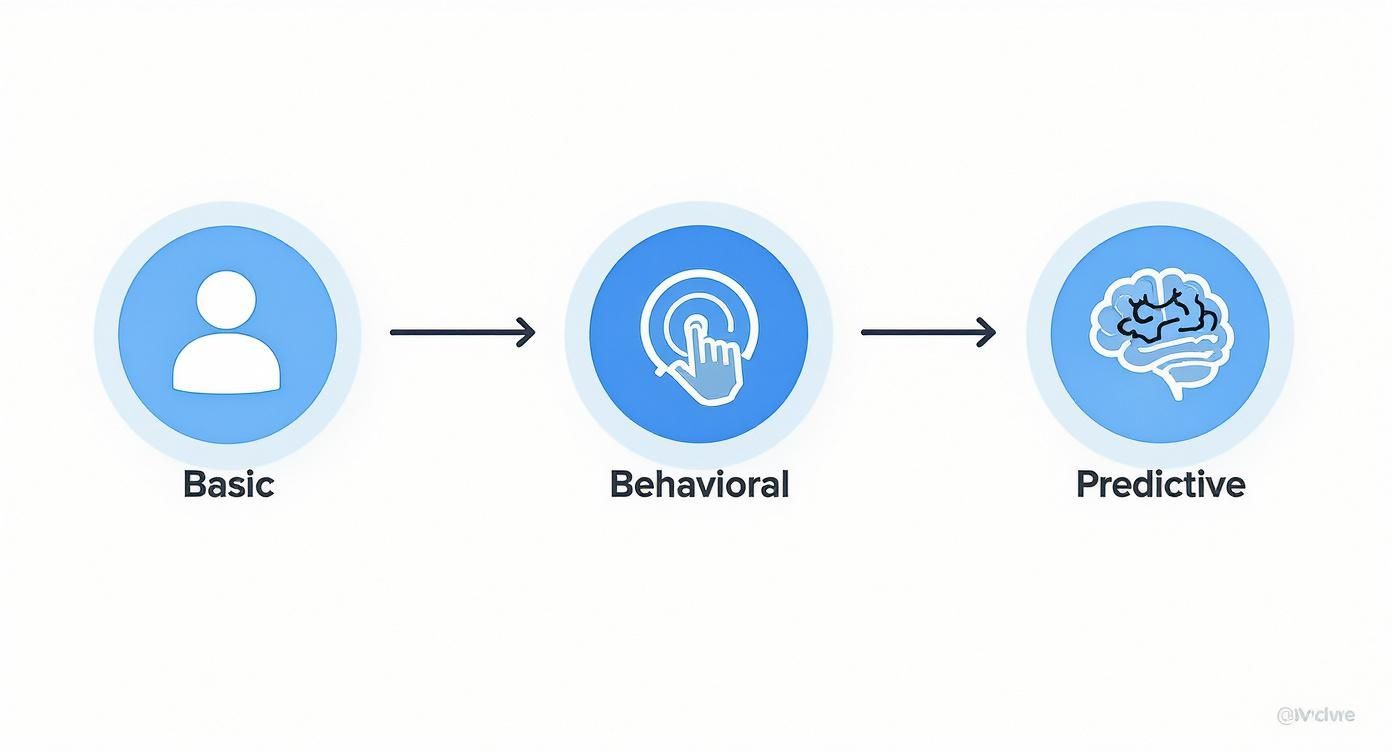
The visualization shows that as a business matures, its segmentation strategy must evolve. You have to move from simply knowing who customers are to predicting what they will do next. This journey from basic data points to sophisticated, AI-powered models is what gives you a real, lasting edge over the competition.
Segmentation Maturity From Basic to Predictive
To give you a clearer picture of this evolution, here’s a breakdown of how segmentation capabilities mature over time. This table can help you identify where your organization currently stands and what the next logical steps are for you to take.
| Maturity Level | Primary Data Source | Common Tactic | Business Impact |
|---|---|---|---|
| Basic | Demographics, Firmographics | One-off email blasts to broad groups (e.g., all VPs in tech) | Inconsistent results, low engagement, high unsubscribe rates |
| Behavioral | Website activity, purchase history, app usage | Drip campaigns triggered by user actions (e.g., abandoned cart) | Improved conversion rates, better customer retention |
| Psychographic | Surveys, interviews, social media analysis | Content tailored to values and interests | Stronger brand loyalty, higher customer lifetime value (CLV) |
| Predictive | AI models, machine learning, cross-channel data | Proactive offers to prevent churn, personalized product recommendations | Significant revenue lift, market leadership, proactive growth |
As you can see, each level builds on the last, adding layers of sophistication and unlocking greater business value. Moving from one stage to the next requires not just new tools but a new way of thinking about your customers and their journey.
Build Your Unified Customer Data Foundation
Any customer segmentation strategy built on a shaky data foundation is doomed from the start. I’ve walked into too many companies where sales, marketing, and product analytics tell three conflicting stories about the same customer. This isn't just inefficient; it's a direct path to wasted resources and missed opportunities.
Siloed data is the number one killer of effective strategy. When your CRM, email platform, and product analytics don't talk to each other, you simply can't build a coherent picture of who your customer is and what they need. This fragmentation is the primary reason so many personalization efforts fall flat.
So, the first, non-negotiable step is to centralize this information into a single source of truth. This unified customer view, often powered by a Customer Data Platform (CDP), becomes the bedrock for every strategic decision you make.
Auditing Your Existing Data Sources
Before you can unify anything, you have to know what you’re working with. This isn’t just an IT task—it's a cross-functional strategic audit. You need input from every team that touches the customer to identify the data points that actually signal intent, value, and churn risk.
I recommend starting with a clear inventory. You can categorize your data into two main buckets:
- First-Party Behavioral Data: This is your gold mine. It’s the information you collect directly, like website clicks, in-app feature usage, purchase history, and content engagement. It tells you what your customers do, not just who they are.
- Third-Party Enrichment Data: This data adds context to what you already know. Think demographic details (age, location), firmographic data for B2B (company size, industry), and even psychographic insights (interests, values).
This process quickly reveals where your insights are strongest and, more importantly, where critical gaps exist. It's the essential first step in building a more holistic and actionable data-driven marketing strategy.
Focusing on Actionable Data Points
Let’s be clear: not all data is created equal. I’ve seen teams drown in terabytes of information that offered zero strategic value. The key is to relentlessly prioritize data that signals a customer's needs or future actions.
The goal of a unified data foundation isn't to know everything about your customers. It's to know the right things—the specific signals that predict behavior and allow you to serve them better than anyone else.
For a SaaS company, this might mean tracking the adoption rate of a key feature or noting a decrease in login frequency. For an e-commerce brand, it could be identifying customers who consistently buy from a specific category or respond to a certain type of discount.
Recent research highlights that economic uncertainty is making buyer behavior harder to predict, which makes this kind of granular, behavioral data even more critical. According to recent consumer behavior findings from McKinsey, companies that merge first-party signals with third-party insights can achieve a much higher degree of precision.
Overcoming Organizational Roadblocks
Let's be honest, building this unified view is as much a political challenge as it is a technical one. The biggest hurdles are often internal. You need buy-in from IT, who manages the tech stack; from sales, who "owns" the customer relationship; and from leadership, who controls the budget.
To get everyone on board, you have to frame this initiative not as a "marketing project" but as a core business strategy that benefits the entire organization.
- For Sales: It means higher-quality leads and deeper insights for more effective conversations.
- For Product: It provides a direct line to how customers are actually using the product, which is invaluable for the roadmap.
- For Leadership: It creates a clear, measurable link between data investment and revenue growth.
Championing this cross-functional effort is the only way to break down the silos that hold back growth. Without this unified foundation, your customer segmentation strategy will never move beyond theory.
Select the Right Segmentation Model for Your Goals
There’s no single ‘best’ segmentation model out there. I’ve seen companies obsess over finding some mythical one-size-fits-all solution, but the reality is, the right approach depends entirely on what you're trying to accomplish. Chasing a complex model when a simple one will do the trick is just as wasteful as using a sledgehammer to crack a nut.
The first question I always ask a leadership team is this: “What are you trying to achieve right now?” Are you focused on cutting down churn? Is the big goal to increase customer lifetime value (CLV)? Or is the whole business geared toward acquiring a very specific type of high-value user? Your answer points directly to the model you should choose.
Moving Beyond Basic Demographics
Most companies start and stop with the basics: demographic segmentation (who they are) and geographic segmentation (where they are). Sure, these are useful for broad-stroke targeting, but they tell you almost nothing about a customer’s real intent or needs. Knowing a customer is a 35-year-old male in California is a data point, not an insight.
The real power in a modern customer segmentation strategy comes from digging deeper into two more sophisticated models.
- Psychographic Segmentation: This is where you group customers by their attitudes, values, and lifestyles. It answers the "why" behind what they do. I worked with a hospitality brand, for example, where we identified a segment of "experience-seekers" who cared way more about unique amenities than price. This allowed us to create high-margin packages that they absolutely loved.
- Behavioral Segmentation: This is where the rubber really meets the road. It groups customers based on what they actually do—their purchase history, how they use your product, their website interactions, and their loyalty. For most businesses, this is the most predictive model you can use because past behavior is the best indicator of future action.
I always tell my teams to think of it this way: Demographics tell you who bought your product. Behaviorals and psychographics tell you why they bought it and what they're likely to do next. That's where the real growth levers are.
Choosing the Right Tool for the Job
Your business model and your immediate goals should dictate how complex you get. Over-engineering your segmentation is a classic mistake. It leads to analysis paralysis and creates these beautiful, complicated models that never actually get used.
Let’s look at a few practical scenarios from my own experience to see how this plays out.
Scenario 1 An E-commerce Business Fighting Cart Abandonment
For a direct-to-consumer brand, a simple yet incredibly powerful behavioral model like RFM (Recency, Frequency, Monetary) analysis is often the perfect place to start. It’s beautifully simple.
| RFM Component | What It Tells You | Strategic Action |
|---|---|---|
| Recency | Who just purchased? | These are your most engaged customers. Target them with cross-sells or loyalty rewards. |
| Frequency | Who buys often? | These are your loyalists. Nurture them with exclusive access and referral programs. |
| Monetary | Who spends the most? | These are your VIPs. Offer them personalized service and high-value incentives. |
This model instantly flags your best customers, those who are at risk, and those you've lost, all without needing a dedicated team of data scientists. It gives you actionable insights from day one.
Scenario 2 A SaaS Platform Focused on Reducing Churn
Now, for a SaaS business, a simple RFM model just won’t cut it. Here, you have to look at product engagement. A more complex, AI-driven clustering model becomes essential. These models can crunch thousands of data points—like login frequency, key feature adoption rates, support ticket volume, and time spent in the app—to uncover patterns you’d never spot on your own.
We used this exact approach at a SaaS company to identify a "low-engagement but high-potential" segment. These users weren't touching the core features we knew correlated with long-term retention. Instead of hitting them with generic emails, we built a targeted in-app onboarding flow just for them. The result? We cut churn in that segment by 18% in a single quarter.
The Ultimate Goal Needs-Based Segmentation
All of these models are really just pathways to what I consider the holy grail: needs-based segmentation. This approach groups customers based on the core problem they're trying to solve with your product or service.
A customer isn't just buying software; they're buying efficiency. They aren't just booking a hotel room; they're buying a seamless travel experience. When you segment based on that underlying need—think "budget-conscious teams needing core functionality" versus "enterprise users needing advanced security"—your messaging and product development become incredibly sharp and resonant.
In my experience, building your personas and campaigns around these core needs is the final step that truly aligns product, marketing, and sales. It’s what turns a good segmentation strategy into a great one.
Use AI for Dynamic and Predictive Segmentation

This is where a modern growth strategy really takes off. The old way of creating static customer segments that you might look at once a quarter is completely obsolete. Today, AI and machine learning let us create dynamic segments that shift and update in real-time, all based on what customers are actually doing.
Think about a potential customer who abandons their shopping cart. A dynamic system instantly moves them into a "high-intent, cart-abandoned" segment. Within minutes, they're getting the first email in a personalized, automated retargeting sequence. That’s the power we're talking about.
This isn't just for e-commerce, either. In the SaaS world, imagine a user who hasn't logged in for 14 days. An AI-powered system can automatically flag this, move them into an "at-risk" group, and trigger a proactive campaign to win them back before they even think about churning.
Uncovering Hidden Opportunities with AI
Let's cut through the buzzwords. When we talk about "AI" here, one of the most practical tools we have is unsupervised machine learning, especially clustering algorithms. These models comb through all your unified customer data—every click, purchase, and support ticket—to find non-obvious groups you'd never spot on your own.
I’ve seen this work wonders. We once ran a clustering model for a marketplace client and discovered a hugely profitable "weekend power user" segment. These weren't people defined by age or location, but by a very specific pattern: they were almost exclusively active between Friday evening and Sunday afternoon, and they spent 3x more than the average user. We never would have found them manually.
This single insight let us completely change our approach:
- We timed promotions to land right in their peak activity window.
- Our ad creative shifted to messaging about weekend projects and activities.
- We even adjusted customer support staffing to give them top-tier service during those hours.
The result was a major lift in revenue and satisfaction from a group that was previously invisible to us.
From Reactive to Predictive Segmentation
The real game-changer is moving from reacting to what customers did to anticipating what they will do. This is the world of predictive analytics. By training models on your historical data, you can build a system that scores customers based on their likelihood to take a certain action.
We're no longer just asking, "What did this customer do?" Instead, we're asking, "Based on everything we know, what is this customer most likely to do next?" This shift changes the entire strategic conversation.
This isn't just theory. Top firms are already using AI-driven clustering to analyze massive streams of consumer data, allowing them to define and update micro-segments almost instantly. With a modern Customer Data Platform (CDP), marketers can then act on these dynamic segments with incredible speed and precision. For a deeper look, Sprinklr explains how leading firms apply AI to segmentation.
Identifying Your Most Valuable Future Customers
Predictive models are especially brilliant at spotting two critical groups hiding in your user base.
- High-Potential LTV Customers: The model can learn the early behaviors of your current best customers and then spot those same patterns in new signups. This is a green light for your sales and marketing teams to roll out the red carpet, prioritizing them with premium onboarding and proactive outreach from day one.
- High Churn-Risk Customers: On the flip side, the system can identify the subtle combination of actions—like a drop in feature usage and a quick visit to the cancellation page—that signals a customer is about to leave. This opens up a crucial window for you to intervene with a retention offer or a support call to fix whatever is wrong.
Building these models isn't just for tech giants anymore. The tools and expertise are more accessible than ever. The real advantage comes from strategically applying these technologies to make your segmentation smarter, faster, and more profitable. To see how this applies directly to your revenue teams, you can read our guide on how predictive analytics for sales can transform your pipeline.
Put Your Segments to Work Across the Entire Company
I’ve seen it happen more times than I can count: a brilliant, data-rich segmentation model gets built, presented in a beautiful slide deck, and then… it dies. It sits in a folder on a shared drive, admired by the analytics team but completely ignored by everyone else.
Let’s be clear: a customer segmentation strategy is completely useless if it’s not put into action.
This is where the real work begins. Activation is where you move from analysis to action, breaking down those stubborn organizational silos and weaving these customer insights into the daily fabric of your marketing, sales, product, and support teams. This is where you actually see a return on your investment.
Success isn't when the model is finished. It’s when everyone in your company starts speaking the same language about your customers. It’s when a sales rep, a product manager, and a marketing specialist can all talk about the “Pragmatic Power User” segment and know exactly who that is, what they need, and how to best serve them.
From Data Points to Human Personas
The first move is to translate your data-driven segments into something human and relatable. Raw data doesn't inspire action, but well-defined personas do. Forget the fluffy, demographic-based personas of the past. These are living, breathing profiles built on real behavioral data.
For each of your most important segments, you need to develop:
- A Clear Persona: Give the segment a memorable name that sticks, like "The Innovator" or "The Budget-Conscious Team." Then, detail their primary goals, the challenges they constantly run into, their core needs, and the specific product features they can't live without.
- A Tailored Journey Map: Get visual and map out the entire customer experience from this segment's unique perspective. Where do they hit roadblocks? What are their "aha!" moments? This map becomes an invaluable tool for spotting opportunities across every single department.
Once you have these tools, it's time to get tactical. The real magic of segmentation is unlocked when it directly informs what each team does every day.
A segmentation model is just a map. It’s valuable, but its real purpose is to guide the people on the ground. Without activation, you've just drawn a very expensive map that leads nowhere.
Breaking Down Silos for Coordinated Action
This is where things really get powerful—when different departments start using the same segmentation language to coordinate their efforts. This goes way beyond just sharing a document. It's about building integrated "plays" that create a seamless, consistent experience for the customer.
I like to use a simple framework to get everyone aligned. I'll pull together a cross-functional workshop focused on our top one or two segments. In that room, I ask each department head to answer a core question based on the segment's persona and journey map.
- Marketing asks: "How can we tweak our ad creative, email copy, and content to solve this segment's specific problems?"
- Sales asks: "How do we prioritize leads from this segment and give our reps messaging that genuinely connects with their needs?"
- Product asks: "What does this segment's behavior tell us about our feature roadmap and what we should build next?"
- Support asks: "What proactive guides or tutorials can we create to solve this segment's most common issues before they even ask?"
This kind of focused collaboration turns segmentation from a "marketing thing" into a company-wide growth engine. Suddenly, everyone is aligned on the same mission: serving the customer better.
A Practical Activation Plan
So, what does this look like in the real world? The table below breaks down how different teams can use segments to drive specific, measurable results. This is the kind of practical plan I use to make sure our segmentation strategy actually translates into a tangible impact on the business.
Cross-Functional Segment Activation Plan
| Department | Activation Tactic | Key Metric (KPI) |
|---|---|---|
| Marketing | Create segment-specific ad campaigns on LinkedIn targeting "Enterprise Adopters" with messaging about security and compliance. | Customer Acquisition Cost (CAC) for the segment |
| Sales | Develop a sales playbook for the "High-Growth Startup" segment, focusing on scalability and speed-to-value. | Lead-to-Opportunity Conversion Rate |
| Product | Prioritize a new integration requested most by the "Pragmatic Power User" segment to increase their reliance on the platform. | Feature Adoption Rate within the segment |
| Customer Success | Build a proactive email sequence for "At-Risk" segments, offering a one-on-one session to address their specific usage gaps. | Segment-Specific Churn Rate |
This cross-functional approach ensures your customer segmentation strategy becomes a living, breathing part of your company's DNA. It stops being an interesting side project for the data team and becomes the fundamental way you acquire, serve, and retain your most valuable customers—driving both growth and efficiency.
Common Segmentation Questions I Hear from Executives
After years of sitting in boardrooms and strategy sessions, I've noticed a pattern. When it comes to building a customer segmentation strategy, leadership teams almost always circle back to the same few critical questions. They're not just asking for theory; they want to know what actually works.
So, let's cut to the chase. Here are my straight answers to the questions that come up time and time again.
How Often Should We Update Our Customer Segments?
Forget the old-school, annual segmentation review. That's a relic from a different era. In today's world, especially for a fast-moving SaaS or e-commerce company, you need to be re-evaluating your segments quarterly—at the bare minimum. If you don't, your segments will go stale, and you'll be marketing to a ghost of who your customer used to be.
The ultimate goal, however, isn't just more frequent updates; it's moving towards dynamic segmentation. This is where things get really interesting. With the right AI and machine learning models, you can update segments in near real-time. A customer's classification should change the very moment they try out a new feature, linger on the pricing page, or click on a specific ad.
The perfect frequency always depends on your business's natural rhythm, but the core principle is simple: your segments must reflect the current reality of your customers, not a snapshot from last year.
What Is the Biggest Mistake Companies Make with Segmentation?
I've seen this happen more times than I can count. A company spends a fortune developing these incredibly sophisticated segments, backed by mountains of data, and then… nothing. The models just sit there, collecting digital dust, because they were never actually woven into the daily tools and workflows of the marketing, sales, or product teams.
Segmentation is not an academic exercise; it's a business strategy. If it doesn't fundamentally change how your teams operate, it has failed. Period.
The second-biggest mistake, and it’s a close second, is leaning too heavily on basic demographics. Knowing you have a group of 'males aged 35-44' is next to useless. It’s far more powerful to know you have a segment of 'price-sensitive power users who are showing signs of churn.' Always prioritize what people do and what they need over who they are on paper.
How Do We Measure the ROI of Our Segmentation Strategy?
If you want to keep your segmentation initiative funded and supported by the C-suite, you have to prove its worth in dollars and cents. This isn't just about feeling good about being "data-driven"; it's about connecting your work directly to business outcomes.
You need to track performance on two levels: the overall health of each segment and the specific results of your campaigns.
First, monitor the big-picture metrics for each segment over time. You should be asking questions like:
- Is the Customer Lifetime Value (CLV) of our ideal customer profile trending up?
- Are our segmented campaigns converting better than our old "batch and blast" efforts?
- Is the churn rate for our at-risk segments actually going down?
Second, get rigorous with A/B testing. Pit a generic campaign against one tailored to a specific segment and measure the difference. That lift is your ROI.
When you can walk into a meeting and show that personalized emails to "Segment A" drove a 300% higher conversion rate than the generic version, the conversation changes. You're no longer just talking about data; you're talking about tangible revenue growth.
At MGXGrowth, we go beyond building models. We work directly with executive teams to embed data-driven segmentation deep into a company's DNA, turning insights into action across your entire organization to fuel real, measurable growth. Find out how we can help you build your growth roadmap at https://www.mgxgrowth.com.
