


In my decades driving growth across regulated sectors, including gaming, I’ve seen Title 31 compliance bifurcate the market. For one camp, it’s a perpetual drag on EBITDA. For the other, it’s a sharpened competitive instrument. The delta is almost always the technology stack they choose to deploy.
Let me be direct: manual compliance is an operational relic. It's an inefficient, error-prone process that exposes your enterprise to crippling financial penalties from FinCEN. More critically, the reputational fallout from a compliance failure can halt growth momentum in its tracks.
Using AI to Navigate Title 31 Compliance
This isn't a technical whitepaper. It’s an executive’s strategic playbook for leveraging AI to master Title 31. We will dissect how the right platforms can transform Anti-Money Laundering (AML) and reporting from a painful cost center into a data-driven function that not only insulates the business but enables scalable growth. This is about architecting operational resilience for the long term, not just avoiding fines.
For any gaming executive, the core challenge is balancing aggressive market expansion with ironclad compliance. Title 31 of the Bank Secrecy Act (BSA) is an immutable operational reality. It mandates that casinos and card clubs report significant cash transactions and suspicious activities to the Financial Crimes Enforcement Network (FinCEN), a bureau of the U.S. Treasury.
The official FinCEN website serves as the definitive source for all BSA regulations and guidance impacting financial institutions, a category that explicitly includes gaming operations.

Executing this flawlessly isn't a choice; it's a prerequisite for market viability. A single misstep can trigger fines that erode shareholder value and inflict brand damage that is exceptionally difficult to remediate.
The Shift from Manual Review to AI Automation
Historically, compliance was a brute-force effort. Teams of analysts manually sifted through transactional data, searching for anomalies. This legacy model is not just inefficient; it's strategically untenable against the sophisticated financial crime typologies we see today.
AI-powered compliance tools engineered for Title 31 represent a fundamental strategic pivot. Instead of allocating more human capital to the problem, these platforms leverage machine learning to preempt it. They deliver tangible operational advantages by:
- Analyzing massive datasets in real-time, processing a volume of information that is orders of magnitude beyond human capacity.
- Identifying complex patterns and subtle anomalies indicative of structuring or other illicit behaviors.
- Automating the filing of Currency Transaction Reports (CTRs) and optimizing the workflow for Suspicious Activity Report (SAR) investigations.
- Dramatically reducing false positives, which reallocates your high-value compliance talent to genuine, high-risk investigations.
From my vantage point, AI adoption is no longer a matter of 'if,' but of 'when' and 'how.' Deferring this investment is a conscious acceptance of unsustainable operational risk. Integrating the right AI is a direct investment in your enterprise's stability and future market share.
This technological migration is rapidly becoming the industry standard. As AI permeates gaming workflows, specialized compliance tools for Title 31 are becoming indispensable. Projections indicate that by 2025, 70% of organizations in the gaming sector will have integrated generative AI technologies, an increase from 65% in the preceding year. You can explore a deeper analysis of AI's integration into game development on Perforce.com.
Understanding What Title 31 Actually Demands
Before evaluating any compliance solution, a clear, business-centric understanding of the core requirements is essential. From a leadership perspective, Title 31 of the Bank Secrecy Act (BSA) is not a legal footnote; it's a set of operational mandates for any gaming operator. Failure to comply directly impacts P&L through fines, erodes market trust, and creates a significant barrier to growth.
Let's distill the regulation into its strategic implications. Title 31 compels gaming businesses to function as a frontline defense against financial crime. By classifying casinos with over $1 million in gross annual gaming revenue as financial institutions, it imposes a substantially higher standard of diligence. Your operational mandate is to assist FinCEN in identifying and preventing money laundering.
My approach has always been to break down complex challenges into their core, manageable components. For Title 31, there are four operational mandates that directly impact your bottom line and your ability to scale without regulatory friction.
The Four Pillars of Title 31 Compliance
These pillars form the foundation of any defensible anti-money laundering (AML) program. Attempting to manage these manually introduces operational bottlenecks and unacceptable levels of risk. This is precisely where AI compliance tools for gaming (Title 31) deliver a decisive competitive advantage.
-
Effective Customer Due Diligence (CDD): This transcends a simple ID check. True CDD involves creating a dynamic, risk-based profile of your patrons—their identity, source of funds, and typical gaming behavior. For a VIP, it’s about differentiating between a legitimate high-net-worth player and an individual attempting to obfuscate illicit funds through complex wagering.
-
Vigilant Transaction Monitoring: Your systems must constantly monitor for player activity that deviates from their established profile. This encompasses tracking all financial movements, from cash-ins and marker activity to chip redemptions. The objective is to detect anomalous patterns that could signal money laundering tactics like "structuring"—the deliberate division of large transactions into smaller amounts to evade reporting thresholds.
-
Precise Currency Transaction Reporting (CTRs): This is a non-negotiable, rule-based requirement. You are mandated to report any cash transaction, or a series of related transactions, exceeding $10,000 within a single gaming day to FinCEN. Accuracy and timeliness are paramount; CTR deficiencies are low-hanging fruit for auditors.
-
Nuanced Suspicious Activity Reporting (SARs): This is where analytical rigor becomes critical. Beyond the $10,000 CTR threshold, your team must identify and report any transaction of $5,000 or more that appears suspicious. "Suspicious" requires a judgment call based on a holistic view of behavior, which can include unusual betting patterns, chip dumping between players, or minimal-play transactions designed to "clean" funds.
In my experience growing businesses in regulated markets, the SAR filing process is the precise point where manual systems collapse. Human analysts are inundated with data and simply cannot connect the subtle, disparate data points that an AI can link in seconds to build a compelling case for suspicion.
Consider an online sportsbook. A new user makes multiple small deposits from disparate payment sources, places several low-risk wagers, and then initiates an immediate withdrawal request. A simple rule-based system might miss this. An AI platform, however, recognizes the entire sequence as a classic money laundering typology and instantly escalates it for review.
The same principle applies on the casino floor. A player buys in for $9,500, plays for a short duration, and then an associate cashes out the chips at a separate cage. This is a classic structuring attempt. AI can correlate these two seemingly independent events across different physical locations within your property—a connection a human-only team would almost certainly overlook. This ability to synthesize a complete picture is what makes modern AI compliance tools a strategic necessity.
Comparing the Top AI Gaming Compliance Platforms
Selecting a technology partner is not an IT procurement decision; it is a core strategic choice that directly impacts risk exposure and growth capacity. In my experience, the right platform acts as a business enabler, whereas the wrong one becomes a persistent operational and financial liability. Here, we will cut through the marketing jargon to focus on what creates tangible value for your casino or sportsbook.
A strategic analysis of the top AI compliance tools for gaming (Title 31) requires looking beyond feature lists. We must assess the sophistication of their machine learning models, the real-world efficiency of their case management systems, and—critically—their integration architecture. This is your framework for aligning a platform’s capabilities with your specific risk appetite and corporate objectives.
What Really Matters When Evaluating These Platforms
Before we compare vendors, let's establish the key performance indicators. As a strategist, I focus on four areas that determine a platform's true operational value.
- Model Accuracy and Adaptability: How effective is the AI at identifying genuinely suspicious activity while suppressing the noise of false positives? A superior model learns from your proprietary data, adapting to new financial crime typologies without requiring constant manual intervention.
- Operational Efficiency: Does this tool augment your compliance team's effectiveness or simply add another layer of complexity? The answer lies in a streamlined user interface, intuitive case management, and robust automation for routine tasks like CTR aggregation.
- Integration and Scalability: What is the total cost of ownership, including the effort required to connect this platform to your disparate data sources—from casino management systems to online payment gateways? The platform must be able to scale seamlessly as you expand operations.
- A Holistic View of Risk: The most effective tools provide a dynamic, 360-degree view of player risk. They should ingest data from every operational touchpoint to generate a single, unified risk score that evolves in real-time with player behavior.
The infographic below illustrates the fundamental pillars of Title 31 that these AI tools are architected to support.
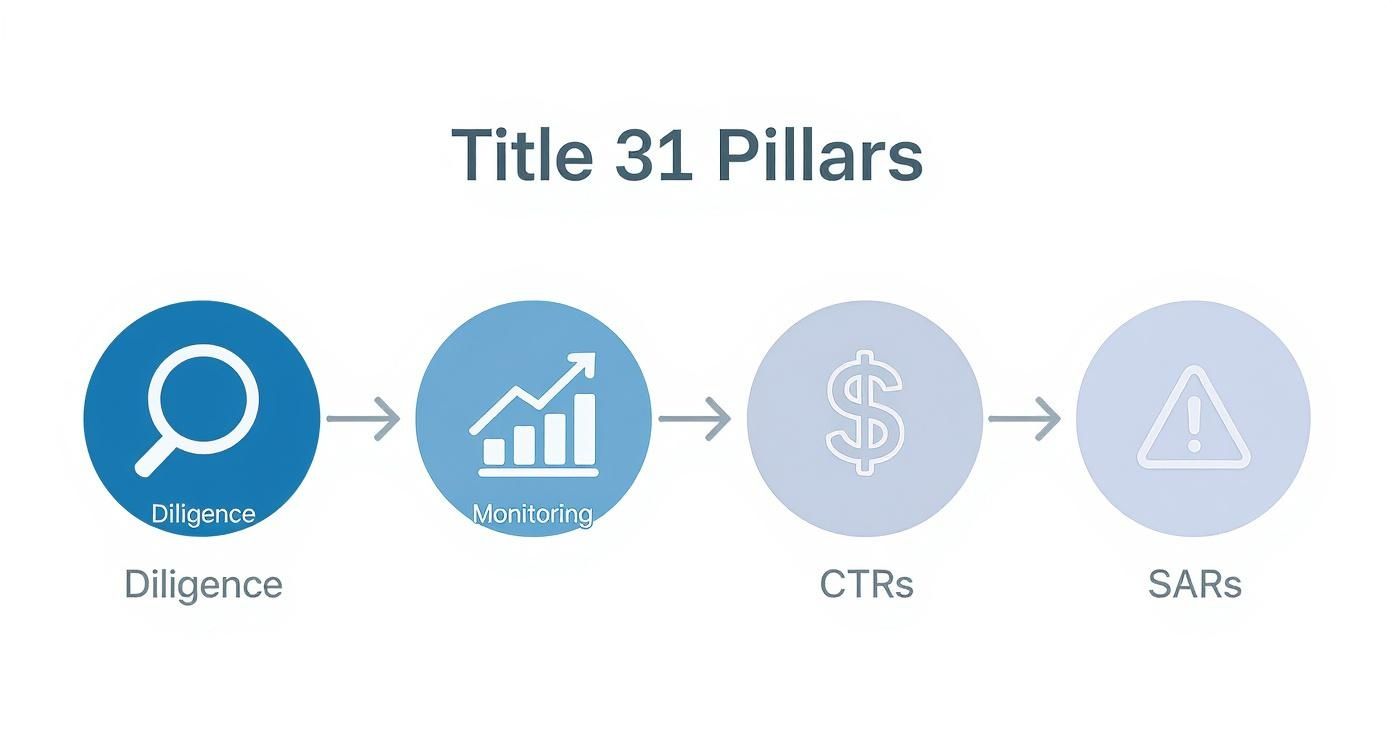
This visual underscores a critical point: any platform under consideration must deliver robust, integrated solutions for due diligence, monitoring, and reporting to provide comprehensive Title 31 coverage.
Platform Showdown: ComplyAdvantage vs. Unit21
Let's conduct a head-to-head analysis of two prominent players in the AI compliance space: ComplyAdvantage and Unit21. Both offer powerful solutions, but they approach the problem from distinct perspectives and are optimized for different operational environments.
H3: ComplyAdvantage: All About Data Superiority
ComplyAdvantage has built its market position on the strength of its proprietary, real-time global risk data. Their platform excels at screening against sanctions lists, watchlists, politically exposed persons (PEPs), and adverse media.
What truly differentiates their offering is the hyper-configurable nature of their data feeds, enabling a highly precise, risk-based screening approach that significantly reduces false positives.
My Takeaway: ComplyAdvantage is an optimal choice for large, multi-jurisdictional gaming enterprises. If your primary challenge is managing complex global screening requirements and reducing false positive fatigue, their data-centric model offers a clear strategic advantage.
H3: Unit21: The Workflow and No-Code Powerhouse
Unit21, conversely, differentiates itself with a highly flexible, no-code platform focused on transaction monitoring and case management. Its core strength lies in empowering non-technical compliance teams.
Analysts can create, test, and deploy complex monitoring rules and models without writing a single line of code. This dramatically reduces dependency on engineering resources, making the compliance function more agile in responding to emerging threats. It is a powerful tool for breaking down the operational silos that often exist between compliance and technology teams.
This shift toward AI is a cross-industry phenomenon. By mid-2025, over 90% of game developers are projected to have integrated AI into their workflows. While their primary use cases are task automation (95%) and gameplay creation (93%), the application of AI for fraud and cheat detection is directly analogous to our Title 31 context. You can discover more insights about the diverse uses of AI in the gaming industry to appreciate the scale of this trend.
The Specialist Solution: Don't Forget About Veriff
While ComplyAdvantage and Unit21 represent comprehensive platforms, specialized tools like Veriff play a crucial role in the ecosystem. Veriff is laser-focused on identity verification (IDV), leveraging AI to confirm that a player is who they claim to be.
For any online gaming or sports betting operation, a robust IDV process is the foundational layer of Customer Due Diligence (CDD). By integrating a best-in-class IDV solution like Veriff with a core monitoring platform like Unit21, you can construct a formidable, multi-layered defense against fraud and money laundering right from the point of customer acquisition.
Feature Comparison of Leading AI Compliance Tools
To clarify the decision matrix, let's compare these platforms' core capabilities as they relate to Title 31 compliance. This table breaks down their strengths and ideal use cases, helping you map their offerings to your specific operational needs.
| Feature | ComplyAdvantage | Unit21 | Veriff (as specialist) |
|---|---|---|---|
| Primary Strength | Real-time global risk data and high-volume screening. | No-code rule engine and customizable case management. | AI-powered identity verification (IDV) and document analysis. |
| Best For | Large, multi-jurisdictional operators managing complex global sanctions and PEP screening. | Agile online gaming and sportsbook operators looking to empower their compliance teams. | Any online operator needing a robust, automated identity check at the front door. |
| Key Differentiator | Its proprietary, configurable data network that dramatically reduces false positives. | The flexibility for non-technical users to build and deploy sophisticated monitoring rules. | Extremely high accuracy in document verification and biometric analysis for onboarding. |
| Integration Model | API-driven, designed to be integrated into existing enterprise systems. | API-first, with a strong focus on connecting to diverse data sources with ease. | Primarily an API integration that plugs directly into your customer onboarding workflow. |
Ultimately, the optimal choice depends on your primary compliance friction point. Are you overwhelmed by false positives from global screening? Or are you struggling to adapt your monitoring rules to new fraud typologies with sufficient speed? A candid assessment of this question is the first step toward selecting the right technology partner to secure and scale your business.
How AI Compliance Actually Works: Two Real-World Scenarios
Feature lists are abstract; real-world application is what drives value. As a strategist focused on tangible growth, I prioritize operational impact. Let's examine how AI compliance tools for gaming (Title 31) execute in two common, complex scenarios where legacy manual processes consistently fail.
This is where the ROI materializes. Your team transitions from reactive report-filers to proactive risk managers, directly protecting revenue streams and ensuring operational continuity.

We'll begin with a brick-and-mortar casino scenario and then pivot to the digital gaming landscape.
Scenario One: The High-Roller on the Casino Floor
Consider a VIP player, a known patron at your Las Vegas property with a preference for high-stakes baccarat. Over a weekend, they execute a series of transactions that, viewed in isolation, appear consistent with their established play style.
Their activity log might look like this:
- Friday PM: Buys in for $8,000 cash at the baccarat table.
- Saturday AM: Procures an additional $7,000 in chips from the cage.
- Saturday PM: Settles a $5,000 marker with cash.
- Sunday AM: Cashes out $9,500 in chips at a different cage from the initial buy-in.
Under a manual review system, this pattern is highly likely to be missed. The cage supervisor observes one transaction, the pit boss another. Since no single transaction breaches the $10,000 CTR threshold, no automated alerts are triggered.
This is a prime example of where an AI compliance platform provides immediate, decisive value. It ingests and synthesizes data from every touchpoint—your Casino Management System (CMS), all cage transactions, table game data, and loyalty program—to construct a unified player profile.
“Before AI, we were underwater. A player could hit four different cages for $8,000 each over a 24-hour period, and detection was a matter of sheer luck—a supervisor manually connecting the dots. Now, the system flags it instantly as a potential structuring scheme and auto-generates a case file. It’s the difference between searching for a needle in a haystack and having the AI deliver the needle to you.”
The AI does not perceive four discrete events. It sees a cumulative cash-in of $29,500 within a single gaming day. It instantly identifies this pattern as a classic structuring attempt designed to circumvent CTR reporting requirements. An alert is automatically generated and routed to the compliance team with all relevant data pre-packaged, enabling a decision on a Suspicious Activity Report (SAR) filing in minutes, not days.
Scenario Two: The Fraud Ring in Online Gaming
Now, let's translate this to the online environment. An online poker site is perpetually defending against sophisticated fraudsters employing chip dumping and bots. A legacy, rule-based system might detect a crude attempt, like one player consistently losing large pots to a single opponent.
However, modern fraud syndicates are far more sophisticated. They leverage dozens of accounts, maintain low transaction values, and use complex betting patterns to slowly siphon funds without triggering simplistic, outdated rule sets.
An AI compliance tool approaches this problem from a fundamentally different perspective. It uses unsupervised machine learning to establish a baseline of "normal" behavior across the entire player ecosystem. It simultaneously analyzes thousands of data points:
- Betting velocity and timing.
- Player-to-player network connections.
- IP addresses and device fingerprints.
- Deposit and withdrawal patterns across networks of associated accounts.
The AI might identify a cluster of 50 seemingly independent accounts that share subtle behavioral markers. Perhaps they all log in within the same five-minute window, exhibit similar betting logic, and consistently lose marginal amounts to a central "collector" account over thousands of hands. A human analyst could never establish these correlations. For legitimate VIPs, this intelligence enhances their experience; one could even integrate an AI concierge for gaming resorts to deliver premium services, further segmenting them from bad actors.
On the casino floor, these AI-driven compliance tools are now indispensable for Title 31 AML enforcement. AI-powered video analytics add another layer of security, identifying suspicious behaviors like unusual hand movements or loitering near a cash cage, triggering immediate alerts for security personnel.
Ultimately, these scenarios demonstrate that AI compliance is not merely about process acceleration. It's about achieving a depth of insight that is impossible for human teams to attain alone. It connects the data dots across departmental silos, closing the very gaps that create compliance vulnerabilities.
A Strategic Roadmap For Implementing AI Compliance
My years of experience have taught me that successful technology adoption is driven by people and process, not just software. Procuring a powerful AI compliance platform is not a silver bullet for your Title 31 challenges.
This roadmap is designed to guide you in transforming compliance from a cost center into a strategic asset. The focus is on integrating the right AI compliance tools for gaming (Title 31) to maximize value and minimize operational disruption.

Building The Data Foundation
The initial and most critical phase is data integration. Your first priority must be to break down the data silos that exist between your casino management system, online betting platforms, payment processors, and loyalty programs.
Only when all relevant data streams are unified can the AI model effectively detect complex, cross-channel money laundering typologies. This holistic view is non-negotiable for defending against sophisticated threats.
The Phased Pilot Program Proving Value
Resist the urge for a "big bang" deployment. A phased pilot program builds internal consensus and demonstrates tangible wins.
- Proves ROI: Generates quantifiable metrics that justify broader investment.
- Identifies Hurdles: Uncovers integration challenges at a manageable scale.
- Builds Champions: Converts early adopters into internal advocates for the project.
In my work, the most powerful catalyst for organizational change is empirical evidence. A successful pilot transforms skepticism into advocacy by delivering concrete outcomes, not just promises.
Upskilling Your Team From Reviewers To Investigators
Automation should liberate your compliance officers from monotonous review tasks. Reinvest that human capital by training them to become data-driven investigators.
Equip your staff with the skills to interpret AI-generated insights, conduct deep-dive investigations into complex cases, and leverage the platform's analytical capabilities. This evolution mirrors how a data-centric retail marketing strategy relies on insights to shape customer behavior.
Tuning Models For Your Specific Risk Profile
No AI model is perfectly configured out of the box. Collaborate closely with your vendor to fine-tune the machine learning algorithms based on your unique risk profile and operational data.
The goal is to optimize the balance between sensitivity and specificity—maximizing the detection of true suspicious activity while minimizing the operational drag of false positives. A well-tuned system focuses your team’s efforts on the highest-priority threats, safeguarding both your revenue and your regulatory standing.
Choosing the Right AI Compliance Partner for Your Casino
After years of driving growth in regulated industries, I can state with certainty that a one-size-fits-all "best" tool does not exist. The only metric that matters is the optimal fit for your specific operational context. This is not a simple compliance checkbox; it is a strategic investment in your enterprise's future.
Making the right decision requires looking beyond a vendor's feature set to a candid assessment of your own business requirements. You must map a platform's capabilities directly to your operational reality. A solution architected for a massive, multi-state resort may be an inefficient allocation of capital for an agile online sportsbook, and vice versa.
A Framework for Making the Right Call
Let's structure the decision-making process around four key pillars. Use this as a practical guide for identifying the ideal technology partner.
-
Scale and Complexity: Are you operating a single property or a global enterprise with a multi-jurisdictional footprint? Large, complex operators require platforms with superior data aggregation capabilities and robust global watchlist screening. A smaller, single-state operation may not require this level of functionality.
-
Business Model: Is your operation a traditional brick-and-mortar casino, purely online, or a hybrid model? An online sportsbook requiring seamless integration with multiple payment gateways will derive more value from an API-first platform than a system designed primarily for a physical casino environment.
-
Your Existing Tech Stack: How effectively will a new platform integrate with your current Casino Management System (CMS) and player databases? A complex, high-friction integration can negate the potential ROI and create significant internal resistance.
-
The Real Budget: Look beyond the initial license fee. You must calculate the total cost of ownership, which includes implementation fees, staff training, and ongoing support costs.
The best AI compliance tools deliver value beyond risk mitigation. They provide a deeper understanding of your customer base, which is the foundation for building a secure and personalized player experience that drives long-term loyalty.
Ultimately, this choice is intrinsically linked to your broader business strategy. A unified data strategy is paramount. To see this principle applied in a wider context, consider our guide on customer journey mapping software, which demonstrates how a deep, data-driven understanding of patron behavior is the true engine of sustainable growth.
Answering Your Questions About AI in Gaming Compliance
When I engage with gaming executives on major technology investments, a consistent set of high-level questions emerges. Addressing these concerns directly is the most effective way to build consensus, secure stakeholder buy-in, and drive decisive action. Here are the most common questions I encounter regarding AI compliance tools for Title 31.
How Do These AI Tools Keep Up with New Money Laundering Tricks?
The most advanced AI platforms do not rely on static, historical rules. They employ a sophisticated methodology known as unsupervised machine learning to build a dynamic baseline of "normal" activity specific to your operation. This enables them to detect anomalous deviations in real-time—even if it's a money laundering typology that has never been seen before.
This provides a critical strategic advantage, allowing your team to get ahead of emerging threats that a rigid, rule-based system would inevitably miss. This proactive posture is essential for protecting both revenue and reputation.
What’s a Realistic Timeline to Get This Up and Running?
From initiation to full deployment, you should budget for an implementation timeline of three to six months. The precise duration depends on the complexity of your data sources and the resource allocation from your internal technology teams. This process encompasses data integration, model tuning, user acceptance testing, and comprehensive staff training.
Based on my experience leading these initiatives, a phased rollout is almost always the superior strategy. Begin with a single property or a specific product vertical. This approach accelerates time-to-value and significantly de-risks the full enterprise-wide migration.
Is This Going to Replace My Human Compliance Officers?
Absolutely not. The strategic objective is to augment your expert team, not replace it. The AI should be viewed as a powerful force multiplier, handling the high-volume, low-complexity task of data analysis at a scale and speed no human team can match.
This liberates your compliance officers to focus on high-value activities: conducting complex investigations, applying professional judgment, and engaging in strategic risk management. Their roles evolve from tactical data review to strategic analysis, which elevates the efficacy of your entire compliance function.
Navigating this landscape requires a partner who understands both the technology and the strategic imperatives of the gaming industry. At MGXGrowth, we specialize in helping organizations like yours integrate AI-driven solutions to secure compliance and unlock new avenues for sustainable growth. Learn more about our approach at our MGXGrowth official website.
