


For decades, I’ve driven growth by focusing on a few core principles: a ruthless obsession with data, a customer-centric mindset, and the willingness to break down the organizational silos that kill momentum. When a new technology emerges, I’m skeptical. I ask one question: does it drive revenue, EBITDA, and market share?
Most technologies are just noise. Agentic AI for luxury brands, however, is different. It’s not just another tool; it’s a strategic asset that learns, adapts, and executes complex, multi-step goals to build brand equity and protect your margins.

Redefining Luxury Operations With Agentic AI
In my experience, true growth is unlocked when you dismantle the walls between inventory, marketing, and client services. When these functions operate in isolation, costs rise, and the customer journey becomes fragmented. That’s a direct threat to the bottom line.
Agentic AI is the connective tissue that bridges those gaps. Think of it as your most effective, autonomous strategist. It doesn't wait for a task list; it anticipates needs and orchestrates the entire VIP experience, from initial discovery to post-purchase engagement, with a clear business objective in mind.
Unlike most AI tools for business that execute discrete tasks, an agentic system is given a complex goal—like "increase customer lifetime value by 15% this quarter"—and then autonomously builds and executes the multi-step strategy to achieve it.
Moving Beyond Basic Automation
- Proactive Clienteling: An agent identifies a VIP's upcoming anniversary, cross-references their purchase history and stated preferences, and tasks a personal shopper with a pre-curated selection of three perfect gifts, complete with inventory status at their preferred boutique.
- Intelligent Inventory: The system analyzes real-time social media sentiment and micro-trends, then autonomously reallocates high-value pieces across your global flagships to meet predicted demand, preventing stockouts and maximizing sell-through.
- Cohesive Campaigns: An agent executes a multi-channel launch for a new collection, orchestrating personalized email invitations for top-tier clients, dynamically shifting ad spend to the highest-performing channels, and coordinating with logistics to ensure delivery times are met.
At its core, agentic AI gives luxury brands the power to deliver hyper-personalized, high-touch service at scale. It’s a direct lever for protecting margins while crafting a truly bespoke customer journey that drives loyalty and revenue.
How Agentic AI Actually Works

To leverage any technology for growth, you must understand its mechanics beyond the buzzwords. Standard AI is a formidable tool. You give it a task, and it executes with precision. It’s the master artisan crafting a bespoke handbag from a detailed pattern—flawless, but entirely reactive to your instructions.
Agentic AI operates on a different strategic level. It's not just the artisan; it's the general manager of the entire operation. It takes a broad business objective—for example, "increase sales for our new fragrance launch by 20% in the APAC region"—and then formulates and executes the cross-functional strategy to achieve it. It doesn’t wait for a to-do list; it creates one.
This is where organizational silos begin to dissolve. A single agent can analyze market sentiment on social platforms, reallocate marketing budgets to high-performing channels in real-time, flag a potential supply chain bottleneck to logistics, and draft personalized follow-up communications for VIP clients who made a purchase. These are not siloed tasks; they are interconnected actions driven by a single, unified business goal.
The Core Components of Autonomy
Agentic AI operates on a continuous, self-optimizing loop. This is a three-stage engine driving your brand's growth strategy:
- Perception: The agent continuously ingests and synthesizes data from its environment: internal sales figures, competitor pricing, real-time social media trends, and global shipping logistics. It builds a live, 360-degree view of the market.
- Reasoning & Planning: Armed with this data, it connects disparate points to formulate a strategic plan. If a key fashion editor features your new timepiece, the agent might reason that demand will spike in specific urban centers and plan to increase ad spend and pre-allocate inventory accordingly.
- Action & Adaptation: The agent executes its plan—launching ad campaigns, notifying the inventory team. Critically, it monitors the results of its actions and adapts its next move based on performance data. This creates a powerful feedback loop that gets more efficient and effective over time.
This capability moves far beyond simple automation. For a deeper analysis of this evolution, our guide on intelligent process automation details the progression from basic scripts to truly intelligent systems.
An agentic system isn’t following a pre-written script. It is given a strategic objective and the autonomy to determine the most effective path to achieve it, learning from every action it takes. That is how you deliver truly personalized, high-touch experiences at scale.
The market is already pricing in this strategic shift. Valued at USD 5.2 billion in 2024, the global agentic AI market is projected to reach nearly USD 196.6 billion by 2034. This isn't speculative; it's driven by real-world adoption, with 45% of Fortune 500 companies reportedly experimenting with these systems for complex operations. You can find more data on this growth at Market.us.
The Real-World Payoff of Using Agentic AI
When I evaluate any new technology, I focus on one thing: the measurable return on investment. I’m not interested in hype; I’m interested in results that show up on the P&L statement.
Agentic AI delivers. We’re talking about autonomous inventory agents that can reduce stocking errors by up to 50%. We’re talking about personalization engines proven to lift sales conversions by a staggering 40%.
These are not soft metrics. This is about driving top-line revenue, expanding gross margins, and building a more resilient, data-driven brand. Beyond the balance sheet, agentic AI helps luxury brands optimize their supply chains, reducing waste and making tangible progress toward sustainability goals—a factor of growing importance to the modern luxury consumer.
Measurable Impact of Agentic AI in Luxury Retail
To grasp the impact, you have to look at the numbers. This table breaks down exactly where agentic AI moves the needle in luxury operations, linking specific capabilities to hard data.
| Benefit Area | Impact Metric | Source |
|---|---|---|
| Inventory Accuracy | 50% error reduction | Cegid study |
| Sales Conversions | 40% increase | Cegid study |
| Waste Reduction | 30% decrease in surplus | MGXGrowth analysis |
The improvements are significant and cross-functional. Intelligent supply chain management doesn’t just move products; it accelerates decision-making and has been shown to cut holding costs by up to 25%.
This is precisely why market leaders like Burberry and Gucci are deploying these systems. They use autonomous agents to monitor inventory levels and predict demand fluctuations across global markets. The results are clear: a 50% reduction in stock errors and a 40% uplift in conversions.
Read also: Check out our guide on How to Increase Customer Lifetime Value for strategies that complement these gains.
Forging Unbreakable Customer Loyalty
One of the most valuable outcomes of agentic AI is its ability to shift client service from a reactive cost center to a proactive revenue driver. It provides the capability to anticipate the needs of your best clients before they even articulate them.
Imagine an AI agent flagging a VIP client’s upcoming anniversary. It doesn’t just send an alert. It curates a shortlist of exclusive, perfectly suited gift options based on past behavior and sends them directly to the client's personal stylist. The experience is seamless, personalized, and high-value.
"The seamless orchestration of personalized experiences builds trust and encourages repeat purchases. It's what sets a luxury brand apart."
— Retail Operations Director
This forward-thinking service creates memorable touchpoints that forge a genuine, profitable emotional connection with your brand.
Here’s a simple, three-step framework to begin implementation:
- Integrate agentic AI modules into your CRM system. This is the foundation for delivering real-time, actionable intelligence to your teams.
- Unite your product and service teams around the insights the AI generates. A unified playbook ensures a flawless, cohesive customer experience.
- Track loyalty KPIs like repeat purchase rate and customer LTV, then use that data to continuously refine the rules and objectives governing your AI agents.
Brands that execute this strategy see tangible returns, including a 15% increase in repeat business and a 20% lift in average order value. This isn't just about customer satisfaction; it's about building a more profitable, sustainable business model.
Pushing for Peak Operational Performance
Behind the scenes, agentic AI acts as a powerful force for breaking down the internal silos that hamstring growth. When information flows freely and tasks are automated intelligently, the entire operation becomes more agile and aligned.
- Faster Decisions: Bringing products to market 35% faster allows you to capitalize on emerging trends and maximize revenue before they fade.
- Improved Sustainability: A more intelligent supply chain leads to 20% fewer product returns, benefiting both the planet and your bottom line.
- Elevated Brand Prestige: Every consistent, proactive, and personalized interaction reinforces your brand's reputation for excellence and strengthens long-term customer loyalty.
These concrete, quantifiable gains are why agentic AI is no longer a "nice-to-have." For any luxury retailer serious about building a durable competitive advantage, it is becoming a strategic necessity.
Real-World Examples of Agentic AI in Luxury

Strategy is nothing without execution. The real value of any technology is demonstrated through its application in the market. Let's move from the theoretical to the practical and examine how agentic AI for luxury brands is already delivering measurable wins.
These are not futuristic concepts; they are data-driven solutions solving a core challenge for luxury brands: how to deliver deeply personal service at scale while preserving exclusivity. These intelligent systems are breaking down the operational walls that have traditionally separated departments.
Consider an autonomous agent rebalancing a collection of limited-edition timepieces across global flagship stores. It isn't just moving inventory. It is analyzing micro-trends, predictive sales data, and local event calendars to position the right product in the right boutique at the precise moment a high-value client is most likely to be receptive. That is proactive, intelligent logistics driving revenue.
The Autonomous Personal Stylist
One of the most potent applications is the AI-powered personal stylist. This is far more than a simple recommendation engine. It functions as a true clienteling partner, working autonomously to deepen relationships with your most valuable customers.
Here’s a practical breakdown of its function:
- Goal-Driven Curation: The agent’s objective isn't just to “sell more.” It’s a specific, measurable goal, such as "enhance the client's wardrobe for the upcoming gala season." It synthesizes the client’s purchase history, known style preferences, and even their public social calendar to inform its strategy.
- Proactive Engagement: Weeks before a major event, the agent curates a personalized lookbook of coordinating pieces—from gown to accessories—and forwards it to the human stylist. It anticipates client needs rather than reacting to inbound requests.
- Seamless Execution: It then checks real-time inventory for each item, reserves them at the client's preferred boutique, and schedules a private fitting, handling all the logistical coordination autonomously.
This process doesn't replace the human touch; it amplifies it. The agent executes the data-intensive heavy lifting, freeing up your expert stylists to focus on what they do best: building personal relationships and providing impeccable, human-centric service.
Dynamic Pricing and Perception Management
Pricing in the luxury sector is a delicate balancing act between revenue optimization and brand equity preservation. An agentic AI pricing engine is engineered for this challenge. It moves beyond simplistic competitor analysis or supply-and-demand curves.
It synthesizes a much broader dataset—including real-time brand sentiment online, the perceived scarcity of an item, and its narrative importance to the current collection. The agent's objective is to optimize for both profit and long-term brand perception, making small, autonomous adjustments that a human team could never execute at the same speed or scale.
This level of operational sophistication is where leading luxury houses are creating a distinct competitive advantage. It’s a clear pattern of measurable success, delivering significant sales growth and higher engagement across all channels.
The results are already evident. In the Middle East, where over 60% of luxury shoppers use smartphones for research or purchase, AI-driven personalization is fueling double-digit growth. The impact is undeniable, with some brands reporting conversion rate increases of up to 30% and customer retention improvements of 20%. You can explore the data on how agentic AI is transforming retail at Rezolve.com.
Automated VIP Marketing and Event Coordination
Finally, imagine an automated marketing agent tasked with managing exclusive event invitations for your top-tier clients. This goes far beyond a generic email blast.
The agent identifies the top 1% of clients based on lifetime value and recent engagement. It then personalizes each invitation with specific references to past purchases and manages RSVPs through a natural, conversational interface. If a client expresses interest but has a scheduling conflict, the agent can autonomously suggest a private viewing at a later date.
This is how you leverage automation to create a truly bespoke experience, ensuring your most important customers feel consistently seen and valued.
A Strategic Framework for Implementing Agentic AI
Deploying agentic AI is not merely a technology project; it’s a strategic initiative that requires a candid assessment of your organization's readiness. Before deploying autonomous agents, you need a crystal-clear understanding of your data infrastructure and your teams' capabilities.
This requires a forensic-level data analysis. You must audit your customer profiles, inventory records, and digital touchpoints to identify what you have, what’s missing, and where inconsistencies exist.
Getting Your House in Order
This foundational work is non-negotiable. It determines the success of everything that follows.
- Initiate a comprehensive data audit. The objective is to identify and remediate gaps in your records and standardize data formats. Inconsistent data is the primary obstacle to effective AI.
- Map existing operational workflows. This exercise will immediately reveal where your organizational silos are—the functional barriers that inhibit collaboration and slow down execution.
- Assess your team's current skills and technology stack. This will highlight where investment in training or new talent is required.
Once you have a clear picture of your internal landscape, the next step is to assemble a small, dedicated team to lead the initiative.
The Power of a Cross-Functional 'Tiger Team'
I refer to these as "tiger teams." They are not typical committees. They are agile, cross-functional units designed specifically to break down the silos we identified. You bring together your top performers from marketing, operations, IT, and clienteling and assign them a single, shared business objective.
Building an aligned team is like forging a strong chain: each link must be solid for the entire system to hold together.
These teams function as a rapid-deployment force. They move quickly to define a pilot project, evaluate technology partners, and establish the key performance indicators (KPIs) that will measure success. For example, a tiger team might pilot an autonomous agent to manage VIP reservation logistics, with a clear goal to reduce booking errors by 15%.
With your team established, you can select the right technology partner. Look for providers with modular APIs for seamless integration, robust security protocols, and—most importantly—a proven track record with other high-end retailers.
To help visualize this process, here is a straightforward roadmap. This is not just a project plan; it's a communication tool to maintain alignment with leadership and stakeholders.
Your Agentic AI Implementation Roadmap
This step-by-step checklist outlines each phase of deployment, an estimated timeline, and the critical activities required to guide your luxury brand through a successful rollout.
| Phase | Typical Duration | Key Activities |
|---|---|---|
| 1. Assess | 4-6 weeks | Conduct a thorough data audit, map your organizational structure and workflows, and complete a skills and tools assessment. |
| 2. Pilot | 2-3 months | Form the tiger team, define clear KPIs for a specific use case, select a tech partner, deploy the agent, and meticulously collect performance metrics. |
| 3. Scale | 6-12 months | If the pilot is successful, expand the integration to other departments, execute a change management plan, and roll out comprehensive training. |
Following a structured roadmap creates accountability and maintains momentum—both essential for coordinating complex, cross-functional business initiatives.
Monitoring Your Pilot and Proving the Value
A pilot project is only as good as its metrics. Define unambiguous KPIs from the outset—such as agent response time, error reduction rates, and, most importantly, customer satisfaction scores.
Utilize dashboards that provide real-time visibility into performance for everyone from the C-suite to frontline advisors. This is about translating technical metrics into tangible business value. For instance, demonstrate how the agent achieved a 10% increase in booking accuracy, which directly impacts both client experience and operational efficiency.
Equally important is building tight feedback loops to enable rapid learning and iteration.
- Ensure KPIs are directly tied to broader revenue and brand objectives.
- Conduct weekly review sessions with the full cross-functional team.
- Diligently document learnings to continuously refine the broader roadmap.
Scaling Thoughtfully Across the Organization
Once your pilot demonstrates clear ROI, the temptation is to scale rapidly. However, a measured, strategic approach is far more effective. The focus must shift to robust change management, comprehensive training, and the creation of a clear governance framework.
Ensure every team that will interact with the new agents has access to user-friendly tools and understands the new operational protocols. As you accumulate more data, you must continuously revisit and update your data models to support new and more advanced use cases.
Scaling thoughtfully helps you avoid the common pitfall of "automation fatigue" and builds lasting adoption among your teams.
The ultimate goal is to empower your workforce to partner with the AI agents, not feel they are competing against them. Foster this collaborative culture by offering incentives and recognition for teams that find innovative ways to use agentic AI to exceed their targets. This nurtures a culture where technology is seen as a tool that amplifies human expertise and drives continuous improvement.
As you move forward, consistently track ROI against the baseline metrics established at the outset. Share wins—and lessons learned—across all departments to build momentum and understanding. Adopting agentic AI is a marathon, not a sprint. You must remain adaptive, keep executives aligned, and let the data guide your every move.
True success is owned by teams that embrace the powerful combination of people and technology.
Common Myths About Agentic AI Debunked
Any significant technological leap inevitably encounters resistance. This is natural and usually stems from a misunderstanding of the technology's true purpose and function. I've seen it repeatedly: the leaders who succeed are those who cut through the noise to see the strategic opportunity.
Let's dismantle some of the most common myths that are preventing luxury brands from exploring agentic AI.
The most pervasive fear is that automation will devalue the brand and eliminate the human touch that defines luxury. This is a fundamental misinterpretation of the technology's application.
Agentic AI is not designed to replace your expert stylists or seasoned client advisors. It is designed to make them more effective. Think of it as a world-class chief of staff that handles the complex, data-intensive work behind the scenes. This liberates your team to focus on what they do best: building relationships and delivering the impeccable, personal service your clients demand.
Dispelling the Cost and Complexity Concerns
The next barrier I often encounter is the perceived cost and difficulty of implementation. There's an assumption that you need a massive, multi-year IT overhaul to begin. While there is an investment, the return materializes much faster than most anticipate.
Agentic AI isn't a cost center; it's a powerful engine for margin expansion. The efficiencies you gain in inventory management, marketing, and clienteling deliver measurable returns that far outweigh the initial outlay.
To illustrate how this can be approached in practice, here is a simple roadmap for adopting this technology in smart, strategic phases.
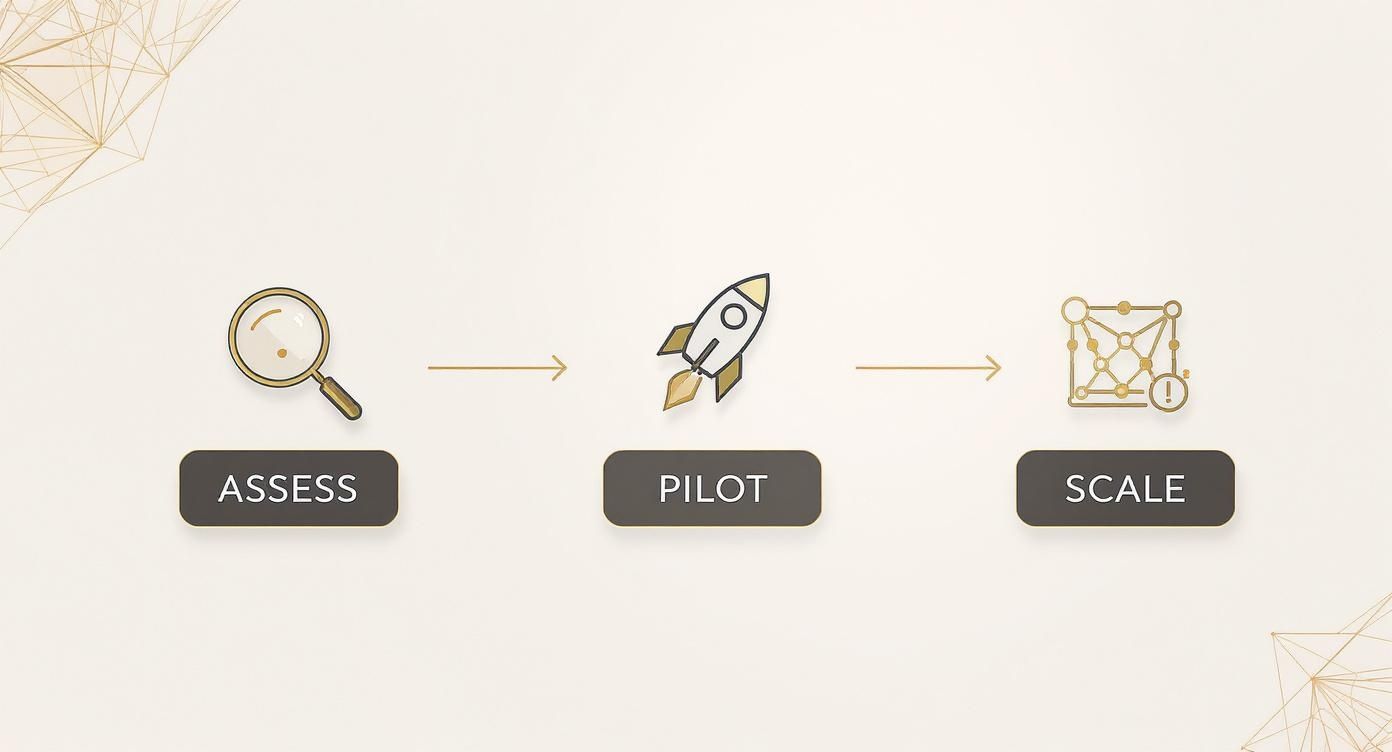
As you can see, the journey is broken down into three manageable stages: Assess, Pilot, and Scale. This demonstrates that adoption does not have to be a monolithic, high-risk project.
Ultimately, agentic AI for luxury brands is about augmentation, not replacement. It’s about driving operational excellence while simultaneously forging a deeper, more profitable connection with your clients.
Common Questions About Agentic AI
Whenever I discuss new technology with leadership teams, the same intelligent questions surface. Let's address the most common inquiries I receive about agentic AI head-on.
So, How Is This Different From Something Like ChatGPT?
This is a critical distinction.
Think of ChatGPT as a brilliant specialist. You give it a task—research a topic and write a summary—and it executes that task exceptionally well. It is a powerful tool that responds to specific prompts.
Agentic AI, in contrast, functions like a general manager. It takes that same research, determines the necessary next steps, formulates a multi-step plan, and then autonomously executes that plan to achieve a defined objective. One is a master of responding; the other is a master of achieving a goal.
Does This Mean Agentic AI Will Replace Our Client Advisors?
Absolutely not. It is here to enhance their capabilities, not make them obsolete.
An agent automates the tedious, time-consuming tasks that reduce your team's effectiveness—sifting through data to identify the perfect client gift, or manually tracking inventory for a specific item. The AI handles that.
This frees your advisors to focus on their highest-value activities: building genuine, personal relationships and delivering an exceptional human touch. It is a tool that amplifies their skills, not a replacement for them.
The objective is simple: let the technology handle the operational complexity so your people can focus on the human connection that defines a luxury experience. Agentic AI for luxury brands is about amplifying your team's talent, enabling them to deliver an even higher, more personalized level of service.
Ready to architect your brand's next stage of growth? MGXGrowth builds AI-powered strategies that drive measurable results. Learn more at https://www.mgxgrowth.com.
