


After decades driving growth across gaming and hospitality, I've seen countless initiatives promise transformation. Most were incremental at best. But casino AI guest personalization is different. It’s not just a technological upgrade; it's a fundamental shift in business strategy. We're moving from a one-to-many broadcast model to a one-to-one dialogue, treating every guest with the bespoke attention previously reserved for a handful of high rollers. This isn't about a better VIP program; it’s about architecting an intelligent, predictive experience for every single guest that drives measurable growth in revenue and loyalty.
Beyond VIP: The New Era of Casino Guest Personalization
For years, the industry standard was simple: segment guests into broad tiers like "Gold" or "Platinum" and push the same offers to everyone in that bucket. It was efficient but blunt. AI shatters this model, enabling a hyper-personalized, one-to-one conversation at a scale that was previously unimaginable. It’s about understanding the individual behind the player card—their game preferences, dining habits, entertainment choices—and using that insight to anticipate their next move.
The critical first step is breaking down the operational silos that hamstring growth. Data from the gaming floor, hotel systems, restaurant point-of-sale, and marketing platforms must flow into a single, unified view of the customer. Only then can AI begin to connect the dots and build the 360-degree profile necessary for true personalization. Structuring these data-driven groups effectively is foundational; you can explore this further in our detailed guide on customer segmentation strategies.
The Strategic Shift from Traditional to AI-Powered Personalization
The move from basic segmentation to AI-driven personalization is not a minor operational tweak; it represents a complete overhaul of strategy and capability. This table breaks down the fundamental differences from an executive's perspective.
| Operational Area | Traditional Approach (Siloed) | AI-Powered Approach (Integrated) |
|---|---|---|
| Guest Segmentation | Broad tiers (Gold, Platinum) based on past spend. | Dynamic micro-segments based on real-time behavior. |
| Offers & Promotions | Generic, pre-scheduled campaigns sent to large groups. | Individualized, predictive offers delivered at the perfect moment. |
| On-Floor Experience | Relies on staff observation and manual intervention. | AI-driven game and amenity recommendations via apps/kiosks. |
| Data Utilization | Historical data used for retrospective reports. | Real-time data used for predictive and prescriptive actions. |
| Marketing | "One-to-many" broadcast messaging. | "One-to-one" conversational marketing at scale. |
| Impact Measurement | Based on overall campaign lift and segment performance. | Measured by individual player lift, engagement, and lifetime value. |
As the table illustrates, the AI-powered model creates a deeply interconnected ecosystem. Every guest interaction informs the next, making the entire experience feel seamless, relevant, and engineered for growth.
From Overload to Opportunity
A modern casino floor, with its thousands of games, can induce decision fatigue. This is where AI delivers an immediate, powerful impact on revenue. Real-time personalization engines analyze every bet, every game, and every interaction to build a unique "taste profile" on the fly.
This isn't just about suggesting another slot machine. It's about understanding that a guest who favors low-volatility slots might also be receptive to a specific poker tournament or a reservation at your steakhouse. It connects their gaming profile to their total property experience, unlocking non-gaming revenue streams.
This data-first, customer-centric approach yields substantial results. Operators deploying AI recommendation engines have reported a 25% uplift in revenue per player and a 30% improvement in player retention. When you eliminate friction and guide guests to experiences they will value, they stay longer, spend more, and return more frequently. It is a direct line to a stronger P&L. You can explore more about these statistical gains on Certainly.io.
Mapping The AI-Powered Guest Journey
To drive sustainable growth, we must shift our focus from individual transactions to architecting the entire guest lifecycle. AI is the enabling technology that transforms a visit from a series of disjointed events into a cohesive, predictive journey that continuously improves. The objective is to understand and shape the guest experience from their first website click to long after they have checked out.
Turning raw guest data into profitable, personalized actions is the core of this strategy. This infographic outlines that powerful flow—from unified data collection to the delivery of AI-driven experiences that build loyalty and drive revenue.
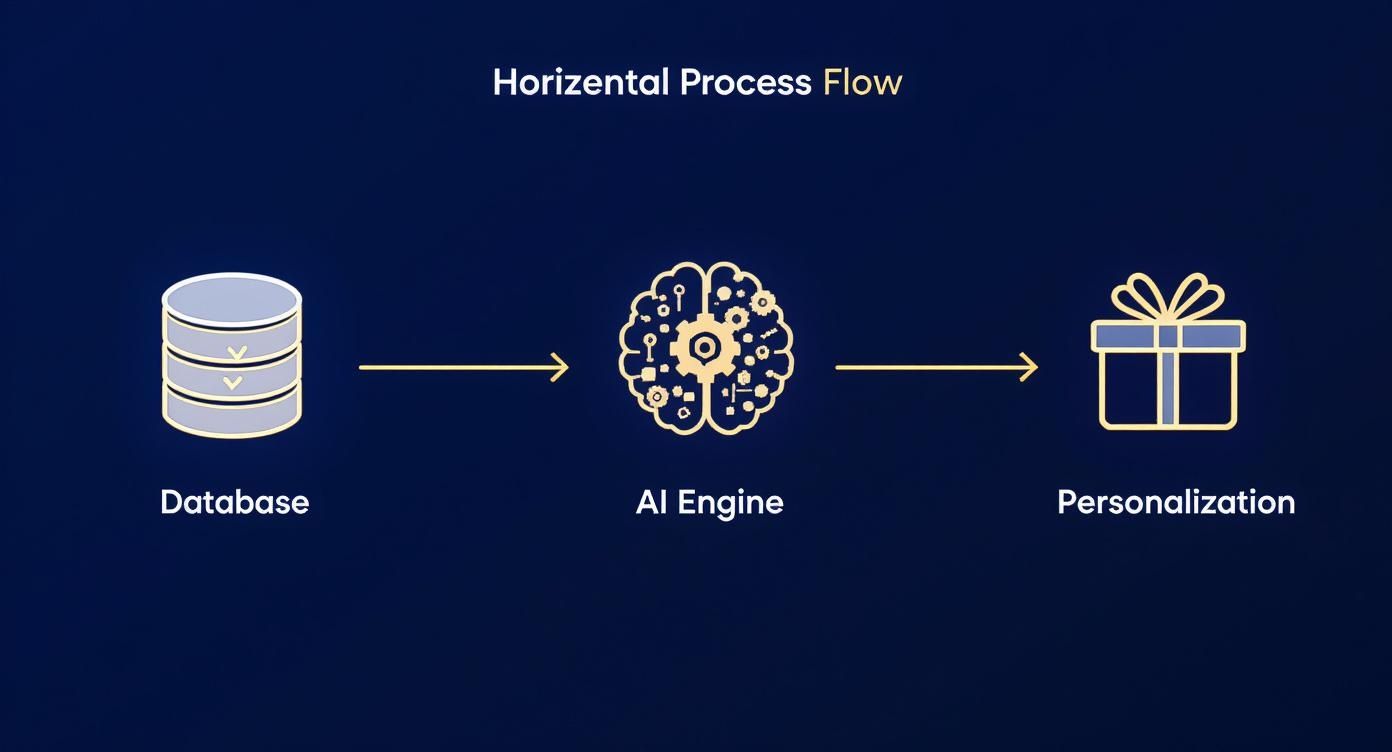
This model shows how unified data fuels an intelligent engine, which in turn creates the personalized moments that forge genuine loyalty and increase lifetime value.
Pre-Arrival Engagement
The guest journey begins long before a guest sets foot on property. During the pre-arrival phase, AI works behind the scenes, analyzing booking data, past visit history, and even website browsing behavior to identify signals of intent. This intelligence allows us to move beyond generic confirmation emails.
For instance, an AI might identify a guest who previously booked a suite and attended a rock concert. Before their next trip, it can automatically trigger a personalized offer that bundles a room upgrade with exclusive pre-sale access to a similar show. This is a targeted, value-added interaction, not a mass-market blast.
On-Property Real-Time Personalization
Upon arrival, the AI shifts from predictive planning to real-time execution. This is where the silos between the gaming floor, hotel, and restaurants must be completely dismantled. Imagine a guest playing their favorite slot machine. The system can instantly push a notification to their phone offering the exact complimentary drink they ordered on their last visit, delivered by the nearest server.
This on-property personalization extends far beyond the gaming floor. Based on real-time play duration and spend, the AI can trigger:
- Dining Recommendations: Suggesting a reservation at the steakhouse as their gaming session concludes around dinnertime.
- Entertainment Prompts: Alerting them that tickets are nearly sold out for a show that aligns with their known interests.
- Retail Offers: Pushing a targeted discount for a boutique as they walk past it.
Post-Visit Loyalty and Re-engagement
The journey doesn’t end at checkout. The post-visit phase is critical for securing the next booking and maximizing lifetime value. The AI analyzes the guest's complete visit—games played, restaurants visited, shows seen—to ensure the follow-up communication is surgically precise.
Instead of a generic "thank you" email, the guest receives a targeted offer for a future stay that specifically references their favorite slot machine or restaurant. This creates a continuous feedback loop that feels personal and relevant, compelling them to return. Mapping this journey is fundamental, and powerful tools can assist; you can find excellent options in guides on customer journey mapping software. This strategic follow-up is what converts a one-time visitor into a high-value loyalist.
Understanding The Core Technologies Driving Personalization
To execute a one-to-one guest engagement strategy, it's essential for leaders to grasp the core technologies from a business perspective. This isn't about becoming a data scientist; it's about understanding how the engine works so you can align its capabilities with your strategic growth objectives.
At its heart is Machine Learning (ML). ML models are prediction machines. They analyze vast quantities of historical guest data—every wager, restaurant bill, and room booking—to identify subtle patterns and forecast future behavior. A well-tuned ML model can predict which slot machine a player will try next or identify a high-value guest showing early signs of churn, often before they are consciously aware of it themselves. This predictive capability allows us to shift from a reactive to a proactive engagement model, anticipating needs and delivering the right offer at the right time.
The Brains Behind The Operation
These technologies function as an integrated stack, turning raw data into profitable actions. Each component plays a specific, vital role in building a comprehensive and actionable view of your guest.
-
Customer Data Platforms (CDPs): This is your strategic command center, the single source of truth for all guest data. A CDP is purpose-built to demolish the data silos that have historically plagued casino operations. It integrates everything—from gaming and hotel property management systems (PMS) to point-of-sale and marketing channels—into a single, unified profile for each guest. Without this foundation, any attempt at true personalization is destined to fail.
-
Machine Learning (ML) Models: If the CDP is the command center, ML is the predictive brain. These algorithms analyze the unified data to forecast guest behavior, calculate lifetime value, and identify micro-segments invisible to human analysts. They continuously work to answer the most critical question: "Based on everything we know, what is this guest likely to do next?"
-
Natural Language Processing (NLP): This is the technology that enables your organization to listen at scale. NLP analyzes unstructured text from sources like chatbot logs, online reviews, and social media comments. It deciphers not only what guests are saying but also the sentiment behind their words, providing invaluable qualitative insights.
Turning Data Into Dialogue
When this tech stack is properly integrated, it creates an automated, intelligent system. Imagine a guest leaves a post-stay survey comment expressing frustration. An NLP model instantly flags the negative sentiment. That insight is fed to the CDP, updating the guest's profile. The ML model, recognizing this new data point, identifies the guest as a churn risk and automatically triggers a personalized "we want you back" offer through your marketing platform.
This seamless flow—from listening (NLP) to unifying (CDP) to predicting (ML)—is a game-changer. It creates a powerful feedback loop where every guest interaction makes the next one smarter and more profitable.
The benefits extend beyond marketing. By 2025, AI is projected to drive a 30% increase in operational effectiveness in casinos by optimizing everything from staffing levels to inventory management. This operational leverage enables properties to deliver a concierge-level experience at scale. You can find more details about these gaming and leisure trends on mygamingandleisure.com.
Turning Marketing From a Broadcast Into a Dialogue
For decades, casino marketing has operated like a megaphone. We developed broad offers, blasted them to large database segments, and hoped for a positive result. This "spray and pray" model is a monologue—impersonal, inefficient, and disconnected from the individual guest's immediate context.
AI shatters that paradigm, transforming the monologue into a dynamic, one-to-one dialogue.
This strategic shift is possible because casino AI guest personalization is not about sending a slightly better email; it’s about developing an almost intuitive understanding of each guest's intent. The system analyzes thousands of data points—gaming history, dining preferences, hotel stays, even physical movement through the property—to predict their next action. Is a guest about to book a trip? Are they showing signs of disengagement and at risk of churn? This predictive intelligence allows us to be proactive, relevant, and effective.
From Mass Messaging to Micro-Moments
Instead of being constrained by a rigid marketing calendar, AI-powered platforms respond to guest behavior in real time. This allows us to engage guests during crucial "micro-moments" with offers that feel less like advertising and more like a timely suggestion from a personal host who truly understands them.
Here is what this looks like in practice:
- Proactive Retention: The AI flags a high-value player whose visitation has dropped. Instead of a generic "we miss you" message, it triggers a personalized offer for a complimentary weekend stay, bundled with free play on their favorite slot machine.
- Intelligent Upselling: A guest who consistently dines at your high-end steakhouse books a standard room. Recognizing this "foodie" profile, the system sends a timely email offering an upgrade to a suite that includes a chef's tasting menu.
- Real-Time Re-engagement: A player hits a significant jackpot on a video poker machine. Seconds later, a push notification congratulates them and suggests a celebratory dinner at your premier restaurant, complete with a one-tap reservation link.
This is empathy at scale. By weaving together data on wins, losses, preferences, and on-property behavior, every communication is precisely tuned to the guest's immediate context. The dialogue becomes relevant because it is based on what they are doing right now.
The New Standard in Campaign Performance
The impact of this strategic shift on the bottom line is undeniable. We are moving beyond simple personalization to predictive communication that adapts dynamically. Top-tier AI platforms can forecast a player's next move—whether to book, play, or churn—and adjust marketing content in real time to match that intent. This has established a new benchmark for campaign performance.
AI-Driven Campaign Performance Uplift
The following table illustrates the quantifiable impact of AI on key marketing metrics compared to traditional broadcast methods.
| Marketing Metric | Traditional Campaign Average | AI-Powered Campaign Average | Percentage Uplift |
|---|---|---|---|
| Email Open Rate | 18% | 41% | 128% |
| Click-Through Rate | 2.5% | 7.5% | 200% |
| Conversion Rate | 1.2% | 4.8% | 300% |
| Player Retention | 65% | 82% | 26% |
By incorporating player habits, wins, losses, and preferences into predictive models, AI fosters a much deeper, more profitable connection with every guest. You can explore more about how AI is changing casino email marketing on iPost.com.
Your Game Plan for Bringing AI to the Casino Floor
A brilliant strategy is worthless without disciplined execution. In my experience driving growth, the most significant wins come not from a "big bang" launch, but from a methodical, phased approach that is relentlessly data-driven. This is not a technical manual for your IT team; it is a strategic roadmap for leaders focused on deploying AI-driven guest personalization to achieve tangible business outcomes.
Phase 1: Get Your Data in One Place
Before any strategy can be implemented, you must break down your data silos. Your gaming, hotel, retail, and marketing systems currently operate as independent fiefdoms. This must end. The primary objective is to build a single, comprehensive view of each guest. This means unifying data from every corner of your operation:
- Gaming Systems: Game preferences, win/loss history, time-on-device.
- Hospitality Systems: Hotel stays, room preferences, spa bookings, dining reservations.
- Point-of-Sale (POS) Data: Every purchase from retail, F&B, and entertainment venues.
- Marketing Channels: Email engagement, app usage, website interactions.
Once this data is unified, you no longer see a "slot player" and a "hotel guest"; you see one customer with a specific behavioral profile. This unified view is the non-negotiable foundation for success.
Phase 2: Run a Pilot Program and Prove the Value
With a unified data stream, the temptation is to launch a massive, property-wide initiative. Resist it. The intelligent path is to select a few high-impact, low-risk pilot projects to prove the concept. The goal is to secure quick wins, demonstrate clear ROI, and build organizational momentum.
Think of this as your proof of concept. You are not just testing the technology; you are validating its direct impact on revenue and EBITDA. This is how you secure C-suite sponsorship for a full-scale deployment.
Personalized game recommendations are an ideal starting point. An AI can analyze a guest's play history and push a notification through the casino app suggesting a specific slot machine they are likely to enjoy. It is a simple, effective method to increase engagement and time-on-device. Measure the results obsessively, comparing the pilot cohort against a control group to isolate the financial lift.
Phase 3: Scale It Up Across the Property
Once your pilot programs have demonstrated measurable success, it is time to scale. This is the phase where you expand your AI initiatives from discrete projects into an integrated, property-wide strategy. You begin connecting all the experiential dots.
To scale effectively, you must establish a dedicated, cross-functional team with representation from marketing, IT, gaming operations, and finance. This group's mandate is to take the learnings from the pilot programs and apply them across the entire guest journey—from pre-arrival marketing to post-visit re-engagement. This phased approach de-risks the investment and ensures that every step is tied to value creation.
Avoiding Common Pitfalls and Measuring True ROI
When implementing a powerful technology like AI, it is easy to stumble. I have seen it repeatedly. The primary reason personalization initiatives fail is not a flaw in the technology, but a failure of strategy. Teams become mesmerized by the AI models and algorithms and neglect the essential groundwork.
The single greatest pitfall is poor data quality. You cannot build a world-class personalization engine on a foundation of messy, incomplete, or siloed data. An AI is only as intelligent as the data it is fed—the adage "garbage in, garbage out" is an immutable law. Before evaluating any software, the first priority must be to establish a clean, unified view of the guest across all touchpoints.

From Vanity Metrics to Verifiable Value
Once your data is in order, the next challenge is measuring what matters. It is tempting to focus on "vanity metrics" like platform engagement or the number of personalized offers sent. While these might look good in a presentation, they are meaningless to the P&L and fail to prove the project's value to the board.
To justify the investment, you must connect every action to tangible business outcomes. The focus must be on the Key Performance Indicators (KPIs) that directly impact financial performance.
The objective is not to personalize things. The objective is to drive measurable growth in revenue, EBITDA, and market share. Every component of your AI strategy must be accountable to these core business goals.
Build your measurement framework around these critical KPIs:
- Increased Player Lifetime Value (LTV): Is your personalization strategy making players more valuable over time?
- Higher Non-Gaming Revenue Per Guest: Are AI-powered recommendations driving incremental spend in restaurants, retail, and entertainment?
- Improved Retention and Reduced Churn: Can you prove that personalized outreach is preventing high-value players from defecting to competitors?
- Gains in Operational Efficiency: Are you using predictive insights to optimize staffing, reduce waste, or lower customer service costs?
When you anchor your reporting to these metrics, the conversation shifts from technical features to financial impact. That is how you prove the real-world value of your strategy and secure the buy-in needed for continued investment. For a deeper look at this critical area, review our guide on client satisfaction measurement, which shares core principles for tracking what truly matters.
Common Questions On Casino AI Personalization
As a growth strategist, I field many questions from leadership teams exploring the integration of AI into their operations. There is significant excitement, but also a healthy level of strategic skepticism. Let's address some of the most pressing questions I hear from executives considering an investment in AI-driven guest personalization. My goal is to provide direct, business-focused answers to help you move forward with confidence.
Is My Data Good Enough to Start?
This is the most common and critical question. The direct answer is: probably not, but that must not be a barrier to starting. Waiting for "perfect" data is a trap that leads to inaction. The key is to begin the process of unifying your core data sources now—gaming systems, hotel PMS, and point-of-sale.
Start with the data you have; this process will inherently expose the gaps. From there, you can build a pragmatic roadmap for improving data hygiene and integration. Launching an initial pilot, even with imperfect data, is the fastest way to identify precisely where your data collection efforts need to be strengthened.
Will AI Replace My Casino Hosts and Marketing Staff?
No. The objective is to augment your team, not replace them. Think of AI as a force multiplier for your most valuable people. AI excels at processing vast amounts of data at a scale no human can match, handling the analytical heavy lifting. This liberates your hosts to focus on their highest-value activity: building genuine, personal relationships with guests.
AI provides the "what" and the "when"—for example, identifying a guest at risk of churn and suggesting a specific, timely offer. Your host then delivers the "why" and the "how"—presenting that offer with a personal touch that builds true loyalty. It makes your best people even more effective.
What is the Biggest Misconception About AI Personalization?
The single greatest mistake is viewing AI as a technology project owned by the IT department. This mindset is a recipe for failure. The implementation of casino AI guest personalization is a business strategy first and a technology project second. It demands a cross-functional team with executive sponsorship from marketing, operations, and finance from day one.
When IT is tasked with leading such an initiative without clear strategic business direction, the project will almost certainly fail to deliver a meaningful return on investment. Success is achieved only when the technology is deployed in direct service of specific, measurable business outcomes.
At MGXGrowth, we specialize in helping businesses like yours move beyond theory to execution. We partner with you to build a practical, data-driven roadmap for AI-powered growth that delivers measurable results. To learn how we can help you architect the next stage of your growth, visit us at https://www.mgxgrowth.com.
