


I’ve spent my career driving EBITDA and market share growth across SaaS, hospitality, and real estate. In that time, I’ve seen one silent killer cripple more ambitious companies than any other: outdated compensation models. Many executives still rely on static, year-old salary surveys, which is like navigating today's hyper-competitive market with a map from last decade. This isn't just an HR problem—it's a critical business liability that fuels attrition and leaves a shocking amount of revenue on the table.
Why Yesterday’s Comp Models Are a Growth Anchor
As a growth strategist, I've learned that the fastest way to stall momentum is to mismanage your most valuable asset—your people. For too long, companies have treated compensation as a reactive, administrative task handled in a silo. This legacy approach is fundamentally broken and actively works against the very growth it’s meant to support.
The root of the problem is a deep-seated reliance on lagging data. Annual salary surveys are practically obsolete the moment they’re published. A compensation plan built on 12-month-old information is a plan for a market that no longer exists, and this creates a cascade of issues that directly eat into EBITDA and market share.

The High Cost of Delayed Data
When your pay scales fall behind the market, the consequences hit your P&L fast and hard. Your best people become flight risks, competitors poach top performers with better offers, and your ability to attract new talent grinds to a halt. This isn't a vague cultural issue; it's a measurable drain on your resources.
Think about the hidden costs for a moment:
- Sky-High Attrition: Losing a key employee can cost anywhere from 50% to 200% of their annual salary when you factor in recruitment, onboarding, and lost productivity. That's a direct hit to your bottom line.
- Recruitment Friction: When your offers aren't competitive, time-to-hire metrics go through the roof. This leaves critical roles unfilled for longer, slowing down revenue-generating projects.
- Eroded Morale: Underpaying even a small segment of your workforce creates a ripple effect of disengagement that damages innovation and customer service across the board.
I don't see compensation as a cost center. I see it as a strategic growth lever. When it’s disconnected from real-time data and business goals, it becomes a deadweight. When it's aligned, it becomes the engine for talent acquisition, retention, and market agility.
This guide will lay out the solution I've used to turn this liability into a genuine competitive advantage: real-time comp management powered by AI. We'll dig into why this shift is no longer a 'nice-to-have' but a foundational pillar of sustainable growth.
Breaking Down the Silos for Strategic Alignment
The traditional model keeps compensation locked inside the HR department, completely cut off from finance and sales. HR has the people data, finance holds the budget constraints, and sales owns the performance metrics, but these streams rarely, if ever, converge. This siloed approach makes it impossible to design incentive structures that actually drive business outcomes.
The future of compensation is about connecting these disparate datasets. By integrating real-time market salary data with internal performance metrics and financial goals, we can finally shift from making reactive, panicked adjustments to proactive, strategic investments in our talent. This is exactly how we turn compensation into a tool that directly fuels revenue, reduces operational drag, and builds a far more resilient organization.
What Is Real-Time AI Comp Management, Really?
Let’s get straight to what real-time comp management with AI actually means for your P&L. For years, I've watched leaders in every industry—from tech startups to established hospitality chains—get stuck in a compensation rut. Their tools were always looking in the rearview mirror.
It’s like trying to navigate rush hour traffic in a new city using a paper map printed last year. You can’t see the sudden gridlock, the unexpected detours, or the brand-new expressway that could get you there faster.
That old, static map is how traditional compensation has worked for decades, relying on annual salary surveys and historical data. You’re always playing catch-up.
Now, picture trading that map for a live GPS. This new tool pulls in data constantly, rerouting you around accidents and showing you the fastest path based on what’s happening right now. That’s the leap to real-time AI compensation. It’s a fundamental shift from being reactive to becoming proactive.
From Static Reports to a Live Data Engine
At its heart, real-time comp management with AI is about building a living, breathing model of both the external talent market and your own internal team. This isn't just basic automation; it’s a sophisticated data engine that’s always on, crunching millions of data points from countless sources.
This approach blows past old-school spreadsheets by weaving together:
- Live Market Salaries: Forget year-old survey data. The system pulls from thousands of current job postings and aggregated salary data to show you what a role is worth today.
- Internal Performance Metrics: It plugs into your HRIS and performance systems to factor in individual and team contributions, so you can be sure you're rewarding your top performers accurately.
- Skill Demand Surges: The AI can spot when demand for a specific skill—like a new coding language or a niche marketing expertise—is heating up, letting you get ahead of the curve.
- Geographic Cost-of-Living Data: For remote and distributed teams, it constantly refines pay recommendations based on real-time economic shifts in different locations.
This continuous stream of information means you can finally make forward-looking pay decisions, not just reactive fixes based on stale intelligence. The system doesn’t just tell you where you are; it shows you where the market is going.
The Move from Analytics to Actionable Insights
But where this technology truly shines is in its ability to move beyond simple analytics. A spreadsheet can tell you what you paid someone last year. An AI system, on the other hand, delivers predictive and prescriptive insights that directly impact your business goals.
The goal isn't just to have more data; it's to have the right data, at the right time, to make the right decision. AI helps us connect the dots between market trends, individual performance, and budget realities, turning compensation into a precision tool for growth.
This shift is happening faster than you might think. A recent analysis shows that 64% of companies are already using AI in compensation management, and another 12% plan to adopt it soon. That means 76% of companies will likely be using AI for their pay strategies by 2025. They’re driven by the need for the kind of real-time insights and equitable pay structures that old methods simply can't provide. You can explore more about how AI is reshaping compensation strategies and what it means for your business.
At the end of the day, real-time comp management with AI isn't about replacing human judgment. It’s about arming it with powerful, data-backed intelligence. It gives leaders the tools to proactively keep their best people, create competitive offers that actually win, and build a foundation of pay equity that strengthens culture from the inside out.
The Core Components of an AI-Powered Comp Platform
From an executive's point of view, any platform is only as good as what’s under the hood. When I evaluate new tech, I’m not just looking at a polished interface; I need to understand the engine that makes it run. A truly effective real-time comp management with AI platform isn't just one tool—it's an entire ecosystem of interconnected parts working together to drive smart business decisions.
To get a real sense of its power, you have to look past the dashboard. You need to see the distinct, high-performance components that make it all click. What separates a basic tool from a genuine growth driver is its ability to break down the walls between data, analytics, and action. I consider four foundational pillars to be non-negotiable for any serious platform in this space.
This flow chart gives you a bird's-eye view of how raw, live data is processed, analyzed, and ultimately turned into actionable recommendations for leaders.
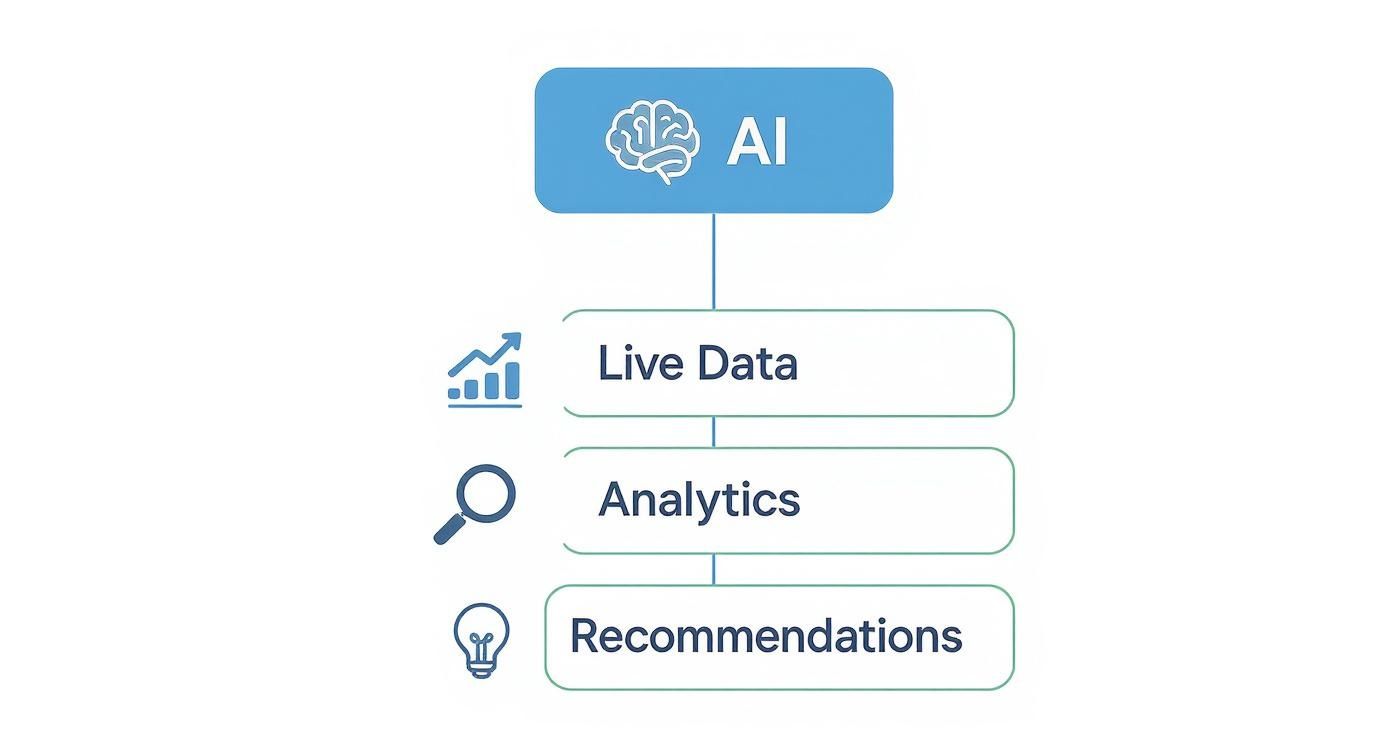
As you can see, each layer builds on the one before it, transforming what would otherwise be a chaotic stream of information into clear, strategic intelligence.
The Real-Time Data Ingestion Engine
First up is the data ingestion engine. This is the heart of the system, constantly pumping in fresh data from a massive array of sources. Think of it as the platform’s central nervous system, gathering signals from everywhere, all at once.
It’s not just pulling from static annual surveys anymore. This engine connects directly to live job postings, anonymized payroll data from across the industry, your internal HRIS platforms, and even performance management systems. This component tears down the silos between HR, finance, and operations, making sure everyone is working from the same real-time truth.
The Predictive Analytics Module
Next, all that data flows into the predictive analytics module. This is the strategic brain of the whole operation. It doesn't just report on what happened last month; it uses machine learning to forecast what’s likely to happen next month. This is what lets you shift from a reactive to a proactive compensation strategy.
This is the part of the system that answers the tough "what if" questions for leadership:
- Who is a flight risk? The AI can identify high-performers whose pay is falling behind the live market, flagging them as potential attrition risks long before they start looking elsewhere.
- What market shifts are coming? It spots roles seeing a sudden spike in demand and salary expectations, giving you a chance to get ahead of compensation adjustments before you start losing candidates.
- What's the real budget impact? You can model scenarios like, "How will a proposed 5% budget increase for engineering affect our ability to retain top talent over the next 18 months?"
This module is all about turning raw data into forward-looking intelligence. It gives you the foresight to act before a small problem snowballs into a crisis.
The strategic shift from static, reactive methods to these dynamic, proactive AI-driven strategies is significant. Here's a quick breakdown of how the old and new worlds compare.
Traditional vs AI-Powered Compensation Management
| Aspect | Traditional Compensation Management | Real-Time Comp Management with AI |
|---|---|---|
| Data Source | Annual surveys, historical internal data | Live market data, payroll data, HRIS, performance metrics |
| Frequency | Annual or semi-annual review cycles | Continuous, 24/7 analysis |
| Decision-Making | Reactive, based on lagging indicators | Proactive, based on predictive forecasts |
| Pay Equity | Manual, periodic audits (often yearly) | Automated, always-on monitoring and remediation |
| Manager Guidance | Broad salary bands, subjective judgment | Specific, data-backed pay recommendations |
| Focus | Internal equity and budget control | External competitiveness and talent retention |
This table really highlights the jump from a backward-looking administrative function to a forward-looking strategic one. It's about making smarter, faster decisions backed by live intelligence.
The Prescriptive Recommendation Engine
This is where all that intelligence gets turned into concrete action. The prescriptive recommendation engine takes the forecasts from the analytics module and translates them into specific, actionable advice. It’s like having a seasoned compensation strategist on call 24/7, giving you data-backed suggestions.
Instead of managers guessing what an appropriate salary offer or merit increase should be, the engine serves up optimized ranges. It might suggest, for instance, "To be competitive for a Senior Software Engineer in Austin, your offer should be between $165,000 and $180,000," based on thousands of real-time data points. This is much like the process of fine-tuning campaigns in marketing automation, where small, data-driven adjustments can produce huge results.
The real value here is consistency and defensibility. When every compensation decision is backed by a clear data narrative, it strips away bias and empowers managers to have confident, transparent conversations with their teams about pay.
The Automated Pay Equity Analysis Tool
Finally, and this is a big one, you have the automated pay equity analysis tool. In the past, pay equity audits were monstrous, manual projects that took months to complete and were outdated the day they were published. This component transforms that static audit into a continuous, automated process.
The AI constantly runs regression analyses in the background, flagging any statistically significant pay gaps based on gender, race, or other demographics. Crucially, it doesn't just find problems; it models the most cost-effective ways to fix them. This isn't just about compliance—it's a powerful tool for building trust and fostering a more inclusive culture. For leadership, it’s a proactive shield against legal risk and a tangible way to show your company is committed to fairness.
Using AI to Achieve True Pay Equity and Retention
For decades, I’ve watched companies treat pay equity as a compliance checkbox—a painful, manual audit performed once a year to mitigate legal risk. This approach is not only slow and inefficient; it’s fundamentally broken. By the time you discover a pay gap through an annual review, the damage to trust, morale, and your employer brand is already done.
In my experience driving growth, true pay equity isn't a defensive tactic. It's a powerful offensive strategy for attracting and keeping the absolute best talent. It sends a clear message that your organization is built on a foundation of fairness, which is a massive differentiator in today’s competitive market. This is where real-time comp management with AI changes the entire game.

Moving From Reactive Audits to Proactive Fairness
Traditional pay equity analysis is like taking a single snapshot of a moving train. It’s a static picture that’s instantly outdated. An AI-powered system, however, is a live video feed, continuously monitoring your compensation landscape for even the slightest deviations from fairness.
This technology doesn't just look at base salaries. Its algorithms constantly analyze total compensation—including bonuses, equity, and other incentives—across every conceivable dimension.
- Role and Level: Comparing pay for employees doing similar work.
- Performance Data: Factoring in objective performance metrics.
- Demographics: Analyzing pay across gender, ethnicity, age, and other protected categories.
- Location: Adjusting for geographic cost-of-labor differences.
By running these sophisticated regression analyses 24/7, the AI flags statistically significant disparities the moment they begin to emerge. It catches minor issues before they fester into major legal and cultural crises.
AI Does More Than Just Find the Gaps—It Closes Them
Identifying a pay gap is only half the battle. The real challenge has always been figuring out how to fix it without blowing up your entire budget. This is where the prescriptive power of AI truly delivers ROI.
Instead of a blanket "give everyone a 5% raise" approach, the system models the most cost-effective and equitable solutions. It can pinpoint the specific individuals who need adjustments and calculate the precise amounts required to close the gaps. This allows leadership to make surgical, data-backed remediation decisions that are both fair and fiscally responsible.
Pay equity isn't just about avoiding lawsuits; it's about building an organization where every single employee feels valued and sees a clear, fair path to success. When your team trusts that the system is equitable, their engagement, loyalty, and performance skyrocket.
This proactive approach is essential for fostering the kind of environment that retains top talent. It’s a core component of human-centred leadership, where technology is used not to replace human connection but to strengthen it by ensuring fairness and transparency.
The Direct Line Between Pay Equity and Retention
The link between perceived fairness and employee retention is undeniable. When talented people feel they are being compensated unfairly, they don't just become disengaged—they leave. And the cost of that attrition is staggering.
Real-time compensation analytics, powered by AI, has completely reshaped how modern organizations approach these critical pay decisions. Instead of relying on old survey data, these systems provide live salary benchmarks drawn from multiple, reliable sources. This capability enables businesses to align their compensation with current market trends, ensuring they remain competitive and avoid creating pay disparities in the first place.
By using AI to maintain continuous pay equity, you are investing directly in retention. You create a culture where difficult conversations about pay are backed by objective data, not subjective bias. This builds a deep well of trust that becomes a powerful retention magnet, reducing preventable attrition and protecting your bottom line.
How AI Unlocks Business Agility and Efficiency
In all my years working across SaaS, real estate, and hospitality, I've learned that the real test of any new tech isn't the hype—it's whether it delivers real-world efficiency and makes the business more agile. That’s precisely where real-time comp management with AI shines. It takes compensation from a clunky, manual process and turns it into a sharp, strategic tool.
The first thing you’ll notice is the automation of tedious, error-prone tasks. Just think about the countless hours your HR and finance teams sink into gathering market data, wrestling with massive spreadsheets, and manually reconciling compensation cycles. It’s low-value work that drains your resources and is rife with human error.
AI basically eliminates this operational drag. By automating all that data collection and analysis, it frees up your most valuable people—your leaders and strategists—to focus on what actually matters. Instead of double-checking spreadsheet formulas, they can spend their time designing pay strategies that motivate the exact behaviors needed to grow the business.
Slash Comp Cycles and Empower Your Managers
One of the biggest headaches in any company is the annual or semi-annual compensation review. It's a long, painful slog often filled with guesswork, back-and-forth negotiations, and subjective calls. Managers are stuck trying to justify raises with incomplete data, which leads to inconsistent and often unfair outcomes.
AI-driven tools cut right through that mess. They give line managers clear, data-backed salary recommendations for every single person on their team, automatically factoring in performance, current market value, and internal equity. This takes the guesswork out of the equation and dramatically shortens the time spent haggling.
By automating the tactical, you empower your leaders to become more strategic. When managers have objective data in their hands, they can have confident, transparent conversations about pay. That builds trust and makes their teams stronger.
And we’re not talking about small tweaks. AI-driven compensation planning can reduce comp cycle times by up to 50%. A process that once took months of administrative agony can now be wrapped up in a few weeks. That means your business can adapt far more quickly to market shifts and internal demands.
Supercharge Payroll Accuracy and Compliance
Beyond planning, AI has a massive impact on payroll—an area where accuracy and compliance are absolutely critical. Traditional payroll is notoriously prone to mistakes, which can lead to expensive corrections, compliance fines, and a serious blow to employee trust. Every single manual entry is a potential point of failure.
AI's predictive power completely changes the game. The system can proactively flag potential errors—like an incorrect bonus calculation or misaligned overtime pay—before the payroll even runs. It makes sure every piece of an employee's pay is calculated correctly, reflecting their performance, tenure, and any recent changes.
This shift toward intelligent automation is quickly becoming the new standard. In fact, projections show that by 2025, AI adoption in payroll is expected to hit 50%, with companies reporting major gains. Integrating AI has been shown to cut payroll processing times by 25-50% and boost accuracy by 30-40%, which directly improves operational efficiency and gets rid of costly human mistakes. If you want to dig deeper into this, you can explore detailed findings on the future of automated compensation systems.
This isn't just about saving time; it's a strategic advantage. When your payroll is consistently accurate and on time, you build a foundation of reliability and trust with your people. By embracing real-time comp management with AI, you're not just buying a new tool. You're building a more agile, efficient, and resilient organization from the ground up.
Your Roadmap for AI Compensation Implementation
Bringing in any new platform can feel like a massive undertaking. As a strategist who’s been in the trenches for dozens of these projects, I can tell you that success doesn't come from the tech itself. It comes from a smart, practical roadmap. This isn't a technical guide for IT; it's a strategic playbook for leaders who need to manage the very human shift required to make real-time, AI-driven compensation actually work.
The whole journey is much more manageable when you break it into distinct phases. I’ve seen too many companies try to boil the ocean, overwhelming their people and losing steam halfway through. A disciplined, step-by-step approach is the only way to build something that lasts.
Phase 1: Assess Your Data Readiness
Before you even think about looking at vendors, you need to look in the mirror. An AI platform is just an engine; your data is the fuel. And if that fuel is dirty, siloed, or just plain missing, the engine is going to seize up.
Start by being brutally honest about your data infrastructure. Do you have clean, easy-to-access records on employee performance, how long they've been with you, and what they're paid now? Does your HRIS talk to your finance and sales systems? Finding these gaps early is the most important thing you can do to set a realistic timeline and give your new system a solid foundation.
Phase 2: Define Your Core Business Objectives
Next, you have to answer a deceptively simple question: What problem are we actually trying to solve? A fuzzy goal like "modernizing HR" is a one-way ticket to a failed project. You need sharp, measurable goals tied directly to business growth.
Are you trying to:
- Cut attrition among your top engineers by 15%?
- Shrink the time-to-hire for crucial sales roles by 25%?
- Automate your pay equity analysis to get ahead of compliance headaches?
Nailing down these objectives will steer every decision you make from here on out, from which technology partner you choose to how you measure success. It keeps the entire project focused on real business results, not just shiny new features.
Phase 3: Select the Right Technology Partner
Once you have your objectives locked in, you can start evaluating potential partners. It’s easy to get wowed by slick demos and fancy dashboards, but don't fall for it. The right partner is the one whose platform directly solves the problems you just defined and whose team gets the organizational change part of the equation.
Look for a partner who can show you exactly how their tool eases your specific pain points. They should also provide a clear, no-nonsense plan for plugging into your existing systems. Think of this as a long-term strategic partnership, not just a software purchase.
Phase 4: Plan a Phased Rollout and Champion Change
Whatever you do, avoid a "big bang" launch. A phased rollout is your best friend. It lets you build momentum, get real feedback from the field, and turn key people into internal advocates for the new system. Start small with a single department—maybe sales or engineering—where the need is greatest. Then, use the wins from that pilot group to make the case for rolling it out everywhere else.
Change management isn't an afterthought; it's the main event. Your biggest hurdle won't be the technology. It will be getting your managers on board and earning the trust of your employees. Be relentlessly transparent about how the new system works, how it ensures fairness, and how it empowers leaders to make better decisions backed by real data.
Successfully steering these kinds of projects is one of the core digital transformation challenges leaders are up against today. It takes a delicate balance of big-picture vision and careful, on-the-ground execution. This structured approach takes the risk out of the process and ensures your new system becomes a powerful tool for growth, not just another subscription you're paying for.
Frequently Asked Questions About AI in Compensation
Whenever I talk to leaders about bringing AI into their compensation strategy, the same sharp questions always surface. People want to know about the real-world impact, not just the tech specs. So, let's get straight to the most common concerns I hear about real-time comp management with AI.
Will AI Replace Our HR Team or Compensation Managers?
This is usually the first question, and the answer is a firm no. The point of this technology isn't to replace the invaluable judgment of your people, but to give them superpowers. Think about all the time your teams spend buried in spreadsheets, pulling data, and running manual analyses. AI takes on that grunt work.
This frees up your HR and compensation pros to do what they do best: craft incentive plans that actually motivate people, coach managers through difficult pay conversations, and analyze the human story behind the numbers. The AI gives you the "what," so your team can focus on the far more important "why" and "how."
How Can We Trust the AI’s Recommendations?
Trust has to be earned, and that comes from transparency. A good AI compensation platform isn't some mysterious black box. It should be able to show you its work, providing a clear, defensible story for every single recommendation.
For instance, if the system suggests a $10,000 salary bump for an engineer, it won't just spit out a number. It will show you the real-time market data for that role, how that person’s pay compares to their peers internally, and the performance data that justifies the change. This data-driven logic helps strip out unconscious bias and gives managers the confidence they need to explain their decisions.
The real shift is moving from subjective "I feel like…" conversations to objective "the data shows…" discussions. That's how you build a foundation of trust with managers and employees.
Is This Only for Large Enterprises?
Absolutely not. It's true that the corporate giants were the first to jump in, but the technology has evolved. Today, it’s far more accessible and scalable for mid-market companies and even fast-growing small businesses. For a smaller, nimble company, being able to make competitive offers based on live data is a huge leg up when trying to snag top talent from bigger, slower competitors.
The trick is to start with a focused goal. A smaller business might zero in on one high-impact area, like closing a pay equity gap or retaining critical tech roles. This way, you can see a strong ROI without a massive upfront investment.
Ready to turn your compensation strategy from a cost center into a true growth driver? At MGXGrowth, we build AI-powered frameworks that deliver real business results. Let’s map out a more agile and equitable future for your team. Learn how we can accelerate your growth.
