


After decades driving growth across SaaS, gaming, and real estate, I've seen one shift fundamentally change how winning companies operate: the move from reacting to historical data to proactively predicting the future. The engine behind this transformation is predictive analysis machine learning. It's not just a tool for your data science team anymore; it's the core of a modern growth strategy, directly impacting revenue, EBITDA, and market share.
From Hindsight to Foresight: A Strategist's Guide
For years, leadership teams made decisions by looking in the rearview mirror. We'd analyze last quarter's sales or last month's churn and then react. In today's market, that's a surefire way to get left behind. Predictive analysis flips this model entirely, giving us the foresight to anticipate market shifts and customer needs before they fully materialize.
Think of it as the ultimate tool for breaking down the silos between your data science, marketing, finance, and operations teams. When everyone is working from the same predictive insights, you create a unified engine for growth. Suddenly, debates based on gut feel are replaced by strategic decisions backed by solid probabilities.
Why This Matters for Growth
The real power here lies in answering your most critical business questions with a level of confidence that was previously impossible:
- Customer Behavior: Which of our high-value customers are on the verge of churning in the next 90 days?
- Revenue Forecasting: What will our revenue actually be next quarter, factoring in our current pipeline and market headwinds?
- Marketing Efficiency: Which leads in our pipeline are most likely to convert into our next best customers?
This isn't some far-off theory. The global predictive analytics market is projected to explode from USD 20.33 billion in 2025 to a staggering USD 181.9 billion by 2035. That's not just a trend; it's a clear signal that this capability is becoming table stakes.
As a growth strategist, I see predictive analytics as the ultimate competitive advantage. It lets you stop guessing and start making smart, strategic bets based on what's most likely to happen. It's how you directly connect your data to real results like EBITDA and market share.
By combining historical data with powerful machine learning algorithms, we build a proactive culture—one that anticipates instead of reacts. This shift is non-negotiable for any leader serious about winning. Mastering this is a cornerstone of any modern data-driven marketing strategy. Think of this guide as your executive briefing on how to make that happen.
How Predictive Machine learning Actually Works
To drive real growth from any tool, you must understand how it works under the hood. Let's pull back the curtain on predictive machine learning—skipping the dense theory to focus on what you, as a business leader, need to know. The goal isn't to make you a data scientist, but to empower you to lead smarter conversations with your technical teams and grasp what's required for success.
I think of it like a world-class chef creating a new signature dish. The process is methodical, evidence-based, and aimed at a predictable, high-quality outcome. Your teams will move through four core stages to turn raw data into a powerful business forecast.
Gathering and Preparing Your Data
Everything starts here—sourcing the best ingredients. Your historical data, from sales transactions to website clicks, is the raw material. But you can't just throw it into a model and expect results. Roughly 80% of the work in any data project is cleaning and preparing this data—fixing errors, standardizing formats, and ensuring it's high-quality.
Just like a chef inspects every ingredient, your team must verify the data's reliability. The unbreakable rule is garbage in, garbage out. A model trained on messy, inaccurate data will only produce flawed predictions, leading to costly business mistakes.
Selecting and Training the Model
With ingredients prepped, it's time to choose the cooking method. In predictive analytics, this is model selection. Are you sorting something into a category (e.g., "Will this customer churn: yes or no?"), which is like deciding to bake a cake? Or are you predicting a specific number (e.g., "What will next quarter's revenue be?"), which is more like grilling a steak to a perfect temperature? The business question must dictate the model.
Once selected, training begins. This is where the learning happens. You feed your clean historical data into the model, and it starts identifying the hidden patterns and relationships. It continuously adjusts its internal parameters until its predictions on the data it's already seen are as accurate as possible.
The goal of training isn't just to memorize the past. It’s to learn the underlying rules so well that the model can accurately predict an outcome it has never seen before.
This visual below maps out that strategic journey from looking backward to planning forward.
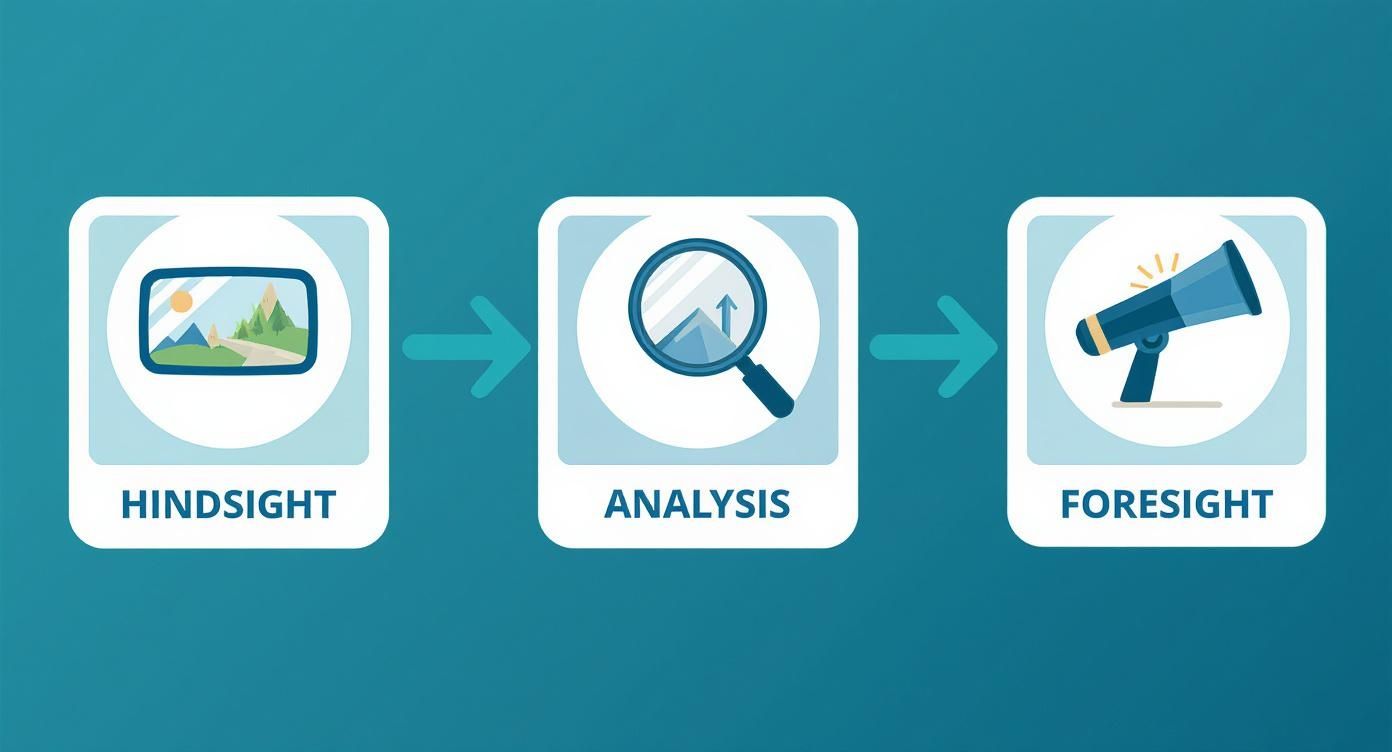
This process is what moves a business from simple hindsight to deep analysis, ultimately giving you true strategic foresight.
Evaluating and Deploying the Model
Before a new dish hits the menu, the chef does a final, crucial taste test. This is model evaluation. You test the trained model against a fresh set of data it has never seen. This step confirms its accuracy and ensures it will perform reliably in the real world, not just in the controlled "kitchen" where it was trained.
Once it passes and meets your standards, it's ready for deployment. This is when the model goes live, begins making predictions on new data, and starts actively guiding your business strategy.
Choosing the Right Predictive Modeling Approach
In my experience, one of the fastest ways a predictive analysis project fails is by choosing the wrong tool for the job. You can have pristine data and a brilliant team, but if your model is built to answer the wrong kind of question, the insights will be useless for driving growth.
This isn't about technical theory; it's about strategic alignment.
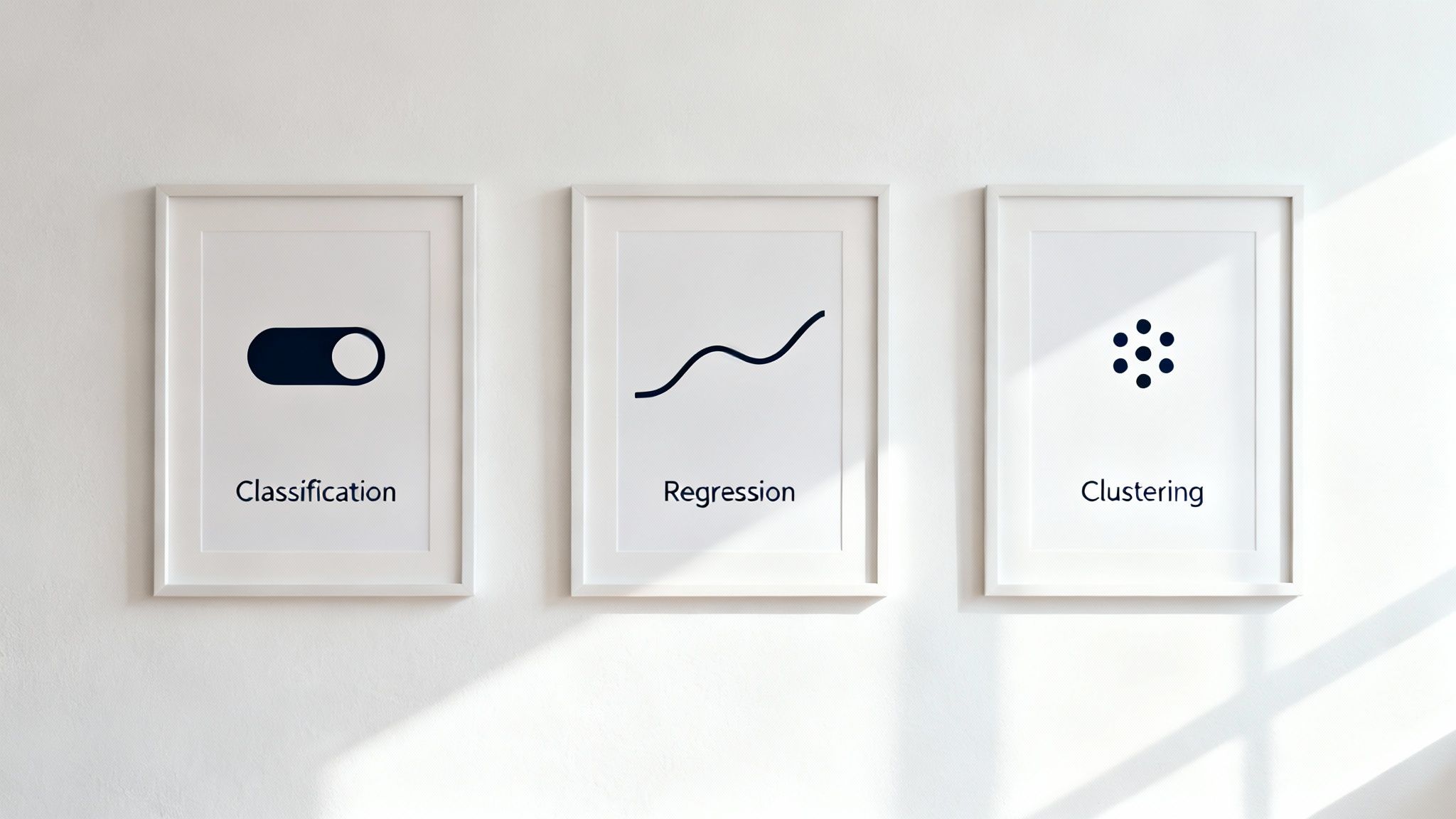
The key is to always start with the business problem first, then work backward to find the right modeling approach. From a growth leader's perspective, three core types of models solve the vast majority of our challenges. Each is designed to provide a specific kind of foresight.
H3: Classification Models: Answering "Yes or No"
Classification models are your tool for answering critical "yes-or-no" questions. Their entire purpose is to sort data into predefined categories, making them incredibly powerful for making decisive, binary choices. Think of them as a system for bucketing opportunities and risks.
For example, a classification model can analyze a customer's recent activity, support tickets, and usage patterns to predict: "Will this customer churn in the next 30 days?" That simple yes or no output triggers a specific action, like enrolling them in a retention campaign. The same logic applies to lead scoring ("Is this lead likely to convert?") or fraud detection ("Is this transaction fraudulent?").
H3: Regression Models: Forecasting the Numbers
When your question is "how much?" or "how many?", you need a regression model. This approach goes beyond simple categories to predict a specific, continuous number. It’s the engine behind almost all accurate financial and operational forecasting.
A SaaS company, for instance, can use a regression model to forecast next quarter's revenue with a surprising degree of confidence. It does this by analyzing historical sales data, pipeline velocity, and even broader market trends. An e-commerce brand could use it to predict the exact number of units to stock for a seasonal product, preventing both costly overstock and missed sales.
The most effective growth strategies are built on a foundation of reliable numbers. Regression models provide the quantitative foresight needed to set ambitious but achievable targets for revenue, EBITDA, and market share.
H3: Clustering Models: Finding Your Hidden Customer Groups
Finally, we have clustering models. These are different. Unlike the other two, clustering is an "unsupervised" technique—you don't feed it historical outcomes. Instead, it sifts through raw data to find natural, hidden groupings based on shared behaviors and attributes.
This is how you uncover your true customer segments, moving beyond basic demographics. A clustering model might identify a high-value segment of "power users" who engage with your product in a unique way. Armed with that insight, you can create hyper-targeted marketing and product experiences that resonate deeply with that specific group, driving loyalty and lifetime value.
Many modern AI tools for business are making this kind of advanced segmentation more accessible than ever before.
To make this crystal clear, let's break down how these models answer different business questions.
Comparison of Predictive Modeling Approaches
| Model Type | Business Question It Answers | Example Use Case |
|---|---|---|
| Classification | "Will this happen?" (Yes/No) | Will a customer click this ad? Is this email spam? |
| Regression | "How much?" or "How many?" | What will our sales be next month? How much will this house sell for? |
| Clustering | "How are these related?" or "What are the natural groups?" | What are our main customer segments? Which products are often bought together? |
Each model serves a distinct purpose. The real skill is in framing your business challenge as a question that one of these models can directly answer. Get that right, and you're well on your way to unlocking real predictive power.
Real-World Applications That Drive Business Growth

Theories and algorithms don't mean much without bottom-line results. In business, success is measured in revenue, efficiency, and market share. This is where predictive analysis stops being an abstract concept and becomes a core competitive advantage—by delivering tangible, measurable value.
These aren't hypothetical ideas; they are proven strategies that directly connect data insights to the profit and loss statement. Let’s look at how this plays out in the trenches.
Optimizing Retail and E-commerce Operations
Imagine a major retailer struggling with inventory. For years, they used historical sales averages, a method that consistently left them with overstocked warehouses for some items and empty shelves for others. It was a constant, costly guessing game.
By implementing a forecasting model, they can now predict demand for specific products on a granular, store-by-store basis. The model crunches dozens of variables—past sales data, seasonality, local holidays, and even weather patterns—to generate surprisingly accurate inventory suggestions.
The impact is immediate and powerful:
- Reduced Waste: Costs from overstocking are cut dramatically, boosting profit margins.
- Increased Sales: Popular products are always available, which means no more lost revenue from stockouts.
- Better Cash Flow: Capital isn't stuck sitting on shelves as slow-moving inventory.
It’s a perfect example of using predictive insights to run a leaner, more efficient, and ultimately more profitable operation.
Protecting Revenue in SaaS and Subscription Businesses
In the world of Software-as-a-Service (SaaS), customer churn is the silent killer of growth. This is where predictive analytics becomes a company’s best line of defense. I once worked with a rapidly growing SaaS company that built a classification model to identify which customers were most likely to cancel their subscriptions.
The model learned to spot subtle behavioral red flags that humans would easily miss—a slight dip in product usage, fewer support requests, or a decline in new feature adoption. Armed with this foresight, the customer success team could step in proactively before a customer decided to leave.
This isn't about guessing who might leave; it's about knowing, with over 90% accuracy, which accounts need immediate attention. It flips customer retention from a reactive firefight into a targeted, strategic mission to protect recurring revenue.
Securing Transactions in Financial Services
The financial services sector is another place where predictive models deliver huge value, especially in real-time fraud detection. A credit card transaction is approved or denied in milliseconds. Older, rule-based systems simply couldn't keep up with sophisticated fraud patterns in that tiny window.
Modern outlier detection models, on the other hand, can analyze thousands of data points for every single transaction almost instantly. They check the purchase amount, location, merchant category, and the customer’s usual spending habits to flag suspicious activity with incredible precision. This saves financial institutions—and their customers—millions of dollars by stopping fraud before the transaction is even complete.
The economic impact here is undeniable. In the United States alone, the predictive analytics market is projected to hit around USD 5.63 billion by 2025 and is expected to grow at a CAGR of 21.61% through 2034. You can explore more data on the U.S. predictive analytics market to see just how this growth is reshaping entire industries.
Implementing Your Predictive Analytics Strategy
A powerful model is just a piece of code until it’s woven into your business operations and starts impacting your P&L. I’ve seen too many brilliant predictive analysis projects stall as cool science experiments, completely disconnected from business reality. A smart deployment plan isn't a nice-to-have; it's the critical bridge between an algorithm and tangible ROI.
From my perspective as a growth strategist, this isn't a tech problem to be solved—it's a business transformation to be led. The real goal is to embed foresight into your company's DNA, making data-driven predictions a core part of how your teams make decisions every day. That requires a deliberate, battle-tested roadmap.
Define Your Business Objective First
Before anyone writes a single line of code, you must answer one question with absolute clarity: What specific, high-value business problem are we trying to solve?
A vague goal like "we want to use AI" is a recipe for failure. A sharp objective, like "we need to cut customer churn by 15% in the next six months," gives your team the focus needed to drive real results. Starting with the business objective ensures your predictive analytics work is directly tied to a key performance indicator (KPI). It aligns everyone, from the C-suite to the data scientists, on what success looks like.
Assemble Your Cross-Functional Growth Team
Predictive analytics is a team sport, and the roster must extend beyond your data science department. To break down silos and ensure the insights are actually used, your team needs to include stakeholders from across the business.
- Executive Sponsor: A leader with the authority to champion the project and remove roadblocks.
- Business Unit Leaders: The managers in marketing, sales, or operations who will use the model's outputs to change how they work.
- Data Scientists & Engineers: The technical experts who will build, train, and maintain the models.
- IT & Data Governance: The team responsible for ensuring data is clean, accessible, and secure.
This cross-functional structure is your best defense against the communication breakdowns that kill these projects. It guarantees the model is not only technically sound but also practical and relevant to the teams on the front lines. For a deeper dive, you can check out our guide on successful business intelligence implementation, which covers similar team-building principles.
Avoid the Common Pitfalls
I’ve watched the same mistakes sink these initiatives time and again. The biggest killer is a lack of sustained executive buy-in. Without it, projects lose momentum and funding dries up. Another classic is poor data quality; a model built on garbage data will only ever give you garbage predictions.
A predictive model is a powerful tool, but it's not a magic wand. Its success depends entirely on the strategic framework you build around it—clear objectives, a unified team, and a relentless focus on business impact.
The global predictive analytics market is booming, expected to grow at a compound annual rate of up to 28.3% in the coming years. This incredible expansion is driven by organizations that are successfully moving past theory and into execution. Discover more insights about the predictive analytics market to see how this growth is being fueled by smart implementation. Getting your strategy right is how you capture your piece of that value.
Your Predictive Analytics Questions Answered
When I sit down with leadership teams to talk about a new predictive analytics initiative, the same practical questions always come up. The technical details matter, but what executives really need are clear, straightforward answers that cut through the jargon. Let's tackle the most common questions I hear so you can move forward with confidence and sidestep the misunderstandings that often kill projects before they start.
How Much Historical Data Do We Really Need?
There’s no magic number. The guiding principle is this: you need enough data to capture the patterns you want to predict. For forecasting seasonal sales, you’d ideally want several years of data to see the cycles. For predicting user interaction with a new feature, six months of high-quality data might be more than enough.
The focus must always be on the quality and relevance of the data, not just the volume. A classic mistake is delaying a project for months chasing a perfect, massive dataset. The smarter approach is to start with a well-defined business problem and let that dictate the data requirements. It's often less than you think.
Can Predictive Analytics Work for a Small Business?
Absolutely. This is one of the biggest misconceptions out there. Cloud computing and the availability of off-the-shelf AI tools have completely leveled the playing field. You no longer need a massive in-house server farm or a giant budget to get started.
A small e-commerce shop can use predictive models to forecast customer lifetime value just as effectively as a global corporation. The key is to focus on the value of the problem you're solving.
If predicting which leads are most likely to convert can boost your sales team's efficiency by 20%, the investment is almost always worth it, regardless of your company's size. It's about ROI, not organizational scale.
What Is the Most Common Reason These Projects Fail?
After decades in this field, I can tell you the number one reason these initiatives fail is a fundamental disconnect from a clear business objective. The project becomes a "tech experiment" looking for a problem, instead of a "business solution" powered by technology. Without a direct line to a critical KPI like revenue growth or cost reduction, it will eventually lose steam and executive support.
The second biggest reason? Bad data. It's that simple. A predictive model is only as smart as the data it learns from.
Here’s the bottom line:
- Secure Executive Buy-In: Ensure leadership is aligned on solving a specific, high-value business problem from day one.
- Prioritize Data Integrity: A forecast built on messy, unreliable data is worse than no forecast at all. It gives you a false sense of confidence.
- Break Down Silos: Your project team must include business leaders and domain experts, not just data scientists working in a vacuum.
Getting these foundational pieces right is the most critical first step toward turning your data into a genuine strategic asset.
At MGXGrowth, we specialize in putting predictive analytics to work to drive measurable growth. We partner with executive teams to bridge the gap between data science and business strategy, ensuring your initiatives deliver real bottom-line results. Architect the next stage of your growth with us.
