


In my decades driving growth across SaaS, marketplaces, and hospitality, I’ve seen a recurring, expensive mistake. Companies chase fleeting tactics-a new button color here, a headline tweak there-while treating conversion rate optimization (CRO) as a marketing side project. This approach consistently fails because it misses the fundamental point: sustained growth is not about isolated tweaks. It’s about building a systematic, data-driven engine that aligns product, marketing, and sales around a single, unified customer journey.
True CRO is a core business discipline, a cultural shift that breaks down departmental silos to create seamless, high-value user experiences. It’s the connective tissue that turns website traffic into predictable revenue and market share. This isn't another generic list of tips you’ve already read. This is a senior executive's playbook, a curated framework of the 12 most impactful conversion rate optimization strategies that have directly contributed to significant EBITDA and revenue growth in my own experience.
We will dissect each strategy, moving beyond the obvious to provide actionable implementation steps and real-world scenarios. You will learn how to build a holistic system for continuous improvement, from granular A/B testing and funnel analysis to sophisticated personalization and multivariate experiments. Forget the superficial advice. Let’s get to work on architecting the next stage of your company’s growth.
1. A/B Testing (Split Testing)
In my experience, the most impactful conversion rate optimization strategies are built on data, not assumptions. A/B testing, also known as split testing, is the foundational practice for this data-driven approach. It is a controlled experiment where you compare two or more versions of a single webpage or app element to see which one performs better against a specific goal, like clicks, sign-ups, or purchases.
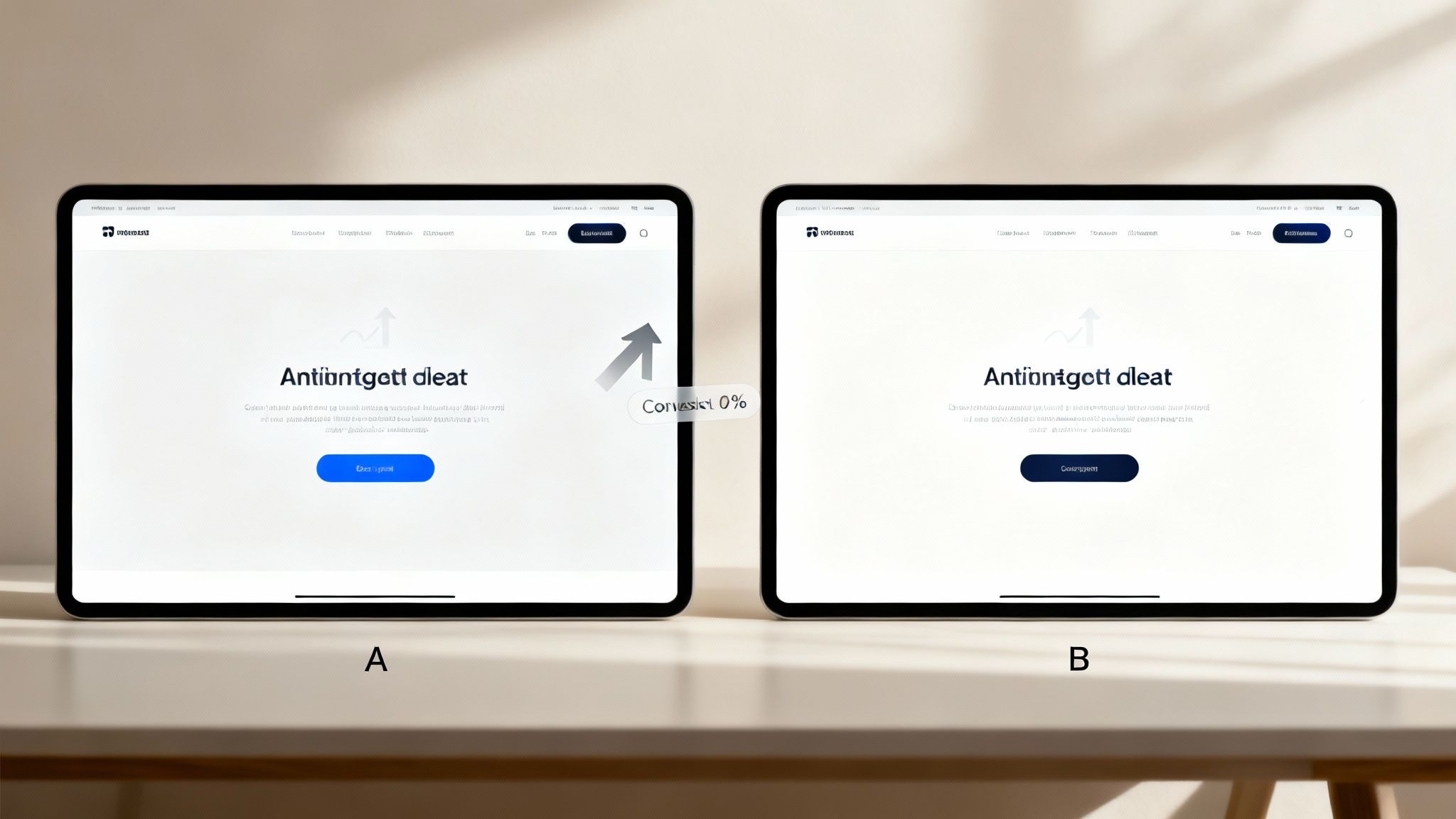
The process is straightforward: you split your traffic between the original version (the control) and a modified version (the variation). By measuring how users interact with each, you gather statistically significant evidence to prove that one outperforms the other. This removes guesswork and allows you to make incremental improvements that compound over time, directly boosting your conversion rates.
How to Implement A/B Testing Effectively
A successful A/B testing program requires discipline. Companies like Netflix and Amazon have built empires on this principle, relentlessly testing everything from button colors to thumbnail images. To get started, platforms like Optimizely or VWO make setting up experiments accessible.
Follow these critical steps for reliable results:
- Isolate Variables: Test only one change at a time. If you change the headline and the button color simultaneously, you won’t know which element drove the change.
- Ensure Statistical Significance: Use a large enough sample size and run the test long enough (typically at least one full business cycle) to ensure your results aren't due to random chance.
- Prioritize High-Impact Pages: Start by testing pages that have the most significant impact on your revenue, such as your homepage, pricing page, or checkout flow.
2. Conversion Funnel Analysis
From my perspective, you can't optimize what you don't measure. Conversion funnel analysis is the practice of mapping and examining the complete journey a user takes from their first interaction to a final conversion. It’s about visualizing the path to purchase-or any other goal-and identifying precisely where prospects are dropping off. This methodical approach is crucial for any data-driven conversion rate optimization strategies.

By breaking down the customer journey into distinct stages, such as from a product page to the shopping cart and then to checkout, you uncover the biggest leaks in your process. For a SaaS business, this could mean tracking users from sign-up to trial activation and finally to a paid subscription. This clarity allows you to focus your optimization efforts where they will have the most significant impact on revenue, turning guesswork into a strategic, surgical operation.
How to Implement Conversion Funnel Analysis Effectively
Leading analytics platforms like Google Analytics, Mixpanel, and Amplitude have popularized this technique, making it accessible to businesses of all sizes. The goal is to stop revenue leaks by understanding user behavior at each critical step. A well-executed funnel analysis not only highlights problems but also informs which A/B tests are worth running.
Follow these critical steps for reliable insights:
- Focus on the Biggest Leaks: Prioritize your efforts on the stage with the highest drop-off rate. A 5% improvement at a major bottleneck is far more valuable than a 20% improvement at a minor one.
- Segment Your Data: Analyze funnels based on different user segments, such as traffic source, device type, or demographics. This can reveal that mobile users, for instance, are struggling with your checkout page while desktop users are not.
- Combine with Qualitative Data: Use tools like heatmaps and session recordings to understand why users are dropping off at a particular stage. Is a button not visible? Is a form field confusing?
3. Landing Page Optimization
In my career, I've seen countless marketing campaigns fail not because of a bad ad, but because of a disconnected landing page. Landing page optimization is the art and science of creating a dedicated, standalone page with a single, hyper-focused objective. It’s where you convert the interest generated from an ad, email, or social post into a tangible action, making it one of the most critical conversion rate optimization strategies.
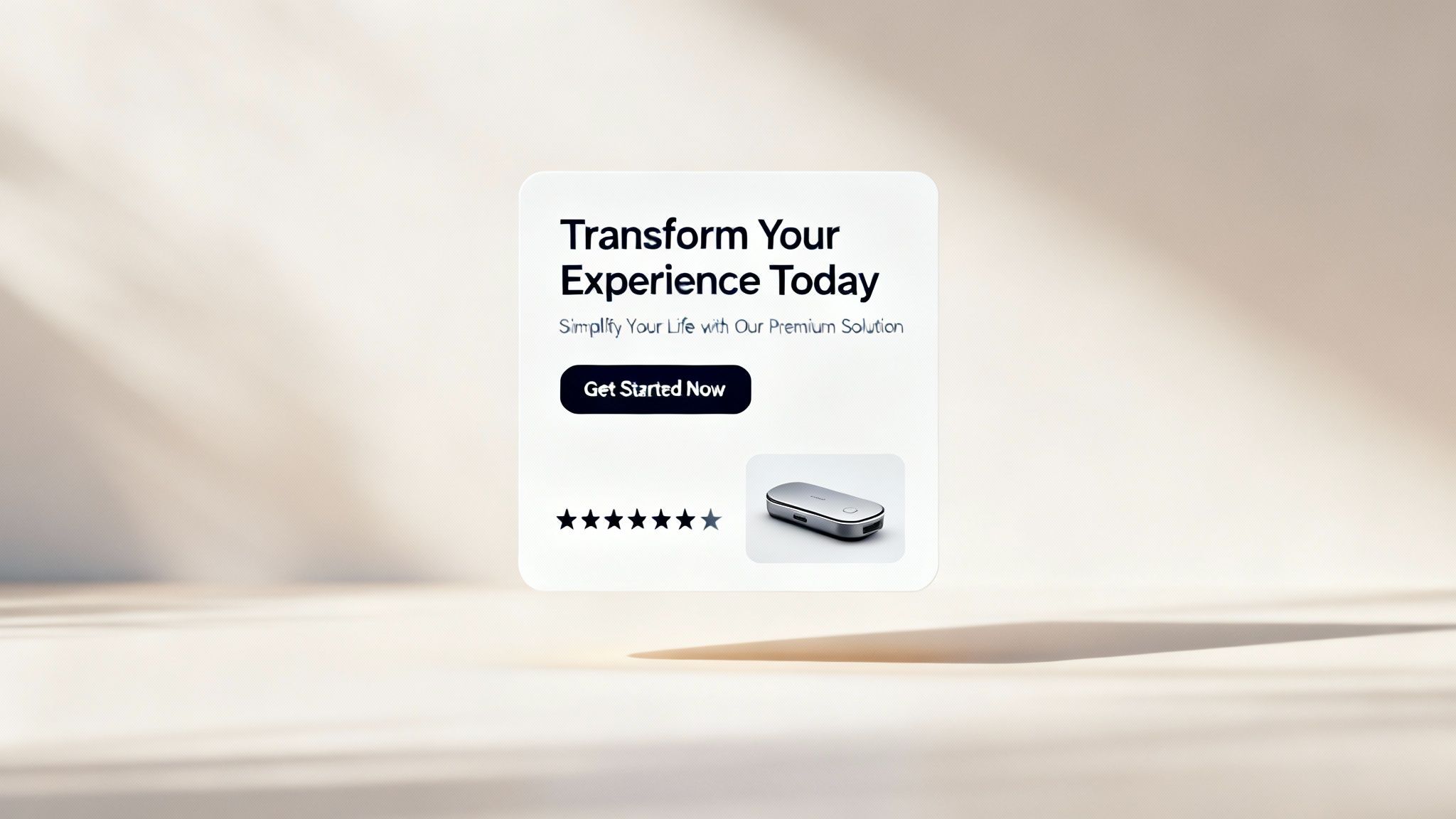
Unlike a homepage, which serves many purposes, a landing page eliminates distractions and guides the user toward one specific conversion goal, whether it’s downloading a whitepaper, signing up for a trial, or making a purchase. Companies like Unbounce and HubSpot have built their entire models around this principle, proving that a well-optimized landing page directly correlates to a higher marketing ROI by bridging the gap between click and conversion.
How to Implement Landing Page Optimization Effectively
A high-converting landing page is a seamless extension of the ad or link that brought the user there. It maintains a consistent message and offers a frictionless path to conversion. Tools like Leadpages and Instapage make it easy to build and test these pages without needing a developer.
Follow these fundamental steps for better performance:
- Maintain "Message Match": Ensure your landing page headline and content directly reflect the promise made in your ad copy. A disconnect here is the fastest way to lose a visitor's trust.
- Focus on a Single Goal: Remove all unnecessary navigation, links, and distractions. Every element on the page, from the headline to the images, should support the single call-to-action (CTA).
- Reduce Friction: Only ask for essential information in your forms. Each additional field you require creates another reason for a user to abandon the process. Simplify and streamline the path to conversion.
4. User Experience (UX) Design Optimization
In my career, I've seen countless marketing campaigns fail not because of poor traffic, but because of a frustrating user experience. Optimizing your user experience (UX) design is one of the most fundamental conversion rate optimization strategies because it directly addresses how users interact with your digital product. It's about making every step intuitive, from initial navigation to final action, ensuring the path to conversion is as frictionless as possible.
A great UX isn't just about aesthetics; it’s about efficiency and clarity. When users can find what they need without confusion, they are far more likely to trust your brand and complete a desired action. Companies like Apple and Google have built empires by obsessing over user-centric design. Their minimalist interfaces and intuitive navigation reduce cognitive load, making it easy for users to achieve their goals and, in turn, for the business to achieve its conversion targets.
How to Implement UX Design Optimization Effectively
Effective UX optimization requires stepping into your customer's shoes and removing every possible roadblock. Pioneers like Don Norman have long advocated for design that anticipates user needs, a principle that drives higher engagement and loyalty. It's a continuous process of observing, testing, and refining based on real user behavior.
Follow these critical steps for a better user experience:
- Identify Friction Points: Use tools like heatmaps and session recordings to see where users get stuck, hesitate, or drop off. These insights are gold mines for identifying UX issues.
- Optimize for Mobile-First: A seamless mobile experience is non-negotiable. Design for the smallest screen first to ensure core functionality is flawless, then scale up for larger devices.
- Prioritize Accessibility: Implement WCAG (Web Content Accessibility Guidelines) standards to ensure your site is usable for people with disabilities. This not only expands your audience but also often improves usability for everyone. You can learn more about mapping the user journey with dedicated software to inform these efforts.
5. Call-to-Action (CTA) Optimization
In my decades of driving growth, I've seen that the smallest elements often have the largest impact. Your call-to-action (CTA) is the final, critical step in the user journey; it's the bridge between passive browsing and active conversion. CTA optimization involves systematically refining the buttons and links that guide users, ensuring they are as clear, compelling, and visible as possible.
This process is about more than just button color. It's a deep dive into user psychology and design principles, focusing on text, placement, size, and shape. A well-optimized CTA removes friction and provides a clear, irresistible path for your user. By treating your CTA as a pivotal part of your conversion rate optimization strategies, you directly influence click-through rates and guide more users toward your most valuable goals.
How to Implement CTA Optimization Effectively
Effective CTA optimization is an exercise in clarity and persuasion. Companies like Mailchimp, with its iconic "Sign Up Free" button, understand that the CTA must align perfectly with user intent and the page's context. It's the final handshake that seals the deal with your customer.
Follow these key steps for high-performing CTAs:
- Use Action-Oriented, First-Person Language: Shift from passive words like "Submit" to active, benefit-driven phrases. Testing "Get My Free Guide" instead of "Download Guide" can create a sense of ownership and urgency.
- Create Strong Visual Contrast: Your primary CTA should be impossible to miss. Use a color that contrasts with the page background and surrounding elements to draw the user's eye directly to the desired action.
- Prioritize Strategic Placement: Place your main CTA "above the fold" where users can see it without scrolling. For longer pages, include secondary CTAs or repeat the primary one to capture users once they have more information.
6. Social Proof and Trust Signals
From my experience scaling businesses, I've learned that trust is the ultimate currency online. You can have the best product in the world, but if prospects don't trust you, they won't convert. Social proof is the most effective way to build that trust by showing that other people, just like them, have already made the decision to buy and are happy with it. It’s a psychological shortcut that eases purchase anxiety and validates the choice to do business with you.
This strategy involves strategically displaying elements like customer testimonials, reviews, user counts, and trust badges from reputable organizations. When a potential customer sees that a well-known company uses your SaaS product or that a product has thousands of five-star reviews, it alleviates their perceived risk. By leveraging the positive experiences of existing customers, you create a powerful, silent salesperson who is always working to boost your conversion rates.
How to Implement Social Proof and Trust Signals Effectively
Great implementation goes beyond just dropping a testimonial on your page; it’s about integrating authentic proof at critical decision-making points. Amazon mastered this by placing star ratings and review counts right below the product title. Slack prominently displays the logos of its impressive enterprise clients to build instant credibility.
Follow these critical steps to leverage this powerful conversion rate optimization strategy:
- Be Specific and Authentic: Vague testimonials like "great service" are useless. Feature reviews that include specific metrics, such as "We increased lead generation by 40% in three months." Adding a customer's photo and title dramatically increases authenticity.
- Place Signals Strategically: Display trust badges (like from Norton or the BBB) and security seals in your checkout or sign-up forms to reduce friction at the final step. Place relevant customer testimonials next to the specific features they are praising.
- Showcase Volume and Momentum: Highlight numbers that imply popularity, like "Join 50,000+ happy customers" or "1,200 downloads this week." This creates a sense of FOMO (fear of missing out) and reinforces that choosing you is a popular, safe decision.
7. Form Optimization and Friction Reduction
In my experience leading growth, the highest-friction points in any customer journey are almost always forms. A clunky, lengthy form is a conversion killer. Form optimization is the art and science of streamlining the data collection process to make it as effortless as possible for the user. By minimizing required fields, reducing cognitive load, and removing every unnecessary step, you directly combat user frustration and abandonment.
The core principle is simple: every field you ask a user to fill out is a potential reason for them to leave. Companies that master this, like Typeform with its conversational one-question-at-a-time design, see dramatically higher completion rates. This is one of the most direct conversion rate optimization strategies because it targets the final step before a user converts, whether it’s for a lead magnet, a demo request, or a purchase.
How to Implement Form Optimization Effectively
Your goal is to make completing a form feel like a natural, easy conversation, not an interrogation. This requires a ruthless focus on the user experience and a commitment to asking only for what is absolutely essential at that moment. Platforms like HubSpot have popularized progressive profiling, where you collect data over time instead of all at once.
Follow these critical steps to reduce form friction:
- Minimize Fields: Challenge every single field. Do you truly need their phone number right now? Aim for 3-5 essential fields for initial lead capture.
- Use Smart Defaults and Autofill: Pre-populate known information and leverage browser autofill to save users time. For example, use geolocation to suggest a country.
- Implement Real-Time Validation: Provide instant feedback if a user makes an error, like an invalid email format, rather than waiting until they hit submit.
- Show Progress: For multi-step forms, use a progress bar. This manages expectations and motivates users to complete the process, reducing abandonment rates.
8. Personalization and Segmentation
In my decades of experience, I've seen that treating all customers the same is a direct path to mediocrity. Personalization and segmentation are powerful conversion rate optimization strategies that move beyond a one-size-fits-all approach. Instead of a generic message, you tailor content, offers, and experiences to individual users based on their behavior, demographics, and preferences.
This strategy works because relevance drives action. When a customer feels understood, they are far more likely to engage and convert. We see this with industry giants like Amazon, whose "Customers who viewed this also viewed" feature is a masterclass in behavioral personalization, and Netflix, which keeps users engaged with a highly customized content library. The goal is to create a one-to-one dialogue at scale.
How to Implement Personalization and Segmentation Effectively
Effective personalization isn't about invasive tracking; it's about delivering genuine value. Companies like HubSpot and Marketo have built their platforms around this principle, enabling businesses to create meaningful, segmented user journeys that boost conversions. It requires a deep understanding of your audience, which can be achieved through methods like cohort analysis. To start, focus on delivering relevant experiences.
Follow these critical steps for reliable results:
- Segment First: Before diving into complex individual personalization, start by grouping your audience into meaningful segments. You can segment by demographics, purchase history, or on-site behavior.
- Leverage First-Party Data: Use the data customers willingly give you, such as past purchases or items viewed, to create relevant recommendations. This builds trust and respects privacy.
- Test Against a Control: Always A/B test your personalized experiences against a generic version. This will provide clear data on what's working and prove the ROI of your efforts.
9. Pricing and Offer Optimization
In my work across various industries, I've found that few levers have as direct an impact on revenue as pricing. Pricing and offer optimization is the strategic process of testing different price points, billing cycles, and package structures to find the sweet spot that maximizes both customer acquisition and lifetime value. It moves pricing from a static number to a dynamic tool for growth, influencing user psychology and perceived value.
This strategy involves more than just changing a number; it’s about framing your value proposition. By experimenting with how you present your offer, such as bundling products or highlighting annual savings, you can significantly alter a customer's willingness to convert. This is one of the most powerful conversion rate optimization strategies because it directly connects your product's value to the customer's decision-making process at the most critical moment.
How to Implement Pricing and Offer Optimization
Effective pricing requires a deep understanding of your customer segments and a willingness to experiment. Companies like Stripe master this by creating tiered pricing that scales with user needs, while Basecamp succeeded with a simple, fixed-price model that eliminated complexity. Both approaches are valid, but they were discovered through testing.
Follow these critical steps for a successful pricing strategy:
- Leverage Pricing Psychology: Test charm pricing (e.g., $99 vs. $100) and anchoring, where you display a higher-priced "premium" option first to make other tiers seem more reasonable.
- Test Billing Cycles: Offer a noticeable discount for annual commitments versus monthly plans. This improves cash flow and customer retention, two critical metrics for any business.
- Create Strategic Bundles: Combine complementary products or features into a single, higher-value package. Test this bundle against individual item purchases to see which generates more overall revenue and a higher average order value.
10. Retargeting and Remarketing Campaigns
In my experience, many businesses focus solely on acquiring new traffic, overlooking the immense value hidden in visitors who have already shown interest. Retargeting and remarketing campaigns are powerful conversion rate optimization strategies designed to re-engage these "warm" prospects. They work by showing targeted ads to users who have previously visited your website but left without converting.
This strategy is effective because it operates on the principle of familiarity and timely reminders. By keeping your brand and products visible as these users browse other sites or social media platforms like Facebook, you create multiple touchpoints. This continuous exposure significantly increases the likelihood that they will return to complete their purchase or sign-up, transforming initial interest into a valuable conversion.
How to Implement Retargeting Effectively
A successful retargeting strategy is about precision and relevance, not just repetition. Companies like Amazon excel at this, showing you the exact product you viewed just moments after leaving their site. Platforms like Google Ads and Meta make this accessible for any business.
Follow these critical steps for reliable results:
- Segment Your Audience: Group users based on their on-site behavior. For instance, create separate campaigns for users who viewed a specific product category versus those who abandoned their shopping cart.
- Use Dynamic Ads: Automatically show ads featuring the specific products or services a user viewed. This hyper-personalization is far more effective than a generic brand ad.
- Implement Frequency Caps: To avoid ad fatigue and annoying potential customers, limit the number of times a single user sees your ad within a given period.
- Exclude Converters: Ensure you stop showing ads to users once they have completed the desired action. This optimizes your ad spend and prevents irrelevant messaging.
11. Video Marketing and Engagement
From my experience scaling growth across different industries, I've seen that nothing builds an emotional connection and conveys complex information faster than video. Video marketing isn't just a trend; it's a powerful tool in your arsenal of conversion rate optimization strategies. It leverages visual storytelling to capture attention, explain value, and build trust in a way that static text and images simply cannot.
Whether it’s a product demo, a customer testimonial, or an explainer video on a landing page, video meets users where they are: seeking fast, digestible, and engaging content. The human element of seeing and hearing a message creates a sense of authenticity and rapport, which directly translates into higher engagement, longer session durations, and, ultimately, more conversions. Companies like Slack use product demos to simplify complex features, while Dollar Shave Club’s viral video became a masterclass in brand storytelling.
How to Implement Video Marketing Effectively
Integrating video requires more than just uploading a file; it demands a strategy focused on the user experience and business goals. Your video must serve a clear purpose in the customer journey, from awareness to decision. Platforms like Wistia or Vidyard provide the analytics needed to measure engagement and optimize performance.
Follow these critical steps for reliable results:
- Keep It Concise and Focused: For web and landing pages, aim for videos under two minutes. Capture attention within the first few seconds before viewers drop off.
- Include a Clear Call-to-Action (CTA): Guide the viewer on what to do next. Add a button, link, or verbal cue within or at the end of the video to drive them toward the conversion goal.
- Optimize for All Viewing Contexts: Add captions for accessibility and for users watching with the sound off. Ensure the video is compressed for fast loading times to avoid hurting your page speed and SEO.
- Test and Measure Everything: A/B test video placement (e.g., above the fold vs. mid-page), thumbnail images, and even the use of autoplay with mute. Track metrics like play rate and completion rate to understand what truly resonates.
12. Multivariate Testing (MVT)
While A/B testing is essential for isolating variables, I've found that some of the biggest conversion lifts come from understanding how elements interact. Multivariate testing (MVT) takes experimentation a step further by simultaneously testing multiple variables and their combinations. Instead of comparing two different pages, MVT analyzes which combination of elements, like a specific headline, image, and call-to-action, performs best together.
This method moves beyond a simple "this vs. that" comparison to reveal complex interaction effects. For instance, a bold headline might perform well on its own, but it could actually decrease conversions when paired with a bright, aggressive button color. MVT provides a more holistic view of your page's ecosystem, making it a powerful tool in your conversion rate optimization strategies arsenal, especially for high-traffic sites.
How to Implement Multivariate Testing Effectively
MVT is a more advanced technique that requires significant traffic to produce statistically reliable results. Companies like Google and Amazon leverage it to fine-tune their user experiences at scale. To implement it correctly, you can use platforms like Optimizely or VWO, which offer dedicated MVT capabilities.
Follow these critical steps for a successful MVT campaign:
- Ensure Sufficient Traffic: MVT splits your audience into many segments, so you need a high volume of visitors to reach statistical significance for each combination in a reasonable timeframe.
- Prioritize High-Impact Elements: Start by testing the most influential elements on your key pages, such as the headline, primary hero image, and CTA text on a landing page.
- Understand Interaction Effects: The primary goal is to analyze the results to see not just which element won, but which combination of elements created the most uplift. This insight is where the real value lies.
12 CRO Strategies Comparison
| Method | 🔄 Implementation complexity | ⚡ Resource requirements | ⭐📊 Expected outcomes | 💡 Ideal use cases | 📊 Key advantages |
|---|---|---|---|---|---|
| A/B Testing (Split Testing) | Low–Medium — straightforward per test, needs statistical rigor | Moderate — testing tool, analytics, sufficient traffic | Measurable conversion lift and validated changes ⭐⭐⭐ | CTA copy, headlines, button changes on high-traffic pages | Data-driven decisions; low-risk validation |
| Conversion Funnel Analysis | Medium — tracking setup and analysis across stages | Moderate — analytics platform, tagging, analyst time | Identifies major drop-offs and prioritizes fixes ⭐⭐⭐ | E‑commerce checkout, SaaS sign-up flows, lead funnels | Pinpoints high-impact optimization opportunities |
| Landing Page Optimization | Low–Medium — design + iterative testing | Low–Moderate — designer/dev, copywriter, landing builder | Higher conversion rates than generic pages ⭐⭐⭐ | Campaign-specific pages, paid ad landing pages | Focused messaging; better ad relevance and QS |
| UX Design Optimization | Medium–High — research, design, and iterative testing | High — UX research, designers, user testing, dev resources | Improved satisfaction, retention and long-term conversions ⭐⭐⭐⭐ | Product redesigns, complex apps, multi-step journeys | Reduces friction; sustainable UX and retention gains |
| Call-to-Action (CTA) Optimization | Low — quick tests and simple changes | Low — minimal dev/design and testing | Quick CTR/CTO improvements; often small lifts ⭐⭐ | Buttons, forms, CTAs across pages and flows | Fast, low-cost wins with measurable impact |
| Social Proof and Trust Signals | Low–Medium — content collection and placement | Low — testimonials, badges, review integrations | Boosts credibility and reduces purchase anxiety ⭐⭐⭐ | New brands, checkout pages, product detail pages | Inexpensive trust-building; increases conversions |
| Form Optimization & Friction Reduction | Low–Medium — UX changes + backend support | Moderate — dev for validation, progressive profiling | Higher form completion and lower abandonment ⭐⭐⭐ | Lead gen, registration, checkout and booking forms | Reduces abandonment; improves data quality and UX |
| Personalization & Segmentation | High — data, rules, and privacy considerations | High — data infrastructure, personalization engine, engineers | Significant relevance and conversion uplift when done well ⭐⭐⭐⭐ | Recommendations, repeat visitors, high-LTV segments | Increases engagement, LTV and conversion rates |
| Pricing & Offer Optimization | Medium — strategic testing and analysis | Moderate — pricing experiments, analytics, finance input | Direct revenue and AOV impact; reveals price sensitivity ⭐⭐⭐ | SaaS plans, bundles, promotions, subscription options | Optimizes revenue; measurable ROI from pricing tests |
| Retargeting & Remarketing Campaigns | Low–Medium — campaign setup and audience rules | Moderate — ad spend, creative, ad platforms | Higher conversions from warm audiences; efficient ROI ⭐⭐⭐ | Cart abandoners, recent visitors, product viewers | Cost-effective re-engagement; measurable lift |
| Video Marketing & Engagement | Medium — production, editing, hosting | High — production resources, hosting bandwidth | Stronger engagement, comprehension, and trust ⭐⭐⭐ | Product demos, testimonials, explainer content, webinars | Builds emotional connection and higher time-on-page |
| Multivariate Testing (MVT) | High — complex design and statistical analysis | High — lots of traffic, advanced tools, data expertise | Optimizes element combinations; deep interaction insights ⭐⭐⭐⭐ | High-traffic pages where multiple elements interact | Reveals best element combos; maximizes learning from traffic |
From Strategy to Execution: Building a Culture of Conversion
We've explored a dozen powerful conversion rate optimization strategies, from the granular precision of A/B testing and form optimization to the broad impact of user experience design and funnel analysis. Each tactic, whether it’s enhancing your CTAs, implementing social proof, or leveraging personalized retargeting, serves as a critical lever for growth. But after decades spent driving revenue growth across diverse industries, I can tell you that the secret to unlocking exponential results isn't found in a single test or a one-off campaign.
The most successful companies don't just do CRO; they become CRO-centric. They transform isolated tactics into a foundational, company-wide culture of continuous improvement.
The Shift from Tactics to a Perpetual Growth Engine
Viewing these twelve strategies as a simple checklist is a common mistake. Executing a multivariate test or optimizing a landing page is a good start, but it's just one turn of the crank. The real goal is to build a perpetual optimization engine, one that is constantly fueled by data, customer insights, and a relentless curiosity to answer the question, "How can we make this better?"
This requires a fundamental shift in mindset. Instead of marketing running tests in a silo, you need a cross-functional commitment. Product teams must be obsessed with reducing friction, sales teams must provide feedback on lead quality from different funnels, and leadership must champion an environment where data-driven experimentation is not just encouraged but expected. It’s about breaking down the walls between departments to create a unified focus on the customer journey.
Every touchpoint, from the first ad impression to the final thank you page, is an opportunity to learn and improve. This is where the true power of conversion rate optimization strategies lies: not as isolated projects, but as an integrated system for sustainable growth.
Actionable Next Steps: Embedding Optimization into Your DNA
So, where do you begin? Don't try to implement all twelve strategies at once. Instead, build a scalable framework.
- Establish a Baseline: Before you change anything, ensure you have robust analytics in place. Use tools to conduct a thorough conversion funnel analysis to identify your biggest leaks. This data is your starting point and your map.
- Form a Cross-Functional "Growth" Team: Assemble a small, agile team with members from marketing, product, design, and even customer support. Empower them to own the optimization process, from hypothesis generation to analysis and implementation.
- Start with High-Impact, Low-Friction Areas: Begin with strategies that offer the biggest potential wins with the least technical overhead. Often, this means focusing on landing page optimization, CTA clarity, and reducing form fields. Early wins build momentum and secure buy-in for more complex initiatives.
- Create a Hypothesis Backlog: Encourage everyone in the company to contribute ideas for tests. Create a structured backlog, prioritizing hypotheses based on potential impact, confidence, and ease of implementation (often called a PIE framework). This democratizes the optimization process.
Ultimately, building a culture of conversion is about fostering an environment where failure is seen as a learning opportunity. Not every A/B test will be a winner. Not every personalization effort will double conversions overnight. The objective is to learn from every outcome, continuously refine your understanding of the customer, and re-invest those insights back into the business. When your organization embraces this iterative loop, you stop chasing fleeting wins and start building a resilient, adaptable, and high-growth enterprise.
At MGXGrowth, we specialize in transforming companies by embedding this data-driven, customer-obsessed mindset into their core operations. We partner with executive teams to break down silos, operationalize analytics, and build the internal systems needed to turn tactical CRO efforts into a strategic, perpetual growth engine. If you're ready to move beyond isolated tests and build a true culture of conversion, let's connect at MGXGrowth.
