


If you want to create buyer personas that actually drive revenue, you have to get out of your own boardroom. This isn't a theoretical marketing exercise; it's a strategic imperative. It means ditching convenient assumptions and digging into the hard, quantitative and qualitative data that reveals what your customers truly need, what drives their decisions, and what their real-world success looks like.
Why Most Buyer Personas Fail to Impact the Bottom Line
I’ve walked into countless boardrooms and seen the same thing: beautifully designed persona documents gathering digital dust. They look impressive, with stock photos and clever names, but they fail to drive a single dollar of revenue or EBITDA growth.
Why? Because they're built on convenient assumptions, not customer reality.
This isn't another academic exercise in marketing theory. We're going to dismantle the common pitfalls I've seen derail growth strategies for two decades. My objective is to provide a practical framework for building profiles that reflect real customer behaviors, turning them from static documents into dynamic tools that align your entire organization toward measurable growth.

The Silo Trap
The most common reason personas fail is that they’re created in a marketing silo. When the marketing team builds profiles based solely on their own analytics, they miss the raw, unfiltered truth that lives in other departments. These aren't buyer personas; they're marketing's best guess, and they're operationally useless.
A true, actionable understanding of your customer is a cross-functional imperative. It absolutely requires input from every single function that interacts with them.
The single biggest mistake is creating personas in a vacuum. They must be forged from the combined intelligence of marketing, sales, product, and customer support. Anything less is just a work of fiction that will fail to produce results.
Vanity Demographics vs. Actionable Insights
Another critical error is fixating on vanity demographics. Frankly, knowing your persona is "35-45 years old and lives in the suburbs" is practically useless for driving revenue. It doesn’t tell you what keeps them up at night, what triggers their search for a solution, or how they measure success in their role.
Actionable personas are built on the psychographics and behavioral data that drive purchasing decisions. You must know:
- Goals: What is the business outcome they are trying to achieve?
- Pain Points: What specific frustrations are blocking them from achieving that outcome?
- Buying Triggers: What event initiates their search for a product like yours?
- Success Metrics: How will their leadership evaluate the success of this purchase?
When you build personas based on this kind of operational data, the results speak for themselves. Companies using data-driven buyer personas have seen up to 5 times higher click-through rates. Even more impressively, they can generate 18 times more revenue from targeted emails than from generic campaigns. You can find more insights into data-driven personas on G2. This isn't just about making marketing easier; it's about making it effective.
Unifying Your Intelligence Gathering Across the Business
Powerful buyer personas aren't just a marketing asset; they're the output of integrated business intelligence. If your persona research starts and ends with a marketing analytics dashboard, you're operating with a massive blind spot. The unvarnished truth about your customers—what truly motivates them, what frustrates them, and what triggers a purchase—is distributed across all your customer-facing teams.
I’ve seen this time and time again: the biggest roadblock to creating effective personas is a failure to break down internal silos. Marketing has one piece of the puzzle, sales has another, and customer support is sitting on a goldmine of post-purchase reality. To build personas that help you close deals and increase LTV, you must synthesize that scattered knowledge. This isn't just about pulling a report; it's about architecting a cross-functional system for gathering and sharing customer intelligence.
Mining the Gold in Your Own Backyard
Before you even think about deploying a survey, you must extract the data you already own. Your internal systems are packed with unfiltered customer behavior and feedback, free from the bias of a formal research setting. This is your ground truth.
To get a complete picture, you must pull insights from a variety of sources. Each department holds a different key to understanding your customer.
Here is a quick breakdown of where to look and who to involve:
Data Sources for Comprehensive Persona Research
| Data Source | Type of Insight | Key Department to Involve |
|---|---|---|
| CRM Data | Win/loss reasons, common objections, deal velocity, high-value industries. | Sales, RevOps |
| Sales Call Recordings | Customer’s own language, emotional triggers, unstated pain points, buying criteria. | Sales |
| Support Tickets | Product friction points, real-world use cases, feature requests, workarounds. | Customer Support, Product |
| Website Analytics | High-intent pages, content engagement, user journey, conversion paths. | Marketing |
| Customer Onboarding Notes | Initial goals, success criteria, implementation challenges. | Customer Success |
By synthesizing information from these diverse sources, you move beyond a one-dimensional marketing view and start building a holistic, 360-degree profile of your buyer that the entire organization can execute against.
Conducting Interviews That Uncover the "Why"
While your internal data tells you what your customers are doing, direct interviews are where you discover why. Be warned: a poorly conducted interview is worse than no interview at all because it can send you chasing false assumptions. The objective isn't to validate your product; it’s to understand their business reality.
Here’s how to structure your conversations to extract high-value insights:
-
Focus on their story, not your solution. Start broad. Ask about their role, their daily tasks, and how their performance is measured. A critical question I always use is, "Walk me through the events that led you to realize you needed a solution like ours." This almost always uncovers the buying trigger—one of the most crucial elements of an effective persona.
-
Listen for what isn't said. Pay close attention to pauses, shifts in tone, or topics they seem to avoid. If a manager gets hesitant when you ask about the budget approval process, that signals a major perceived hurdle you need to understand and address in your sales process. You will never get that from a survey.
-
Ask "How," not just "Why." The word "why" can put people on the defensive. Instead of, "Why did you choose us?" ask, "How did you go about evaluating your options?" This encourages a narrative, revealing their decision-making process and the exact criteria they used to evaluate you against competitors.
A persona built without the raw input from sales calls and support tickets is fundamentally incomplete. You're missing the customer's true voice from their most candid moments—when they're trying to solve a real problem or justify a major purchase.
This entire process hinges on having the right people at the table. To make this work, you need a well-defined organizational structure for your marketing department that clearly outlines how it collaborates with sales, support, and product.
Adding Scale to Your Insights
Interviews provide incredible depth, but surveys and user analytics provide scale. These quantitative tools are essential for validating the hypotheses developed from your qualitative research across a much larger audience.
You must combine both for a complete, defensible picture.
-
Run Targeted Surveys: Forget sending a 50-question survey that no one will finish. Use short, focused surveys to test specific assumptions. For example, if your interviews revealed a common pain point, send a one-question poll to a broader email segment asking them to rank their top three professional challenges.
-
Analyze User Behavior: Use tools like Hotjar or FullStory to observe how people actually use your website or product. Where do they click? Where do they rage-click in frustration? Where do they abandon the process? This data often reveals a significant gap between what customers say they do and what they actually do.
By systematically mining your internal data, conducting deep-dive interviews, and then validating your findings at scale, you’ll move far beyond generic profiles. You’ll begin building a living, data-backed representation of your customer—one that the entire organization can rally behind to drive growth.
From Raw Data to an Actionable Strategic Asset
You've done the hard work of gathering cross-functional customer intelligence. Now comes the crucial part: synthesizing that mountain of raw data into a living, breathing persona that drives better strategic decisions.
This is where many teams fail. They get lost in endless spreadsheets and interview transcripts, producing a research summary, not a strategic tool. The goal isn't just to report what you found; it's to synthesize it into something tangible and actionable.
You need a practical methodology to spot critical patterns and build a framework that your sales, marketing, and product teams can all rally behind. This is how you transform abstract data points into a true representation of your customer.
The process pulls from different streams of intelligence—your analytics, CRM data, and those invaluable direct interviews—to build a unified picture.
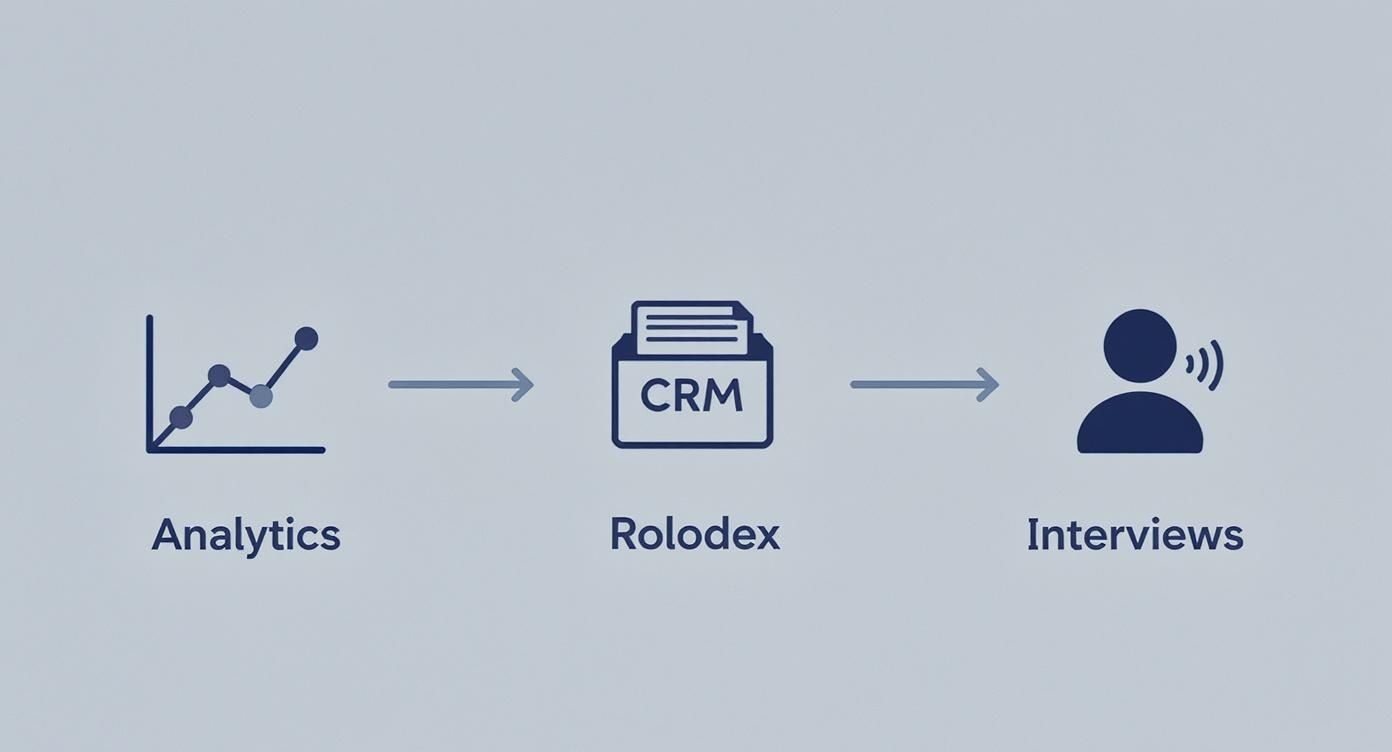
This visual drives home why you must integrate both the numbers (quantitative) and the narratives (qualitative). Your personas will be exponentially more powerful for it.
Finding the Patterns in the Noise
Your first job is to become a pattern-recognition machine. As you sift through your notes, support tickets, and CRM data, you're not just looking for one-off comments. You're hunting for the common threads that define distinct customer segments.
I am a strong proponent of a low-tech but incredibly effective method: affinity mapping. Print key quotes, pain points, and stated goals from your research onto sticky notes. Then, get your cross-functional team in a room and start clustering them on a whiteboard.
The magic happens when you stop seeing individual data points and start seeing the clusters. These groups of recurring challenges, shared motivations, and common goals are the real building blocks of your personas.
You'll start to see segments emerge organically. Maybe one group consistently mentions the need to "prove ROI to the CFO," while another is obsessed with "reducing manual data entry." There they are. Those are your proto-personas. Forget demographics for now; focus purely on the drivers of behavior.
Building the Persona's Story
Once you have those distinct clusters, it's time to bring them to life. This is where so many companies create something that falls flat—a dry list of bullet points. A persona isn't a spec sheet; it's a strategic narrative. You have to craft a story that makes this customer tangible.
Give them a name that hints at their role or primary driver, like "Compliance Chloe" or "Growth-Focused Gary." Then, flesh out their story by answering these core questions:
- What's their day-to-day really like? Describe their routine and the tools they're constantly using. This context is critical for understanding their world.
- What are they trying to achieve? What does "a win" look like in their role? How is their success measured?
- What are their biggest headaches? Pinpoint the specific obstacles that get in their way. Use direct quotes from your interviews here to make the pain palpable.
- What was the final straw? What event or frustration finally kicked off their search for a solution like yours?
When you frame the persona as a story, it becomes memorable and actionable. A salesperson is far more likely to remember the struggles of "Stressed-Out Steve," who's drowning in spreadsheets, than a generic profile with a list of demographic data.
Zeroing In on What's Actionable
A persona document must be a tool, not a novel. While the story provides the soul, you must distill the information into elements that directly guide your go-to-market strategy. My go-to template cuts through the fluff and focuses on what actually drives decisions.
The Must-Have Components of a Great Persona:
- Goals & Success Metrics: What they're aiming for and how they know they've succeeded. This tells you exactly how to position your product's value.
- Pain Points & Challenges: The specific problems keeping them up at night. This is the fuel for all your marketing messages and content.
- Buying Triggers: The "aha!" moment that starts their search. Knowing this helps you show up at precisely the right time.
- Key Purchasing Drivers: The checklist they use to evaluate solutions (e.g., ease of use, security, price, integrations). Your sales team needs this to win.
- Watering Holes & Communication Preferences: Where do they get their information? Do they prefer deep-dive whitepapers or quick video tutorials? This dictates your entire channel strategy.
This isn't just a summary; it's a strategic roadmap. It connects your research directly to the campaigns you run, the copy you write, and the way you empower your sales team. It's also fundamental for understanding where this persona fits into their overall experience with your brand. To get a better handle on that, you can check out our guide on the best customer journey mapping software.
The numbers back this up: a staggering 71% of companies that exceed their revenue and lead goals have formally documented their personas. That is not a coincidence. It is the result of aligning the entire organization around a deep, shared understanding of the customer. Moving from a pile of data to a documented persona is the bridge that connects solid research to real revenue.
Putting Your Personas to Work in Marketing and Sales

Let's be clear: building a buyer persona isn't the finish line. It’s the starting pistol. The ROI of a persona is only unleashed when it is operationalized—when it moves off the slide deck and steers the day-to-day execution of your marketing and sales teams.
I’ve seen it happen too many times. A company invests significant time and resources into research, only to let the final profiles stagnate. A persona that isn't actively shaping decisions is little more than an expensive art project. The goal is to embed this customer understanding so deeply into your operations that it becomes second nature.
This is where research converts to revenue. It’s about making your customer knowledge operational so that every marketing dollar spent and every sales call made is maximally effective.
Sharpening Your Marketing Messaging
Your marketing team now has an incredibly powerful lens for every piece of content, every ad, and every email they create. Personas eliminate guesswork, replacing "what we think sounds good" with "what we know resonates with our ideal buyer."
Imagine you’ve developed a persona named "Compliance Chloe." She's a risk-averse manager in a heavily regulated industry. Before, your messaging might have focused on innovation and speed. But for Chloe, the right message is about security, reliability, and mitigating risk.
Suddenly, your team can pivot with precision:
- Email Subject Lines: "New Features to Boost Productivity" becomes "How We Help You Meet Q4 Compliance Standards."
- Landing Page CTAs: A generic "Get Started Free" becomes a much more compelling "Request a Secure Demo."
- Blog Content: You stop writing general productivity tips and start creating in-depth guides on data security or recent regulatory changes in her field.
That level of specificity is what cuts through the noise. It signals to your customer that you don't just know their job title; you understand their business reality.
Aligning Content to the Buyer's Journey
Personas are also your secret weapon for effective content mapping. Every persona takes a unique path from awareness to decision, requiring different information at each stage. Your content must serve as the guideposts along that journey.
For instance, "Growth-Focused Gary," a startup founder, might first encounter your brand through a high-level podcast on scaling a business. "Compliance Chloe," on the other hand, is far more likely to find you after a targeted search for a detailed whitepaper on industry regulations.
You stop spraying content everywhere and hoping something sticks. Instead, you strategically place the right information in the right channels, at the exact moment your persona needs it most. It's the difference between shouting into a void and having a quiet, persuasive conversation.
By mapping your content directly to your persona’s needs and information-gathering habits, you build a funnel that feels helpful, not pushy. It’s a methodical way to build trust and authority with the very people most likely to become high-value customers.
Empowering Sales with Actionable Intelligence
For your sales team, personas are a game-changer. They transform a cold lead on a spreadsheet into a familiar challenge with a clear set of motivations. When a salesperson identifies a new lead as a "Growth-Focused Gary," they instantly have a strategic playbook.
They know Gary is likely concerned with scaling his team, is motivated by gaining market share, and will ask tough questions about ROI and implementation speed. This allows them to tailor their entire outreach and conversation.
This isn’t just about building rapport; it drives measurable business outcomes. In fact, research from International Brand Equity shows that sales teams who effectively use personas see a 14% increase in client retention and a striking 19% increase in revenue growth. You can dig deeper into these buyer persona statistics and their impact to see the numbers for yourself.
Here’s how that translates into a salesperson's daily workflow:
- Tailored Outreach: Instead of a generic template, their email can lead with a pain point specific to that persona's role.
- Anticipating Objections: They can walk into a call already prepared for questions about pricing, security, or integration.
- Speaking Their Language: They can frame the product’s value using the specific goals and success metrics that matter to that persona.
When marketing and sales operate from the same persona playbook, the customer receives a seamless, consistent experience. This fundamental alignment is the engine of a powerful go-to-market strategy, turning deep customer insight into your most potent competitive advantage.
How to Keep Your Buyer Personas Fresh and Relevant
Creating your buyer personas is a critical first step, but the work doesn't stop there. Think of them less as a static document and more as a living, breathing guide. Markets pivot, customer needs evolve, and a persona that was accurate six months ago can quickly become an outdated sketch.
I've seen it time and again: the companies that consistently outperform their markets are those who are constantly refining their customer understanding. They treat their personas as a dynamic asset, not a "set it and forget it" project. This requires building a robust process for validation and evolution.
From Smart Guesses to Hard Evidence
Immediately after building your personas, what you have is a collection of well-researched, intelligent hypotheses. The next, most critical, phase is to validate them in the real world. You must be willing to challenge your own work with data.
The most direct way to do this is by testing your persona-driven messaging.
-
A/B Test Your Angles: Let's say you have a persona named "Compliance Chloe" who prioritizes data security. Create two versions of an ad. One uses a generic message about efficiency, while the other hits her pain point head-on with a headline like, "Lock Down Your Data with Enterprise-Grade Security." The numbers will tell you which message truly resonates.
-
Check Your Content's Performance: Are the blog posts and guides you wrote for "Growth-Focused Gary" actually getting traction with people who fit his profile? Dig into your metrics. Analyze time on page, download rates, and conversion rates for your persona-specific landing pages.
This feedback loop is what transforms a theoretical persona into a powerful marketing tool. You’re constantly sharpening your insights based on what your audience actually does, not just what your team thinks they'll do.
Let Your Performance Data Be the Judge
Your analytics platform is the ultimate arbiter of truth. You can set up segments that mirror your persona definitions and see if their actual behavior on your site matches your research predictions.
For example, a dashboard might show you where your users are coming from.
By segmenting this data by persona, you might discover that "Chloe" almost always finds you through organic search after Googling specific compliance terms. Meanwhile, "Gary" clicks on your paid social ads. This insight allows you to immediately optimize your channel strategy and budget allocation for higher ROI.
A persona isn’t correct because a focus group said so. It's correct because the performance data proves it. Your Google Analytics, your CRM, and your marketing automation platform are the ultimate judges of your work.
Create a Continuous Feedback Loop
Data shows you what people are doing, but your front-line teams know why. The insights from your sales and customer success teams are pure gold, and you need a system to capture that intelligence.
Here’s a simple process you can implement:
-
Quarterly Sales Huddles: Get your sales team in a room every quarter specifically to discuss personas. Ask them what objections, questions, and buying triggers they're hearing on their calls. Is "Compliance Chloe" suddenly asking about a new regulation? That’s your early warning that her priorities are shifting.
-
Mine Customer Support Tickets: Look for trends in your support system. A sudden spike in questions about a specific feature from one persona segment could signal that their needs are outgrowing your product. This is a massive opportunity for reducing customer churn because it helps you get ahead of their problems.
-
Schedule Quick "Refresher" Interviews: You don't need to launch a massive research project every six months. Simply schedule a few calls with recent customers who fit your key personas. A simple question like, "What's changed in your world since you bought from us?" can uncover incredibly valuable insights.
This approach turns persona maintenance from a huge, annual project into a lightweight, ongoing process. It ensures your entire strategy is always aligned with who your customer is today, not who they were last year.
A Few Common Questions I Always Get About Buyer Personas
Even with the best roadmap, a few questions always surface when teams start building out buyer personas. I’ve heard these from just about everyone—marketing VPs, startup founders, you name it. Let's address them directly.
These aren't textbook answers; they come from years of seeing what actually drives growth (and what doesn't).
How Many Buyer Personas Do We Actually Need?
There's no magic number, but the principle I always operate by is: as few as possible, but as many as necessary.
It’s easy to fall into the trap of creating a persona for every minor customer variation. That is a strategic mistake. You end up with a dozen "personas" that are impossible to operationalize, and your messaging becomes so diluted it resonates with no one.
Start by focusing on your 2-3 primary personas. These represent the absolute core of your business—either your largest source of revenue today or your most significant growth opportunity. Nail these first. Get your marketing, content, and sales outreach perfectly tuned for this core group.
Trying to be everything to everyone is a classic recipe for being nothing to anyone. Focus. Master your core audience before you even consider adding secondary personas. You can always expand later, but only after your primary personas are deeply embedded in your go-to-market execution.
What’s the Single Biggest Mistake You See Companies Make?
Hands down, the biggest and most expensive mistake is creating personas in an internal bubble. I see it constantly. The marketing team locks themselves in a room, pores over their own analytics, and emerges with beautifully designed PDFs that are completely detached from reality.
Those aren't buyer personas. They're marketing's idea of a buyer persona.
They're missing the essential reality checks from the sales team, the technical nuances from the product team, and—most critically—the unfiltered voice of the actual customer. This siloed approach is precisely why so many personas fail to produce any ROI. The process must be cross-functional. It requires the raw context from sales calls, the real-world problems from support tickets, and direct quotes from customer interviews to be worth anything at all.
How Can We Tell If Our Personas Are Actually Working?
You measure them. Success isn't a gut feeling; it's in the data. If your personas are accurate, you will see a real, tangible lift in your key business metrics. We're not talking about vague improvements—we're talking about tracking specific performance indicators.
Before you roll out any persona-driven campaigns, establish a clear baseline. Then, monitor metrics like these:
- Lead Quality: Is your MQL-to-SQL conversion rate increasing? That’s a strong signal you're attracting the right audience.
- Engagement Rates: Are your persona-segmented emails achieving higher open and click-through rates than your old generic campaigns? They should be.
- Sales Cycle Velocity: Are deals closing faster for leads that align with your key personas?
- Website Conversion: Are your persona-specific landing pages converting visitors at a higher rate?
If you don't see a positive shift in these numbers within a quarter, it’s a red flag. It means your personas are likely inaccurate and need to be refined. Don't be afraid to revisit and challenge them—that is part of a data-driven process.
At MGXGrowth, we don't just build personas; we build the entire revenue engine around them. If you're ready to move from theory to measurable top- and bottom-line performance, let's talk about architecting your next stage of growth. Discover how we partner with ambitious brands by visiting us at https://www.mgxgrowth.com.
