


Across my career in SaaS, real estate, and hospitality, I've seen countless technologies promise transformation. Intelligent Process Automation (IPA), however, is one of the few that delivers. For me, this isn't just another buzzword from the IT department. It’s a strategic lever for re-engineering your business from the ground up to drive revenue, EBITDA, and market share.
What Is Intelligent Process Automation, Really?

As a growth strategist, I view everything through the lens of tangible results. From my perspective, Intelligent Process Automation isn't about shaving a few percentage points off operational costs by automating simple tasks. It’s a strategic imperative for building a more agile, data-driven, and hyper-competitive organization.
Let's use an analogy. Traditional automation is like a single-purpose machine on an assembly line. It executes one task, over and over, with perfect repetition. But if an unexpected variable appears—say, a component arrives in a slightly different shape—that machine grinds to a halt. It lacks the ability to think or adapt.
IPA, in contrast, is the data-driven factory manager overseeing that entire value chain. It doesn't just execute; it analyzes data, makes informed judgments, and manages exceptions with intelligence. That is the fundamental difference between incremental efficiency and a genuine competitive advantage.
Moving Beyond Simple Task Automation
The true power of Intelligent Process Automation lies in its ability to fuse the execution "hands" of automation with a cognitive "brain." It orchestrates several key technologies to create a system that can manage complex, end-to-end processes that were once exclusively handled by human capital.
This powerful combination typically includes:
- Robotic Process Automation (RPA): Think of this as your digital workforce—the "hands" that execute structured, rules-based tasks like data entry, file transfers, or invoice processing with relentless precision.
- Artificial Intelligence (AI) & Machine Learning (ML): This is the cognitive "brain." It analyzes unstructured data, identifies patterns, makes predictions, and improves its performance over time by learning from outcomes.
- Natural Language Processing (NLP): This enables the system to understand and process human language, which is mission-critical for automating customer service emails, chatbot interactions, or analyzing customer feedback at scale.
When you integrate these elements, you're not just automating tasks; you are creating a digital team capable of managing high-volume, dynamic processes that previously required constant human intervention.
Why It's a Strategic Growth Imperative
From an executive's viewpoint, why is this a must-have? Because it directly impacts your P&L and competitive positioning. The market data tells the story. The global intelligent process automation market is valued at around USD 15.2 billion in 2024 and is on a steep growth curve, driven by this fusion of AI, machine learning, and automation. You can get more insights about the IPA market's growth trajectory to understand the scale of this shift.
For any leader serious about growth, IPA is not an IT project; it is a core business strategy. It’s about dismantling the operational bottlenecks that stifle innovation and liberating your top talent to focus on high-value work—like creating new products or deepening client relationships—instead of being mired in manual processes.
When you achieve this, you aren't just optimizing a single workflow. You are fundamentally rewiring your company’s operating model to be faster, smarter, and more resilient. That is the real promise of intelligent process automation.
Understanding the Core Technologies Driving IPA
To fully grasp the strategic value of intelligent process automation, you have to look under the hood. The goal isn’t to turn you into a technologist; it’s to understand the components of your new digital workforce. When you see it this way, you can connect each piece directly to business outcomes, like accelerating revenue growth and capturing market share.
At its heart, IPA is a fusion of several technologies, but two are the primary engines: Robotic Process Automation (RPA) and Artificial Intelligence (AI), including its critical subset, Machine Learning (ML). The strategic advantage is unlocked when these two work in concert—creating a capability far greater than the sum of its parts.
The Digital Hands: Robotic Process Automation
Let’s start with Robotic Process Automation (RPA). I always describe RPA as the "digital hands" of your operation. These software bots are designed to mimic human actions for structured, repetitive, and rules-based tasks. Think of them as dedicated digital employees who execute high-volume, predictable work flawlessly, 24/7.
For example, an RPA bot can:
- Log into an application to move files between designated folders.
- Extract data from a structured PDF invoice and input it into your ERP system.
- Execute daily data reconciliation reports between two different software platforms.
RPA is exceptional for driving efficiency in stable, unchanging processes. The limitation? Its rigidity. If a process deviates—like an invoice arriving in a new, unrecognized format—it gets stuck. It cannot apply judgment to handle exceptions, which is precisely where its intelligent counterpart comes in.
This diagram illustrates how IPA is built on foundational elements to create a complete, intelligent system.
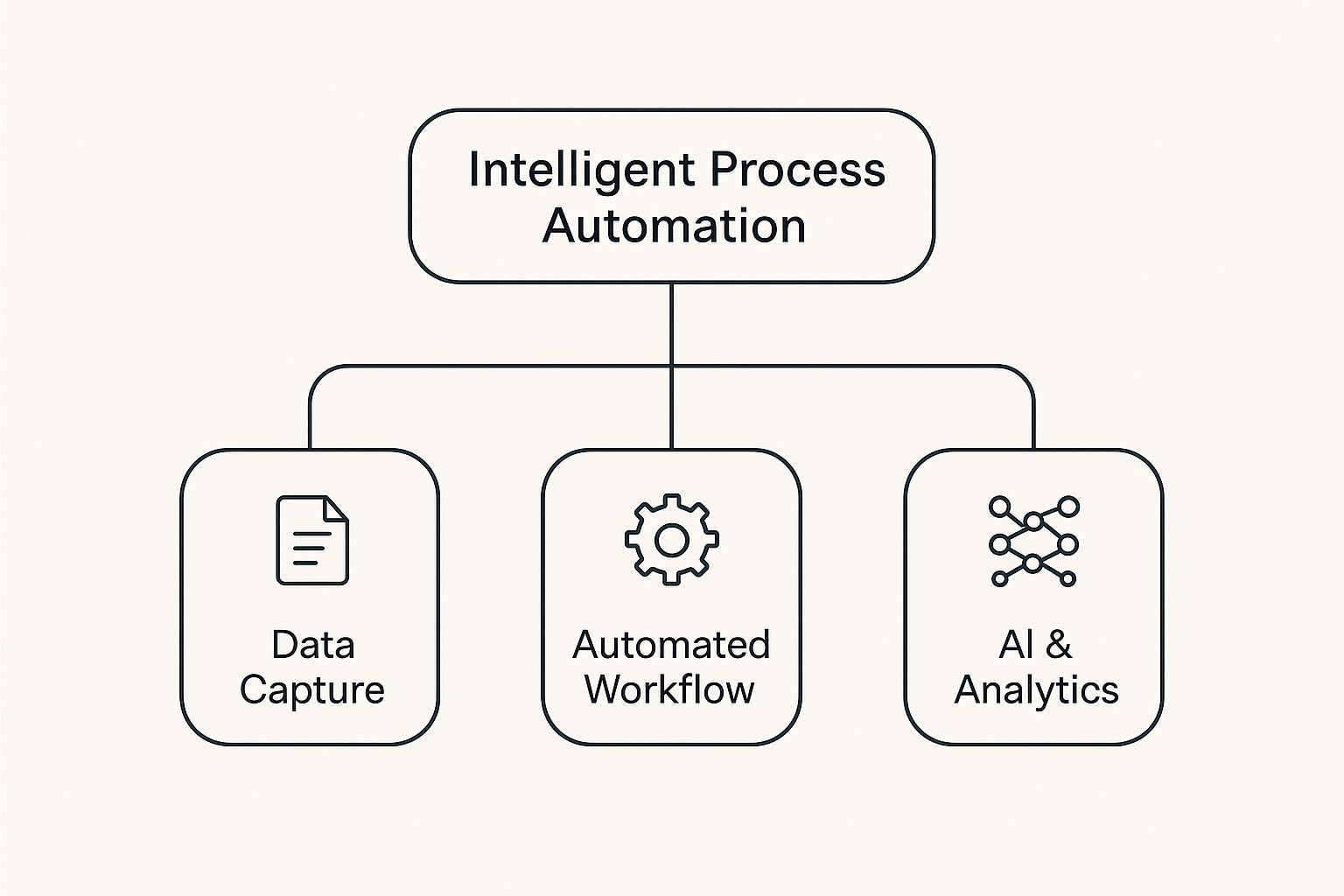
As you can see, IPA is not a single technology but a strategic framework combining data capture, workflow automation, and intelligent analytics to drive business outcomes.
The Cognitive Brain: AI and Machine Learning
If RPA provides the hands, then Artificial Intelligence (AI) and Machine Learning (ML) deliver the "cognitive brain." This is what puts the intelligence in intelligent process automation. AI empowers the system to process unstructured data, learn from experience, and make autonomous decisions.
This represents a quantum leap from basic automation. An RPA bot merely follows a script; an AI-powered system can interpret the meaning behind that script. It understands context, identifies patterns, and manages variability. For instance, it can analyze a customer's email (unstructured data), discern their sentiment, and route it to the appropriate department—all without human intervention.
By embedding cognitive capabilities into automation, you transform a simple task-doer into a problem-solver. This is how you pivot from mere cost reduction to building genuine operational agility and a superior customer experience.
RPA vs Intelligent Process Automation A Strategic Comparison
To solidify the distinction, a side-by-side comparison is useful. This table contrasts traditional RPA with IPA across the dimensions that matter most to business leaders. It underscores the strategic leap from automating isolated tasks to optimizing intelligent, end-to-end business processes.
| Dimension | Robotic Process Automation (RPA) | Intelligent Process Automation (IPA) |
|---|---|---|
| Primary Goal | Task efficiency and cost reduction | End-to-end process optimization and value creation |
| Data Handling | Structured data only (spreadsheets, forms) | Handles structured and unstructured data (emails, images, documents) |
| Decision Making | Rules-based, follows a predefined script | Data-driven, makes predictions and judgments |
| Flexibility | Rigid; fails when processes change | Adaptive; learns and adjusts to new scenarios |
| Scope | Automates discrete, repetitive tasks | Automates complex, dynamic, end-to-end workflows |
| Core Technology | Software bots mimicking human actions | A combination of RPA, AI, ML, and other cognitive tools |
The conclusion is clear: RPA is a powerful tool for efficiency, but IPA is a strategic capability that drives intelligent business transformation.
How They Work Together to Create Value
The real breakthrough occurs when you pair the digital hands of RPA with the cognitive brain of AI. This creates a powerful feedback loop where the system can execute, analyze, and learn, becoming more effective with every cycle.
Consider a complex process like onboarding a new client at a financial services firm.
- First, AI-powered tools scan and comprehend various application documents—driver's licenses, bank statements—and extract key information, regardless of format.
- That structured data is then passed to RPA bots, which execute the high-volume work: entering the information into multiple back-end systems and performing initial compliance checks.
- If an anomaly is detected—for instance, a document is flagged for potential fraud—an ML model assesses the risk based on historical data and decides whether to escalate it to a human agent or approve it.
This seamless integration allows you to automate entire processes once deemed too complex for automation. You are no longer just accelerating a single task; you are re-engineering the entire value chain for speed, accuracy, and intelligence. That is the true strategic value of intelligent process automation.
How IPA Impacts Your Revenue and Market Share

In every boardroom I've been in, the conversation ultimately converges on a few critical questions: How do we accelerate growth? How do we capture more market share? And how do we accomplish this while expanding our profit margins?
As someone who helps businesses answer these questions, I see intelligent process automation as more than a technology upgrade. It is a direct, strategic solution to these fundamental challenges. It’s easy to get lost in the technical jargon, but let's connect IPA to what truly matters—the metrics on your P&L statement. This is about building a smarter, more resilient enterprise.
Driving Efficiency Beyond Simple Cost Cutting
The initial conversation around automation often starts with cost reduction, and for good reason. IPA excels at this. Some studies indicate it can slash operational costs by 40% to 75%.
But if you stop there, you're missing the strategic upside. True efficiency isn’t just about spending less; it’s about generating a higher return from every dollar invested.
Consider your supply chain. An IPA system does more than just process orders faster. It can analyze shipping routes in real-time, predict delays using weather data, and automatically reroute a shipment before a disruption occurs. That’s not just saving money on one delayed order; it’s protecting revenue and preserving the customer relationship.
The strategic power of intelligent process automation is in transforming your operations from a cost center into a competitive weapon. It’s about creating an organization that can outmaneuver and outperform the competition.
Improving Accuracy to Mitigate Risk and Protect Margins
Errors are expensive. A minor inaccuracy in a financial report can lead to significant compliance penalties. An incorrect customer order erodes trust and results in costly returns. These seemingly small mistakes accumulate and directly impact your bottom line.
Intelligent process automation creates a system founded on precision. By removing human error from repetitive, high-volume tasks, you dramatically enhance data integrity.
- In Finance: IPA bots can reconcile thousands of transactions in minutes with near-perfect accuracy, flagging anomalies that a human might overlook. This ensures compliance and maintains clean financial records.
- In Customer Onboarding: The system can instantly validate new customer information against multiple databases, reducing fraud and ensuring your CRM isn't populated with flawed data from the outset.
This isn't just about avoiding penalties. Unwavering accuracy builds trust with customers, auditors, and investors. It’s how you protect your margins and build a reputation for reliability.
Delivering a Superior Customer Experience
Today, the battle for market share is won or lost in the customer experience. Your ability to deliver fast, personalized, and seamless service is what differentiates you from competitors. This is where IPA provides your customer-facing teams with a decisive advantage.
Imagine a customer service email arrives. Instead of a human manually reading and routing it, an IPA system can instantly understand the customer's sentiment and intent and retrieve their entire history. From there, it can either resolve the request autonomously or escalate it to the ideal agent with a complete summary and recommended solutions.
Suddenly, your support team transitions from reactive to proactive. Response times plummet, issues are resolved correctly on the first attempt, and your people spend their time on high-value conversations instead of administrative tasks. That is the kind of experience that builds loyalty, increases customer lifetime value, and ultimately wins you more of the market.
At its core, the most significant impact of intelligent process automation is what it does for your people. By automating monotonous work, you liberate your team to focus on what they do best: thinking strategically, solving complex problems, and innovating. And that is the ultimate engine for sustainable growth and market leadership.
Putting IPA to Work: Examples from the Real World
Theory is valuable, but what matters is how this technology solves real-world business problems. As an executive, I care about the application, not the acronym. How does intelligent process automation actually move the needle on the ground?
Time and again, I’ve seen that the most successful initiatives are those that directly link technology to a clear business objective. You don't implement IPA for its own sake; you deploy it to solve a high-stakes problem—whether that’s mitigating fraud, accelerating a production line, or creating a world-class customer experience.
Let’s get specific and look at how leading companies are leveraging IPA to win.
Financial Services: Protecting Revenue from Fraud
In the financial sector, you succeed based on speed and security. One of the greatest threats to both revenue and customer trust is fraud. The traditional approach—relying on manual reviews—is not only slow and costly; it's perpetually one step behind sophisticated fraudsters.
This is a prime use case for intelligent process automation.
Consider a credit card application. An IPA system can instantly analyze hundreds of data points on the application, cross-referencing them against external databases and internal historical records. The real value is unlocked when machine learning identifies subtle, complex patterns of potential fraud that a human analyst would almost certainly miss.
- An RPA bot initiates the process, extracting data from the application form, regardless of its format.
- Next, an AI model scrutinizes that information, flagging inconsistencies or red flags based on patterns learned from millions of prior applications.
- If a risk is detected, the system doesn't just reject the application. It instantly escalates it to a human fraud specialist, complete with a concise summary of the identified risks.
This isn't just about loss prevention. It’s also about customer acquisition. This process allows legitimate customers to be approved in seconds, not days, which dramatically improves their experience and reduces applicant drop-off. The result is a system that simultaneously protects the bottom line and accelerates revenue growth.
Manufacturing and the Smart Factory Floor
For any manufacturer, success hinges on three pillars: efficiency, quality, and safety. The best-in-class companies are relentlessly seeking ways to produce better products, faster, and at a lower cost. This is where IPA is fueling the "smart factory," moving beyond simple assembly-line robotics into a new era of connected, intelligent production.
This shift is enabled by pairing RPA with powerful AI tools like computer vision, natural language processing, and advanced analytics. These combinations are unlocking new value across industries. For example, automotive giant Stellantis NV has embedded AI-guided robotics and autonomous mobile robots directly into its production lines as a core component of its digital strategy. You can get a sense of the broader market impact from this analysis of how IPA is reshaping manufacturing.
This integration creates a factory floor that can practically think for itself.
An IPA system can leverage computer vision to inspect components for microscopic defects with a precision and consistency that a human eye cannot match. It can predict when a machine is likely to fail and schedule maintenance before it breaks, preventing costly unplanned downtime. This is how an operations department evolves from a cost center into a powerful competitive advantage.
Optimizing the Global Supply Chain
A modern supply chain is a highly complex network of suppliers, logistics partners, and distribution centers. A minor disruption in one part of the world can trigger significant problems thousands of miles away. In this environment, visibility and agility are not just advantages; they are essential for survival.
Industry leaders are using IPA to do more than just manage their supply chains—they are using it to anticipate and adapt to challenges before they escalate.
Imagine managing inventory across dozens of warehouses globally. Here’s how IPA brings order to that complexity:
- Demand Forecasting: An IPA system analyzes historical sales data, seasonal trends, and even external variables like weather forecasts or social media sentiment to generate highly accurate demand predictions.
- Automated Procurement: Based on these forecasts, RPA bots automatically generate and dispatch purchase orders to suppliers the moment inventory levels fall below a predetermined threshold. No human intervention is required.
- Intelligent Logistics: The system then tracks shipments in real-time. If it predicts a delay at a port or a transit bottleneck, the AI can proactively reroute the shipment to maintain the flow of goods.
By integrating these disparate functions, intelligent process automation creates a supply chain that continuously learns and optimizes itself. It reduces the cash tied up in inventory, prevents stockouts, and ultimately ensures your products reach your customers on schedule.
Each of these examples tells the same story: IPA's true power lies not in automating a few tasks, but in fundamentally redesigning core business processes to be faster, smarter, and far more resilient.
A Phased Roadmap for Successful IPA Implementation

From my experience leading large-scale business transformations, I can tell you that the difference between success and failure is rarely the technology itself. It’s the strategy. Launching an intelligent process automation initiative without a clear, phased roadmap is like building a skyscraper without a blueprint—it’s destined for chaos.
When different departments pursue their own siloed automation projects, you end up with a fragmented collection of point solutions that never deliver enterprise-wide value. To win, you need a disciplined, data-driven roadmap that builds momentum, proves its value, and scales intelligently across the organization.
Phase 1: Identify and Prioritize
The first step is always the most critical: determining where to start. You can't boil the ocean. Instead, you must work cross-functionally—breaking down the traditional silos between IT, operations, and finance—to identify processes that are ripe for automation.
Begin by targeting "quick wins" that will deliver the highest impact for the lowest effort.
- High-Volume, Repetitive Tasks: Think of processes like invoice processing or data reconciliation. These are ideal starting points.
- Prone to Human Error: Any workflow where a simple mistake has costly consequences, such as compliance checks or customer data entry, should be a top priority.
- Significant Bottlenecks: Identify the processes that create friction and slow down the entire organization, such as manual approvals that delay the supply chain.
By focusing on these areas first, you generate immediate momentum and secure early victories that build the business case for further investment. This isn't just about identifying tasks; it's about finding and eliminating the operational drag that inhibits growth.
Phase 2: Pilot and Prove
Once you have your shortlist, resist the urge to go big immediately. Select a single, high-impact process for a pilot project. The objective here is simple: prove the value of intelligent process automation in a controlled, measurable environment.
Before you begin, define what success looks like in concrete terms. Are you targeting a 25% reduction in processing time? A 99% accuracy rate? Or a specific dollar amount in cost savings? You must measure everything, because this data becomes the foundation of your business case for scaling.
A successful pilot does more than validate the technology. It creates a powerful internal success story that converts skeptics into advocates and secures the executive buy-in required for the next phase.
Phase 3: Scale and Govern
With a proven win under your belt, it's time to scale. This is where many initiatives fail. Scaling is not just about doing more of the same; it's about building the infrastructure for long-term, sustainable success. This means establishing a Center of Excellence (CoE).
Your CoE becomes the central command for your entire intelligent process automation strategy. It is responsible for establishing best practices, managing the technology stack, and ensuring that every new project aligns with broader corporate objectives. It is the governance engine that prevents a slide back into fragmented, siloed efforts.
The incredible growth projected for this market—from an estimated USD 9.1 billion in 2024 to a projected USD 84.2 billion by 2037—underscores how critical a structured approach is. You can learn more about the future of intelligent automation and why getting this right is so important.
Following this phased approach transforms intelligent process automation from an isolated IT project into a core pillar of your growth strategy, ensuring it delivers measurable returns for years to come.
Leading Your Team Into the Future of Work
Throughout my career, I've learned that the most profound business transformations are never just about technology—they’re always about people. Intelligent process automation is a perfect example. We've discussed strategy and implementation, but the ultimate prize is how it reshapes the nature of work, transforming your organization from the inside out.
Many leaders mistakenly view automation solely as a tool for replacement. This is a critical error in judgment. The true opportunity isn’t about taking people out of the process; it’s about taking the process out of the people. This allows us to transition from roles defined by repetitive tasks to work that leverages uniquely human capabilities.
Once IPA assumes the monotonous, rules-based work, your team is liberated to do what humans do best: think strategically, solve complex problems creatively, and build deep, meaningful relationships with customers.
The Rise of the Human-in-the-Loop Model
This creates a new operational dynamic I call the "human-in-the-loop" model. This is not a conflict of human versus machine. It is a partnership—human with machine. In this model, your employees become the managers of a digital workforce, intervening to handle complex exceptions, make final judgments on critical decisions, and continuously refine the automated systems.
Think of it as giving your entire team a strategic upgrade. A financial analyst, for example, no longer spends their week manually compiling data for reports. Instead, they collaborate with an IPA system that aggregates and prepares the data in minutes. This frees them to dedicate their time to analyzing that information, identifying trends, and delivering sharp, strategic insights to leadership—the high-value work that drives business performance.
This shift is non-negotiable for future growth. The objective is to elevate your talent, enabling them to operate at a higher strategic level where their contributions directly impact revenue and market share. This is how you build a smarter, more agile organization.
Investing in Your Most Valuable Asset
For this transition to be successful, you must commit to upskilling your workforce. As roles evolve, your team will require new competencies in areas like data analysis, critical thinking, and process management. Investing in training is not just a line item on the budget; it is the single most critical investment you can make in your company's future.
The leaders who will win in the next decade are those who see intelligent process automation as a catalyst for human potential. When you embrace this new way of working, you don't just create more efficient processes—you unlock the full intellectual horsepower of your entire organization. And that is the ultimate competitive advantage.
Your Questions About IPA, Answered
As a strategist, I’ve sat in countless boardrooms where leaders are trying to cut through the noise surrounding new technologies. When it comes to something as powerful as intelligent process automation, the questions are always sharp and focused on the bottom line. It's my job to connect the dots between the tech and what really matters: revenue, efficiency, and competitive advantage.
Let's dive into the two biggest questions I get from other leaders.
What's the Real Difference Between IPA, RPA, and AI?
This is where many executives get bogged down, but the distinction is critical for strategic clarity. The most effective way I explain it is by thinking about how you would assemble a high-performance team.
- Robotic Process Automation (RPA): Think of RPA as your most dependable junior team member. It's a workhorse, flawlessly executing high-volume, repetitive tasks that adhere to a strict set of rules. It operates 24/7 without fatigue or error.
- Artificial Intelligence (AI): This is your senior analyst or subject matter expert. AI handles the complex, judgment-based work—like understanding natural language, identifying patterns in unstructured data, or making sophisticated predictions.
- Intelligent Process Automation (IPA): IPA is not a single tool; it’s the entire high-performance team working in perfect synchronization. It’s the integrated system where AI provides the "brains" for complex decisions and RPA provides the "hands" to execute tasks across your business.
You can derive value from each component individually, but the strategic breakthrough happens when you combine them. That integrated capability is what defines IPA.
How Do We Actually Measure the ROI of an IPA Project?
Calculating the return on an IPA investment must extend far beyond simple labor cost reduction. If that's your only metric, you're missing the strategic value. A comprehensive ROI analysis must evaluate the investment's impact across the entire business, from top-line revenue to bottom-line risk mitigation.
The most successful teams I've worked with tie every automation metric directly to a core business objective. They move beyond tracking "hours saved" and start measuring how those reclaimed hours are redeployed to drive sales, innovate, or enhance the customer experience.
When building your business case, your ROI model must include:
- Operational Gains: This is the most straightforward component. Measure metrics like accelerated processing cycles, drastically reduced error rates, and increased throughput.
- Top-Line Growth: Quantify the impact on revenue. Are you onboarding new customers faster? Are lead conversion rates improving? Are you increasing the lifetime value of your customer base?
- Stronger Compliance and Risk Management: Don't overlook the financial value of enhanced security and accuracy. This includes calculating the cost savings from reduced fraud, improved regulatory adherence, and more reliable data.
When framed this way, intelligent process automation is no longer just an IT project or a cost-cutting exercise. It becomes a clear and defensible driver of profit and market leadership—and that's a conversation every executive wants to have.
At MGXGrowth, our sole focus is on helping businesses translate AI-driven strategies like intelligent process automation into tangible, measurable financial outcomes. We aren't just consultants; we are growth partners who architect and execute a data-driven roadmap with you. You can learn more about our approach on our website.
