


If you want to get your customer acquisition cost under control, you need a fundamental mindset shift. Stop thinking of CAC as just a marketing metric and start seeing it for what it truly is: a critical indicator of your entire business's health. In my experience across multiple industries, the fastest way to lower it isn't just about slashing ad spend; it's about a deep audit of your biggest channels, a relentless focus on lead quality, and optimizing the entire customer journey—not just the top of the funnel.
This is how you move from just spending less to spending smarter and building a truly sustainable growth engine.
Your Customer Acquisition Cost Is a Health Metric, Not Just a Number
I’ve sat in too many boardrooms where Customer Acquisition Cost (CAC) gets flashed on a screen as another number for the marketing team to wrestle down. Let me be blunt: your CAC is the pulse of your business. When it starts creeping up, it’s not just a marketing issue; it’s a symptom of a much deeper problem that often points to a lack of alignment across your entire organization.
This single metric tells a story about how well-aligned your teams are, how efficient your processes are, and whether you truly understand your ideal customers. A high CAC almost always points to fractures in the system—cracks I've seen appear in every industry I've worked in, from SaaS and gaming to real estate. The real culprits are usually hiding in plain sight.
The Real Reasons Your CAC Is Soaring
It’s almost never about one bad ad campaign. The root causes are more systemic and often stem from a breakdown in communication and collaboration between departments that should be working together seamlessly toward a common goal: profitable growth.
- Organizational Silos: When your marketing, sales, and product teams are all rowing in different directions, the customer experience becomes a choppy, confusing mess. Every point of friction in that journey is a place where you lose potential customers you’ve already paid to attract. I've seen this cripple companies of all sizes.
- A Broken Customer Journey: Your funnel might look perfect on a whiteboard, but what's the real-world experience like? Every unnecessary click, every piece of confusing jargon, and every slow-loading page adds cost without delivering any value to the customer. This is pure waste.
- Disconnect from Your Ideal Buyer: So many companies cast their nets too wide, hoping to catch anyone and everyone. This "spray and pray" tactic is an expensive relic of a bygone era. It inflates your CAC by wasting money on audiences who were never going to convert in the first place.
Throughout my career, I've found that the most significant CAC reductions don't come from tweaking ad bids. They come from re-engineering the growth engine to eliminate internal friction and deliver a seamless customer experience from first touch to final conversion.
In this guide, we're skipping the surface-level fixes. We’re going to diagnose the health of your acquisition engine from the inside out. I'll walk you through my framework for pinpointing the real sources of inefficiency and lay out actionable strategies to get your entire organization on the same page. The goal here is sustainable growth, not just a temporary dip in a metric. It's about building a more efficient, customer-centric machine.
To get started, let's run a quick diagnostic. I've put together a checklist of high-impact areas where you can often find immediate cost-saving opportunities.
Immediate CAC Reduction Audit Checklist
This high-impact checklist is designed to help you audit critical areas and uncover immediate cost-saving opportunities in your acquisition efforts.
| Focus Area | Action Item | Potential Impact |
|---|---|---|
| Paid Ad Channels | Audit your 3 highest-spend campaigns for underperforming keywords, audiences, and creative. Pause the bottom 20%. | High |
| Lead Quality | Analyze conversion rates from MQL to SQL. Are sales rejecting a high percentage of leads? Revisit lead scoring criteria. | High |
| Landing Pages | Review the top 5 traffic-driving landing pages. Is the messaging aligned with the ad? Is the CTA clear? A/B test a new headline. | Medium |
| Onboarding Flow | Go through your own sign-up and onboarding process. Identify and remove at least 1 unnecessary step or field. | Medium |
| Retargeting | Check your audience exclusion lists. Are you still showing acquisition ads to new customers? Exclude recent converters. | High |
This checklist is your starting point. Use it to identify the low-hanging fruit and build momentum as we dive deeper into a more comprehensive optimization strategy.
Conduct a Holistic Funnel Audit
Your customer’s journey doesn’t respect your org chart. It flows seamlessly from a social ad run by marketing, to a landing page built by product, to a demo handled by sales. When these teams operate in silos—a problem I’ve seen cripple growth in even multi-billion dollar companies—you're leaking cash at every single handoff.
The only way to plug these leaks is to stop analyzing channels in isolation and start mapping the entire customer path, from the very first touch to the final conversion. This isn't just another marketing exercise. It's a cross-functional mandate that forces collaboration and creates shared accountability across the company.
This infographic gives you a sense of how a modern marketer has to monitor performance across a whole web of channels just to get a clear picture of what's happening.
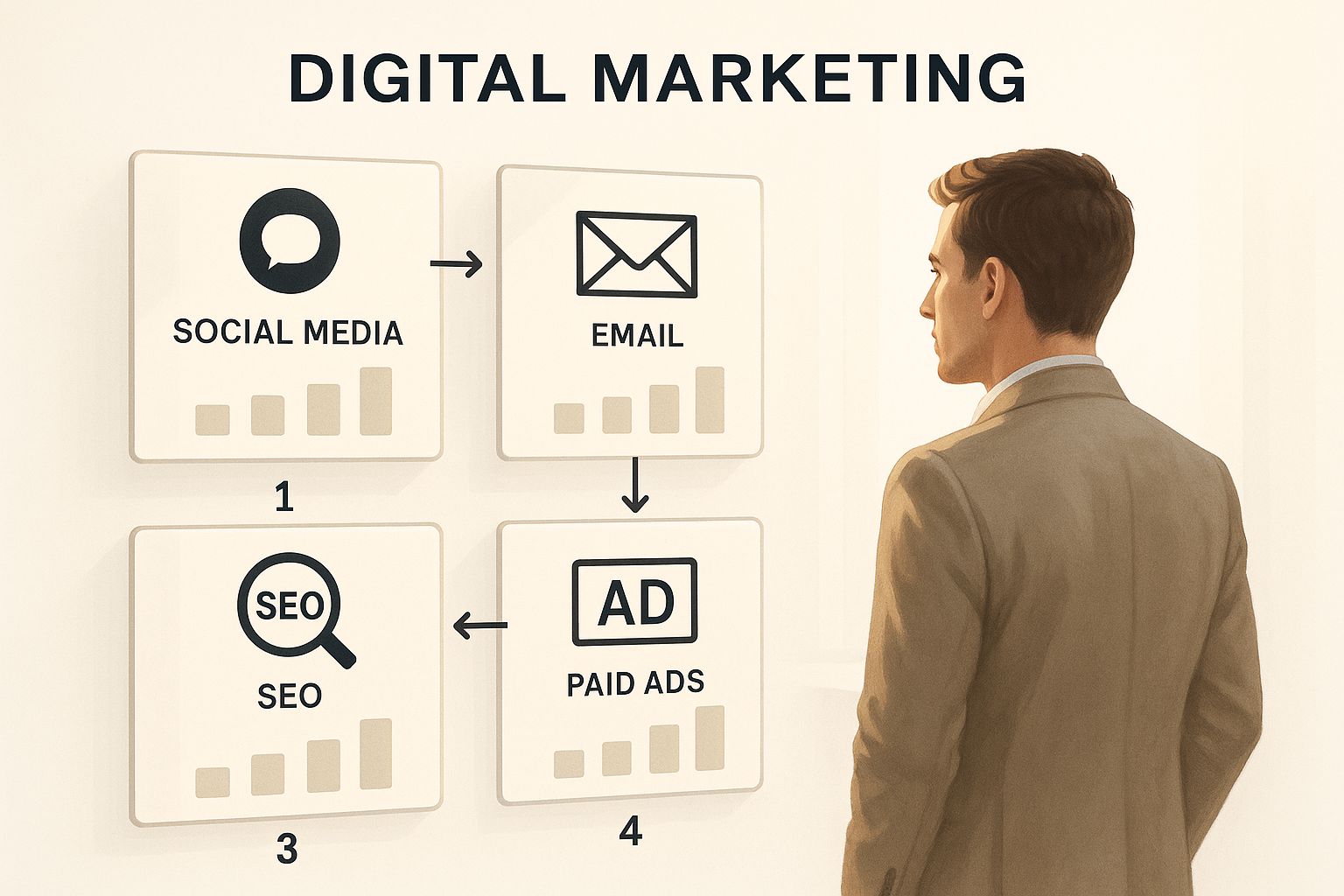
The big takeaway here is that each channel is an interconnected part of a larger system. Trying to optimize one without considering the others can easily backfire. A holistic view isn't a nice-to-have; it's non-negotiable for any executive serious about driving efficient growth.
Map the Customer Journey End to End
If you genuinely want to understand how to reduce customer acquisition cost, you first need to see exactly where you're losing money. Get your marketing, sales, product, and customer support leads in a room (virtual or physical) and literally build a visual map of the entire acquisition funnel.
For each stage, you need to identify a few key things:
- The Owner: Which department is responsible for this step?
- The Key Metric: What's the main success metric? (e.g., Click-Through Rate, Form Submission Rate, Demo Scheduled Rate).
- The Handoff Point: Where does responsibility transfer to the next team?
- The Drop-Off Rate: What percentage of prospects are bailing at this stage?
This process is incredibly revealing and almost immediately exposes the friction points. For instance, at a SaaS company I advised, we discovered a shocking 40% drop-off between a lead submitting a demo request and actually scheduling it. Marketing was delivering great leads, but the handoff to sales was so slow and clunky that we were burning through qualified prospects we had already paid to acquire.
Create a Single Source of Truth
Once the journey is mapped, the next critical move is to consolidate your data. The goal is to build a shared dashboard that becomes the single source of truth for the entire acquisition funnel. This isn't a marketing dashboard or a sales dashboard—it's a growth dashboard.
The moment every department sees their metrics on the same screen, the blame game ends and problem-solving begins. It breaks down the "us vs. them" mentality and aligns everyone around the real objective: converting a prospect into a customer efficiently.
Optimizing this entire funnel is a proven way to lower CAC. Think about how people shop today: a buyer might discover a product on TikTok, check reviews on Instagram, compare prices on Google, and finally buy weeks later on an app. This complex path requires precise mapping, especially when industry benchmarks show CAC varies wildly by sector—from $53 in food and beverage to $76 in electronics. Even small tweaks in your funnel can produce substantial savings. You can find more insights by looking into the average customer acquisition cost by industry.
At a marketplace I worked with, we took a hard look at our funnel and aligned the ad copy promising "free delivery" directly with the landing page headline and the checkout flow. That one simple act of messaging consistency cut our CAC by 20% in a single quarter. Why? Because it eliminated user confusion and built immediate trust. That's the power of a holistic audit in action.
Get Laser-Focused on Your Targeting

The days of "spray and pray" marketing are long gone. Honestly, burning cash on audiences that are way too broad is the fastest way to inflate your Customer Acquisition Cost. I've seen this single mistake cripple otherwise solid companies.
Real efficiency comes from ruthless prioritization. You have to focus your resources only on the people who are most likely to become your best customers—those who will deliver the highest lifetime value.
This means you need to go way beyond basic demographics and build a dynamic Ideal Customer Profile (ICP). And I don't mean a static document that gets created once and then collects dust in a shared drive. Your ICP needs to be a living, breathing profile that you constantly feed with both hard numbers and real-world feedback from the front lines.
Find Out Who Your Best Customers Really Are
Your existing customer base is a goldmine, but you have to know where to dig. Don't just look at who buys from you—analyze who your most profitable customers are. I'm talking about the ones with the highest lifetime value. Start by segmenting your customer list to find this top-tier group.
Once you’ve identified them, it's time to play detective and find the common threads:
- Firmographics and Technographics: What's their company size, industry, or annual revenue? For B2B, what's their tech stack look like? This kind of data adds critical layers of accuracy to your targeting.
- Behavioral Data: How did they find you in the first place? What content did they engage with before converting? Which features of your product do they use the most?
- Qualitative Insights: Get on the phone with them. Talk to your sales and customer support teams—they're on the front lines and hear the unvarnished truth every day. You need to understand their biggest pain points, their ultimate goals, and exactly why they picked you over the competition.
This deep-dive analysis is the bedrock for everything else. It’s what lets you build incredibly powerful lookalike audiences on ad platforms, making sure your ad spend is reaching people who mirror the exact traits of your most valuable customers.
I once worked with a mobile gaming company whose CAC was spiraling out of control. After digging into their player data, we found a wild statistic: 80% of their total revenue came from a tiny segment of "whale" profiles. We slashed our CAC by 40% in just two months by doing one thing: excluding everyone else and focusing the entire ad budget on this hyper-specific group.
Become a Master of Exclusion
Knowing who not to target is just as important as knowing who to target. In the world of paid media, negative keywords and audience exclusions are your secret weapons for efficiency.
Think about it: every dollar you stop wasting on an irrelevant click is a dollar you can put back into reaching a high-potential audience.
This isn't a one-and-done task, either. Your exclusion lists need constant attention. Are you still showing acquisition ads to people who just became customers? Are you blowing money on search terms that have zero commercial intent? A disciplined approach to exclusion is one of the fastest ways to see a real, tangible drop in your CAC and a big improvement in your lead quality.
Use Technology as a Strategic Multiplier
I've worked in a bunch of different industries, from SaaS to real estate, and the conversation around technology always seems to get hung up on buzzwords. Let's get straight to the point: AI and automation aren't just trendy add-ons anymore. They are your best bet for acquiring customers efficiently at scale. If you’re not using this tech as a strategic multiplier, you can bet your competitors are.
The real win here isn't just about plugging in a new tool. It’s about fundamentally changing how your teams operate by giving them superpowers. Technology should be doing all the repetitive, data-crunching grunt work, which frees up your people to focus on what humans do best: building relationships, thinking strategically, and closing complex deals.
Move Beyond Buzzwords to Real-World Application
A lot of executives hear "AI" and immediately picture some massive, futuristic system that’s years away. The reality is that the most powerful applications are often practical, targeted enhancements to the funnel you already have.
Here’s where you can actually start making a difference today:
- Predictive Lead Scoring: Stop treating every lead the same. AI models can analyze thousands of data points—like demographics, website behavior, and firmographics—to predict who’s actually going to buy. This allows your sales team to stop chasing dead-end leads and focus their energy on the ones that matter most.
- Dynamic Ad Bidding: Why are you still setting fixed bids for your ad campaigns? Let the algorithms handle it. AI-driven bidding on platforms like Google and Facebook can adjust your bids in real-time for every single ad impression, all based on the probability of conversion. It's a game-changer for optimizing your ad spend.
- Automated Nurture Sequences: Don't let valuable leads go cold just because your team is swamped. With automation, you can build out highly personalized email and messaging campaigns that guide prospects through your funnel with relevant content, all triggered by their own actions.
The most effective growth engines I've ever built didn't replace talented people with tech. They amplified the impact of those people by giving them smarter tools to work with.
A Framework for Integrating New Tools
Bringing in new technology can feel like a huge headache, but it doesn't have to be. The secret is to start small, prove the value, and then scale. Zero in on tools that solve one specific, measurable problem in your customer acquisition process.
When you're evaluating a new platform, ask these three simple questions:
- Does it solve a clear bottleneck? If your sales team is drowning in unqualified leads, a predictive scoring tool is an obvious win.
- Can it integrate with our current tech? A tool that just creates another data silo is a step backward, not forward.
- Is the ROI easy to measure? You must be able to draw a straight line from the cost of the tool to a lower CAC or a higher conversion rate.
The results speak for themselves. Companies that strategically weave AI into their acquisition strategy have seen their CAC drop by as much as 50%. This is especially true in industries like SaaS and e-commerce, where AI tools can fine-tune targeting and personalize outreach at a scale that's just not humanly possible. You can dig deeper into the impact of AI on acquisition costs if you're curious. This isn't just about saving a few bucks; it's about building a smarter, more responsive, and far more profitable growth machine.
Look Beyond the First Purchase: It's All About Lifetime Value
It’s a classic rookie mistake I see all the time: an obsession with getting the initial acquisition cost as low as possible. But here’s the unvarnished truth from my experience—a high CAC isn't automatically a bad thing. It can actually be a brilliant investment, but only if that customer’s lifetime value (LTV) is multiples higher.
The entire conversation within your executive team has to shift from short-term cost-cutting to long-term value creation.
This is where the real winners separate themselves from the pack. They understand that a customer who costs $300 to acquire but ends up spending $1,500 is infinitely more valuable than a "cheap" $50 customer who churns after a single month. The true north for sustainable growth isn't just your CAC; it’s your LTV:CAC ratio.
The LTV and CAC Connection
Think of the relationship between LTV and CAC as the ultimate health check for your growth engine. For a truly healthy, scalable business, you need to be shooting for a ratio of at least 3:1.
What does that mean? For every dollar you put into acquiring a customer, you should be getting at least three dollars back over their entire relationship with you.
A 1:1 ratio means you're just treading water, and anything below that means you're literally paying to lose money with every new sign-up. Keeping a close eye on this number isn't just a good idea—it's non-negotiable for anyone responsible for P&L.
The real magic happens when you realize you have two levers to pull. You can either obsess over reducing your CAC or focus on increasing your LTV. My experience across dozens of high-growth companies has proven that increasing LTV is almost always the more powerful and sustainable strategy for driving EBITDA growth.
Real-World Strategies to Increase LTV
Even a small improvement in customer retention can dramatically increase your "allowable" CAC. This gives your marketing team more breathing room to compete and land those higher-value customers.
Here are three areas you can focus on right now to start boosting LTV.
- Nail the Onboarding Experience: Those first 30 days are everything. A confusing or clunky onboarding process is the fastest way to lose a new customer. You need to map out every single step, hunt down any point of friction, and ensure they achieve a meaningful "win" as quickly as possible.
- Build Smart Upsell Pathways: Don't just sit back and hope customers find your premium features. Use their behavior to trigger automated, personalized offers for upgrades or add-ons right when they're most likely to need them. It feels helpful, not pushy, and directly drives revenue.
- Launch a Killer Referral Program: Who are your best salespeople? Your happiest customers. A well-designed referral program that rewards both the existing customer and the new one turns your loyal fans into a low-cost, high-trust acquisition channel. This creates a powerful cycle where high-LTV customers bring in more high-LTV customers, completely changing your growth economics for the better.
Answering Your Key Questions About CAC Reduction
Over the years, I’ve heard the same critical questions from executives and marketing leaders who are serious about getting their Customer Acquisition Cost under control. Here are my direct, no-nonsense answers based on decades of experience in the trenches, driving growth across SaaS, marketplaces, and more.
What Is the Very First Step to Reduce My CAC?
Start with a ruthless audit of your highest-spend acquisition channels. I’m not just talking about surface-level metrics like cost-per-click or impressions. You need to dig deeper and pinpoint the lead-to-customer conversion rate for every single campaign.
I guarantee you'll find that a small handful of campaigns are burning a massive hole in your budget for very little return. Pause them. Immediately. This single move buys you the financial breathing room to double down on what’s actually working, giving you an instant efficiency lift while you figure out your next strategic move.
The fastest way to fund your best marketing is to stop paying for your worst. It sounds simple, but it requires discipline and a willingness to kill projects that aren’t delivering real, bottom-line results.
How Do I Know if My CAC Is Good or Bad?
Here’s the thing: a "good" CAC is completely meaningless without context. It all comes down to its relationship with your Customer Lifetime Value (LTV). A $500 CAC would be a total disaster for a brand selling $50 t-shirts, but it’s an absolute home run for a SaaS company with a $15,000 LTV.
The only metric that truly matters here is your LTV:CAC ratio. For a healthy, scalable business, you should be aiming for a ratio of at least 3:1. That means for every dollar you spend to get a customer, you make three dollars back over their lifetime. Your entire mission is to constantly improve that ratio, either by pushing CAC down or—even more powerfully—by driving LTV up.
Which Marketing Channels Typically Have the Lowest CAC?
The channels with the lowest CAC in the long run are always the ones you own and control. It's not even a fair fight.
- Organic Search (SEO): The upfront investment in creating genuinely helpful content pays off for years. You end up attracting high-intent customers at a cost that gets closer to zero over time.
- Referral Programs: Turning your happiest customers into your best salespeople is the ultimate low-cost acquisition play. Plus, referred customers almost always have a higher LTV.
- Email Marketing: You’ve already done the work to build your list. Nurturing those leads and converting them into customers costs a tiny fraction of what you'd spend on new paid ads.
Paid channels like social and search ads are fantastic for speed and scale, but the bedrock of sustainable, low-cost growth is always built on the channels you own.
At MGXGrowth, we partner with executive teams to move beyond theoretical concepts and implement the data-driven strategies that drive real business results. We architect sustainable growth engines that lower acquisition costs and maximize lifetime value. Learn more about our approach at https://www.mgxgrowth.com.
