


In my decades of driving growth across diverse industries, from high-stakes SaaS platforms to intricate hospitality operations, I've seen one truth hold constant: sustainable success isn't built on isolated wins. It's built on a foundation of efficient, repeatable, and scalable processes. Too often, I encounter organizations trapped by siloed teams, legacy workflows, and a crippling fear of change. The result is stagnant revenue, bloated costs, and frustrated customers.
But it doesn't have to be this way. The key to unlocking exponential growth lies in systematically dismantling what isn't working and rebuilding with intention. This isn't just about tweaking a few steps; it's a strategic imperative for any company serious about scaling. The difference between market leaders and laggards often comes down to their commitment to operational excellence.
In this article, we'll move beyond theory and dive into the practical application of 10 powerful business process improvement methods. I'll provide actionable insights and real-world scenarios to help you select and implement the right framework for your specific challenges. Think of this as your executive playbook for transforming operational friction into a powerful, sustainable competitive advantage.
1. Six Sigma: The Data-Driven Path to Perfection
Six Sigma is a disciplined, data-driven methodology focused on eliminating defects to near perfection. At its core, it’s about making decisions based on statistical analysis, not guesswork or intuition. My teams have used it to systematically define problems, measure performance, analyze root causes, improve processes, and implement controls to sustain the gains, a framework known as DMAIC.

While Six Sigma has its roots in manufacturing, its versatility is its greatest strength. I’ve applied its principles to optimize customer onboarding in SaaS and reduce check-in times in hospitality, proving its power in any environment where quality and consistency are paramount. It's one of the most rigorous business process improvement methods because it forces you to quantify both the problem and the solution.
How to Implement Six Sigma
- Secure Leadership Buy-In: This isn't a grassroots effort. Six Sigma requires commitment from the top to allocate resources and champion the cultural shift toward data-driven decisions.
- Invest in Training: Proper training and certification (Yellow Belt, Green Belt, Black Belt) are crucial. This ensures your team speaks the same language and applies the statistical tools correctly.
- Focus on High-Impact Projects: Start with a well-defined problem that directly impacts customer satisfaction or the bottom line. Early wins build momentum for wider adoption. For example, Bank of America used Six Sigma to improve its loan processing time by 25% while reducing errors.
Why Six Sigma Works
This methodology forces a culture of precision and accountability. By focusing on measurable defects and their root causes, you move beyond temporary fixes to create lasting, systemic improvements. General Electric famously saved over $12 billion in six years by embedding Six Sigma into its operational DNA, a testament to its transformative potential when fully embraced.
2. Lean Manufacturing/Lean Thinking: Maximizing Value by Minimizing Waste
Lean Thinking is a methodology dedicated to maximizing customer value while relentlessly eliminating waste. My teams have adopted this approach to identify and cut out the "seven wastes" (muda): unnecessary transportation, excess inventory, wasted motion, waiting times, overproduction, over-processing, and defects. It’s about creating more value for customers with fewer resources.

While born from the Toyota Production System, I've seen Lean transform service industries just as effectively. We've applied it to streamline marketing campaign workflows and accelerate software development cycles. It’s one of the most intuitive business process improvement methods because it centers on a simple, powerful question: "Does this activity add value for the customer?" If the answer is no, it's waste.
How to Implement Lean Thinking
- Start with Value Stream Mapping: The first step is to visualize your entire process from start to finish. This map makes it easy for the whole team to see where bottlenecks, delays, and non-value-added steps are hiding.
- Implement 5S Workplace Organization: A clean, organized environment (Sort, Set in Order, Shine, Standardize, Sustain) is the foundation of efficiency. It reduces wasted time searching for tools or information and improves safety.
- Focus on Kaizen (Continuous Improvement): Lean isn't a one-time project. Foster a culture where employees are empowered to make small, incremental improvements every day. This collective effort compounds into significant gains over time.
Why Lean Thinking Works
This methodology creates a culture of efficiency and continuous improvement that is driven by every member of the team. By focusing on customer value and eliminating everything else, you streamline operations and become more agile. Intel, for example, achieved a 25% productivity improvement in manufacturing by applying Lean principles, demonstrating its power to enhance performance even in highly advanced environments.
3. Kaizen: The Philosophy of Continuous Incremental Improvement
Kaizen, a Japanese term meaning "good change," is more of a philosophy than a rigid methodology. It champions continuous, incremental improvement involving every single employee, from the C-suite to the front line. My experience has shown that its power lies in fostering a culture where everyone is empowered to identify and implement small enhancements regularly, creating significant momentum over time.
Unlike radical overhauls, Kaizen focuses on low-cost, low-risk changes that accumulate into massive transformations. I've used it to refine sales scripts, tweak user interface elements, and optimize internal communication workflows. It’s one of the most accessible business process improvement methods because it democratizes innovation, making everyone an owner of the company's success. Toyota’s famous system, where over a million employee suggestions are implemented annually, is a testament to this philosophy's scalability.
How to Implement Kaizen
- Establish a Suggestion System: Create a simple, accessible way for employees to submit ideas. This could be a physical box, a dedicated email, or a channel in your communication platform. The key is to make it frictionless.
- Hold Kaizen Events (Blitzes): Dedicate a short, intense period (1-5 days) for a cross-functional team to tackle a specific problem. Canon used this approach to reduce a key machine setup time by a staggering 96%.
- Celebrate and Recognize: Publicly acknowledge and reward contributions, no matter how small. This reinforces the desired behavior and shows that every improvement is valued, which builds incredible cultural momentum.
Why Kaizen Works
This approach builds a powerful, self-sustaining engine of improvement by empowering the people closest to the work. It eliminates the fear of failure associated with large-scale projects and fosters a proactive mindset. At Lockheed Martin, this bottom-up approach to problem-solving led to identifying and implementing changes that resulted in $2 million in annual savings, proving that small, consistent changes truly compound into transformative results.
4. Business Process Reengineering (BPR): The Clean Slate Revolution
Unlike methods that focus on incremental improvements, Business Process Reengineering (BPR) is about radical, fundamental change. It asks a simple but powerful question: "If we were starting from scratch today, how would we design this process?" I've led BPR initiatives where we didn't just tweak a workflow; we completely obliterated it and built a new one designed for maximum speed and efficiency.
BPR is not for the faint of heart. It involves a top-down, revolutionary overhaul of core processes to achieve dramatic improvements in cost, quality, and service. It’s one of the most transformative business process improvement methods because it challenges the very assumptions on which your operations are built. When successful, the results are game-changing, like when Ford used BPR to reduce its accounts payable workforce by 75% by re-thinking the entire procurement-to-payment process.
This infographic illustrates a classic BPR outcome, showing how IBM Credit redesigned its loan approval workflow.
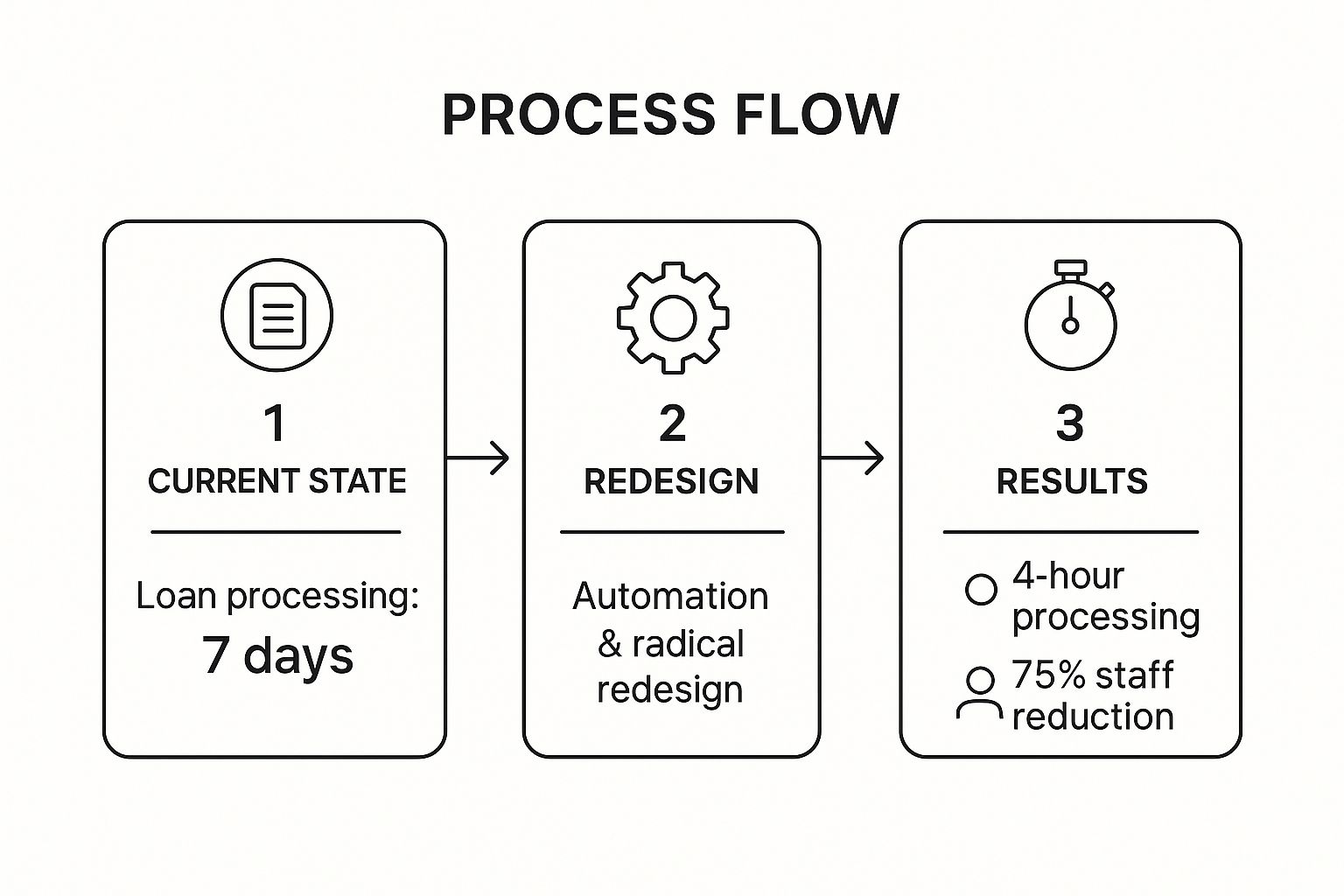
The visualization highlights how a radical redesign, enabled by technology, can compress a week-long process into mere hours.
How to Implement BPR
- Secure Executive Sponsorship: BPR is disruptive and will face resistance. It cannot succeed without a powerful executive champion driving the vision and clearing political hurdles.
- Focus on High-Impact, Cross-Functional Processes: Target processes that directly affect customers and span multiple departments, as this is where the biggest bottlenecks and opportunities for improvement often lie.
- Challenge Every Assumption: Question why each step exists. Use technology not just to automate an old process but to enable a completely new, more effective one.
- Plan for Change Management: BPR fundamentally alters jobs and responsibilities. Communicate the vision clearly and prepare your team for the transition to avoid chaos and morale loss.
Why BPR Works
This methodology delivers quantum leaps in performance rather than small, incremental gains. By starting with a clean slate, you eliminate legacy inefficiencies and align processes directly with strategic goals. While it carries higher risk, its potential to create a significant competitive advantage by drastically cutting costs and improving customer experience, as seen with IBM Credit and Hallmark, makes it a powerful tool for ambitious organizations.
5. Total Quality Management (TQM): Embedding Quality in Your Culture
Total Quality Management (TQM) is less of a rigid process and more of a cultural philosophy. It centers on the principle that every employee, from the C-suite to the frontline, is responsible for delivering quality to the end customer. In my experience, TQM's power lies in its holistic view; it’s not just about fixing a single process but about creating an integrated system geared toward continuous, incremental improvement.
Unlike Six Sigma's focus on defect elimination, TQM is a broader management approach dedicated to long-term success through customer satisfaction. I’ve seen it transform organizations by empowering employees and aligning all departments toward a common goal of excellence. This makes it one of the most foundational business process improvement methods for companies that want to make quality their core competitive advantage.
How to Implement Total Quality Management
- Establish a Customer-Obsessed Vision: Leadership must define and relentlessly communicate a vision where customer satisfaction is the ultimate measure of success. This sets the tone for the entire organization.
- Empower All Employees: Implement "quality circles" and suggestion systems that actively involve team members in problem-solving. True TQM requires total participation, not just top-down directives.
- Focus on Process, Not Just Results: TQM teaches that if you perfect the process, the results will follow. Regularly analyze and refine workflows to prevent errors before they happen, rather than just inspecting the final product.
Why TQM Works
This methodology creates a proactive culture of ownership and pride. When everyone is responsible for quality, the organization becomes a self-correcting system that consistently meets and exceeds customer expectations. FedEx, for instance, used TQM principles to achieve its legendary 99.7% on-time delivery rate, proving that a company-wide commitment to quality can become a powerful market differentiator.
6. Agile Methodology: Embracing Change for Rapid Growth
Agile is an iterative approach that breaks down large projects into small, manageable increments called sprints. It prioritizes flexibility, collaboration, and rapid response to change over rigid, long-term planning. I’ve seen firsthand how adopting an Agile mindset allows teams to deliver value faster and adapt to customer feedback in real-time, moving from slow, sequential workflows to a dynamic, continuous delivery cycle.
Though born in software development, I’ve adapted Agile principles to marketing campaigns, product launches, and even corporate strategy. Its power lies in creating tight feedback loops that keep work aligned with business goals. It's one of the most effective business process improvement methods for environments where market conditions and customer needs change rapidly, allowing organizations to pivot without losing momentum.
How to Implement Agile Methodology
- Start with a Pilot Project: Choose a small, cross-functional team and a well-defined project. This creates a safe space to learn the mechanics of frameworks like Scrum or Kanban before a full-scale rollout.
- Invest in Coaching and Training: Agile is a cultural shift. Bring in experienced Agile coaches to guide your teams, facilitate ceremonies like daily stand-ups and retrospectives, and empower them to self-organize.
- Focus on Customer Collaboration: Involve stakeholders and customers throughout the process, not just at the beginning and end. Their continuous feedback is crucial for ensuring the final product meets their actual needs. ING Bank, for example, restructured its entire organization around Agile principles to become more customer-centric and adaptive.
Why Agile Works
This methodology builds resilience and speed into your operations. By focusing on delivering functional increments of work quickly and regularly seeking feedback, you reduce the risk of building the wrong thing. Spotify famously uses an Agile-inspired model of "Squads, Tribes, Chapters, and Guilds" to maintain a startup-like culture of innovation and speed even as it has scaled into a global giant.
7. Design Thinking: Solving Problems from the User's Perspective
Design Thinking is a human-centered innovation framework that focuses on understanding the end-user's needs to solve complex problems. It's less about a rigid process and more about a mindset shift. My teams have used its five stages (Empathize, Define, Ideate, Prototype, Test) to move beyond internal assumptions and build solutions that truly resonate with customers.

Unlike purely analytical methods, Design Thinking brings creativity and empathy to the forefront. I’ve seen it transform a struggling product feature by first deeply understanding user frustration, then rapidly prototyping and testing solutions. This is one of the most powerful business process improvement methods for innovation because it ensures you're solving the right problem, not just optimizing a flawed solution.
How to Implement Design Thinking
- Start with Deep Empathy: Go beyond surveys. Conduct interviews, observe users in their natural environment, and build detailed personas. The goal is to feel their pain points firsthand.
- Build Multidisciplinary Teams: Innovation happens at the intersection of different perspectives. Bring together people from engineering, marketing, sales, and support to ideate solutions collaboratively.
- Prototype Rapidly and Cheaply: Don’t over-invest in early ideas. Use low-fidelity prototypes like sketches, wireframes, or role-playing to gather feedback quickly and fail forward without significant cost.
Why Design Thinking Works
This methodology forces you to ground your decisions in genuine user needs, drastically reducing the risk of building something nobody wants. It cultivates a culture of curiosity and continuous learning. Airbnb famously used Design Thinking to go from a near-failure to a global leader by focusing on improving the photography on their listings, a direct result of empathizing with both hosts and guests. This focus on the human experience is what drives breakthrough innovation.
8. Value Stream Mapping (VSM): Visualizing the Flow to Eliminate Waste
Value Stream Mapping (VSM) is a lean technique that forces you to see your business through the customer's eyes. It’s about visualizing every single step, both value-added and non-value-added, in the process of delivering a product or service. My teams have used VSM to map everything from software development cycles to customer support ticket resolution, creating a powerful visual blueprint that immediately highlights bottlenecks and waste.
Unlike a simple process flowchart, VSM meticulously tracks both material and information flows. This dual focus is critical; I’ve seen projects where the physical work was efficient, but information delays were killing lead times. It's one of the most revealing business process improvement methods because it forces an honest, end-to-end conversation about what activities truly matter to the customer.
How to Implement Value Stream Mapping
- Walk the Gemba: Don't create your map from a conference room. You must physically walk the process path, from start to finish, and talk to the people who do the work. This is non-negotiable for an accurate map.
- Map the Current State First: Resist the urge to jump to solutions. First, create a detailed map of your current process, warts and all. This baseline is essential for identifying the biggest opportunities.
- Focus on a Single Product Family: Trying to map everything at once leads to chaos. Select a single product or service family and map its complete value stream before moving to the next one. Intel, for instance, used VSM on specific chip families to cut manufacturing cycle time by 50%.
Why Value Stream Mapping Works
VSM succeeds because it makes waste impossible to ignore. Handoff delays, excess inventory, and redundant approvals become glaringly obvious on the map. This visual clarity aligns teams and creates a shared understanding of the problem, paving the way for a collaborative future-state design. Virginia Mason Medical Center applied this to patient flow, drastically reducing wait times and improving care delivery by visually identifying and eliminating process waste.
9. Root Cause Analysis (RCA): Digging Deeper Than Symptoms
Root Cause Analysis (RCA) is less of a single methodology and more of a mindset focused on solving problems at their source. Instead of just treating symptoms, my teams use RCA to systematically uncover the fundamental reason an issue occurred. This approach stops the endless cycle of firefighting and prevents the same problems from recurring.
I've seen its power in everything from software development, where it helps us understand why a critical bug was released, to customer service, where we dissect the real reason for a spike in negative feedback. It's one of the most foundational business process improvement methods because it forces you to look past the obvious and ask "why" until you can go no further. It's about fixing the system, not just the single output.
How to Implement Root Cause Analysis
- Define the Problem Unambiguously: Start with a clear, concise problem statement that everyone agrees on. If you can't define the problem precisely, you'll never find its true root.
- Gather Objective Data: Collect evidence, not opinions. This could be system logs, customer feedback, process flowcharts, or performance metrics. Data removes blame and focuses the team on facts.
- Use Proven Techniques: Employ structured methods like the "5 Whys" (asking "why?" repeatedly) or the Fishbone (Ishikawa) diagram to brainstorm potential causes across different categories like people, process, and technology. NASA famously uses exhaustive RCA to analyze mission failures, ensuring critical mistakes are never repeated.
Why Root Cause Analysis Works
RCA fosters a culture of learning and continuous improvement, rather than blame. When a server goes down, the goal isn't to find who made a mistake, but why the system allowed that mistake to happen. By addressing the core process or system flaw, you create more resilient and reliable operations. It shifts the focus from reactive problem-solving to proactive problem prevention.
10. DMAIC (Define, Measure, Analyze, Improve, Control)
DMAIC is the core, five-phase engine that powers Six Sigma, but I’ve often used it as a standalone framework for structured problem-solving. It provides a logical, data-driven sequence for tackling complex issues without the full resource commitment of a company-wide Six Sigma program. My teams appreciate it because it transforms ambiguous problems into a clear, step-by-step roadmap for resolution.
This method shines when the problem is complex and the root cause isn't obvious. I’ve applied DMAIC to streamline software development cycles and optimize lead qualification processes, proving its value far beyond its manufacturing origins. It’s one of the most practical business process improvement methods because it guides a team from problem identification all the way to sustaining the solution.
How to Implement DMAIC
- Define with Precision: The "Define" phase is critical. Clearly articulate the problem, project goals, and customer impact. If you can’t define it, you can't measure it. A poorly defined problem is the number one reason these projects fail.
- Measure Before Acting: Resist the urge to jump to solutions. In the "Measure" phase, collect baseline data to understand the current state. This data becomes the benchmark against which you'll measure success.
- Pilot Your Improvements: Before a full-scale rollout in the "Improve" phase, test your proposed solution on a smaller scale. This pilot allows you to work out kinks and gather real-world feedback without disrupting the entire operation.
Why DMAIC Works
DMAIC provides a disciplined framework that prevents teams from skipping crucial steps or relying on assumptions. By insisting on data at each stage, it ensures that improvements are both effective and sustainable. Motorola famously used the DMAIC cycle to drastically reduce defects in their manufacturing processes, laying the groundwork for what would become the global standard for quality improvement and saving billions in the process.
Business Process Improvement Methods Comparison
| Methodology | Implementation Complexity 🔄 | Resource Requirements ⚡ | Expected Outcomes 📊 | Ideal Use Cases 💡 | Key Advantages ⭐ |
|---|---|---|---|---|---|
| Six Sigma | High (3-5 years, complex DMAIC phases) | High (training, certification, data tools) | Significant defect reduction, cost savings | Large orgs with complex processes | Data-driven, measurable ROI, quality focus |
| Lean Manufacturing/Thinking | Medium to High (cultural change needed) | Medium (training, continuous effort) | Waste reduction, faster delivery times | Manufacturing, processes needing efficiency | Waste elimination, employee empowerment |
| Kaizen | Low to Medium (incremental improvements) | Low (employee engagement, training) | Continuous, small improvements | Organizations fostering continuous change | Low cost, culture building, quick results |
| Business Process Reengineering (BPR) | Very High (radical redesign, disruptive) | Very High (time, investment, leadership) | Dramatic performance improvements | Organizations needing major transformation | Breaks silos, leverages tech, competitive edge |
| Total Quality Management (TQM) | High (long-term, cultural change) | High (training, systemic efforts) | Organization-wide quality and performance | Enterprises aiming for total quality | Holistic, customer-focused, employee involvement |
| Agile Methodology | Medium (iterative, needs skilled teams) | Medium (cross-functional teams, training) | Faster delivery, flexible responses | Software, projects requiring adaptability | Collaboration, flexibility, early feedback |
| Design Thinking | Medium (time-consuming early phases) | Medium (multidisciplinary teams, prototyping) | Innovative, user-centered solutions | Innovation projects, product development | User focus, creativity, risk reduction |
| Value Stream Mapping (VSM) | Medium (data collection and detailed mapping) | Medium (team involvement, data analysis) | Waste identification, process visualization | Process improvement and lean implementations | Clear visualization, prioritization |
| Root Cause Analysis (RCA) | Medium (requires skilled facilitation) | Medium (data gathering, analysis tools) | Sustainable problem resolution | Quality issues, recurring problems | Prevents recurrence, builds learning |
| DMAIC (Six Sigma core) | High (structured phases, statistical analysis) | High (data, expertise, reviews) | Measurable and sustainable process improvement | Data-driven projects, quality initiatives | Structured, risk reduced, measurable outcomes |
Your Next Move: From Knowledge to Actionable Growth
Throughout my career, I've seen countless organizations invest in powerful ideas only to see them falter at the execution stage. We've just navigated a comprehensive arsenal of business process improvement methods, from the statistical rigor of Six Sigma and DMAIC to the people-centric empathy of Design Thinking. The truth is, the framework itself is only a fraction of the equation. Success isn’t found in a textbook definition of Kaizen or a perfectly drawn Value Stream Map; it’s forged in the relentless application of these principles.
The most critical takeaway is that there is no universal 'best' method. A high-growth SaaS startup scaling its customer onboarding process has fundamentally different needs than an established enterprise overhauling its supply chain with Business Process Reengineering. The former might thrive on Agile's iterative sprints, while the latter requires the radical, top-down approach of BPR. The art and science lie in diagnosing your specific challenge and selecting the right tool for that precise job.
Bridging the Gap Between Strategy and Reality
The true differentiator between companies that merely talk about improvement and those that achieve it is a culture obsessed with data and allergic to silos. Inefficiency loves to hide in the handoffs between marketing, sales, product, and customer success. A methodology like Total Quality Management (TQM) isn't just a set of quality-control tactics; it's a cultural commitment to customer-centricity that must be shared across every single department. Without that cross-functional alignment, even the most brilliant process redesign is destined to fail.
Your next steps should be deliberate and focused. Don't attempt to boil the ocean by simultaneously implementing Lean, Agile, and Six Sigma. This only creates confusion and initiative fatigue. Instead, follow a more pragmatic path:
- Identify One High-Impact Bottleneck: Pinpoint a single, specific process that is creating tangible friction. Is it your sales-to-service handoff? Your software deployment cycle? Your customer ticket resolution time?
- Select the Right Tool: Based on the nature of that problem, choose one of the methods we've discussed. Is it a problem of waste (Lean)? A complex issue with an unknown cause (Root Cause Analysis)? An opportunity for radical innovation (Design Thinking)?
- Execute and Measure: Apply the chosen framework with discipline. Define your success metrics upfront, gather baseline data, and track your progress relentlessly. This creates a powerful feedback loop that builds momentum.
Mastering these business process improvement methods is not an academic exercise; it is the engine of sustainable growth. It's how you scale operations without sacrificing quality, accelerate revenue without burning out your team, and build an organization that is resilient, adaptable, and perpetually improving. The journey from knowledge to action starts with a single, well-executed step. Take it now.
Choosing the right framework is crucial, but embedding it within your culture to drive measurable results is the real challenge. At MGXGrowth, we partner with executive teams to bridge that gap between strategy and execution, ensuring your process improvement initiatives translate directly into revenue and market share growth. Learn how we can help you build a high-performance operating system at MGXGrowth.
