


Across decades of driving growth in SaaS, marketplaces, and gaming, I’ve seen one internal threat consistently sabotage even the most brilliant strategies: organizational silos. These invisible walls between departments aren't just a cultural nuisance; they are a direct drag on revenue, EBITDA, and market share. Breaking down these silos isn't a "nice-to-have" HR initiative. It's a core P&L imperative and the key to unlocking sustainable growth.
The True Cost of a Divided Company
The most dangerous threats to a business are the ones that don’t show up on a balance sheet—at least, not right away. Organizational silos are exactly that. They're a silent killer of productivity and profit, often disguised as "communication issues" or "process friction." But from my seat as a growth strategist, I see those as just symptoms of a much deeper, more expensive problem.
This isn't just about teams not getting along. It's about tangible, financial losses that directly hit your bottom line.
Translating Inefficiency into Hard Costs
When departments function as independent fiefdoms, the financial drain is staggering. This is a multi-trillion-dollar problem globally, quietly eroding value from the inside. Consider this: research shows that silo-driven inefficiencies cost companies a shocking 350 hours per year, per employee. That's one full workday every single week vaporized. For a mid-sized tech company, that easily translates into millions in wasted payroll.
The problem compounds when you look at data. Siloed information is often poor-quality and a nightmare to access, which adds up to a global economic drag of about $3.1 trillion annually. Simply put, your people are spending far too much time hunting for information that should be at their fingertips. If you want to dig deeper, you can explore more on the financial impact of silo busting to see the full picture.
I once consulted for a high-growth SaaS company where the disconnect between Sales and Product was so thick you could feel it. Sales reps were out there promising features the product roadmap couldn't possibly support, leading to angry customers and churn. Meanwhile, Product was building tools the sales team had no idea how to sell. The blame game was costing them millions.
The Ripple Effect on Growth and Customer Experience
Internal fractures always find their way to the outside, damaging the one thing that truly matters: the customer experience. When your marketing, sales, and support teams are out of sync, the customer's journey becomes a bumpy, frustrating mess.
We've all seen it happen:
- Inconsistent Messaging: A prospect sees a compelling offer from marketing, but when they connect with a sales rep, the rep has no idea what they're talking about. Trust vanishes in an instant.
- Poor Product Feedback Loops: The customer support team is sitting on a goldmine of feedback about product flaws, but that info never makes it back to engineering in a useful way. So, the product never improves.
- Wasted Marketing Spend: Marketing is crushing it, generating thousands of leads. But if those leads aren't qualified in a way that aligns with what sales actually needs, the conversion rate tanks and customer acquisition cost (CAC) skyrockets.
These aren't minor operational hiccups. They are systemic failures that hand your competitors a massive advantage.
A Firsthand Account of Quantifying the Loss
At that SaaS company I mentioned, we decided to put a real number on the problem. We calculated the cost of churn directly tied to mismatched expectations. We tracked the hours sales reps wasted chasing leads that were never going to close. We tallied the engineering resources spent on features that didn't actually drive revenue.
The final figure was shocking. It was large enough to make breaking down organizational silos the C-suite's number one priority overnight. Suddenly, it wasn't a "culture" initiative anymore; it was a P&L imperative. The first, most critical step was mapping every point of friction and quantifying its impact. That made the invisible costs visible—and undeniable.
A Framework For Diagnosing Your Silos
You can’t fix a problem you can’t see. A common refrain I hear from leaders is that they feel the friction of silos but struggle to pinpoint where the walls are and what’s holding them up. It's all too easy to just blame "communication issues," but that's a symptom, not the root cause.
To start breaking down these barriers, you need to move beyond gut feelings and get specific with a diagnostic framework. It's about mapping the invisible hurdles that create drag, stall decisions, and ultimately damage the customer experience.
Identifying The Different Types Of Silos
Silos aren't a one-size-fits-all problem. They manifest in different ways, and knowing which type you're up against is the first step toward finding the right solution. In my experience, they typically fall into a few main categories, each with its own unique flavor of dysfunction.
To help you spot them, here's a quick breakdown of the most common silos I encounter, what usually causes them, and the tell-tale signs to look for.
| Silo Type | Primary Cause | Key Symptom |
|---|---|---|
| Functional Silos | Departments optimizing for their own goals and KPIs. | Marketing and Engineering don't speak the same language; Sales operates on its own island, often making promises that Support can't keep. |
| Geographical Silos | Physical or virtual distance between teams. | An "us vs. them" mentality between the headquarters and a regional office; lack of spontaneous collaboration between remote teams. |
| Data & Tech Silos | Disconnected systems and tools that don't share information. | The CRM doesn't talk to the marketing platform; customer service tickets are invisible to the product team, leading to missed insights. |
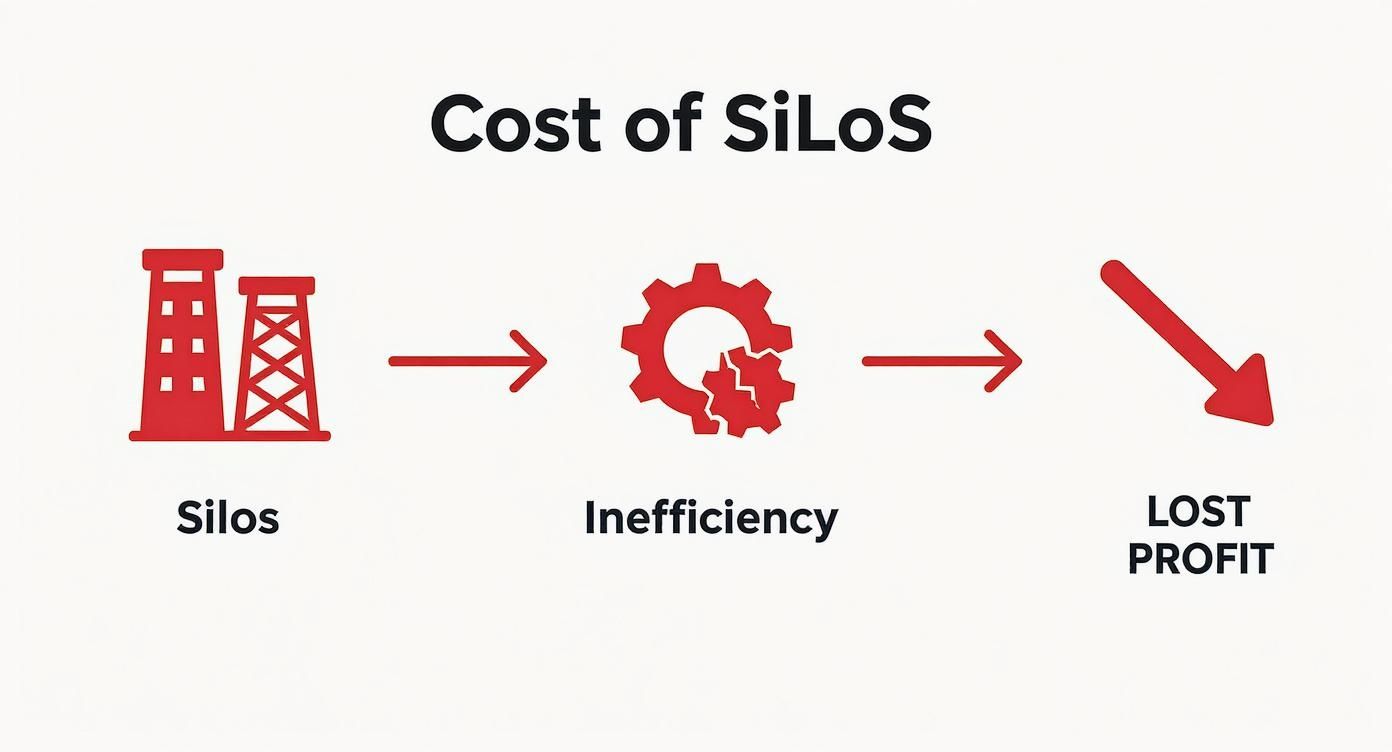
Each of these silo types creates a direct line from internal friction to lost profit—a connection every leader needs to understand.
This simple flow shows that silos aren't just an internal HR headache; they are a direct cause of inefficiency that chips away at your bottom line.
Uncovering The Root Causes
Once you've put a name to the type of silo, the real detective work begins: diagnosing the cause. This requires an investigative, data-driven approach. I’ve found two methods are incredibly effective for visualizing friction points and getting to the heart of the matter.
1. Process And Journey Mapping
Stop asking teams if they collaborate and start mapping how they actually work together on critical tasks. The customer journey is a fantastic place to start. Trace every single touchpoint, from the first ad they see (Marketing) to the final sale (Sales) and the follow-up call (Customer Success).
As you map this out, get granular. Where are the handoffs? Where does information get dropped? At what point does the customer experience feel clunky or disconnected? This exercise is a powerful way to make departmental walls visible and show how they create real-world problems. You can explore various business process improvement methods to give this mapping exercise a solid structure.
2. Targeted Interviews
Data and process maps tell you the "what," but it's the one-on-one conversations that reveal the "why." You need to sit down with individual contributors and mid-level managers from different departments. Ask them about their biggest roadblocks and day-to-day frustrations.
You're listening for recurring themes like:
- Misaligned Incentives: Is the sales team rewarded for closing deals quickly, even if it leads to high churn for the customer success team down the line?
- Bureaucratic Red Tape: Do simple cross-departmental requests get buried under layers of approvals that grind everything to a halt?
- Lack of Shared Tools: Does one team live in Slack while another is exclusively on Microsoft Teams, creating a communication black hole?
These conversations are gold. They uncover the hidden cultural norms and structural issues that keep silos standing strong.
And it’s not just a feeling; the data backs it up. A recent study found that 68% of organizations list data silos as their top worry—that's a 7% increase from the previous year. This isn't a niche problem, either. 79% of knowledge workers say their organizations are siloed, and 63% report that information is scattered across fragmented toolsets.
The real culprit? Often, it's the system itself. 58% of respondents identified organizational structure and bureaucracy as the key drivers of silos, proving this isn't just about personalities—it requires a systematic fix.
By using this framework—identifying the type, mapping the process, and talking to your people—you can build a clear and accurate diagnosis of your organization's silo problem. Only then can you start architecting a real, lasting solution.
A Blueprint for Cross-Functional Initiatives
Alright, you’ve mapped the friction points and diagnosed why your teams are walled off from each other. Now for the hard part: execution. This is where most leaders fail. They’ll schedule a mandatory team-building day or an all-hands meeting, hoping a few hours of forced fun will magically fix deep-seated organizational problems.
Let's be clear: that’s not a strategy. It's a band-aid on a bullet wound.
Real change requires you to fundamentally redesign how work gets done. It’s about building cross-functional initiatives with a clear, undeniable business purpose. These projects become the scaffolding for a more collaborative culture, pulling people out of their departmental trenches to work toward a common goal.
The Shared Goal Framework
In my experience, the fastest way to dissolve a silo is to give people a reason to work together that’s more compelling than any reason they have to work apart. This is the heart of what I call the Shared Goal Framework. It's deceptively simple: find one, high-impact business metric that no single department can move on its own.
This isn’t about assigning a group project. It's about getting entire departments—like Sales, Product, and Customer Support—obsessed with the same number.
I saw this work wonders at a SaaS company I was advising. We set a single, company-wide objective: reduce customer churn by 15% in two quarters.
Suddenly, the game changed for everyone.
- Product couldn’t hit that number alone. They desperately needed insights from Support on why customers were actually leaving.
- Customer Support couldn’t do it alone, either. They needed Product to fix the core issues causing all the user frustration in the first place.
- Sales had a huge stake in this. High churn made their job of hitting net new revenue targets nearly impossible.
Their individual KPIs became secondary to the shared mission. The framework doesn't just encourage collaboration; it makes it the only path to success.
Architecting Your Initiative
Once you have that shared goal, you need to build the operational structure to support it. This is the blueprint that keeps the initiative from fizzling out after the kickoff meeting.
Secure Executive Sponsorship
This is completely non-negotiable. A cross-functional project without a powerful executive sponsor is dead on arrival. This person isn’t just a figurehead; they are the tie-breaker in disputes, the one who clears bureaucratic roadblocks, and the one who holds everyone accountable to the C-suite.
Their active involvement sends a clear signal: breaking down organizational silos is a top-tier business priority, not a side project.
Define Roles and Create a Shared Data Source
Ambiguity is the enemy of collaboration. You have to be crystal clear about who is responsible for what.
- The Initiative Lead: One person who owns the outcome. They manage the project, keep communication flowing, and report progress to the executive sponsor.
- The Core Team: A small group with representatives from each key department. These people must be empowered to make decisions on behalf of their teams.
- A Shared Source of Truth: All data for the initiative—every metric, report, and analysis—must live in one accessible place. This could be a shared dashboard, a dedicated Slack channel, or a central project management board. When Product and Support are arguing about churn reasons, they should both be looking at the exact same data.
It's no surprise that one study found 95% of professionals are motivated to reduce silos. Giving them a shared data source is one of the most powerful ways to enable that.
Silos thrive on information asymmetry. When one team has data that another doesn't, mistrust and finger-pointing are inevitable. Creating a single source of truth removes this dynamic and forces everyone to operate from the same set of facts.

Case Study: Tiger Teams in Action
At a marketplace platform I worked with, we were stuck in that classic chicken-and-egg growth problem. To bust through it, we created what we called Tiger Teams.
These were small, agile groups of experts pulled from different departments—Product, Marketing, Data Science, and Operations—to tackle one specific growth challenge.
These teams operated completely outside the traditional hierarchy. We gave them a clear mission, a budget, and the autonomy to execute without getting bogged down by endless approvals. One Tiger Team was tasked with increasing seller onboarding completion rates. By bringing different perspectives into one room, they quickly realized the friction wasn't just in the product UI (a Product issue) but also in the marketing messaging (a Marketing issue) that set the wrong expectations from the start.
Working together, the team redesigned the entire onboarding flow in just six weeks. Under the old, siloed structure, a project like that would have taken at least six months. That’s the power of a well-architected cross-functional initiative. It's not just about feeling collaborative; it's about driving speed and getting results.
Actionable Tactics for Fostering Collaboration

A brilliant strategy for tearing down silos is just a document until you put it into practice. The real work happens in the trenches, where daily habits and processes either build walls higher or start knocking them down. This is where we get tactical.
This isn't about awkward trust falls or forced happy hours. It's about fundamentally re-engineering how your teams talk to each other, share what they know, and hold one another accountable. Let's move from the 'why' to the 'how' with a playbook of methods I've seen work time and again.
Build a Central Nervous System for Knowledge
Information hoarding is a classic symptom of a siloed company. When customer insights, project updates, or critical data live exclusively in one team’s private Slack channel or buried on a local drive, you create information inequality. It’s a massive drag on productivity.
The solution is to build a centralized knowledge hub—a single source of truth accessible to everyone. This could be a well-organized Notion workspace, a Confluence site, or even a shared SharePoint. Frankly, the tool matters less than the discipline to use it consistently.
Make it a non-negotiable rule: if it’s important, it lives in the hub. This simple mandate kills the "I didn't know" excuse and gives people the information they need to do their jobs effectively.
This tactic directly attacks operational snags that ripple through a divided company. With fragmented processes, 46% of employees say decisions take longer, and the risk of making the wrong call skyrockets. Giving everyone the same playbook is the first step toward fixing this.
Mandate Structured Cross-Departmental Syncs
I can almost hear the collective groan—"not another meeting." But I’m not talking about aimless check-ins that could have been an email. I’m talking about highly structured, agenda-driven syncs between departments that are codependent.
Take Marketing and Sales, for example. They should have a mandatory weekly or bi-weekly huddle with a fixed agenda:
- Shared Metrics Review: How are MQL-to-SQL conversion rates tracking against our shared goal?
- Pipeline Analysis: Which deals are stuck? What content or air cover from Marketing could help push them forward?
- Frontline Feedback: What are prospects really saying on calls? What objections keep coming up that Marketing needs to address in its messaging?
These meetings create a regular forum for accountability and problem-solving that you just can't replicate with asynchronous chats. They force an alignment that simply doesn't happen otherwise.
Speak the Same Language
One of the sneakiest ways silos take root is through language. When Marketing’s definition of a "Marketing Qualified Lead" (MQL) is worlds apart from what Sales considers a real "prospect," you have a fundamental breakdown.
The solution is to create a shared vocabulary. A universal dictionary for your key business terms, backed by hard data.
- Define It: What are the exact criteria a lead must meet to become an MQL?
- Measure It: How is this tracked in your CRM and marketing automation tools?
- Report It: Is this definition used consistently across every single dashboard and report?
When everyone is speaking the same data-driven language, the finger-pointing stops. The conversation shifts from "your leads are bad" to "how can we adjust our MQL criteria to improve conversion?" It’s a subtle but powerful change from blame to shared ownership.
Engineer Empathy Between Teams
You can't really understand another department's challenges until you've walked a mile in their shoes. Building empathy is a critical, and often overlooked, part of breaking down organizational silos. You have to create opportunities for people to see the business from a different perspective.
Here are a couple of powerful ways to make that happen:
- Strategic Job Rotations: For high-potential employees, a short-term rotation into another department—say, for three months—is invaluable. A product manager who spends a quarter with the customer support team will come back with a profoundly deeper understanding of user pain points.
- Cross-Functional Mentorship: Pair a junior sales rep with a senior engineer or a marketing manager with someone from finance. These relationships build personal connections across departmental lines and help people see how their work impacts the bigger picture.
These are the kinds of human-centric tactics that create the connective tissue a collaborative culture needs to thrive. It's a core component of what I call human-centred leadership—a philosophy that starts with understanding and connecting the people within the system.
Choosing the right tactic often comes down to balancing the effort required against the potential payoff. Not every solution is right for every situation. Here's a quick way to think about where to start.
Silo-Busting Tactics by Effort and Impact
| Tactic | Implementation Effort | Potential Impact | Best For |
|---|---|---|---|
| Shared Vocabulary | Low | High | Companies where teams use conflicting metrics and terminology. |
| Structured Syncs | Medium | High | Teams with misaligned goals, like Sales and Marketing. |
| Knowledge Hub | Medium | Medium | Organizations where information is hoarded or hard to find. |
| Job Rotations | High | High | Developing future leaders and fostering deep cross-functional understanding. |
This table isn't exhaustive, but it should give you a good framework for prioritizing your efforts. Start with the low-effort, high-impact tactics to build momentum, then tackle the bigger, more systemic changes.
Keeping the Momentum: How to Measure and Sustain a Truly Collaborative Culture
Breaking down organizational silos isn't a project with a neat finish line. It's more like changing your company’s entire operating system. After you've launched your first cross-functional initiatives and introduced new ways of working together, the real challenge begins: making it all stick.
If you don't actively measure what matters and create feedback loops that reward the right behaviors, people will inevitably drift back to their old, comfortable corners. It’s human nature.
Look Beyond the Obvious Metrics
From my own experience driving growth, I can tell you one thing for sure: what gets measured gets managed. But if you’re only tracking things like project completion rates, you're completely missing the point. The goal isn't just to finish a task together; it's to fundamentally change how you work together. This means you need a new scorecard that goes way beyond traditional departmental KPIs.
Most companies get stuck tracking lagging indicators—things like revenue, customer churn, or NPS scores. While those are absolutely crucial for business health, they're the results of your efforts, not a measure of the effort itself. To keep the momentum going, you need to get obsessed with the leading indicators that actually predict those big outcomes.
These are the metrics that tell you if a collaborative culture is actually taking root:
- Decision Velocity: How long does it take to get a decision that requires sign-off from Product, Marketing, and Sales? Start tracking this. Shaving the time down from ten days to just two is a massive, tangible win.
- Wasted Effort Reduction: Send out a simple quarterly survey. Ask your teams, "In the last three months, how often did you discover another team was working on a project that overlapped with yours?" A drop in this percentage is a clear sign that communication is finally breaking through.
- Blended Team Staffing: Take a look at your project staffing. What percentage of projects are staffed by people from multiple departments versus just one? An increase in these mixed-team projects shows that collaboration is becoming the default setting, not the exception.
Weave Collaboration into Your Company's DNA
Let's be honest—metrics are just numbers on a dashboard until you connect them to what people really care about: their performance reviews, their compensation, and their career path. This is how you make collaboration a non-negotiable part of how you operate.
You cannot expect people to prioritize collective success if you only reward individual achievement. The incentive structure must reflect the behavior you want to see.
A great place to start is by building cross-functional contribution directly into your performance review process. Don't just ask managers if their direct reports are "good team players." Get specific. Ask for documented examples of how an employee contributed to a project outside their core department.
Better yet, tie a portion of bonuses or incentives to shared, company-wide goals. When a product manager’s bonus is partly dependent on hitting a lead generation goal traditionally owned by Marketing, you'll be amazed at how quickly those two teams start talking. This is a core part of any successful organizational change management strategy—making sure the new structures are supported by the right incentives.
Be the Chief Storyteller
Finally, you have to become the chief storyteller of this transformation. Momentum is fueled by belief and emotion, not just data. You have to constantly broadcast progress and celebrate the wins, no matter how big or small.
When a cross-functional "Tiger Team" launches a new feature in record time, put them on a pedestal. Don't just send a Slack message; feature their story in the next all-hands meeting. Have the executive sponsor explain exactly why their collaborative approach was the secret to their success. This accomplishes two critical things: it gives public recognition to the people doing the hard work, and it provides a clear blueprint for what winning looks like to the rest of the company.
This continuous communication loop—sharing the right metrics, celebrating the right wins, and reinforcing the vision—is what prevents your silo-busting efforts from becoming just another "flavor-of-the-month" initiative. It’s how you turn a series of disconnected projects into a lasting, collaborative, and high-growth culture.
Frequently Asked Questions
After years of guiding leaders through the messy reality of breaking down silos, I've heard the same questions pop up over and over. The strategy seems clear in a presentation, but making it happen on the ground is another story. Here are my straight-up answers to the toughest questions I get asked.
Where Should A Company Start?
The biggest mistake I see is trying to fix everything at once. Don't launch a massive, company-wide "collaboration initiative." That's a recipe for burnout and failure.
Instead, find the single most painful and expensive point of friction between two critical teams. Nine times out of ten, it’s the handoff between Marketing and Sales. Start there.
Your mission is to solve one specific, measurable problem. Something like, "We need to improve our MQL-to-SQL conversion rate by 20%." By laser-focusing on a high-value, contained problem, you can score a quick, visible win. That early success gives you the blueprint—and the political capital—to tackle the next silo.
How Do You Get Buy-In From Resistant Leadership?
You won’t win over skeptical leaders with fuzzy talks about culture. You win them over with data that speaks their language: P&L, EBITDA, and market share. As we've discussed, the cost of silos is very real, it's just often hidden in plain sight.
You have to do the hard work of quantifying the pain. Show them exactly how much money is being torched on duplicated work between the main engineering team and a satellite office. Calculate the revenue leaking out from customer churn because the sales and support experiences are completely disconnected.
When you can walk into a boardroom and say, "This specific disconnect is costing us $2.4 million in annual recurring revenue," the entire conversation shifts. It’s no longer a debate about feelings; it’s a strategic discussion about profitability.
Can Technology Alone Solve The Silo Problem?
Not a chance. This is a trap that countless companies fall into. They spend a fortune on a new CRM, a project management tool like Asana, or a communication platform like Slack, expecting it to magically fix their collaboration issues.
Technology is an enabler, not a solution. A shared platform is useless if the underlying processes are a mess and the incentives are pulling people in opposite directions. You have to fix the human system first—the goals, the accountability, and the workflows. Only then can the right technology supercharge your efforts.
Putting a tool in place before fixing the process just helps you execute a bad process faster.
At MGXGrowth, we do more than just offer advice. We get in the trenches with executive teams to diagnose the real sources of silos and implement practical, data-driven strategies that align your people, processes, and technology for good. We build the operational frameworks that turn collaboration from a buzzword into a true competitive advantage. Learn more about how we drive real business results at https://www.mgxgrowth.com.
