


In my decades of driving growth for SaaS, marketplace, and hospitality giants, one truth stands unshakable: average marketing gets you average results. Real, sustainable growth, the kind that moves the needle on revenue and EBITDA, is not about shouting into the void. It’s about precision. It's about understanding who your customer is, what they value, and how they behave.
The most powerful tool in our arsenal for achieving this is strategic customer segmentation. Too often, I see brilliant marketing, product, and sales teams operating in silos, each with their own fragmented view of the customer. This misalignment is a silent killer of growth, leading to wasted spend and missed opportunities. The customer segmentation strategies we will dissect here are not just academic exercises; they are battle-tested frameworks for breaking down those silos.
This guide provides a blueprint for moving from broad strokes to surgical precision. We will explore ten distinct models, from foundational demographic and behavioral approaches to more advanced value-based and technographic analyses. The goal is to align your entire organization around a unified customer vision and unlock the high-impact opportunities hidden within your data.
Each strategy is presented as a practical tool to help you:
- Identify your most valuable customer groups.
- Personalize messaging and product offerings effectively.
- Allocate resources for maximum return on investment.
By mastering these frameworks, you can turn deep customer insights into your most formidable competitive advantage. Let's get started.
1. Demographic Segmentation: The Foundational Layer
In my decades of driving growth, I've seen countless complex strategies come and go. Yet, the one constant, the bedrock of nearly all successful customer segmentation strategies, is demographics. This method involves categorizing your audience based on observable, statistical attributes like age, gender, income, education, occupation, and family life cycle stage. It's the most traditional approach for a reason: the data is often readily available, easy to collect, and provides a clear, objective starting point for understanding who your customers are.

While some modern marketers dismiss demographics as overly simplistic, I see it as the essential first layer of context. It answers the fundamental "who" before you can effectively tackle the "why" or "how." Without this baseline, more advanced segmentation efforts lack a critical grounding in reality. It’s like building a skyscraper without a solid foundation; the structure is destined to fail.
Why It's Foundational
Consider how major brands leverage this. Cosmetics companies like L'Oréal don't market a single anti-aging cream to both a 25-year-old and a 65-year-old. Their product lines, messaging, and even packaging are segmented by age-specific needs. Similarly, Pampers masterfully targets families based on their life cycle stage, offering different products for newborns, toddlers, and potty-training children. Each stage represents a distinct set of problems and purchase drivers.
Key Insight: Demographic data provides the structural frame for your customer portrait. While other data types add color and texture, demographics define the silhouette.
Actionable Implementation Tips
To make demographic segmentation work, you must treat it as a dynamic starting point, not a static label.
- Combine and Conquer: Never use demographic data in a vacuum. Layer it with behavioral data (e.g., what actions they take) and psychographic data (e.g., their values and interests) for a multi-dimensional view. A 30-year-old, high-income urban professional behaves very differently from a 30-year-old, high-income suburban parent.
- Update Relentlessly: People's lives change. They get married, change jobs, and move. Your demographic data must be refreshed regularly to remain relevant and avoid mis-targeting.
- Ensure Compliance: Collecting demographic information requires strict adherence to data privacy regulations like GDPR and CCPA. Always prioritize transparency and consent.
2. Behavioral Segmentation: Moving from "Who" to "What"
If demographic segmentation is the foundation, then behavioral segmentation is the architectural blueprint. In my experience, understanding what customers do is infinitely more powerful than simply knowing who they are. This strategy groups customers based on their actions and interactions with your brand, including purchase history, feature usage, website navigation patterns, and engagement with marketing campaigns. It shifts the focus from static attributes to dynamic, real-world behaviors.
This is one of the most predictive customer segmentation strategies because past behavior is the single best indicator of future action. While demographics tell you that a customer might be interested, behavior tells you they are interested. It’s the difference between guessing and knowing, and in the world of high-stakes growth, knowing is everything. This approach allows you to engage with customers based on their proven needs and intent, not assumptions.
Why It's Predictive
The modern masters of growth live and breathe this strategy. Amazon’s recommendation engine, which famously drives over a third of its sales, is a masterclass in behavioral segmentation. It doesn't just look at what you bought; it analyzes what you browsed, what you added to your cart, and what others with similar patterns purchased. Likewise, Spotify creates hyper-personalized playlists like "Discover Weekly" by analyzing your listening history, skipped tracks, and playlist additions, creating a uniquely engaging user experience. These companies win by responding to actions, not profiles.
Key Insight: Actions speak louder than attributes. Behavioral data provides direct evidence of customer intent and engagement, making it the most actionable type of segmentation for driving personalization and conversions.
Actionable Implementation Tips
Effective behavioral segmentation requires robust tracking and a focus on the right actions.
- Track the Entire Journey: Don't just focus on the final purchase. Map and track micro-behaviors like webinar attendance, content downloads, feature adoption rates, and support ticket submissions. These are all signals of intent and satisfaction.
- Focus on Profit-Driving Behaviors: Not all actions are created equal. Use analytics to identify the specific behaviors that correlate most strongly with high lifetime value (LTV), such as repeat purchases in a specific category or consistent use of a premium feature.
- Create Dynamic Segments: Customer behavior changes constantly. Implement marketing automation or CRM tools that can update segments in real-time. For example, a user who hasn't logged in for 30 days should automatically move from an "active" segment to an "at-risk" segment, triggering a re-engagement campaign.
3. Psychographic Segmentation: Uncovering the "Why"
If demographics tell you who your customers are, psychographics tell you why they buy. In my experience building brands from the ground up, this is where true connection is forged. Psychographic segmentation is a more advanced strategy that groups audiences based on their intrinsic psychological traits like values, attitudes, interests, lifestyle, and personality. It moves beyond observable data to understand the motivations that drive purchasing decisions.

This method requires a deeper level of customer insight, but the payoff is immense. When you can align your brand's messaging with a customer's core beliefs and lifestyle, you transcend a simple transaction and create a loyal advocate. It’s the difference between selling a jacket and selling an identity of rugged outdoor adventure, a distinction that has fueled the growth of countless iconic brands.
Why It Creates Connection
Look at how powerful this is in practice. Patagonia doesn't just sell outdoor gear; it targets a segment of environmentally conscious consumers who value sustainability and activism. Their marketing and corporate initiatives resonate deeply with this group's values, creating fierce loyalty. Similarly, Harley-Davidson's success is built on appealing to a psychographic profile centered on freedom, rebellion, and individualism, not just a demographic of middle-aged men. They sell an escape, a lifestyle.
Key Insight: Psychographics provide the emotional and motivational context for your customer. It’s the narrative that gives meaning to their demographic and behavioral data.
Actionable Implementation Tips
To effectively leverage psychographic data, you must go beyond assumptions and get into your customers' heads.
- Gather Rich Data: Use a mix of qualitative and quantitative methods. Surveys with Likert scale questions, in-depth interviews, focus groups, and social media listening tools are invaluable for uncovering attitudes, interests, and opinions (AIOs).
- Build Rich Personas: Don't just list traits. Create detailed persona profiles that tell a story. What does their typical day look like? What media do they consume? What are their aspirations and frustrations? This brings the segment to life for your marketing, sales, and product teams.
- Align Brand Messaging: Ensure your copy, creative, and overall brand voice speak directly to the values of each psychographic segment. If you're targeting health-conscious consumers, your messaging must emphasize natural ingredients, wellness benefits, and transparency, just as Whole Foods does.
4. Geographic Segmentation: Local Relevance at Scale
In my career, I've seen companies with world-class products fail because they treated every market as a monolith. The assumption that a customer in Tokyo has the same needs as a customer in Texas is a fast track to irrelevance. This is where geographic segmentation becomes a powerful tool in your arsenal of customer segmentation strategies. It involves dividing your market based on physical boundaries: countries, regions, cities, climates, or even urban versus rural settings.
This approach is rooted in a simple truth: place matters. Culture, climate, language, and local regulations all shape consumer behavior. Ignoring these nuances is like trying to communicate in a language your audience doesn't understand. Effective geographic segmentation allows you to tailor your product, messaging, and go-to-market strategy with surgical precision, creating a sense of local familiarity that builds trust and drives adoption.
Why It's Foundational
Think about how global giants make this work. McDonald's doesn't just sell the Big Mac everywhere; they offer the McRice in the Philippines and the McSpicy Paneer in India to cater to local palates. Similarly, a retailer like Home Depot doesn't stock snow blowers in its Miami stores or hurricane shutters in its Denver locations. They use climate-based geographic segmentation to ensure product-market fit at the most fundamental level. This isn't just about marketing; it's about operational intelligence.
Key Insight: Geographic segmentation transforms a global strategy into a series of successful local executions. It acknowledges that the context of "where" is just as critical as the context of "who."
Actionable Implementation Tips
To move beyond simply mapping your customers, you must infuse your geographic data with local intelligence.
- Go Beyond Borders: Don't just segment by country. Drill down into regions, cities, and even specific neighborhoods. Consider factors like population density (urban vs. rural) and climate zones, which often have a greater impact on purchasing habits than national borders.
- Adapt Your Messaging: Translate your marketing materials, but also transcreate them. This means adapting your message to reflect local customs, cultural values, and idioms. A slogan that works in New York might fall flat or even offend in Seoul.
- Leverage Localized Tech: Use GPS and IP address data for hyper-local targeting, such as sending push notifications for in-store promotions when a user is near a physical location. This turns broad geographic segments into real-time, actionable opportunities.
5. Value-Based Segmentation: Prioritizing for Profitability
In my experience, one of the most common drains on a company's resources is treating all customers equally. While it sounds noble, it’s a direct path to inefficiency. Value-based segmentation is the antidote. This strategic approach categorizes customers not by who they are or what they do, but by their economic value to the business. It’s about understanding which customers drive the most profit and focusing your best resources on them.
This method moves beyond simple revenue figures to consider metrics like Customer Lifetime Value (CLV), purchase frequency, and overall profitability. It forces a crucial shift in mindset from acquiring any customer to acquiring the right customer. By identifying your high-value segments, you can allocate marketing spend, sales efforts, and premium service resources where they will generate the highest return, creating a powerful engine for sustainable growth.
Why It's Foundational
Think about how airlines operate. Their frequent flyer programs like AAdvantage are a masterclass in value-based segmentation. They create distinct tiers (Gold, Platinum, Diamond) that provide escalating benefits to their most loyal, highest-spending travelers. This not only rewards and retains their most valuable customers but also incentivizes others to increase their spending to reach the next tier. Similarly, a B2B SaaS company like Salesforce designs entirely different sales processes, support levels, and product features for its high-CLV enterprise clients versus its small business segment.
Key Insight: Value-based segmentation isn’t about neglecting lower-value customers; it's about strategically aligning your investment with the value each customer segment delivers to your business.
Actionable Implementation Tips
To effectively implement value-based customer segmentation strategies, you must move from historical data to predictive insights.
- Calculate CLV with Foresight: Don't just look at past purchases. Use predictive models to forecast future revenue and profitability. This helps you identify customers with high potential value, not just high historical value.
- Create Tiered Service Levels: Align your customer service and success resources with customer value. Your "Platinum" tier customers should have a dedicated account manager and priority support, while "Bronze" tier customers might be served through a digital knowledge base and community forums.
- Monitor Value Migration: Customers are not static. Actively track when a mid-tier customer starts showing high-value behaviors and when a top-tier customer's engagement drops. This allows you to intervene proactively to either nurture growth or prevent churn.
6. RFM Segmentation (Recency, Frequency, Monetary)
Throughout my career, I’ve found that one of the most powerful predictors of future behavior is past behavior. This is where RFM segmentation becomes an indispensable tool, especially for e-commerce and retail businesses. This quantitative model analyzes customer value based on three simple yet profound dimensions: how Recently they purchased, how Frequently they purchase, and the Monetary value of those purchases. It’s a data-driven method that moves beyond who customers are to understand what they do.
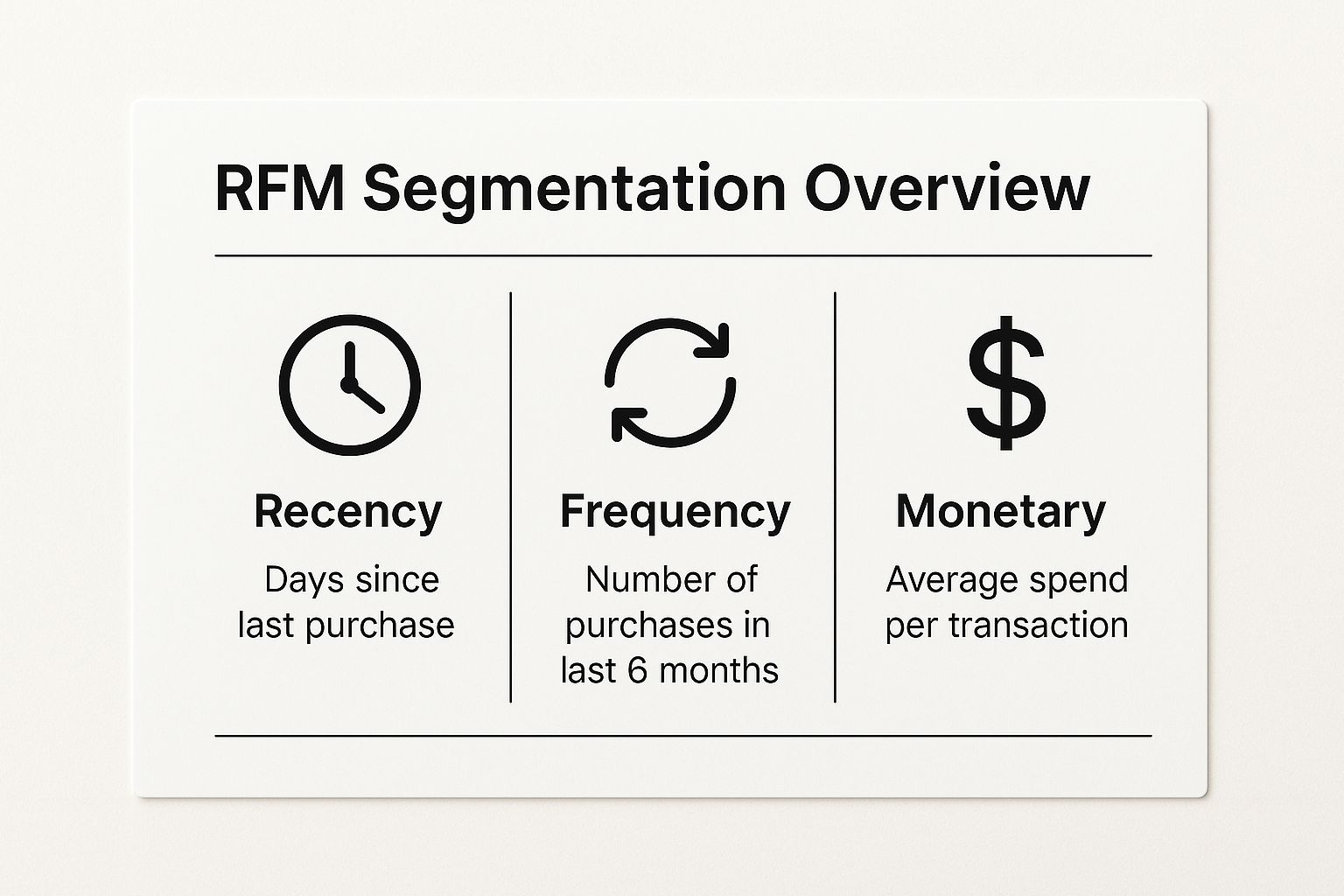
While demographic or psychographic profiles provide context, RFM gives you a direct, actionable hierarchy of your customer base. It allows you to quickly identify your champions, your at-risk customers, and everyone in between, enabling laser-focused communication. This is one of the most efficient customer segmentation strategies for prioritizing marketing spend and effort.
Why It's Foundational
Think about Amazon's masterful use of targeted promotions. They don't send the same offer to a customer who buys weekly versus one who hasn't purchased in a year. The first customer (high recency and frequency) might get a loyalty reward, while the latter (low recency) receives a "we miss you" discount. This is RFM in action. Similarly, retail loyalty programs use RFM scores to identify VIPs who receive exclusive perks, fostering loyalty and increasing their already high monetary value.
Key Insight: RFM analysis tells you which customers are most engaged and valuable right now. A customer who bought yesterday is far more likely to buy again than one who bought a year ago, regardless of their demographic profile.
Actionable Implementation Tips
To leverage RFM effectively, you must move from scoring to action. The scores themselves are just numbers; their power lies in the distinct strategies you build for each segment.
- Define Your Segments: Don't just score customers from 1-5 on each metric. Create named segments like "Champions" (high R, F, M), "At-Risk Customers" (low R, high F/M), and "New Customers" (high R, low F/M). Each name implies a specific marketing action.
- Tailor Your Actions: Your "Champions" should receive loyalty rewards and early access to new products. Your "At-Risk" group needs a targeted win-back campaign. Your "New Customers" require an onboarding sequence to encourage a second purchase.
- Recalculate and Automate: RFM scores are not static. A customer's status can change with every purchase or period of inactivity. You must regularly recalculate scores and automate the corresponding marketing campaigns to keep your efforts relevant and timely.
7. Needs-Based Segmentation: Aligning with Customer Purpose
Across my career, I've found that the most powerful growth lever is a deep, almost obsessive, focus on the customer's core problem. Needs-based segmentation moves beyond who the customer is (demographics) or what they do (behavior) to uncover why they are looking for a solution in the first place. This strategy groups customers based on the specific "job" they are trying to get done, the problem they need to solve, or the fundamental need they seek to fulfill. It is one of the most customer-centric customer segmentation strategies available.
This approach, heavily influenced by Clayton Christensen's "Jobs to be Done" theory, forces a profound shift in perspective. Instead of pushing a product, you pull customers in by offering the perfect tool for their specific job. It’s about understanding the underlying motivation, the "why" behind the purchase, which unlocks unparalleled opportunities for creating value and fostering loyalty.
Why It's Foundational
Think about a job search platform like LinkedIn. It doesn't just see "users"; it sees distinct need-based segments. There's the recent graduate whose "job" is to land their first professional role, the mid-career professional looking for a leadership position, and the passive candidate who needs to be enticed by a compelling opportunity. Each group requires different features, content, and messaging because their underlying needs are fundamentally different. Financial services firms do this by targeting life events like buying a home or planning for retirement, each representing a unique cluster of needs.
Key Insight: People don't buy products; they "hire" them to do a job. Understanding that job is the key to creating a solution they can't live without.
Actionable Implementation Tips
To effectively implement needs-based segmentation, you must become an expert in your customer's world.
- Embrace the 'Jobs to be Done' Framework: Conduct in-depth customer interviews not about your product, but about their process, struggles, and desired outcomes. Ask "why" repeatedly to uncover the core need driving their search for a solution.
- Map Needs to the Customer Journey: Identify how customer needs evolve at different stages of their journey, from awareness to post-purchase support. This reveals opportunities for need-specific interventions and features that build momentum.
- Validate with Behavioral Data: Your qualitative insights about customer needs must be validated with quantitative data. Do customers with a specific "need" actually engage with the features you built for them? Use analytics to confirm your hypotheses and refine your segments.
8. Technographic Segmentation: The Digital Footprint
In my work with SaaS and tech-forward companies, I’ve found that one of the most predictive customer segmentation strategies is also one of the most overlooked: technographics. This modern method categorizes customers based on their technology stack, digital tool usage, device preferences, and overall technical sophistication. In a world where your customer’s tech choices directly impact their business operations and purchasing decisions, understanding their digital footprint is no longer a luxury, it's a necessity.
Technographics tell you how your customers operate. It moves beyond who they are (demographics) and what they value (psychographics) to reveal the tools and platforms they rely on. For B2B companies, this is gold. Knowing a prospect uses Salesforce, HubSpot, or Marketo allows you to tailor your integration messaging and sales pitch with surgical precision. It’s the difference between a generic cold call and a highly relevant strategic conversation.
Why It's Foundational
Think about it: a company heavily invested in the Adobe Experience Cloud has different needs and integration requirements than one running on a collection of open-source tools. Software companies like HubSpot are masters of this, segmenting their outreach based on a prospect's current marketing automation platform. This allows them to highlight specific pain points and migration advantages. Similarly, mobile app developers must create distinct marketing funnels for iOS versus Android users, as their platform loyalties often correlate with different spending habits and feature expectations.
Key Insight: Technographic data isn't just about what technology a customer uses; it's a powerful proxy for their operational maturity, budget, and strategic priorities.
Actionable Implementation Tips
To effectively leverage technographics, you must go beyond simple tool-spotting and analyze the underlying signals.
- Map the Ecosystem: Don't just identify one piece of software. Use tools to map out a prospect's entire tech stack. Understanding how their CRM, marketing automation, and analytics platforms interact reveals their operational workflow and potential gaps your solution can fill.
- Segment by Digital Maturity: Group customers by their level of tech adoption. A company just adopting its first CRM is a different segment from a power user with a fully integrated martech stack. Your messaging, onboarding, and support must adapt to their sophistication level.
- Monitor Technology Trends: The tech landscape changes rapidly. Regularly monitor adoption trends for new software and platforms within your target industries. This allows you to anticipate customer needs and proactively tailor your product roadmap and marketing messages.
9. Lifecycle Stage Segmentation: The Journey-Based Approach
In my experience orchestrating growth, I’ve learned that a customer's value isn't a static number; it's a dynamic story. Lifecycle Stage Segmentation treats customers not as transactions, but as partners on a journey. This powerful method involves grouping customers based on where they are in their relationship with your brand, recognizing that their needs, behaviors, and value evolve significantly over time. It's about delivering the right message at the right moment, from initial awareness to loyal advocacy.
This approach is a cornerstone of modern customer segmentation strategies because it’s inherently proactive. Instead of just reacting to past behavior, it anticipates future needs. It helps you understand if a customer is a new lead needing education, a paying user primed for an upsell, or a long-time advocate who can drive referrals. Ignoring this progression is like trying to have the same conversation with a first date and a spouse of ten years; the context and goals are entirely different.
Why It’s Foundational
The brilliance of lifecycle segmentation lies in its alignment with the customer journey. SaaS platforms like HubSpot have built their empires on this concept, nurturing users from a free trial to a fully integrated, multi-product subscription. They don't just sell software; they guide a user's growth. Similarly, financial services firms excel by targeting key life events. They offer a student loan to a college student, a mortgage to a newly married couple, and retirement planning to a seasoned professional, all based on that individual’s personal lifecycle.
Key Insight: Lifecycle segmentation transforms your marketing from a series of disconnected campaigns into a cohesive, guided journey that builds relationship equity and lifetime value.
Actionable Implementation Tips
To effectively segment by lifecycle stage, you must define clear, data-driven transitions between each phase.
- Define Stage Gates: Establish specific, measurable criteria that move a customer from one stage to the next. For a SaaS business, this could be completing onboarding (New User → Activated User) or using a specific feature set five times (Activated User → Engaged User).
- Automate Progression: Use marketing automation platforms to trigger stage-specific communication. When a user crosses a threshold, they should automatically receive content, offers, and support relevant to their new stage, ensuring a seamless experience.
- Monitor Velocity: Track how quickly customers move between stages. A bottleneck might indicate friction in your product or a gap in your communication. Analyzing this "stage velocity" is a critical health metric for your customer base.
10. Firmographic Segmentation: The B2B Blueprint
For my colleagues in the B2B world, firmographic segmentation is not just another strategy; it's the absolute table stakes. This is the business-to-business equivalent of demographics, where we categorize organizations based on their specific, observable attributes. Think of factors like industry vertical, company size, annual revenue, employee count, and geographic location. Just as you wouldn't sell a skateboard to a retiree, you wouldn't pitch enterprise-grade software to a five-person startup.
In my experience building growth engines for B2B SaaS companies, I've seen firsthand that a clear firmographic focus prevents wasted effort. It allows sales and marketing teams to align their resources precisely on the accounts that have the highest potential for conversion and long-term value. This is one of the most direct and powerful customer segmentation strategies for any business that sells to other businesses. It’s about focusing your firepower where it will have the greatest impact.
Why It's Crucial for B2B
This approach is how industry titans create their empires. Salesforce, for example, excels at this by offering different product tiers and sales approaches for SMBs versus Fortune 500 enterprises. Similarly, a specialized consulting firm might only target healthcare companies with over $1 billion in revenue because their solutions are tailored to the complex regulatory and operational challenges of that specific segment. This focus creates deep domain expertise and a powerful competitive moat.
Key Insight: Firmographics answer the "who" and "where" of your B2B market. It defines your total addressable market and provides the critical first filter for all lead generation and account-based marketing efforts.
Actionable Implementation Tips
To effectively use firmographic data, it must be both accurate and integrated into your go-to-market motion.
- Enrich Your Data: Don't rely solely on information provided in a contact form. Use data enrichment tools like Clearbit or ZoomInfo to append firmographic details to your CRM records, ensuring your data is complete and up-to-date.
- Align Sales and Marketing: Firmographic segments should form the basis of your Service Level Agreement (SLA) between sales and marketing. Define exactly which industries, company sizes, or revenue brackets constitute a Marketing Qualified Lead (MQL) to ensure seamless handoffs.
- Layer with Other Segments: Combine firmographics with behavioral data (e.g., which companies are visiting your pricing page) and technographic data (e.g., what existing software they use) to identify accounts that are not only a good fit but are also showing active buying intent.
Customer Segmentation Strategies Comparison Guide
| Segmentation Type | Implementation Complexity 🔄 | Resource Requirements ⚡ | Expected Outcomes 📊 | Ideal Use Cases 💡 | Key Advantages ⭐ |
|---|---|---|---|---|---|
| Demographic Segmentation | Low — easy to collect & use | Low — widely available data | Basic customer grouping, limited predictive power | Mass marketing, regulatory-friendly targeting | Simple, cost-effective, clear segments |
| Behavioral Segmentation | High — requires complex data | High — data collection & analysis | Highly predictive, personalized marketing | E-commerce, loyalty programs, personalized offers | Data-driven, tied to business outcomes |
| Psychographic Segmentation | High — specialized research | High — surveys, focus groups | Deep emotional connections, brand loyalty | Lifestyle brands, emotional engagement | Strong brand differentiation, targeted messaging |
| Geographic Segmentation | Low — location data readily available | Low — cost-effective local marketing | Regional adaptation, cultural relevance | Retail chains, global products, localized marketing | Easy targeting, clear boundaries |
| Value-Based Segmentation | Medium-High — analytics needed | Medium — requires profitability data | Maximized ROI, prioritization of high-value customers | Loyalty programs, enterprise clients | Focus on profitability, resource optimization |
| RFM Segmentation | Low — straightforward scoring | Low — transactional data | Identifies valuable & at-risk customers | Retail, subscription services, email targeting | Simple, revenue-focused, automated |
| Needs-Based Segmentation | High — deep customer research | High — qualitative & quantitative | Highly relevant value propositions | Complex products/services, innovation-driven markets | Customer-centric, reduces price competition |
| Technographic Segmentation | Medium — technical tracking | Medium — digital analytics tools | Optimized digital experiences & channel strategies | Digital-first companies, tech products | Predicts tech behavior, enhances digital marketing |
| Lifecycle Stage Segmentation | Medium-High — automation needed | Medium — automation & data tracking | Improved customer journeys, timely messaging | SaaS, financial services, B2B growth | Optimizes interaction timing, increases conversions |
| Firmographic Segmentation | Medium — business data sources | Medium — business databases | Targeted B2B marketing, qualified prospecting | B2B sales, enterprise solutions | Essential for B2B, industry-specific targeting |
From Strategy to Execution: Activating Your Segmentation Model
Throughout my career, I've seen countless companies invest heavily in data platforms, only to fall short at the last mile: activation. We've journeyed through a powerful arsenal of ten distinct customer segmentation strategies, from foundational demographic and firmographic models to the highly nuanced behavioral, psychographic, and AI-driven approaches. The lesson I've learned, often the hard way, is that the magic isn't in choosing a single "best" model. It's in the artful synthesis of several.
The most potent strategies are almost always hybrids. You might start with firmographics to identify target industries and company sizes, but that alone is a blunt instrument. True precision comes when you layer on technographic data to understand their tech stack, behavioral data to see how they engage with your product, and value-based segmentation to pinpoint which accounts are driving the most profit, not just revenue. This multi-layered view transforms a generic list into a strategic map of your market.
Moving Beyond Analysis to Alignment
The ultimate goal of any segmentation exercise is not to produce a beautiful slide deck or a complex dashboard. The goal is to drive action and achieve organizational alignment. A segmentation model that lives exclusively within the marketing department is a missed opportunity. Its true power is unlocked when it becomes the common language spoken across marketing, sales, product development, and customer success.
Think about it this way:
- Product Teams can use needs-based and behavioral segments to prioritize features for the most valuable user groups, directly linking development efforts to retention and LTV.
- Sales Teams can leverage lifecycle stage and RFM segmentation to focus their outreach on high-potential leads and at-risk accounts, dramatically improving efficiency and conversion rates.
- Customer Success can use value-based and psychographic insights to tailor onboarding and support, fostering loyalty and turning high-value customers into vocal brand advocates.
Key Takeaway: Effective segmentation breaks down internal silos. When every team operates from the same understanding of who the most valuable customers are and what they need, the entire organization moves in lockstep toward a unified growth objective.
Your Actionable Path Forward
Analysis paralysis is the enemy of progress. The most successful growth leaders I know are pragmatists who prioritize momentum. Don't wait for the "perfect" model; start with what you have and commit to an iterative process of refinement.
Here are your immediate next steps to put these customer segmentation strategies into practice:
- Start with a Foundational Layer: Choose a primary model that is easiest to implement with your current data. For a B2B SaaS company, this is likely firmographic. For a D2C e-commerce brand, it might be behavioral.
- Enrich with a Second Dimension: Select a second, more nuanced model to add depth. Layer psychographic or needs-based data onto your demographic base. Combine RFM analysis with behavioral triggers. This is where you'll start to uncover high-impact insights.
- Define and Test One High-Value Segment: Don't try to boil the ocean. Identify a single, promising segment and build a pilot campaign around it. Personalize the messaging, the offer, and the channel. Measure the results rigorously.
- Socialize the Wins: Once you have a proven win, share it across the company. Show the sales team how tailored outreach improved close rates. Show the product team how a feature request from a key segment reduced churn. This builds the internal momentum needed for wider adoption.
Segmentation is not a one-time project; it is a dynamic, evolving capability that sits at the very heart of a customer-centric growth engine. It is the critical bridge between understanding your customers and serving them with the precision and relevance they now expect. Mastering this discipline is no longer a competitive advantage, it is a fundamental requirement for sustainable growth in today's market.
Ready to move from theoretical models to tangible revenue growth? At MGXGrowth, we specialize in implementing the data frameworks and operational workflows that turn customer segmentation into your most powerful growth lever. Let's build your execution plan together. Learn more at MGXGrowth.
