


Improving operational efficiency isn’t about chasing smaller expense reports. After decades of driving growth in SaaS, real estate, and hospitality, I can tell you it's about strategically creating value. It’s about getting into the trenches of your core processes, eliminating the friction that slows you down, and automating the grunt work so your best people can focus on what actually moves the needle. The goal isn't just to cut costs; it's to build a smarter, faster, more resilient company from the ground up.
Rethinking Operational Efficiency Beyond Cost Cutting
For decades, I've watched countless executives chase "efficiency" by taking a red pen to their budgets. Slashing travel, freezing hiring, cutting marketing spend—it's a familiar, defensive playbook. But let me be direct: that isn't a strategy for sustainable growth. It's a race to the bottom that often damages morale and suffocates innovation.
True operational efficiency isn't about doing more with less. It’s about doing more of what actually drives growth. We need to reframe this entire concept from a cost-saving tactic into an offensive, value-creating engine for your business.

From Defensive Cuts to Offensive Growth
Genuine efficiency is the force that fuels your most important initiatives. When you eliminate waste from your processes, you're not just saving money; you're freeing up your best people to focus on high-impact work. This is how you unlock real competitive advantages.
I’ve seen this firsthand in SaaS, real estate, and hospitality. Inefficiencies aren't just line items on a P&L; they are friction points that slow down your teams and frustrate your customers.
The most critical shift is moving from a mindset of "How can we spend less?" to "How can we generate more value with the resources we have?" This question changes everything. It forces you to connect operational improvements directly to customer satisfaction and revenue growth.
When your operations run smoothly, the benefits compound across the organization. The table below breaks down this fundamental shift in thinking.
Core Pillars of Strategic Operational Efficiency
| Pillar | Traditional Focus (Cost-Cutting) | Strategic Focus (Growth-Driving) |
|---|---|---|
| People | Reducing headcount; freezing hiring. | Empowering teams; investing in training and automation to free up talent for high-value tasks. |
| Process | Eliminating "nice-to-have" steps; enforcing rigid controls. | Removing friction; designing workflows that improve speed, quality, and customer experience. |
| Technology | Cutting software licenses; delaying upgrades. | Investing in tools that provide a clear ROI through productivity gains and better data. |
| Metrics | Lower operational expenses; reduced cost-per-unit. | Faster time-to-market; higher customer lifetime value (CLV); improved employee satisfaction. |
This framework is designed to help you build that high-performance engine by focusing on the right side of that table. It comes down to a few key areas:
- Pinpointing High-Impact Areas: Identifying the specific bottlenecks in your workflows that are costing you more than just money—they're costing you momentum.
- Measuring What Truly Matters: Moving beyond vanity metrics to KPIs that reflect real progress in customer value and team productivity.
- Building a Resilient Culture: Embedding a mindset of continuous improvement where every team member is empowered to identify and solve for inefficiency.
This is my C-suite perspective on how to improve operational efficiency not by shrinking, but by strategically building a stronger, more agile organization.
Pinpointing Friction with a Brutally Honest Process Audit
You can't fix a problem you can't see. Before you throw a single dollar at new software or a major team restructuring, your very first move should be a brutally honest audit of your core workflows. This isn't about making pretty flowcharts to hang on a wall; it’s about getting into the trenches and mapping out how work actually gets done in your organization.
I've seen it time and again. Too many leaders operate on assumptions about their own processes. I’ve walked into multi-billion dollar companies where the executive team’s idea of the sales cycle was completely disconnected from what their account executives were doing every single day. The outcome is always the same: wasted resources, frustrated teams, and stalled growth.
A real audit is an exercise in asking tough, even uncomfortable, questions. It’s about tracing the path of value from its starting point—be it a new sales lead or a customer support ticket—all the way to its resolution.
Mapping the Real-World Workflow
Your objective here is to find the friction points—the little snags and big roadblocks that drain resources and kill momentum. I always recommend starting small by focusing on a few critical, high-impact processes. Don't try to boil the ocean. Just pick one or two that directly touch your customer or your revenue.
- Lead Capture to Sales Handoff: Where are your marketing-qualified leads getting stuck? How long does it actually take for a sales rep to make that first contact? I once advised a SaaS company where we discovered a 48-hour lag in this exact handoff. It was a black hole created by something as simple as incompatible CRM fields between the marketing and sales teams.
- Customer Onboarding: What are the literal steps a new customer has to go through to get value from your product? We found a marketplace client had seven manual data-entry steps that required input from three different departments just to activate a new seller's account. No wonder they had a churn problem.
- Product Development to Launch: How does an idea truly move from a concept to deployment? I often find the biggest delays aren't in the coding at all, but in the tangled approval and review cycles between siloed departments.
This visual flow breaks down the core sequence for this kind of audit. You start by mapping the process, then you measure its performance, and only then can you really spot the best opportunities for automation.
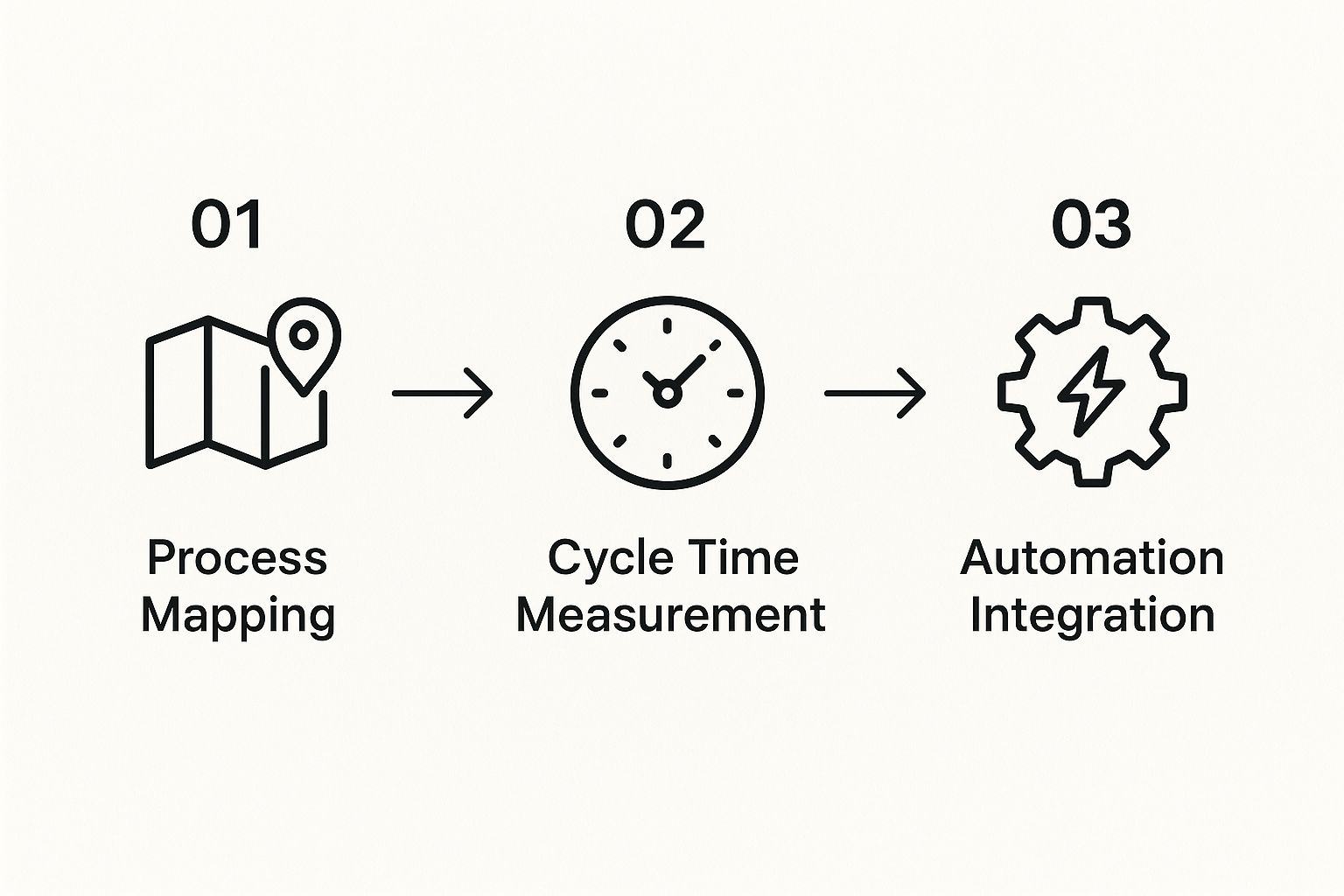
It’s a simple progression, but it’s critical. You have to understand a process before you can improve it, and you must measure it before you can effectively automate it.
Combining Hard Data with Human Insight
A truly effective audit blends the quantitative with the qualitative. The numbers will tell you what is happening, but only your people can tell you why.
First, gather your quantitative metrics. Things like cycle time (the total time from start to finish), throughput (how many units get processed in a set time), and error rates. These are your objective performance indicators, your cold, hard facts.
But the real gold is in the qualitative insights. You need to sit down with the people on the front lines—the sales reps, the support agents, the project managers. Ask them this simple question: "If you could wave a magic wand and fix one broken part of this process, what would it be?"
I promise you, their answers will point you directly to the biggest bottlenecks. When you combine hard data with this on-the-ground intelligence, you transform a simple audit into a prioritized, actionable plan for improving operational efficiency right where it matters most.
Using Automation and Digital Tools as a Strategic Lever
Technology can be an incredible force for efficiency, but I've seen it go wrong more times than I can count. Too many companies just throw new software at a broken process hoping for a miracle. All they end up with is faster, more expensive chaos.
The goal isn't just to digitize a flawed workflow. It's to completely rethink and redesign it with technology as a core part of the strategy.
Once you’ve audited your processes, you should have a clear hit list of tasks that are practically begging for automation. I'm talking about the repetitive, data-heavy, rule-based work that bogs down your best people and opens the door for human error.

Find Your High-Impact Automation Targets
First things first, go after the low-hanging fruit. Where are your teams burning hours on tasks that demand consistency but not much creative thinking? These are your prime candidates.
- Data Syncing: Just think about the time wasted copying customer info from your CRM to your ERP or invoicing software. This is a classic, error-prone task that an automation tool can handle perfectly every single time.
- Report Generation: How many hours does your team lose each week just pulling the same data from different places to build a standard report? Automating this frees up your analysts to actually analyze the data, not just collect it.
- Standard Communications: Think about customer onboarding emails or payment reminders. Automating these sequences not only saves a ton of time but also guarantees every customer gets a consistent, professional experience.
This isn't about replacing people. It's about freeing them from the grind so they can focus on the strategic, high-value work that actually moves the needle.
Empower Your Teams with Low-Code Platforms
In this day and age, you can't afford to let every small automation idea get stuck in a six-month IT queue. This is where low-code and no-code platforms like Zapier or Make are changing the game. They put the power to build solutions directly into the hands of the people who know the workflows inside and out.
When you give a marketing ops manager the ability to connect two apps on their own, or a sales leader the tools to automate lead assignments, you build a more agile and responsive organization. It spreads out the problem-solving and creates a culture where everyone owns a piece of the efficiency puzzle.
The real magic happens when you move beyond just automating a single task and start thinking about true workflow integration. When you connect your different systems, you create a seamless flow of information that transforms how work gets done.
The move toward automation is one of the biggest drivers of operational efficiency today. Industry reports consistently show that it slashes time spent on repetitive tasks and dramatically cuts down on human errors. Businesses that automate their predictable workflows find they can scale up with fewer resources and less risk. You can find more details on these operational efficiency trends and how they're shaping the business world.
Ultimately, using technology this way is about building an operational ecosystem where information flows without friction, manual drudgery is a thing of the past, and your team is laser-focused on the work that truly requires their unique human talent.
Weaving Continuous Improvement into Your Company's DNA
Let’s be clear: boosting operational efficiency isn’t a one-and-done project you can check off a list. It’s a complete cultural shift. The most successful turnarounds I’ve ever been a part of weren't driven by top-down mandates that lost steam after a quarter. They were built from the ground up, championed by the very people who live inside these processes day in and day out.
The real goal here is to create an environment where every single employee feels empowered—not just permitted—to spot and fix inefficiencies. This is where you find the kind of gains that actually stick. But getting there requires a thoughtful, structured approach to changing how people view their own work.
Honestly, this is the non-negotiable part. I’ve watched technically perfect automation projects completely implode because the company culture just wasn't ready for the change. If you don't get buy-in from your people, the fanciest process maps and software are just expensive wall art.
Tear Down Silos with 'Tiger Teams'
One of the most common mistakes I see is companies trying to solve a departmental problem using only people from that department. It never works. The truth is, your most important workflows—everything from generating a lead to onboarding a new customer—slice right through multiple teams. A siloed view can’t possibly solve a cross-functional problem.
This is why I’m a huge advocate for creating cross-functional 'tiger teams'. These are small, nimble groups pulled together from different departments to tackle one specific process challenge.
- Here's a real-world example: At a SaaS company I worked with, the customer onboarding process was painfully slow. We put together a tiger team with someone from sales, a customer success manager, an engineer, and a representative from the billing department. Their mission was simple: cut the average onboarding time by 30% in 90 days.
- What happened? Once they were all in the same room, they realized the bottlenecks weren't inside any single department. The real friction was in the handoffs between them. When the sales team finally understood the headaches they were creating for engineering, and engineering saw how their process impacted support, they completely redesigned the flow in just a few weeks.
This approach doesn't just solve a problem; it forces collaboration and builds empathy. When your teams truly grasp the downstream impact of their work, they start solving for the bigger picture instead of just protecting their own turf.
Create Feedback Loops People Actually Trust
Your frontline employees know where the problems are. They see the broken steps, the pointless tasks, and the customer frustrations that are often completely invisible to leadership. You have to build safe, structured channels for that priceless insight to make its way to the surface.
And no, an "open-door policy" isn't enough. I'm talking about implementing formal, blameless feedback systems. Things like regular 'process retrospectives' or even an anonymous digital suggestion box can work wonders. The absolute key, though, is to visibly act on the feedback and tell people what you’ve changed. When employees see their ideas are taken seriously, they transform into your most powerful allies for improvement.
A culture of continuous improvement is built on psychological safety. Your team has to know, without a doubt, that they can point out a flaw without fearing blame or criticism.
This isn't just a niche concern. A recent PwC survey on digital trends found that boosting operational efficiency is a massive priority across the board, with 93% of energy sector companies calling it critical. The research is clear: businesses that invest in things like digital supply chains and data analytics are the ones slashing costs and getting to market faster. You can dig into more of the findings on digital supply chain management to see how this is playing out in different industries.
At the end of the day, the audits and the tools are just the starting line. The real engine of efficiency is a culture where every single person on your team is obsessed with finding a better, smarter way to get things done.
Measuring Success with KPIs That Actually Matter
You’ve probably heard the old saying, "What gets measured gets managed." It's a classic for a reason. But I've seen far too many organizations get completely sidetracked by vanity metrics—the kind that look impressive in a presentation but have zero connection to actual business growth. Chasing the wrong key performance indicators (KPIs) is one of the fastest ways to burn resources while thinking you're making progress.
The real goal is to establish KPIs that are a direct reflection of your operational health. They need to connect the dots between your process improvements and high-level business goals. This means moving beyond simplistic output numbers and focusing on indicators that tell a story about speed, quality, and the value you deliver to customers.

Shifting from Output to Impact
I once advised a SaaS company that was obsessed with one support metric: the number of tickets closed per agent. On the surface, it seemed logical. More tickets closed must mean more work is getting done, right? But their customer satisfaction (CSAT) scores were flat, and customer churn was slowly creeping up.
When we dug in, the problem was obvious. The team was incentivized to close tickets as fast as possible, which often led to rushed, incomplete answers. This just forced customers to open a new ticket or reply again, creating a frustrating cycle of repeat inquiries. The real issue wasn't the volume of tickets; it was the quality of the resolution.
We completely changed their focus by shifting the primary KPI from 'tickets closed' to 'First-Contact Resolution Rate'. Suddenly, the incentive wasn't about speed at all costs; it was about solving the customer's problem correctly the very first time.
That single change had a massive ripple effect. Agents spent more time on each initial ticket, but the number of repeat inquiries plummeted. This freed up a huge amount of team capacity, their CSAT scores jumped by 15% in just two quarters, and morale soared because the team felt they were actually helping people.
Key Performance Indicators for Operational Efficiency
To get a true picture of your operational efficiency, you need a set of metrics that connect what your teams are doing day-to-day with the company's financial goals. Your KPIs should tell a complete story. The table below outlines some of the most impactful KPIs I've seen companies use to drive real growth, moving beyond simple cost and output metrics.
| KPI | What It Measures | Why It Matters for Growth |
|---|---|---|
| Cycle Time | The total time from the start to the end of a process (e.g., "lead to close" or "bug report to fix deployed"). | A shorter cycle time means you deliver value to customers faster, which directly impacts revenue and satisfaction. |
| Throughput | How many units of work are completed in a specific timeframe. | This is a pure measure of your process capacity and is crucial for identifying and eliminating bottlenecks. |
| First-Contact Resolution | The percentage of customer issues resolved in the first interaction. | High FCR lowers operational costs, frees up team capacity, and dramatically improves customer satisfaction. |
| Customer Satisfaction (CSAT) | A direct measure of how happy customers are with a specific interaction or product. | This is the ultimate gut check. If your efficiency gains are making customers unhappy, you're optimizing the wrong thing. |
| Employee Engagement | The level of commitment and enthusiasm an employee has for their work and the company. | Unhappy, burnt-out teams are never efficient. Engagement is a leading indicator of future productivity and quality issues. |
By tracking a balanced set of indicators like these, you can ensure that your efforts to become more "efficient" are also making your business stronger, more resilient, and better at serving its customers. This creates a clear line of sight from the daily grind to the bottom line.
The Human Element Fueling Your Efficiency Engine
Across every industry I’ve worked in, from SaaS to hospitality, I’ve seen one truth hold firm: you can have the most perfectly designed processes and the most advanced tech, but a disengaged, burnt-out team will sink your operations. Your people are the engine. Treating their well-being as some "soft" HR initiative instead of a hard-nosed business strategy is a catastrophic mistake.
Sustainable efficiency is a direct byproduct of a positive employee experience. When you give people the right digital tools, invest in their professional growth, and offer genuine flexibility, the impact on productivity and quality is immediate and measurable. This isn't just about morale; it’s about tangible results like lower error rates, higher retention, and a greater capacity for innovation.
The Data-Driven Case for Employee Well-Being
Don't just take my word for it—the connection between workforce engagement and operational performance is clear as day in the data.
Disengaged employees cost the global economy an estimated $8.9 trillion in lost GDP. That's a staggering drain on productivity. In the U.S. alone, poor employee health is responsible for another $575 billion in lost productivity every year.
Conversely, the data shows a clear upside. Workers who have flexible working conditions are 39% more productive. And those working remotely report a 22% increase in deep-focus work compared to being in a traditional office. You can dig into more productivity statistics that connect well-being to business outcomes to see just how strong this link is.
An engaged, empowered, and well-supported workforce isn't an expense on your P&L. It is your single greatest asset in achieving operational excellence and building a resilient, high-growth business.
Ultimately, any real journey to improve operational efficiency has to be human-centric. Empowering your team really boils down to giving them three critical things:
- The Right Tools: Give them technology that removes friction from their day, not adds to it.
- A Path for Growth: Invest in training and development that shows them they have a real future with your company.
- Trust and Autonomy: Offer flexibility in how and where work gets done. Focus on the outcomes, not just the hours logged.
When you put your people first, you create a self-sustaining cycle. Supported employees drive superior operational results, which in turn fuels further business growth.
Frequently Asked Questions
Over the years, I've heard the same questions pop up again and again from executives trying to get a handle on their operations. Here are my straight-to-the-point answers to the most common ones.
Where Is the Best Place to Start Improving Operational Efficiency?
Start where the pain is most acute for your customer. It's that simple. I always push leaders to look at the processes that directly touch the customer experience first.
Take a hard look at your customer onboarding, how you handle support tickets, or your product delivery workflow. These areas are almost always ripe with opportunities for quick wins. When you make improvements here, you're not just trimming internal fat—you’re immediately boosting customer satisfaction and loyalty, which pays dividends across the entire business.
How Do I Get Buy-in From My Team for These Changes?
You don't get buy-in by sending a memo from on high. You earn it by bringing people into the fold from the very beginning.
Pull your teams directly into the process audit. Sit down with them and ask a simple question: "What's the single most frustrating bottleneck you deal with every day?" When your people help identify the problem and have a hand in designing the solution, their buy-in isn't something you have to chase—it becomes a natural part of the journey.
A quick tip: Frame these initiatives as a way to eliminate the tedious, soul-crushing work from their plates, not as another way to squeeze more out of them. This simple shift in perspective—from cost-cutting to empowerment—is a much more powerful and genuine motivator.
What Is the Biggest Mistake Companies Make?
The single biggest blunder I see is treating efficiency as just another word for cost-cutting. That kind of tunnel vision might give you a small bump in the next quarter's numbers, but it creates deep, long-term damage. You end up with burned-out employees, a decline in quality, and frustrated customers.
Real operational efficiency is about creating more value with the resources you already have, not just spending less. Another classic mistake is rushing to buy shiny new software before you even understand the broken process you're trying to fix. All you'll accomplish is automating your existing chaos.
Ready to move from theory to execution? At MGXGrowth, we partner with executive teams to break down silos, implement data-driven strategies, and build the high-performance operational engine your business needs to scale. Let's architect your next stage of growth together. Find out how we can help at https://www.mgxgrowth.com.
