


A local restaurant growth agency isn't another line item on your marketing budget. I see it as a fractional growth partner—an extension of your leadership team whose sole purpose is to connect marketing, operations, and technology into a cohesive, profit-generating engine. Their mandate isn't chasing vanity metrics like likes or impressions; it's to drive tangible business outcomes like EBITDA growth, increased customer lifetime value, and improved RevPASH. They cut through the noise to focus on the levers that actually grow your bottom line.
Why Your Restaurant Needs a Growth Partner, Not Just a Marketer
Across my career driving growth in hospitality, SaaS, and marketplaces, I’ve seen a recurring pattern that cripples independent restaurants. They hire a marketing agency. They funnel thousands into campaigns, only to see their already razor-thin margins evaporate. This approach is fundamentally flawed because it treats a symptom—the need for more foot traffic—instead of diagnosing and solving the core business problem.
Here's the critical distinction: most marketing agencies operate on a task-based model. They deliver clicks, manage social media posts, and send an invoice. A true growth partner, on the other hand, is obsessed with outcomes. Their success isn't measured by campaign reach, but by the direct, quantifiable impact on your table turnover rate, average check size, and overall operational efficiency.
This infographic outlines how a growth-oriented view connects every marketing initiative to core operational and financial KPIs.
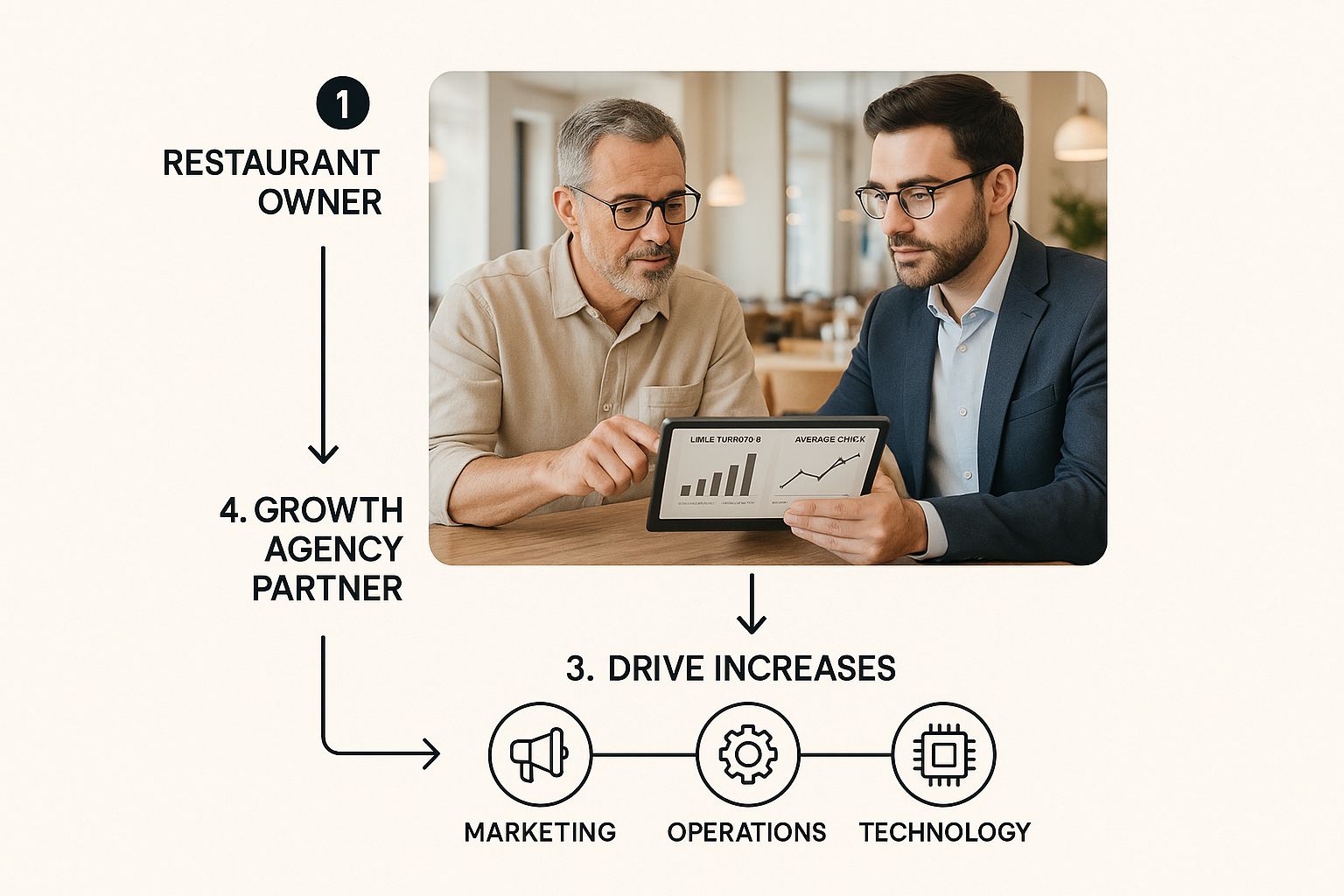
The central principle here is integration. Marketing activities, executed in a silo, are just noise. When integrated with operations and finance, they become a powerful growth lever.
The Brutal Reality of the Modern Restaurant Economy
Let's be candid about the current operating environment. The U.S. restaurant industry is projected to hit $1.5 trillion in sales by 2025, but this growth is not evenly distributed. Independent, full-service restaurants—the cultural anchors of our communities—are competing for a $253.9 billion segment of that market against formidable headwinds.
Most operators are grappling with labor shortages and navigating an average profit margin of just 3–5%. The traditional playbook is obsolete.
A marketer asks, "How can we get more engagement on this post?" A growth strategist asks, "How can we re-engineer the Tuesday night menu and corresponding digital campaign to increase our RevPASH (Revenue Per Available Seat Hour) by 15%?" The difference in framing dictates the outcome.
A growth partner dives deep into your business model. They break down the silos between front-of-house, the kitchen, and your digital presence. By analyzing your POS data, they identify latent revenue opportunities and help you construct robust restaurant revenue growth strategies that align every facet of the operation toward a single objective: sustainable, profitable growth.
Turning Vague Wishes Into Profitable KPIs

Before engaging a local restaurant growth agency, you must define what winning looks like in quantitative terms. I've witnessed countless businesses burn through capital because their objectives were qualitative and unmeasurable.
"We need more customers" is a wish, not a strategy. A true growth partner is data-driven, and you must provide them with the right metrics to optimize for.
From Top-Line Revenue to Bottom-Line Profit
To ensure accountability—both for an agency and your internal team—you must look beyond top-line sales. The financial health of your restaurant is revealed through a handful of Key Performance Indicators (KPIs). These metrics provide an unvarnished view of your profitability.
Your culinary, service, and marketing functions must be aligned, and that alignment is driven by the data that truly impacts the P&L.
Here are the core KPIs I advise every restaurant owner to build their dashboards around:
- Customer Acquisition Cost (CAC): The precise, fully-loaded cost to acquire a new customer, whether in-person or online.
- Customer Lifetime Value (CLV): The total net profit generated from a single customer over the entire duration of their relationship with your brand. A healthy LTV:CAC ratio is non-negotiable.
- Table Turnover Rate: A measure of asset utilization. How efficiently are you monetizing your most expensive asset—your physical space?
- RevPASH (Revenue Per Available Seat Hour): This offers a more granular view of revenue efficiency, calculating the revenue generated by each seat, every hour it's available.
An agency more enthusiastic about your Instagram followers than your RevPASH is a social media manager, not a growth partner. You are not building an audience; you are building a profitable enterprise.
Your KPIs Depend on Your Concept
The right metrics are never universal. The KPIs for a high-volume QSR are fundamentally different from those of an intimate, fine-dining establishment.
For example, the QSR might be laser-focused on optimizing its Customer Acquisition Cost through third-party delivery platforms and increasing its Average Order Value (AOV) by a specific dollar amount.
Conversely, the fine-dining restaurant is likely more concerned with increasing its table turnover rate on a Saturday night by a fractional amount and implementing a beverage pairing strategy to elevate the gross profit per table.
This initial step is critical. We must translate broad business ambitions into concrete, measurable targets that an agency can execute against.
From Vague Wishes to Actionable KPIs
Here is a framework for converting common restaurant goals into the data-driven KPIs a growth agency can build a strategy around.
| Common (But Vague) Goal | Data-Driven KPI | Why It Matters for Growth |
|---|---|---|
| "We need more customers." | Decrease Customer Acquisition Cost (CAC) by 15%. | Ensures growth is profitable, forcing efficient, targeted marketing spend rather than simply buying revenue. |
| "I want to be busier." | Increase table turnover rate by 10% during peak weekend service. | Focuses on maximizing revenue from existing fixed assets during high-demand periods. |
| "Let's increase sales." | Boost Average Order Value (AOV) from $45 to $52. | Drives incremental revenue from every transaction through strategic upselling and cross-selling. |
| "We need more repeat business." | Increase Customer Lifetime Value (CLV) by 20% within 6 months. | Shifts focus from transactional, one-off visits to building a long-term, high-value customer base. |
Note the shift in clarity. When you provide an agency with a precise target, the entire dynamic of the relationship changes.
The conversation moves from subjective marketing "activities" to a data-backed discussion about measurable business outcomes. This is the foundation of a real data-driven marketing strategy and the only way to select a partner who will generate a meaningful return on your investment.
My Vetting Checklist for Growth Agencies
Selecting a growth partner is one of the highest-leverage decisions a restaurant owner can make. A misaligned partner doesn't just exhaust your marketing budget; it consumes valuable time and can inflict lasting brand damage. I've seen it happen.
To mitigate this risk, you must look beyond polished case studies and assertive sales tactics. I've developed a vetting framework over the years to distinguish between task-oriented vendors and true strategic partners who comprehend the harsh realities of this industry.
Look for Deep Industry Specialization
First, I immediately disqualify generalist agencies. The restaurant industry operates under a unique set of constraints: perishable inventory, thin margins, and immense operational complexity. An agency that delivered results for a SaaS company or a dental practice lacks the specific operational context required to succeed here.
I ask a direct, pointed question: "Walk me through a campaign for a restaurant with a similar service model to mine. What were the specific KPIs, and what was the quantifiable impact on their P&L?"
If their response centers on vanity metrics like impressions or web traffic, the conversation is over. I need to hear them speak fluently about table turnover, RevPASH, COGS, and customer lifetime value. This is the language of our business.
A true local restaurant growth agency understands more than just marketing funnels; they understand inventory velocity, labor cost management, and the controlled chaos of a Saturday night service. They must grasp the entire operational ecosystem, not just a marketing silo.
Scrutinize Their Diagnostic Process
A premier agency never proposes a solution before conducting a thorough diagnostic. The initial discovery calls should feel like an interrogation—they should be asking you far more questions than you ask them. A major red flag is any agency presenting a pre-packaged "restaurant marketing plan." It signals a lack of strategic rigor.
These are the types of questions I expect a top-tier agency to ask me:
- Can you provide read-only access to your POS data and other relevant analytics platforms?
- What is your current average check size, and what has been its trajectory over the last 12 months?
- What are your busiest and slowest dayparts, and what is the corresponding labor cost percentage for each?
- Have you calculated the lifetime value of a repeat customer versus a first-time guest?
An agency that doesn't demand this data is planning to operate without a map. They are preparing to test tactics with your capital, which is a fundamentally unacceptable proposition.
Demand Proof and Verifiable References
Case studies are marketing collateral. References are evidence. I always require conversations with two or three current or former restaurant clients. This is non-negotiable.
When speaking with a reference, I bypass generic questions. I probe with specific, challenging inquiries to uncover the true nature of the partnership:
- Describe a time a campaign failed. How did the agency identify the failure, communicate it, and what was the strategic pivot?
- Provide an example of a proactive, strategic recommendation they brought to you that was outside the initial scope of work.
- How did they integrate with your operational team on the ground?
- What was the measurable, financial ROI you achieved from their engagement?
This process reveals far more about an agency's character and capability than any sales presentation. It demonstrates how they perform under pressure and whether they are a genuine partner or simply a vendor. In hyper-competitive markets like New York City, home to over 17,600 restaurants, agencies must be exceptionally agile and results-oriented to survive. That environment serves as an excellent benchmark for what to expect. To understand this landscape better, review these NYC restaurant industry and its trends.
Testing the Waters: How to Design a Pilot Project and De-Risk Your Investment

A core principle I've applied throughout my career is to never commit to a long-term engagement without a preliminary trial. The most effective way to de-risk an agency partnership is to initiate a small-scale, sharply defined pilot project. Consider it a paid audition. It provides an empirical basis for evaluating the working relationship before committing significant resources.
A well-designed pilot is not an amorphous "let's see what you can do" exercise. It is a strategic, 60- or 90-day engagement engineered to solve one specific, high-impact business problem. This methodology yields a clear, data-driven answer to the only question that matters: "Does this partnership generate a positive ROI?"
Picking the Right Problem to Solve
First, you must isolate a single, persistent challenge that a local restaurant growth agency can realistically address within the pilot timeframe. The goal is not to transform the entire business, but to move one critical metric that has a tangible impact on the bottom line.
Here are examples of effective pilot project objectives:
- Reduce reservation no-shows by 25% by implementing and optimizing a multi-channel confirmation and reminder system.
- Increase weekday lunch revenue by 15% through a targeted local digital advertising campaign and menu special.
- Lift average online order value by 10% by redesigning the digital menu to incorporate strategic upselling prompts.
Each objective is specific, measurable, achievable, relevant, and time-bound (SMART). Selecting the right target is paramount; it creates a clear framework for evaluating the agency's performance. For more ideas on targeted initiatives, our guide to restaurant digital advertising can help identify areas ripe for quick wins.
A successful pilot is judged on more than just the final KPI. It is a real-world test of the agency's communication cadence, proactivity, and ability to integrate with your operational staff. How they navigate unforeseen challenges is often more telling than the final report.
Laying Down the Ground Rules: Scope, Budget, and Metrics
Once the objective is defined, you must formalize the terms of engagement. I advocate for a concise, one-page document outlining the pilot's structure to prevent any ambiguity.
Your pilot agreement should codify these key elements:
- Scope of Work: A precise definition of the agency's deliverables. Will they be executing a geo-targeted ad campaign, re-engineering the online ordering UX, or building an email automation sequence? Specificity is key.
- Budget: A fixed, all-inclusive cost for the pilot. This avoids the pitfalls of open-ended retainers and enables a clean ROI calculation.
- Success Metrics: A clear definition of success. Define the baseline metric before the project commences and the target KPI to be achieved by the end of the 60 or 90-day period.
- Reporting Cadence: A pre-agreed schedule for communication. I find that weekly check-ins and a comprehensive final report provide the right balance of oversight and autonomy.
This disciplined methodology removes subjectivity from the evaluation process. It transforms a hopeful experiment into a calculated business decision and forces mutual alignment on what success looks like from day one—the cornerstone of any accountable partnership.
Measuring Real ROI and Long-Term Impact
The pilot project served its purpose. You’ve engaged a local growth agency. Now, your role shifts from vetting to performance management. Every dollar of investment must be accountable to a return.
This requires more than a cursory glance at a monthly report. It requires a concise, clean dashboard that tracks the KPIs we identified earlier. You must be able to isolate the agency's impact from market seasonality. Was the revenue increase in July a result of their patio promotion campaign, or was it simply seasonal lift? A competent partner will help you answer that question with data, not conjecture.
Beyond the Spreadsheet Metrics
True ROI is not exclusively captured on a P&L statement. Over my career, I've learned that the most valuable partnerships deliver strategic value that is often difficult to quantify in a spreadsheet. The hard financial metrics are essential, but they don't represent the full picture.
I ask a series of qualitative questions to assess this broader impact:
- Are they increasing my leverage? A great agency should feel like a force multiplier, creating bandwidth for me to focus on higher-level strategic work.
- Are they proactive thought partners? Are they bringing new, data-backed ideas to the table, or are they waiting for me to assign tasks?
- Are they breaking down silos? A true growth partner serves as the connective tissue between marketing, FOH, and BOH teams.
For example, a dashboard shouldn't just display marketing metrics in isolation. It should visualize the relationship between marketing inputs and core operational outputs.
This is the level of integration I expect. A dashboard like this connects a marketing initiative directly to critical operational metrics like Cost of Goods Sold and labor costs, providing a holistic view of business health.
Holding Partners Accountable When Times Get Tough
Any agency can appear competent in a favorable economic climate. The true test of a strategic partner is their performance during a downturn when consumer spending tightens. This is where I distinguish the strategists from the tacticians.
Current economic headwinds are materially impacting the restaurant industry. Recent data shows average tips have fallen, a leading indicator of shrinking consumer disposable income. Simultaneously, overall restaurant spending growth has turned negative. These are not abstract statistics; they are direct threats to your P&L that demand a swift, intelligent response. You can analyze these economic trends in the restaurant sector for a deeper understanding.
When a downturn hits, I expect an agency to pivot instantaneously. The strategic conversation must shift from, "How can we increase our ad spend?" to "How can we refine menu pricing, optimize labor scheduling, and leverage our CRM to drive high-margin repeat business?" If your agency cannot transition from a growth-at-all-costs mindset to a margin-preservation mindset when the market dictates, they are not a true growth partner.
Ultimately, measuring impact is about building a more resilient, antifragile business. The right agency doesn't just deliver a report; they help you construct a stronger, more adaptable operation. That is the only ROI that truly matters.
Answering Your Toughest Questions About Growth Agencies
Over my career, I've advised hundreds of restaurant owners on engaging external growth partners. The same questions and valid concerns consistently surface. Let's address them directly.
How Much Should I Expect to Pay?
This is invariably the first question, but it's framed incorrectly. While monthly retainers can range from $2,000 to over $10,000, the absolute cost is irrelevant without considering the return. Procuring services based on the lowest price is a reliable path to failure.
The correct question is, "What is the expected ROI on this investment?" A sophisticated local restaurant growth agency at $5,000/month that generates $15,000 in incremental, profitable revenue is a financially sound decision. Conversely, a $2,000/month agency that delivers no measurable impact is an expensive liability. You are not purchasing a list of marketing services; you are investing in business outcomes.
What’s the Real Difference Between a Marketing and Growth Agency?
The distinction is critical and frequently misunderstood. A traditional marketing agency is a vendor contracted to execute specific tasks. They manage ad campaigns, handle social media, and report on top-of-funnel metrics like clicks and impressions. Their focus is limited.
A growth agency is a strategic partner obsessed with the entire business system. They connect every marketing action to bottom-line financial and operational outcomes—profit margins, operational efficiency, and customer lifetime value. They are business strategists first, marketers second.
They will seek access to your POS data to inform menu engineering. They will analyze your online ordering UX to increase average ticket size. They will leverage customer data to build a loyalty program that drives profitable repeat visits. Their function is to dismantle the silos between your customer-facing activities and your core operations.
How Long Until I See Real Results?
I understand the need for velocity. While building sustainable, long-term growth is a marathon, you must see tangible leading indicators of success within the first 90 days. Patience is a virtue, but it should not be blind.
It may take six months or more to observe a significant impact on net profit. However, you should expect to see early, measurable wins in key metrics, such as:
- An improved conversion rate on online reservations.
- An increase in the velocity and sentiment of online reviews.
- A reduction in the customer acquisition cost from a specific channel.
This is precisely why a well-structured pilot project is indispensable. It establishes a clear, mutually agreed-upon milestone to be achieved within a compressed timeframe. An agency that claims it will take a year to show any measurable impact without defining clear interim benchmarks is a significant red flag.
Can't I Just Hire a Few Freelancers Instead?
You can, but in doing so, you are appointing yourself to the non-revenue-generating role of project manager. When you engage separate freelancers for SEO, social media, and email marketing, you become the sole point of integration. This is a classic formula for a fragmented strategy and inefficient capital allocation.
The primary value of a premier growth agency lies not in their individual tactical skills, but in the integrated, cohesive strategy they architect and execute. They function as the connective tissue ensuring that SEO insights inform social media content, which in turn fuels CRM campaigns. This unified, systems-based approach is what drives meaningful business results—and it liberates you from the operational burden of managing disparate tactical teams.
At MGXGrowth, we don't execute marketing tasks. We architect and implement growth systems that integrate every operational function with your bottom line. We partner with ambitious brands to drive quantifiable business results, translating raw data into sustainable, profitable revenue. Discover how we build growth strategies that deliver real business results.
