


When a restaurant's performance falters, it's rarely a single event. It's the culmination of negative trends—a slow erosion of margins, a gradual decline in customer traffic, a subtle shift in team morale. As a growth strategist who has revitalized businesses across multiple sectors, I see these patterns clearly. A restaurant business turnaround consultant is the specialist brought in not just for quick fixes, but to architect a data-driven recovery plan and rebuild the business for sustainable, long-term growth.
Recognizing the Symptoms of Restaurant Distress
After decades of driving growth in hospitality and beyond, I’ve learned that a struggling business is like any complex system showing signs of failure. The symptoms you observe—like empty tables on a Friday night—are merely the final output of deeper, systemic problems. Ignoring these signals is the fastest path to failure.
It's easy for owners to get trapped in the daily operational whirlwind, extinguishing one fire after another. This reactive state prevents them from seeing the foundational flaws eroding their business. They fixate on the what (sales are down) instead of performing a root-cause analysis of the why (perhaps the menu is misaligned with customer data, operations are inefficient, or the team culture is disengaged). A brutally honest, data-backed diagnosis is the first, non-negotiable step toward a turnaround.
The Most Common Red Flags
The warning signs are almost always hiding in your data, often disguised as just another challenging week. But when these issues become chronic, it’s a clear signal that an external perspective is required.
- Persistent Cash Flow Problems: Are you constantly juggling payables to meet payroll or satisfy suppliers? This is the clearest indicator that your cost structure is fundamentally misaligned with your revenue model.
- High Staff Turnover: A revolving door of employees isn’t just an HR issue; it's a significant financial drain and a clear signal of poor leadership, a toxic culture, or a miscalibrated compensation structure. It directly impacts service consistency and customer experience.
- Declining Customer Satisfaction: A surge in negative online reviews or a measurable drop-off in repeat customers are lagging indicators. By the time you see them, the root problem has already taken hold, and you're witnessing the public consequence. You can learn more about how to track this in our guide on client satisfaction measurement.
Separating Symptoms from Root Causes
A core part of my role is to look past the obvious symptoms and connect data points that internal teams, operating in silos, often miss. This is where an outside consultant’s cross-industry perspective delivers immense value. It’s about distinguishing the symptom from the underlying disease.
A common strategic error is treating symptoms with temporary fixes. Cutting labor hours might improve this week's P&L, but if inefficient scheduling is the root cause, you’re simply degrading service quality and guaranteeing future customer churn.
To illustrate, here’s how a strategist thinks differently about common restaurant challenges:
Diagnosing Distress Symptoms vs Root Causes
| Symptom (What You See) | Potential Root Cause (What a Consultant Finds) |
|---|---|
| High Food Costs | Outdated menu pricing, lack of a centralized procurement process, or poor inventory velocity. |
| Empty Dining Room | Ineffective marketing channels, a brand that doesn't resonate with the target demographic, or inconsistent service delivery. |
| Negative Online Reviews | Lack of standardized staff training, an uninspired menu, or operational bottlenecks in the kitchen impacting ticket times. |
| Low Staff Morale | Absence of clear leadership and performance metrics, inadequate incentive structures, or a toxic work environment. |
This analytical approach is what separates a temporary patch from a true, long-term solution.
The restaurant industry is notoriously competitive. While the 90% first-year failure rate is a myth, the reality remains stark. Data shows that around 17% of independent restaurants close within their first year. For those that survive, an estimated 70% may still fail within the next three to five years without significant operational and strategic evolution. Acknowledging these odds is the first step toward defying them.
How a Turnaround Consultant Drives Real Change
Let me be clear: a restaurant turnaround consultant isn't a magician. We don't implement solutions based on anecdote. We are strategists and operational architects. My function is to get under the hood of your business, diagnose the interconnected failures between your kitchen, front-of-house, and financial systems, and re-engineer them into a single, powerful engine optimized for growth.
Think of my role as an interim Chief Operating Officer. I bring an objective, data-driven perspective that’s nearly impossible to achieve when you’re mired in daily operations. When I engage with a business, the first step is to build a complete, unfiltered, 360-degree view of the entire operation.
The 360-Degree Business Audit
It all starts with what I call a 360-degree business audit. This is far more than a P&L review. I analyze everything—from supply chain efficiency and unit economics of every menu item to customer journey friction points. It's a deep, forensic analysis of your numbers, processes, and people.
We're looking for the precise points where value is leaking from your business. Is it in your financial structures? Your daily workflows and tech stack? Your market positioning? This initial phase is about creating a data-backed roadmap that focuses our collective energy on the initiatives with the highest potential for impact.
A huge part of this is breaking down silos to identify the root cause. Poor cash flow is a symptom, not the disease. The real problems are often hidden—an outdated POS system slowing down service, a poorly designed kitchen layout creating production bottlenecks, or marketing spend that isn't tied to customer acquisition cost (CAC). I've seen it all. We might end up re-engineering the cook line for efficiency, renegotiating supplier contracts based on volume, or implementing waste-tracking systems that improve both speed and food quality.
This diagram illustrates how a consultant's work integrates every part of the operation.
As you can see, it’s a multi-front strategy. We move from a comprehensive audit to laser-focused execution across finance, operations, and marketing.
From Diagnosis to Actionable Strategy
Once we've quantified the problems, the real work begins. The audit findings almost always highlight a few critical areas requiring immediate intervention:
- Rigorous Cost Control: We implement systems to track your prime costs—food, beverage, and labor—with precision. This isn't about arbitrary cuts. It's about intelligent optimization. We identify and eliminate waste, thereby boosting margins without compromising quality.
- Menu Engineering: Your menu is your most powerful sales tool. We analyze item-level contribution margins and sales velocity to engineer a menu that is a profit-generating machine, simplifies kitchen execution, and guides customers toward high-margin choices.
- Performance Marketing: Forget untracked, generic advertising. We build targeted marketing campaigns designed to attract your ideal customer profile—the ones with high lifetime value—rebuilding your brand's reputation and driving a steady stream of profitable traffic.
My objective isn’t just to patch immediate leaks. It's to install the systems and foster a data-driven culture that prevents them from recurring. This requires aligning every team member, from line cooks to servers, around shared, measurable goals.
Ultimately, this entire process is about building organizational resilience. You can learn more by reading our guide on how to improve operational efficiency. A successful turnaround transitions a restaurant from a reactive, fire-fighting mode to a proactive, data-informed business poised for long-term, stable growth.
The Three Pillars of a Successful Turnaround
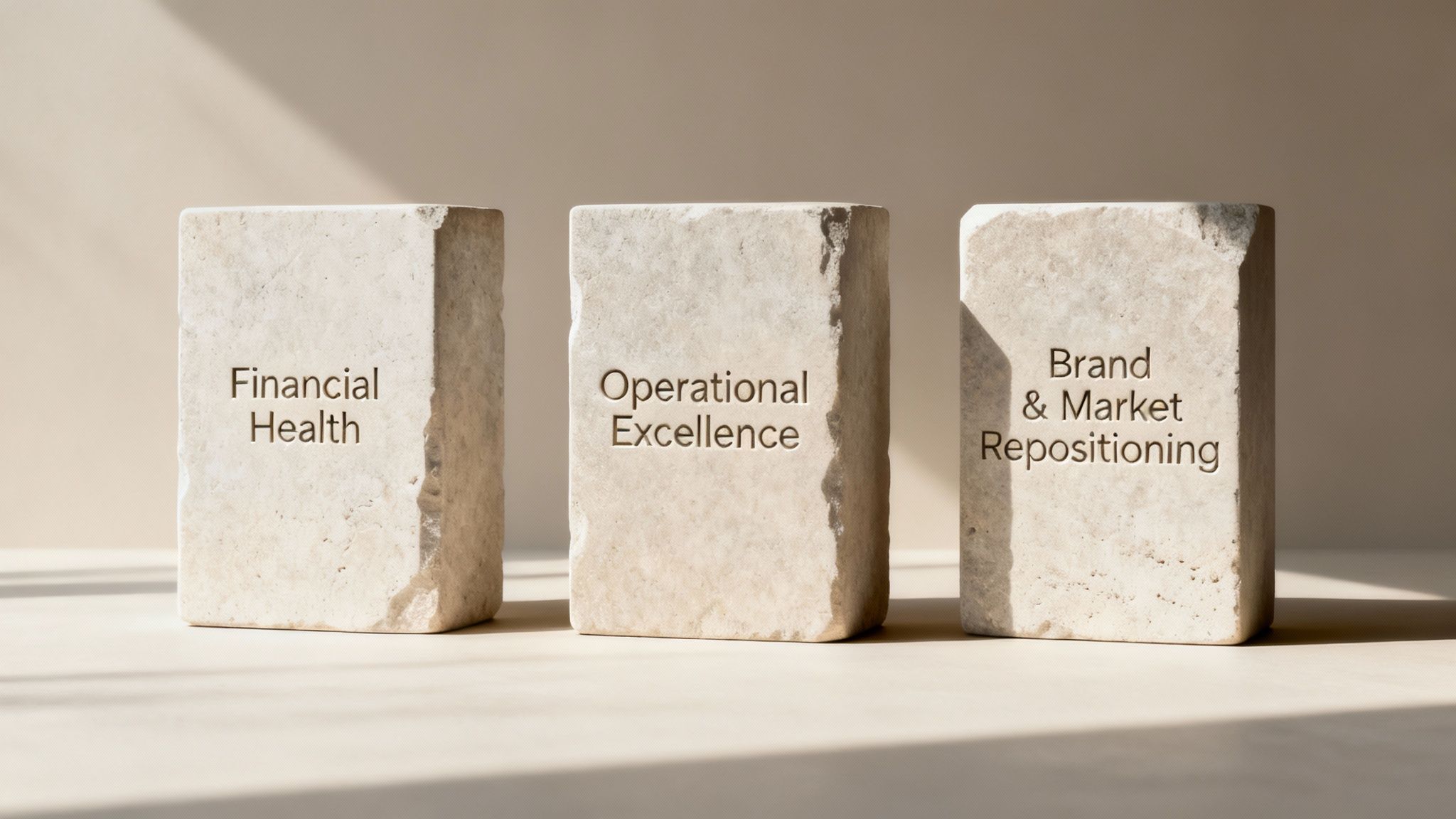
When a restaurant is underperforming, owners often seek a single, silver-bullet solution. The reality is, one doesn't exist. A sustainable, lasting turnaround is a systematic effort built on three interdependent pillars that must be addressed concurrently.
Neglecting one of these areas is like trying to balance a three-legged stool with only two legs—the entire structure is destined to collapse. I’ve seen countless owners invest heavily in marketing while their financial controls were hemorrhaging cash; it never works. A true restaurant business turnaround consultant understands that you must rebuild the entire foundation, not just patch a single crack.
That foundation is built on financial health, operational excellence, and market perception.
Pillar 1: The Financial Deep Dive
First, we must stop the bleeding. This is the most urgent phase, involving a forensic financial analysis that goes far beyond the P&L. We scrutinize every line item—from supplier contracts and utility usage to labor schedules and food cost variances—to pinpoint precisely where capital is being inefficiently deployed.
This is not about slash-and-burn cost-cutting that degrades the guest experience. It is about surgical optimization. For example, we might discover that 15% of your food cost is attributable to waste from inefficient prep or a lack of inventory controls. By implementing smarter systems, we can recapture that entire margin without altering a single recipe.
The objective here is to achieve immediate financial stability. This creates the necessary runway to address the deeper, more complex operational and strategic issues.
Think of this phase as financial triage in an emergency room. Our first job is to stabilize the patient and stop any critical bleeding. Only then can we begin the long-term healing process. This immediate action creates the foundation for everything that follows.
Pillar 2: Operational Re-Engineering
With the financials stabilized, we shift focus to the restaurant's engine: its day-to-day operations. This is where we re-engineer workflows for maximum efficiency and consistency. An operational audit invariably uncovers bottlenecks and legacy processes that owners, immersed in the daily grind, have become blind to.
Common areas of focus include:
- Kitchen Workflow Optimization: Redesigning station layouts to reduce movement and shave seconds off every task, which translates to minutes on ticket times and increased throughput.
- Data-Driven Labor Scheduling: Utilizing historical sales data to build schedules that perfectly align staffing levels with customer demand, eliminating overtime without ever being understaffed.
- Modern Inventory Systems: Implementing just-in-time ordering, strict receiving protocols, and rigid portion controls to eradicate waste and ensure product consistency.
Optimizing these core systems is what transforms a chaotic restaurant into a well-oiled machine, improving both profitability and the customer experience simultaneously.
Pillar 3: Brand and Market Repositioning
The final pillar is about rebuilding your relationship with the market. Once your financials are solid and your operations are streamlined, you finally have a product worth marketing. This is where we leverage customer data and market analysis to sharpen your unique value proposition.
Who is your ideal customer, and what do they value most? We find the data-driven answers and then construct targeted marketing campaigns to bring them through the door. This could involve a menu refresh that highlights high-margin signature dishes, a complete social media channel overhaul, or a local PR campaign to announce your revitalization.
It’s about ensuring the market perceives your restaurant for what it has become: a revitalized, reliable, and compelling dining destination.
To synthesize, here is a framework for how these three pillars function in practice.
The Three Pillars of Restaurant Turnaround
| Pillar | Primary Objective | Common Actions |
|---|---|---|
| Financial Health | Achieve immediate cash flow stability and identify profit leaks. | P&L and balance sheet analysis, vendor contract renegotiation, COGS reduction, prime cost optimization. |
| Operational Excellence | Create efficient, consistent, and repeatable systems. | Kitchen workflow redesign, labor scheduling based on sales data, inventory management implementation, service training. |
| Market Perception | Rebuild brand reputation and attract the ideal customer base. | Menu engineering, targeted marketing campaigns, online reputation management, refreshed branding, local PR initiatives. |
By addressing all three pillars with equal strategic intensity, a consultant can guide a restaurant from the brink of failure to a position of long-term, sustainable success.
Measuring the ROI of a Turnaround
Engaging a consultant is a significant investment, not another line item expense. I’ve seen it in every industry I’ve operated in—from SaaS to hospitality—leadership’s first question is always, "What's the ROI?" For a restaurant in distress, that answer must be tangible, data-driven, and directly tied to metrics that impact EBITDA. No vanity metrics.
My goal is to transition your entire operation from one that runs on intuition to a culture that thrives on data. A successful turnaround doesn't just extinguish today's fires; it builds the systems to prevent them. This begins by establishing a dashboard of vital signs so you can monitor the health of your business in real time.
Focusing on Prime Cost
The single most critical metric for your restaurant's financial health is Prime Cost. This is the sum of your Cost of Goods Sold (COGS) and all labor costs. For a healthy restaurant, this number should ideally fall between 55% and 65% of total sales. The moment it creeps higher, profitability evaporates.
A consultant's first mandate is to bring this number down through strategic, not arbitrary, actions. We implement precise improvements—optimizing inventory, renegotiating supplier terms based on data, or building intelligent staff schedules. Tracking this one KPI provides an immediate, unambiguous measure of the turnaround's financial impact.
Key Operational KPIs for Sustainable Growth
Beyond Prime Cost, we must track the operational levers that drive the financial engine. These KPIs measure the efficiency of your most critical assets: your physical space and your team.
- Table Turn Time: How long does a party occupy a table from seating to departure? Reducing this time by even a few minutes allows for more covers during peak hours, directly increasing revenue potential without adding seats.
- Revenue Per Available Seat Hour (RevPASH): This metric provides a holistic view of how effectively you are monetizing your dining room. It is calculated by dividing total revenue by the number of seats multiplied by hours of operation. A rising RevPASH is a clear indicator that your efficiency and pricing strategies are working.
- Customer Lifetime Value (CLV): A turnaround isn't just about financial engineering; it's about re-engaging your customer base. By tracking CLV, we can measure our success in converting first-time diners into loyal patrons. This is the bedrock of long-term stability and a powerful example of business model innovation.
Ultimately, the real ROI of working with a restaurant business turnaround consultant isn't just measured in the cost savings or revenue gains of the first six months. It is measured in the creation of a resilient, data-informed organization capable of adapting and thriving for years to come.
What to Expect from the Turnaround Timeline
A restaurant turnaround is not an overnight fix; it is a disciplined, strategic campaign. Having led transformations across numerous industries, I can confirm that real, sustainable change requires patience and a phased execution plan. The most significant mistake owners make is expecting an immediate miracle. It is more effective to view this as a phased recovery, with clearly defined objectives for each stage.
This structured approach creates transparency. It aligns your team, sets realistic expectations, and provides a clear roadmap from financial distress to stability and, ultimately, growth. It is a demanding journey, but it becomes far more manageable when executed in distinct, measurable phases.
Phase 1: The First 30 Days of Stabilization
The initial month is pure triage. My immediate priority is to halt the financial hemorrhage and stabilize core operations. We execute a rapid, data-first diagnostic to identify the most critical cash drains—be it uncontrolled food costs, bloated labor schedules, or an unprofitable menu mix.
The objective here is simple: immediate impact. We focus on quick wins that plug the largest leaks. This is not about the long-term strategic vision yet. It is about survival and creating a stable platform from which to build.
Phase 2: The 90-Day Implementation
Once we've achieved stabilization, the subsequent 90 days are dedicated to execution. This is where we begin deploying the new systems and processes identified during the diagnostic phase. We break down the organizational silos that often separate the kitchen, front-of-house, and back-office financial controls.
This phase typically includes:
- System Rollouts: Implementing new tools for inventory management, deploying intelligent labor scheduling software, or reconfiguring the POS to capture actionable data.
- Process Training: Onboarding the team to new standard operating procedures (SOPs), from precise portion control in the kitchen to effective upselling techniques for servers.
- Metric Tracking: Establishing the key performance indicators (KPIs) that will serve as our single source of truth for measuring progress going forward.
Phase 3: The 6-12 Month Optimization
The final phase is dedicated to fine-tuning the entire operation for long-term, profitable growth. We obsessively analyze the performance data generated by our new systems and make iterative, data-driven adjustments. Is the new menu mix achieving its target contribution margin? Did the revised floor plan measurably improve table turn times? We use hard data, not intuition, to optimize every component of the business.
A restaurant business turnaround consultant's true value is not just in saving the business. It's in building a resilient, data-driven culture that can sustain success long after the engagement concludes.
A full turnaround typically takes 12 to 24 months to realize its complete financial and operational impact, though a positive shift in cash flow is almost always evident within the first quarter. This journey requires unwavering commitment and collaboration from the entire organization to achieve true transformation. You can get more insights on how this timeline leads to lasting results and why team alignment is so crucial over on aaronallen.com.
How to Choose the Right Turnaround Partner

The decision to engage a consultant is a critical inflection point. From this moment, the single greatest determinant of your success is selecting the right partner. Not all advisors are created equal, and a compelling presentation is meaningless without a track record of delivering measurable, bottom-line results.
You are not looking for a validator. You need a partner who will challenge your assumptions with objective data. This individual must be as invested in your restaurant's recovery as you are, which requires due diligence beyond a surface-level resume review.
Vetting for Verifiable Results
When I evaluate a new strategy or partner, I demand empirical proof. You must do the same. Move past the sales pitch and request detailed, verifiable case studies. Do not accept vague success stories—insist on seeing the data.
Here are the critical questions you must ask:
- KPI Improvement: "Show me the data for your last three engagements. Which specific KPIs did you improve, and by what exact percentage? I want to see the Prime Cost reduction or the RevPASH growth."
- Methodology: "Walk me through your diagnostic process. What specific analytical tools and frameworks do you use to identify root causes, not just symptoms?"
- Fee Structure: "How is your compensation aligned with my restaurant's performance? Break down your fee structure and provide a projected ROI model."
A great restaurant turnaround consultant doesn’t just offer advice; they deliver a quantifiable return on investment. Their value should be clearly visible on your P&L statement through reduced costs and increased revenue, often generating a 10x return on their fees.
The Importance of Cultural Fit
Finally, never underestimate the importance of cultural fit. A brilliant strategist who cannot command the respect of your team is operationally useless. This person will be in the trenches with everyone, from your investors to your dishwashers.
They need the executive presence to explain complex financial models to you and the operational credibility to gain the trust of your line cooks. It’s about more than personality; it’s about their ability to break down silos and align your front-of-house and back-of-house teams. The right partner is a leader who can rally the entire organization toward a single, unified objective.
Your Restaurant Turnaround Questions Answered
When you're leading a struggling business, the questions can be overwhelming. I understand. Having worked with leaders across diverse industries, I know the path forward is paved with clear, direct answers. Let's address some of the most common questions I hear from restaurant owners.
When Do I Need a Consultant Instead of a Manager?
This is an excellent question, and the distinction lies in one word: the system.
A general manager is skilled at operating the system you have in place. They optimize daily operations, manage personnel, and execute your existing vision. But what happens when the system itself is fundamentally broken?
You engage a restaurant business turnaround consultant when your foundational model is failing. If you are trapped in a cycle of negative cash flow, high employee turnover, and declining customer loyalty, you do not need someone to manage a flawed system. You need an expert to help you re-engineer it from the ground up.
What Does Hiring a Turnaround Consultant Cost?
The cost is contingent on the scope and complexity of the required intervention. A discrete project, such as a menu re-engineering, will have a different cost structure than a comprehensive, hands-on turnaround engagement spanning several months.
I advise clients to view this not as a cost, but as an investment. A reputable consultant will not simply issue an invoice; they will provide a financial model. They should be able to project a clear return on investment, mapping out how their fees will be more than covered by waste reduction, efficiency gains, and revenue growth.
Can a Consultant Really Save a Restaurant on the Verge of Closing?
Absolutely, but with a critical caveat. Success is contingent on two factors: timing and your own commitment to executing difficult changes.
A consultant can architect a powerful strategy, but they cannot reverse time. The earlier you engage an expert—before you have exhausted all cash reserves—the higher the probability of success. If you have some operational runway and are fully committed to making the necessary, often tough, decisions, a turnaround is entirely achievable.
The consultant provides the strategy and the roadmap, but success ultimately hinges on the owner’s leadership and the team’s collective ability to implement that vision with precision and discipline.
At MGXGrowth, we don't deliver a static playbook. We embed with your team to architect and execute a data-driven comeback plan. Learn more about our strategic advisory services and see how we deliver measurable, bottom-line results.
