


In my decades of driving revenue growth across hospitality, I've seen countless restaurants with phenomenal food fail due to a fragmented marketing approach. The truth is, exceptional cuisine is merely the price of entry. Sustainable growth is architected through a cohesive, data-driven marketing engine where every campaign is a measurable lever for increasing customer lifetime value and market share.
Too often, marketing, operations, and finance operate in silos, preventing a holistic view of the customer journey from first impression to repeat purchase. This prevents restaurants from understanding what truly motivates guest behavior and drives profit. The most effective strategies are not isolated tactics; they are integrated systems designed to attract, engage, and retain customers predictably.
This list isn't just a collection of ideas; it's a strategic breakdown of proven restaurant marketing campaigns that work. We'll dissect the 'why' behind their success, providing a replicable framework to break down those internal barriers. You will learn how to connect with your customers on a deeper level and translate that engagement into tangible, bottom-line results. Let's move beyond the menu and start building a framework for predictable growth.
1. User-Generated Content (UGC) Campaigns
User-generated content (UGC) campaigns are among the most effective restaurant marketing campaigns that work because they transform your customers into a volunteer marketing force. Instead of telling the market how great your food is, you empower satisfied diners to do it for you. This strategy hinges on encouraging customers to create and share photos, videos, or reviews of their dining experiences on social media, typically using a branded hashtag.
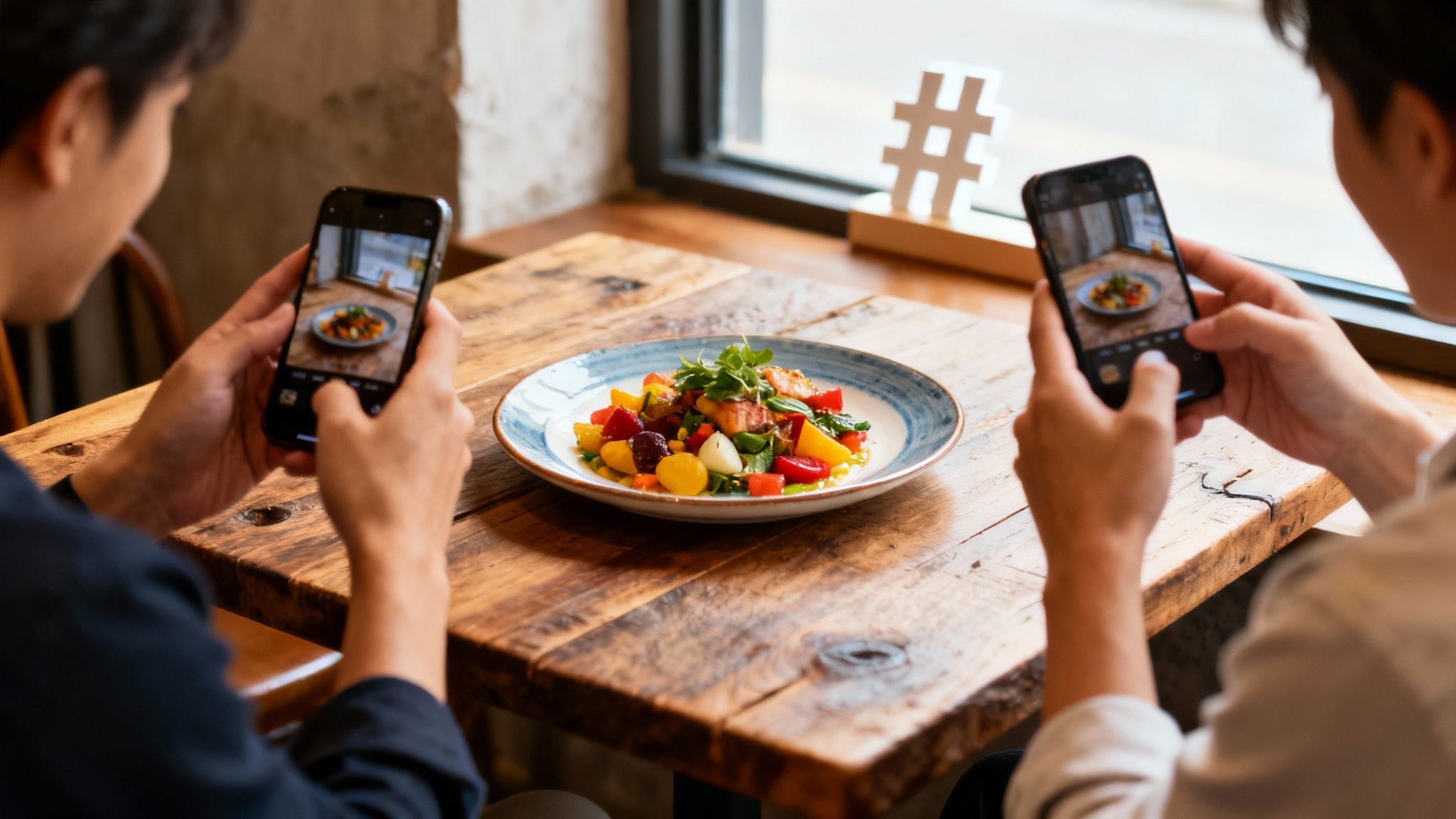
This approach leverages social proof and authenticity, two currencies that are invaluable in today's market. When a potential customer sees a peer enjoying your restaurant, the endorsement feels more genuine and trustworthy than a polished, brand-produced advertisement. It's a direct line to organic reach and community building.
Strategic Breakdown: Starbucks' #RedCupContest
Starbucks’ annual #RedCupContest is a masterclass in UGC. The campaign is simple: customers share creative photos of their holiday-themed red cups for a chance to win a prize.
- What They Did: They created a simple, highly visual prompt tied to a seasonal, limited-time product (the red cup). The hashtag was easy to remember and share.
- Why It Succeeded: It gamified the customer experience, created a sense of tradition and community, and generated millions of organic social media impressions annually. The visual nature of the content was perfectly suited for platforms like Instagram.
- Key Takeaway: Link your UGC campaign to a signature, visually appealing item or a specific season. Make participation feel like a fun, creative activity, not just a marketing ploy.
How to Implement This Strategy
To replicate this success, you don't need Starbucks' budget. You need a clear plan.
- Create a Unique Hashtag: Make it short, memorable, and directly related to your brand (e.g., #[YourRestaurantName]Eats).
- Offer a Compelling Incentive: This doesn't have to be expensive. A gift card, a free dessert, or having their photo featured on your official social media pages can be powerful motivators.
- Promote and Engage: Announce the campaign clearly in-store, on menus, and across your digital channels. Crucially, engage with every submission by liking, commenting, and resharing the best content. This validates your customers' efforts and encourages more participation.
2. Limited-Time Offers (LTO) and Scarcity Marketing
Limited-time offers (LTOs) are a powerful tool in any restaurant’s arsenal, representing one of the most consistently effective restaurant marketing campaigns that work. This strategy leverages the psychological principles of scarcity and FOMO (fear of missing out) by making a specific menu item or deal available for only a short period. This creates a powerful sense of urgency that compels customers to act now rather than later.
The following timeline visualizes the typical impact of a well-executed LTO campaign, showing how different phases generate specific results.
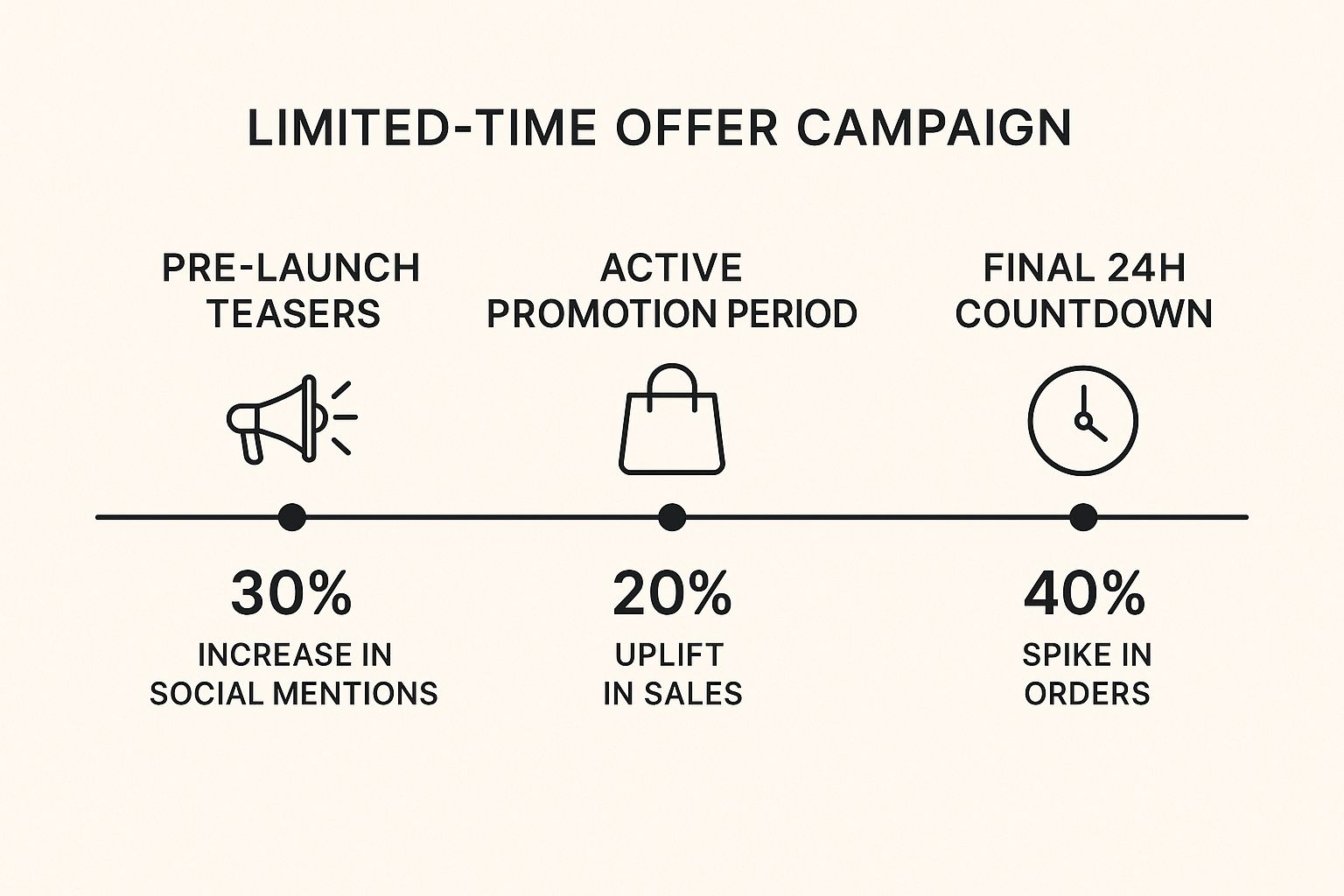
The data clearly illustrates how urgency builds over time, culminating in a significant sales spike just before the offer expires. LTOs are not just about a temporary sales lift; they generate buzz, test new product viability, and can become beloved annual traditions that customers eagerly anticipate.
Strategic Breakdown: Popeyes' Chicken Sandwich
The 2019 launch of the Popeyes Chicken Sandwich is a legendary example of LTO and scarcity marketing. What began as a standard new product launch quickly escalated into a national phenomenon.
- What They Did: Popeyes launched a simple, high-quality chicken sandwich and engaged in a witty Twitter battle with competitor Chick-fil-A, sparking massive organic conversation. The resulting demand was so overwhelming they sold out of their two-month supply in just two weeks.
- Why It Succeeded: The initial viral buzz created massive demand, but the subsequent sell-out created authentic scarcity. This unavailability fueled media stories and intensified consumer desire, making its eventual return a major cultural event. It was no longer just a sandwich; it was a must-have item.
- Key Takeaway: While you can't always plan for virality, you can plan for scarcity. Combine a high-quality, buzz-worthy product with a launch that feels like an event. Authentic scarcity, whether planned or accidental, can be a more powerful marketing tool than any advertisement.
How to Implement This Strategy
From my experience, executing a successful LTO requires precise operational and marketing alignment. Here’s a blueprint for making it work.
- Create Authentic Scarcity: Don’t overuse LTOs. Use them strategically for seasonal ingredients, partnerships, or to test a new menu concept. If everything is "limited," then nothing is.
- Build Anticipation: Use social media and your email list to tease the LTO before it launches. A simple countdown timer or a sneak-peek photo can build excitement. Rewarding loyal customers with early access can also create a VIP feel.
- Align Operations: Ensure your supply chain and kitchen staff are prepared for a potential surge in demand. Running out of a popular LTO too quickly can frustrate customers if not handled correctly. Learn more about how to structure effective restaurant promotions that work on mgxgrowth.com.
- Promote with Urgency: Your marketing messaging across all channels should highlight the limited nature of the offer. Use phrases like "while supplies last," "only until Sunday," or "get it before it’s gone" to drive immediate action.
3. Loyalty Programs and Rewards Apps
Loyalty programs are powerhouse restaurant marketing campaigns that work by transforming one-time guests into high-value repeat customers. In my experience, the shortest path to sustainable growth isn't always acquiring new customers; it's maximizing the lifetime value of your existing ones. Modern rewards apps go far beyond simple punch cards, leveraging data to create personalized, gamified experiences that foster genuine brand affinity and drive predictable revenue.
This strategy works by directly incentivizing the behavior you want to see: repeat visits and higher average checks. By collecting customer data through the app, you gain invaluable insights into purchasing habits, visit frequency, and favorite items. This allows for hyper-targeted marketing that feels less like an advertisement and more like a personalized recommendation, dramatically increasing customer retention.
Strategic Breakdown: Chipotle Rewards
Chipotle Rewards is a prime example of a modern loyalty program executed flawlessly. Launched in 2019, it rapidly grew to over 30 million members, demonstrating a deep understanding of customer motivation.
- What They Did: They built a simple, points-based system integrated into a seamless mobile ordering app. Members earn points for every dollar spent, which can be redeemed for free entrées. They also introduced gamified "Achievement" badges and personalized challenges.
- Why It Succeeded: The program excels in its simplicity and value proposition. The path to a reward is clear and attainable, encouraging frequent use. Personalization, such as offering bonus points on a customer's favorite order, makes members feel recognized and valued, which is crucial for building long-term loyalty.
- Key Takeaway: Focus on a frictionless user experience. Your loyalty program should make the customer's life easier, not more complicated. Integrate it directly with your mobile ordering and payment systems for a seamless journey from earning to redemption.
How to Implement This Strategy
A successful loyalty program is a data-driven retention engine, not just a discount system.
- Offer an Immediate Sign-Up Bonus: Incentivize enrollment by giving new members an instant reward, like a free drink or appetizer. This removes friction and provides immediate gratification.
- Personalize the Experience: Use purchase data to send tailored offers. If a customer always buys a specific coffee, send them a "buy one, get one free" offer for that exact item. This shows you're paying attention.
- Create Tiers and Exclusivity: Introduce tiered levels (e.g., Silver, Gold, Platinum) with escalating benefits like early access to new menu items or exclusive event invites. This gamifies participation and provides a tangible goal for your most loyal customers.
4. Influencer and Local Partnership Collaborations
Influencer and local partnership collaborations are powerful restaurant marketing campaigns that work by tapping into the established trust and reach of content creators. Instead of broadcasting a message to a cold audience, you partner with food bloggers, social media personalities, or local community figures whose followers already value their recommendations. This strategy provides an authentic endorsement that can feel more like a trusted friend's suggestion than a traditional advertisement.
This approach is about borrowing credibility and accessing a hyper-targeted audience. When a mega-influencer like Charli D’Amelio partners with a brand, she brings her massive, engaged following with her. The key is aligning your brand with an influencer whose audience perfectly matches your ideal customer profile, creating a seamless and effective endorsement.
Strategic Breakdown: Dunkin's "The Charli"
Dunkin's collaboration with TikTok star Charli D'Amelio is a textbook example of leveraging a massive digital personality to drive tangible business results. They didn't just sponsor a post; they co-created a product named "The Charli."
- What They Did: Dunkin' turned Charli D'Amelio's go-to coffee order into an official menu item. They promoted it heavily across social media, directly integrating the product with her personal brand.
- Why It Succeeded: The campaign felt incredibly authentic because it was based on her actual, well-known coffee preference. It directly appealed to her Gen Z fanbase, driving a reported 57% increase in app downloads and a significant spike in cold brew sales.
- Key Takeaway: Move beyond simple sponsored posts. Co-creating a menu item or a unique experience with an influencer makes the partnership feel genuine and gives their followers a specific, tangible reason to visit.
How to Implement This Strategy
You don't need a global celebrity to make this work. In my experience, focused local partnerships often yield a higher ROI by activating a passionate community.
- Identify the Right Partners: Focus on micro-influencers (10K-100K followers) or respected local food bloggers. Their audiences are often more engaged and geographically relevant. Ensure their brand and followers align with your target demographic.
- Create a Unique Offer: Provide more than just a free meal. Offer a unique experience, an exclusive menu item collaboration, or a special discount code for their followers. This gives them something valuable to share and helps you track the campaign's direct impact.
- Define Clear Expectations: Establish clear deliverables, timelines, and compensation in a formal agreement. While you should allow creative freedom, provide brand guidelines to ensure the message is on-point. Explore these concepts further in my detailed guide on restaurant branding and marketing on mgxgrowth.com.
5. Email Marketing and Personalized Automation
Email marketing remains one of the most powerful and high-ROI restaurant marketing campaigns that work because it gives you a direct, owned channel to your customers. Beyond generic newsletters, modern email strategy uses personalization and automation to deliver the right message at the right time, turning one-time visitors into regulars and regulars into brand advocates. This approach nurtures customer relationships directly in their inbox, bypassing the crowded and algorithm-dependent nature of social media.
By segmenting your audience based on their behavior, such as past orders, visit frequency, or even their birthday, you can send hyper-relevant offers that feel personal, not promotional. This level of customization dramatically increases open rates, click-through rates, and, most importantly, revenue. It's about building a conversation, not just broadcasting a message. For a deeper dive, you can learn more about marketing automation implementation and its benefits.
Strategic Breakdown: Panera Bread's Personalization Engine
Panera Bread excels at using customer data to power its email marketing, making subscribers feel like the brand truly understands their tastes. Their campaigns are a prime example of data-driven personalization in action.
- What They Did: Panera leverages its MyPanera loyalty program data to send emails with personalized recommendations based on a customer's order history. If you frequently order the "You Pick Two" with a broccoli cheddar soup, your emails will feature that item or suggest complementary new products.
- Why It Succeeded: This strategy moves beyond a one-size-fits-all approach. The recommendations are genuinely useful, increasing the likelihood of a visit. By showcasing items a customer already loves, they eliminate decision fatigue and create a seamless path to their next order.
- Key Takeaway: Connect your email marketing to your loyalty program or POS data. Use purchase history to create targeted segments and send personalized offers that reflect your customers' actual preferences.
How to Implement This Strategy
You don’t need a massive IT department to execute effective email marketing. The key is starting with a solid foundation and building from there.
- Build Your List Organically: Offer a compelling reason for customers to subscribe. This could be a 10% discount on their next order, a free appetizer, or exclusive access to new menu items. Promote sign-ups in-store, on your Wi-Fi landing page, and through your website.
- Segment and Personalize: Start with simple segments like new subscribers, frequent visitors, and customers who haven't visited in a while. Use automation to send a welcome series to new sign-ups and a "we miss you" offer with an incentive to lapsed customers.
- Focus on Value and Visuals: Every email should offer value, whether it's a special offer, a story about your ingredient sourcing, or an announcement about an upcoming event. Use high-quality, mouth-watering photos of your food and a clear call-to-action (e.g., "Order Now," "View Menu," "Make a Reservation").
6. Social media contests and giveaways
Social media contests and giveaways are potent restaurant marketing campaigns that work by incentivizing direct audience engagement. The concept is straightforward: offer a desirable prize in exchange for specific actions like following your page, tagging friends, or sharing a post. This creates an immediate spike in interaction and visibility far beyond your existing follower base.
From a growth perspective, this strategy is about trading value for reach and data. A well-executed contest turns your audience into active promoters. Every "tag a friend" entry is a direct, peer-to-peer recommendation that leverages social proof, dramatically lowering your customer acquisition cost while rapidly growing your follower count and engagement metrics.
Strategic Breakdown: Buffalo Wild Wings’ "Free Wings for a Year"
Buffalo Wild Wings masterfully uses giveaways to maintain high engagement and brand relevance. Their recurring "Free Wings for a Year" contest is a prime example of a high-value offer that galvanizes their target audience into action.
- What They Did: They created a simple contest with an aspirational prize perfectly aligned with their brand. Entry typically involves following their account and engaging with the contest post, often by tagging friends who they would share the prize with.
- Why It Succeeded: The prize is not just valuable; it's brand-centric and memorable. It creates a powerful incentive that drives viral sharing, as each tag introduces new potential customers to their page. This tactic generates thousands of entries and keeps the brand top-of-mind.
- Key Takeaway: Your prize must be compelling and directly related to your restaurant's experience. A generic gift card is good, but an exclusive, brand-specific prize like "Free Pizza Fridays for a Month" creates more excitement and reinforces what you sell.
How to Implement This Strategy
You can launch a powerful giveaway campaign on a minimal budget by focusing on strategy over prize value. The goal is to maximize organic reach and build a more engaged community.
- Make Entry Simple and Shareable: The most effective contests require low-friction actions. The "Follow us, like this post, and tag 2 friends" model is popular for a reason-it's easy and directly fuels account growth.
- Partner with Local Businesses: Amplify your reach and prize value by collaborating with a non-competing local business, like a nearby movie theater or boutique. A "Dinner and a Movie" giveaway, for example, cross-promotes both brands to new audiences.
- Be Transparent and Follow Through: Clearly post the rules, duration, and how the winner will be chosen. When the contest ends, announce the winner publicly and, if possible, share a photo of them enjoying their prize. This builds trust and encourages participation in future campaigns.
7. Local SEO and Google My Business Optimization
Local Search Engine Optimization (SEO) is one of the most fundamental and high-return restaurant marketing campaigns that work today. It's not about chasing fleeting trends; it’s about strategically positioning your restaurant to be the immediate, obvious answer when a hungry customer searches for dining options nearby. This campaign focuses on dominating local search results, with your Google Business Profile (GBP) serving as your digital front door.
When someone searches "pizza near me," they have high purchase intent. Optimizing for these queries drives direct foot traffic and online orders. It’s about being visible at the exact moment a customer decides where to eat, making it a non-negotiable strategy for sustainable, local growth.
Strategic Breakdown: Chipotle's Local Dominance
While often seen as a national giant, Chipotle's success heavily relies on a hyperlocal strategy. Each of its thousands of locations is treated as a distinct local business online, with its own optimized presence.
- What They Did: Chipotle created individual, location-specific pages on its website, each optimized for terms like "burritos in [City Name]." Their Google Business Profiles for each store are meticulously managed with accurate hours, photos, and review responses.
- Why It Succeeded: This approach ensures that whether a customer is in downtown Chicago or a suburb of Dallas, the nearest Chipotle ranks prominently. It captures local search intent at scale by treating each store as its own micro-market, maintaining brand consistency while competing like an independent local favorite.
- Key Takeaway: Treat every location as its own local entity. Even if you only have one restaurant, own your digital neighborhood by optimizing for hyper-specific, "near me" search terms.
How to Implement This Strategy
Winning at local SEO is a game of details and consistency. It’s a low-cost, high-impact campaign you can start immediately.
- Claim and Optimize Your GBP: Your Google Business Profile is your most valuable local SEO asset. Fill out every single section completely, from business categories and attributes (e.g., "outdoor seating," "delivery available") to a detailed description.
- Maintain NAP Consistency: Ensure your Name, Address, and Phone number (NAP) are identical across your website, GBP, social media, and all online directories. Even a small variation like "St." versus "Street" can confuse search engines.
- Generate and Respond to Reviews: Actively encourage satisfied customers to leave Google reviews. Crucially, respond to every single review, positive or negative, within 48 hours. This shows Google (and potential customers) that you are an engaged and reputable business.
8. Experiential Marketing and Community Events
Experiential marketing and community events are powerful restaurant marketing campaigns that work by shifting the focus from a simple transaction to a memorable experience. Instead of just serving food, you create an immersive environment that forges a deeper, emotional connection with your guests. This strategy involves hosting special events, pop-ups, cooking classes, or community partnerships that give people a reason to visit, talk, and share.
This approach transforms your restaurant into a community hub. By creating unique, shareable moments, you generate organic buzz and foster a loyal following that views your brand as an integral part of their lifestyle, not just a place to eat. These events are goldmines for authentic social media content and invaluable word-of-mouth marketing.
Strategic Breakdown: Chipotle's 'Cultivate Festival'
Chipotle’s 'Cultivate Festival' was a masterclass in brand-building through experiential marketing. It was a free festival celebrating food, music, and ideas, effectively bringing Chipotle’s “Food with Integrity” mission to life for thousands of attendees.
- What They Did: They hosted large-scale, free-admission events in major cities featuring celebrity chefs, live music, and interactive experiences focused on sustainable agriculture. It was far more than a food tasting; it was a cultural event.
- Why It Succeeded: The festival wasn’t a direct sales pitch. It built brand affinity by aligning Chipotle with values its target audience cared about, such as sustainability and community. It generated massive media coverage and social media engagement, reinforcing its brand identity on a national scale.
- Key Takeaway: Build an event around your brand’s core mission or values. Focus on providing genuine value and entertainment to your community, and the brand loyalty will follow.
How to Implement This Strategy
You don't need a festival-sized budget to succeed with experiential marketing. The key is creating an authentic and engaging experience for your specific audience.
- Start Small and Relevant: Begin with a monthly themed dinner, a cooking class with your chef, or a "meet the farmer" event with a local supplier. These smaller-scale events are manageable and help you build momentum.
- Partner with Local Businesses: Collaborate with a nearby brewery for a beer-pairing dinner or a local artist for a gallery night. Partnerships expand your reach to a new audience and add value to the event.
- Design for Sharing: Create "Instagrammable" moments. This could be a unique table setting, a special photo backdrop, or a visually stunning dish exclusive to the event. Encourage guests to share their experience online.
- Capture and Leverage Content: Document every event with high-quality photos and videos. This content becomes a powerful asset for your future marketing efforts, from social media posts to email newsletters, showing potential customers the vibrant community you’ve built.
Top 8 Restaurant Marketing Campaigns Compared
| Strategy | 🔄 Implementation Complexity | 💡 Resource Requirements | 📊 Expected Outcomes | 🎯 Ideal Use Cases | ⭐ Key Advantages |
|---|---|---|---|---|---|
| User-Generated Content (UGC) Campaigns | Moderate: requires monitoring and moderation | Low: incentivizing customers with prizes/discounts | High engagement and organic reach | Building community and authentic social proof | Cost-effective; continuous fresh content |
| Limited-Time Offers (LTO) and Scarcity Marketing | Moderate-High: planning and supply chain needed | Medium: marketing, inventory management | Immediate sales boost and buzz | Driving urgency, testing new menu items | Creates urgency; seasonal excitement |
| Loyalty Programs and Rewards Apps | High: tech investment and ongoing management | High: app development, maintenance, customer service | Increased customer retention and spend | Encouraging repeat visits and personalized marketing | Predictable revenue; valuable data collection |
| Influencer and Local Partnership Collaborations | Moderate-High: influencer vetting and coordination | Medium-High: compensation, content production | Expanded reach with authentic endorsements | Targeting specific demographics and viral growth | Trusted endorsements; quality content |
| Email Marketing and Personalized Automation | Moderate: list building and content creation | Medium: email platform subscriptions, strategist | High ROI and direct customer communication | Targeted promotions and customer engagement | Highly personalizable; measurable ROI |
| Social Media Contests and Giveaways | Moderate: management and compliance oversight | Low-Medium: prizes and campaign coordination | Rapid follower growth and engagement spikes | Viral engagement and brand awareness | Cost-effective; builds email lists |
| Local SEO and Google My Business Optimization | Moderate: ongoing updates and reputation management | Low-Medium: time investment | Increased local visibility and foot traffic | Attracting nearby customers searching online | Free organic traffic; high conversion rates |
| Experiential Marketing and Community Events | High: extensive planning and staffing required | High: event costs and logistics | Strong emotional connections and PR coverage | Building brand loyalty and community presence | Unique experiences; premium pricing potential |
Architecting Your Growth Engine: From Campaigns to Culture
Across my career, I've seen countless organizations chase fleeting trends. They launch a campaign, see a temporary lift, and then scramble for the next "big idea." The truly dominant brands, however, understand a fundamental truth: isolated tactics do not build sustainable growth. The restaurant marketing campaigns that work are not one-off events; they are interconnected cogs in a finely tuned growth engine.
We've explored a range of powerful strategies in this article, from the community-building power of User-Generated Content to the targeted precision of Local SEO. But the ultimate takeaway isn't to simply copy-paste these ideas. It's to see them as a system. The data from your loyalty program should directly inform the creation of your next Limited-Time Offer. The content captured during an experiential event must become the fuel for your email and social media automations. This is where the magic happens.
Moving Beyond Campaigns to a System
The most critical shift you can make is from a campaign-centric mindset to a system-centric one. This means breaking down the walls that traditionally separate marketing, operations, and customer service. Your front-of-house staff are your best source of customer feedback, your kitchen team understands product velocity, and your marketing data reveals hidden patterns in guest behavior.
Key Insight: Winning restaurants operate less like a series of disjointed projects and more like a single, cohesive organism. Every part of the business feeds data and insights into the others, creating a powerful feedback loop that accelerates learning and optimization.
Think of it this way: a successful UGC campaign isn't just about getting nice photos. It's a data-gathering operation.
- Who is posting? This identifies your most passionate brand advocates.
- What dishes are they featuring? This validates your menu's star performers.
- When are they visiting? This informs your daypart marketing strategies.
This data should then flow directly into your other marketing efforts. Reward those advocates through your loyalty app. Feature their preferred dishes in your next email blast. This is how you transform a single campaign into a perpetual motion machine for growth.
Your Actionable Path Forward
The path from siloed tactics to an integrated growth engine is a journey, not a sprint. Start small but be deliberate.
- Select Two Channels: Choose two of the strategies we've discussed, for example, your Loyalty Program and your Email Marketing.
- Create an Integration Point: Mandate that the next email campaign must be segmented based on loyalty program data. Perhaps you send a special offer only to members who haven't visited in 60 days.
- Measure and Learn: Track the results of this integrated effort. Did it reactivate dormant customers? What was the open rate and redemption rate?
- Expand the System: Once you've proven the concept, connect another channel. Pull insights from your Google Business Profile (e.g., popular search queries) to inspire your next social media contest.
By forcing these connections, you begin building the muscle memory for a data-driven culture. You stop asking "what campaign should we run?" and start asking "how can our systems work together to create a better guest experience and drive more revenue?" This is the strategic pivot that separates market leaders from everyone else. It’s how you build a brand that not only survives but thrives in any economic climate.
Tired of running disconnected campaigns and ready to build a cohesive, data-driven growth engine for your restaurant? At MGXGrowth, we specialize in implementing the systems and strategies that turn marketing activities into predictable revenue. Visit us at MGXGrowth to learn how we can help you architect your own high-performance marketing ecosystem.
