


For decades, the perfect casino host has been something of a unicorn. We've all imagined that ever-present, all-knowing concierge who anticipates a high-value guest's every desire before they've even articulated it. But that ideal has always collided with a simple, human limitation—you can only be in one place at a time. This created a hard ceiling on both scalability and, more importantly, profit.
Now, the autonomous AI casino host is shattering that ceiling, transforming what was once a fantasy into a strategic, data-powered reality that directly impacts EBITDA.
Why Casino Hospitality Needs a New Playbook

Having spent my career driving growth across gaming and hospitality, I've seen the same operational hurdles time and again. Traditional service models are straining at the seams; they simply can’t deliver the deep personalization modern guests demand at a scale that actually moves the needle on revenue. We've squeezed every last drop of efficiency out of our human capital.
The root of the problem? Silos. Marketing, player development, hotel ops, and F&B are all sitting on mountains of valuable data, but those departments rarely communicate in a meaningful, real-time way. This disconnect creates a fragmented guest experience and leaves an immense amount of money on the table.
Think about it from a data perspective. A VIP’s host might be completely unaware of a frustrating check-in experience. Marketing might blast a generic buffet offer to a guest who just dropped a grand at the high-end steakhouse. These are the points of friction that erode loyalty and reduce lifetime value.
The Strategic Shift to Automation
The debate is no longer if casinos should adopt AI, but how fast they can integrate it to secure a competitive advantage. AI is rapidly becoming a core component of modern casino operations. In fact, by 2025, it's expected to be a key driver in personalizing the entire gaming journey and supercharging efficiency. We're talking about a system that can make tailored suggestions for everything from room upgrades to dinner reservations—something that was impossible to execute for every guest before now. To dive deeper, you can learn more about the future of AI in gaming from top industry analysts.
An autonomous AI casino host isn't just another software platform; it's the central nervous system for the entire property. It represents a fundamental shift in operational strategy.
This technology is about fundamentally re-architecting the guest journey. It breaks down the departmental silos that kill efficiency and creates a seamless, highly profitable ecosystem where every interaction is optimized for value.
Moving Beyond Human Limitations
Even your most talented human host has a finite bandwidth. They can only manage a limited portfolio of players. They can't be on call 24/7. And they certainly can't process thousands of data points in a split second to deploy the perfect offer at the perfect time. An AI host can.
Let’s be data-driven about the old model's limitations:
- Scalability: A human team can’t possibly deliver high-touch treatment to every guest. An AI, however, can provide a baseline of personalized engagement to 100% of your database.
- Data Synthesis: A person can't simultaneously cross-reference a player's gaming history, hotel folio, dining habits, and real-time location to predict their next action. The AI does this instantly.
- Proactive Engagement: Human hosts are often forced to be reactive, responding to requests or issues. The autonomous AI casino host is architected to be predictive, identifying revenue opportunities and mitigating friction before it occurs.
This isn't about replacing your team. It's about augmenting them. By offloading the heavy lifting of data analysis and routine communication, the AI frees up your people to do what they do best: build genuine, high-value relationships. That's the new playbook for creating sustainable, market-leading growth.
Understanding the Autonomous AI Host
Let's cut through the marketing fluff. An autonomous AI host isn't a smarter chatbot or a fancier booking system. In my experience, real breakthroughs happen when you connect disparate systems into one intelligent, unified operational fabric. That is precisely what this technology is designed to achieve.
Think of the autonomous AI casino host as the central nervous system for your entire guest experience. It is the connective tissue linking every part of your operation—your CRM, player tracking, hotel management, and point-of-sale terminals—all in real time. It ingests that raw data and transforms it into decisive, profitable action.
This system doesn't just react to a query. It synthesizes a player's entire history and context to understand latent needs. It knows their win/loss record from last night, their preferred steakhouse, their typical check-in time, and the slot machine they favor. It sees the complete customer picture.
The Conductor of the Casino Orchestra
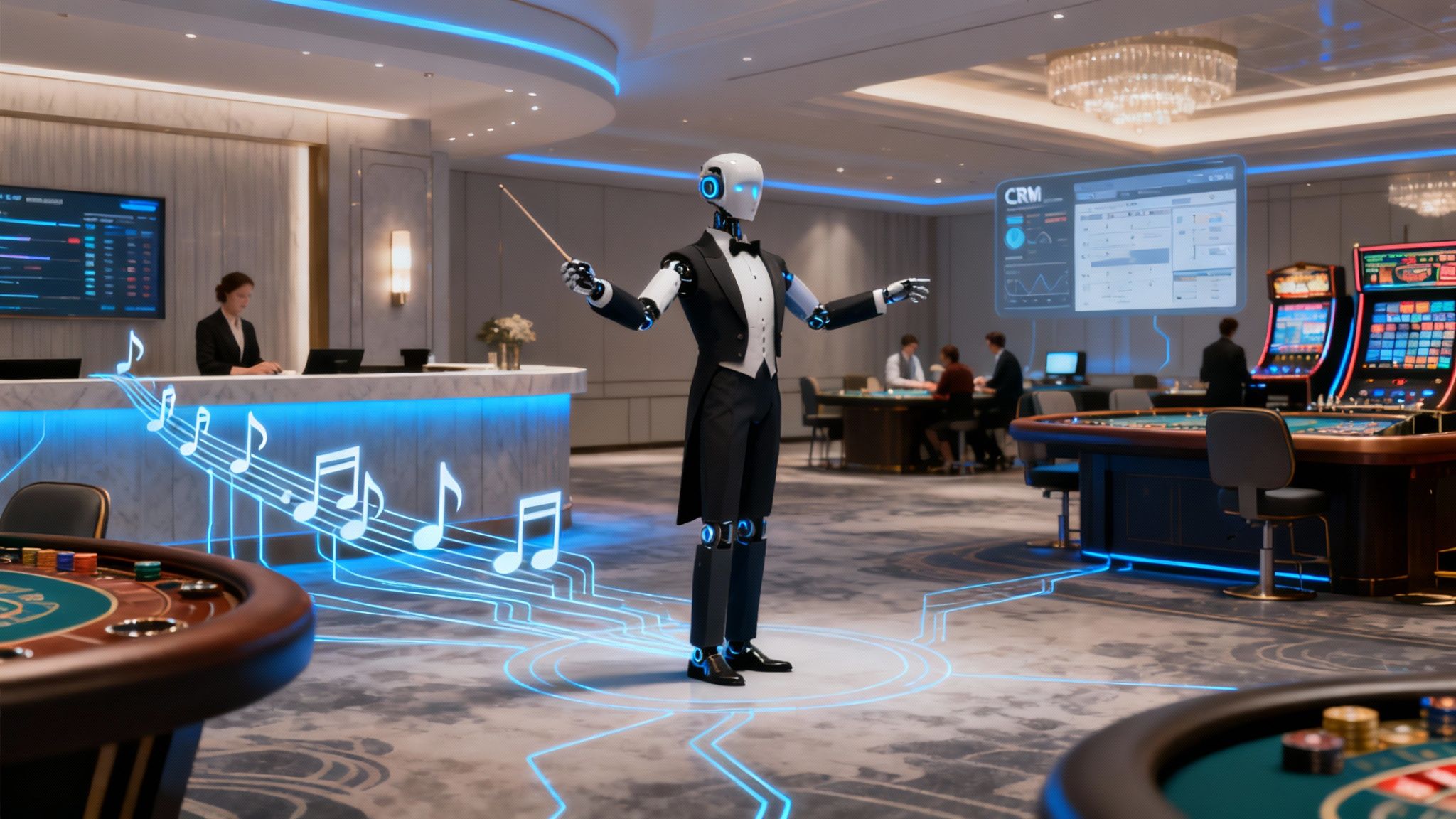
I often explain it to executive teams like this: view your casino as a world-class orchestra. You have talented sections—marketing, hotel ops, gaming, F&B. They all play their parts well. But without a conductor, you get noise, not a symphony.
The autonomous AI host is your conductor. It ensures every department works in concert to create a seamless guest experience that is also maximally profitable.
Imagine a high-value player walks onto the property. The AI can instantly coordinate a room upgrade, notify their human host, and push a personalized welcome offer for their favorite restaurant to their mobile device. This isn't a clunky, multi-step process. It is one fluid, intelligent action.
The real magic is integration. An autonomous AI host demolishes the walls between your data silos. It turns all that isolated information into a true 360-degree view of every single guest. This unified intelligence is what makes real personalization possible at scale.
A human team, no matter how skilled, simply cannot achieve this level of coordination. The sheer volume and velocity of the data are prohibitive. The AI host bridges that gap, making hyper-personalized service a reality for thousands of guests simultaneously.
Core Components That Power the System
So, how does it actually function? Let's look under the hood. This isn't black-box magic; it's a strategic combination of proven technologies.
- Machine Learning (ML) Models: These are the personalization engines. They analyze guest behavior to identify patterns, predicting what a player will want next so the system can deliver offers that convert.
- Predictive Analytics: This is what shifts the host from reactive to proactive. By analyzing data streams on the fly, the AI can anticipate a guest's next move—like identifying a player who’s about to cash out and deploying a timely bonus to extend their play.
- Natural Language Processing (NLP): This is the communication layer. It enables the AI to understand and respond to guests conversationally, whether through an in-app chat or a voice command in their hotel room.
These components operate in a continuous feedback loop. The AI makes an offer, tracks the guest's response, learns from it, and refines its strategy for the next interaction. This cycle of learning and optimization is the core of intelligent process automation. It's how we move from simply reacting to guests to proactively architecting a more engaging and profitable hospitality model.
How AI Unlocks Measurable Revenue Growth
Let's get to the point. In my world, sophisticated technology is irrelevant unless it directly drives the bottom line. As a growth strategist, I’m not captivated by promising tech; I'm focused on tangible EBITDA. The real power of an autonomous AI casino host is its ability to pull the most critical revenue levers across your entire operation.
This isn't about ambiguous metrics like "guest satisfaction." This is about converting superior service into cash flow. It's about transforming every guest interaction into a revenue opportunity and using data-driven actions to increase spend, extend stays, and ultimately maximize the lifetime value (LTV) of every individual on your property.
From Data Points to Dollars
The traditional approach to casino hosting is reactive and constrained by the number of people your hosts can engage with daily. An autonomous system operates on a completely different paradigm—it functions at a scale and velocity that's impossible for humans, processing thousands of data points in real time to deploy the perfect offer at the perfect moment.
Consider the application. Imagine sending a personalized slot tournament invitation to a player the second their betting patterns indicate they're on a hot streak. Or, pushing an intelligent suite upgrade offer to a guest's phone moments after they hit a significant jackpot. This is proactive, data-fueled revenue generation.
This infographic crystallizes the key growth areas an AI host impacts, showcasing the clear financial upside.
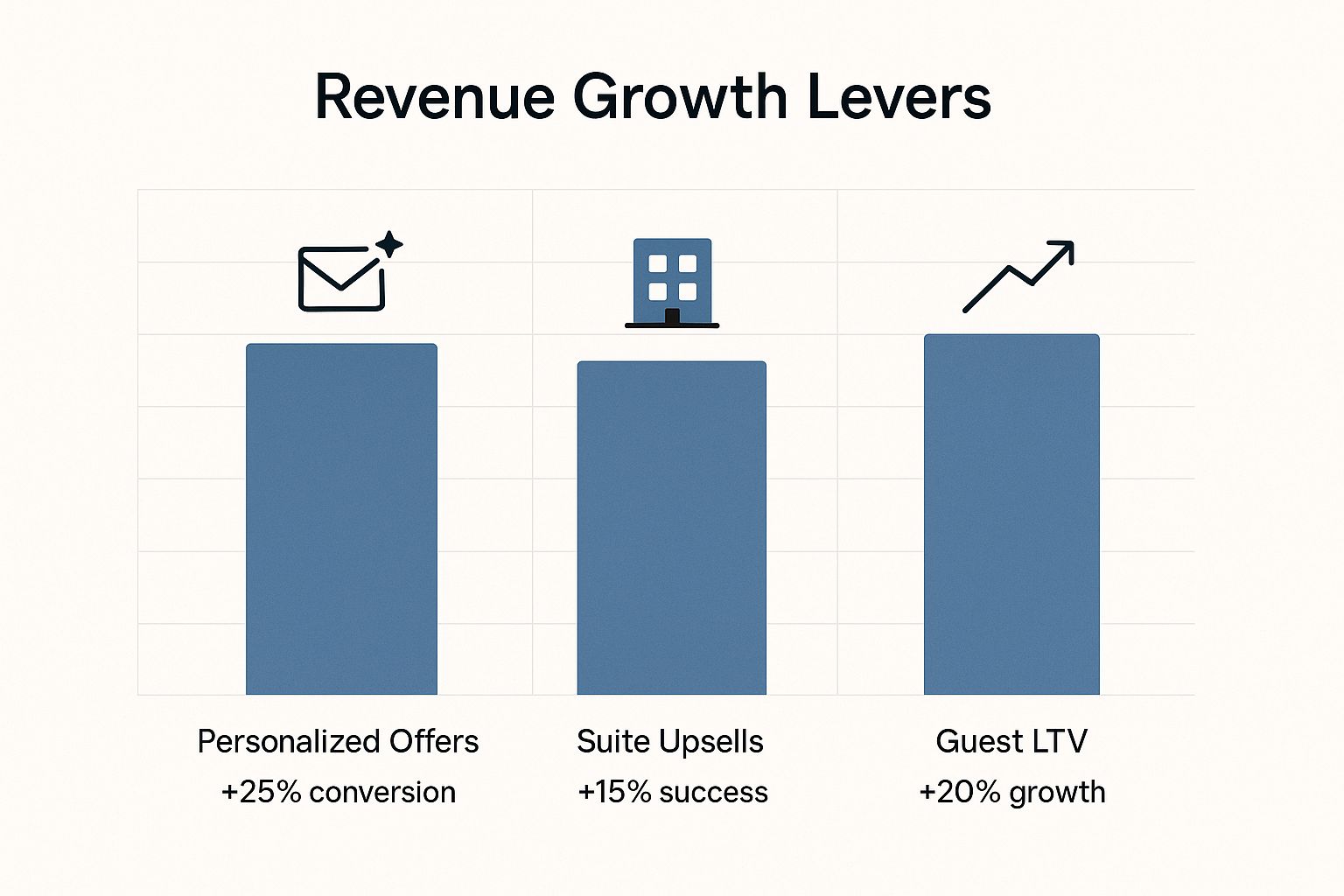
The data is unequivocal. Targeted, AI-driven actions consistently outperform broad, manual campaigns.
The Science of Hyper-Personalization
At its core, an autonomous AI host is a hyper-personalization engine. It moves far beyond basic demographics to understand individual behaviors, preferences, and even in-the-moment context. This deep, granular insight allows it to create offers that feel less like marketing and more like intuitive, high-value service.
This is more than knowing a guest's name. It's knowing their preferred game, average bet, favorite steakhouse, and typical length of stay. With that intelligence, the AI can execute highly profitable actions:
- Dynamic Reinvestment: Instead of generic free play, the AI calculates the optimal reinvestment amount for each player in real time to extend their play and maximize their theoretical value.
- Intelligent Upselling: It identifies guests most likely to convert on an upsell for a show, spa treatment, or room upgrade based on their real-time spending and on-property behavior.
- Proactive Retention: By analyzing play velocity and session duration, the AI can predict when a high-value player is at risk of leaving. It then proactively delivers a compelling offer—like a dining credit or bonus play—to incentivize them to extend their stay.
The objective is to make every offer feel like a one-to-one interaction. When you deliver the right incentive to the right person at exactly the right time, conversion rates increase dramatically, and you stop wasting capital on promotions that miss the mark.
To execute this effectively, you must understand your audience on a granular level. For a deeper analysis, review our guide on advanced customer segmentation strategies, which details how to group guests for maximum impact.
Revenue Impact of AI Host vs Traditional Host
To make the financial benefit explicit, let's compare the two models side-by-side. The following table highlights how an AI-powered system outperforms traditional methods across key growth vectors.
| Growth Lever | Traditional Host Approach (Limitations) | Autonomous AI Host Advantage (Outcomes) |
|---|---|---|
| Personalized Offers | Relies on manual segmentation and past visit data. Offers are often generic and sent out in broad campaigns, leading to low conversion rates. | Analyzes real-time behavior to deliver unique, 1:1 offers at the moment of highest intent. Results in a +25% conversion lift. |
| Amenity Upsells | Depends on host availability and intuition. Opportunities are frequently missed if a host is busy or unaware of a guest's non-gaming preferences. | Proactively identifies prime upsell moments (e.g., after a win) and delivers targeted offers for suites, dining, or shows via mobile. Boosts upsell success by +15%. |
| Player Retention | Reactive approach. A host might notice a high-value player leaving and try to intervene, but often it's too late. | Predicts churn risk by analyzing play velocity and session data. Proactively sends retention offers to extend stays and keep valuable players on property. |
| Guest Lifetime Value | Focused primarily on gaming spend during the current trip. Limited ability to influence non-gaming revenue or future visit frequency. | Drives spend across the entire property (dining, retail, spa) and nurtures long-term loyalty through continuous, personalized engagement. Increases overall Guest LTV by +20%. |
Ultimately, the autonomous host doesn't just perform the same job better; it executes functions that are simply impossible for a human-only team to manage at scale, leading to significant, measurable growth.
Maximizing Total Property Spend
A critical metric for any savvy casino executive is Total Guest Value, which extends far beyond gaming revenue. An autonomous AI host excels at breaking down the silos between the casino floor and other amenities, driving spend across your entire resort.
Visualize these scenarios:
- Connecting Gaming to Dining: A player concludes a profitable session at a blackjack table. The AI host instantly sends a notification to their phone with a reservation offer for the steakhouse, perhaps including a complimentary glass of their preferred wine.
- Boosting Retail Traffic: The system detects a guest has been browsing luxury watches in your resort's app. It can then trigger a notification for a special, limited-time offer at your on-site jewelry store.
Executing this level of integrated marketing manually is a logistical nightmare. The AI acts as the central nervous system for your entire property, ensuring a win on the floor translates into revenue for your restaurants, shops, and showrooms. This is how you capture a larger share of wallet and build sustainable market share.
Building Your AI Implementation Roadmap
Let's be pragmatic. Implementing an autonomous AI casino host is a major strategic initiative, not just another IT project. I’ve spent decades breaking down corporate silos, and I can state with certainty: if your marketing, operations, and IT teams are not perfectly aligned from day one, the project is destined for failure.
This is your practical, no-nonsense guide to successful execution. We will walk through this step-by-step, from initial concept to a fully operational system, with a relentless focus on measurable return. This isn't about chasing technological trends; it's about building a powerful new engine to drive real growth for your property.
Identify Your Quickest Wins
The initial move is not a massive, property-wide overhaul. That is a recipe for budget overruns and operational disruption. Instead, you must identify the low-hanging fruit—those pilot projects that deliver the fastest, most demonstrable ROI. This is how you build momentum and secure executive buy-in.
Start by targeting the high-volume, low-complexity tasks that are currently consuming your team's bandwidth.
- Automate Common Requests: What are the top five questions your front desk or concierge answers repeatedly? An AI can handle those instantly, freeing up your staff to manage more complex guest needs.
- Personalize Welcome Offers: Replace generic welcome emails. The AI can leverage pre-arrival data to push a personalized offer to a guest's phone the moment they check in—perhaps a discount at their favorite steakhouse.
- Streamline Room Service: By integrating the AI with your F&B systems, you can create a simple, conversational ordering process. Better yet, it can intelligently suggest add-ons based on that guest's past order history.
Securing these early wins proves the concept and demonstrates immediate value. It makes the case for scaling the investment a much simpler conversation. Start small, prove the ROI, and then prepare to scale.
Map Out a Phased Rollout
Once you have a few wins, it's time to develop a structured, phased rollout plan. The global online gambling market provides a clear signal; it grew from $58 billion in 2019 to nearly $90 billion by 2021. Those casino industry statistics underscore how rapidly consumer expectations for digital convenience are accelerating. To deliver a comparable experience on-property, your data and technology infrastructure must be flawless.
Your rollout should follow a logical progression.
- Data Integration and Cleansing: An AI is only as effective as the data it's fed. The first and most critical phase is integrating your core systems—CRM, PMS, player tracking—and cleaning the data. "Garbage in, garbage out" isn't a cliché; it's a fundamental truth in data science.
- Vendor Selection and Partnership: Don’t just hire a technology vendor; select a strategic partner. You need a team that understands the unique operational pressures of hospitality and gaming, not just the AI itself. They should function as an ally who can help you navigate the complexities of integration and change management.
- Model Training on Property-Specific Data: Once integrated, the AI must be trained. It must learn from your specific data to understand the unique behaviors of your guests, the nuances of your property, and the specific service standards of your brand.
A well-designed pilot program is non-negotiable. Select a specific segment of your operation—a single hotel tower or a particular tier of your VIP list—to test, learn, and refine the system. This is how you mitigate risk and work out the kinks before a full-scale deployment.
Augmenting Your Team, Not Replacing It
Let me be unequivocal: the objective is to make your team more effective, not to eliminate headcount. An autonomous AI casino host is designed to handle the 90% of logistical and data-intensive tasks that are impossible for a human to manage at scale.
This frees your hosts to do what they do best: build relationships. Armed with insights from the AI, they can focus on delivering the high-touch, personal service that creates unbreakable loyalty with your highest-value players. To explore this concept further, read our guide on business intelligence implementation. This is the future of casino hospitality—a perfect synthesis of AI's efficiency and the human connection that can never be commoditized.
Real-World Examples of AI in Casino Operations
Theory is one thing, but in this business, results are paramount. The concept of a fully autonomous AI casino host isn't a distant sci-fi fantasy. It is being built today on the foundation of proven technologies that are already delivering significant value to casino operations. These aren't just experiments; they are the building blocks for the next evolution of casino hospitality.
By examining these real-world applications, you can see a clear trajectory from where we are today to the kind of intelligent, integrated system we've been discussing. Each example solves a tangible business problem and delivers a measurable return, proving the model one component at a time.
Dynamic Yield Management in Hospitality
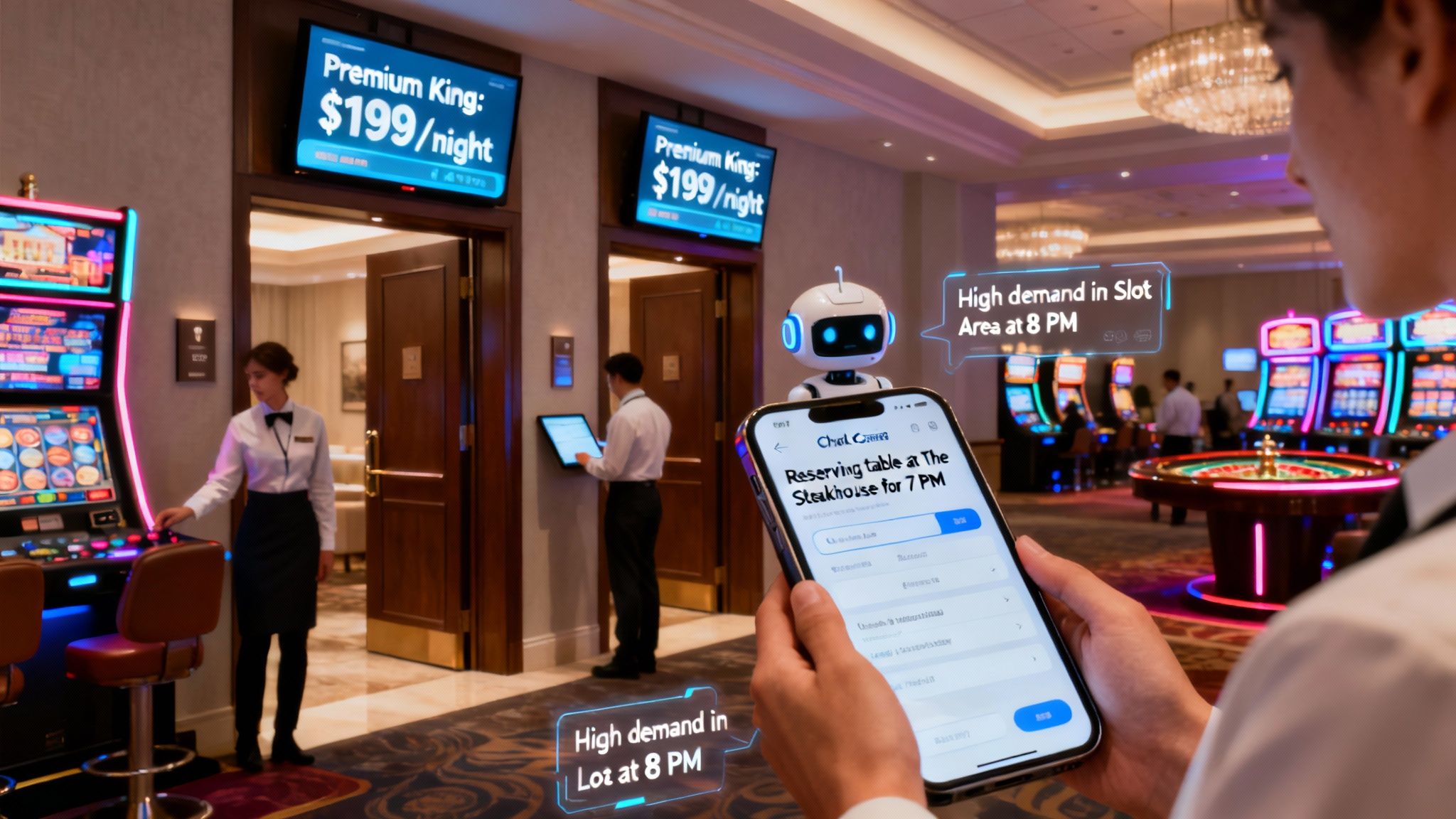
One of the most significant wins for AI has been in dynamic room pricing. The era of static seasonal rates is over. Today, sophisticated AI algorithms process thousands of data points in real time to maximize the revenue from every room, every night.
Consider the variables a human team cannot possibly track simultaneously:
- On-property events and real-time casino floor traffic
- Local competitor pricing and city-wide hotel occupancy
- Historical booking patterns and incoming flight data
- Individual guest LTV and specific gaming history
By continuously optimizing room rates based on this live intelligence, a casino can maximize revenue from its most perishable asset: an empty hotel room. This is a perfect example of AI executing its core function—connecting data from the gaming floor and hotel operations to directly drive bottom-line results.
Predictive Re-engagement for At-Risk VIPs
Another game-changer is the use of AI to identify high-value players who are at risk of churning—and intervening before they do. Historically, this relied on gut instinct. Now, it is a precise, data-driven science.
AI models monitor subtle shifts in player behavior that signal disengagement, such as a slight decrease in average bet, shorter session times, or a change in game preference. The moment the system flags a VIP as "at-risk," it can trigger an automated, personalized intervention. This could be a perfectly timed bonus offer, an invitation to a private event, or an alert to their human host to make a personal call. This type of proactive retention is a core function of an autonomous AI casino host.
An AI system doesn't wait for a valuable player to leave. It steps in at the first sign of trouble, using data to protect the relationships that keep the business thriving.
The Rise of AI-Powered Concierge Services
Beyond the gaming floor, AI is fundamentally reshaping the guest experience. We are already seeing AI-driven humanoids and robots deployed in casinos to enhance every interaction. Back in 2022, the industry was already predicting that 85% of customer interactions would soon be handled without a human, with AI leading the charge. Japan has been at the forefront, using humanoids like Pepper for personalized guest support and demonstrating what is possible. You can discover more about humanoids in the future of gambling to see how this is unfolding.
From chatbot concierges that manage dinner reservations flawlessly to systems that optimize staffing levels on the floor in real time, the proof of concept is well-established. Every personalized promotion that drives spa traffic or automated room upgrade that delights a guest is another component of the larger puzzle. These aren't isolated tools; they are the elements of a broader, autonomous system that will soon orchestrate the entire guest journey.
Let's be precise about the endgame. This is not about building a casino run entirely by robots. That is a fundamental misunderstanding of what drives long-term value in hospitality. The actual goal is to create a hyper-efficient, data-driven operation where technology and people work in perfect synergy, each leveraging their unique strengths.
We are talking about augmentation, not replacement. The autonomous AI casino host is architected to handle the high-volume, repetitive, and data-intensive work that consumes a human host's time. Consider the thousands of logistical and personalization tasks occurring daily—processing bookings, sending reminders, making initial recommendations. The AI can manage 90% of these flawlessly, operating at a scale no human team could ever match.
The New Role: Strategic Relationship Manager
With the operational heavy lifting automated, your human hosts are liberated from the administrative grind. Their roles evolve from service providers into something far more valuable: strategic relationship managers. No longer bogged down by logistics, they can focus exclusively on forging the deep, personal connections that create unwavering loyalty with your most important guests.
This new dynamic creates a powerful synergy.
Your human hosts, now armed with AI-driven insights, become exponentially more effective. They can approach a guest already knowing their preferred game, their family's names, and the details of their recent wins. They can bypass the transactional and focus on creating a memorable, high-value experience.
This powerful combination is the ultimate competitive advantage. It merges the analytical efficiency of an autonomous AI casino host with the irreplaceable warmth and empathy of a skilled human professional. This isn't just about improving service; it's about engineering a growth engine built on superior intelligence and genuine human connection. That is how you win—and keep—market share.
Frequently Asked Questions
When I sit down with casino executives to discuss implementing an autonomous AI casino host, the conversation quickly moves beyond the technology to the bottom line. Here are the tough, practical questions that consistently arise, and the direct answers I provide.
Will an Autonomous AI Host Replace My Human Staff?
No. This is not about replacement; it's about empowerment. The AI serves as the ultimate force multiplier, handling the high-volume, repetitive work that currently bogs down your team.
This liberates your most valuable people to do what they do best: build relationships with high-value players, solve complex problems, and add the personal, human touch that technology cannot replicate. It elevates your hosts to strategic relationship managers, arming them with the data to make every guest interaction more meaningful and profitable.
How Do We Manage Data Privacy and Security?
This is a critical, non-negotiable priority. Data security must be the foundation of this entire initiative. A robust data governance framework is essential, as is partnering with vendors who are experts in regulations like GDPR and CCPA. All guest data must be encrypted, with access controls that are rigorously enforced.
We operate on a principle of 'privacy by design.' The goal is to leverage data to create a superior, personalized guest experience, but never at the expense of the trust our industry is built upon. Protecting guest information isn't a compliance checkbox; it is central to brand protection.
Recent security breaches in our industry—some costing operators over $100 million—are a stark reminder that there is zero room for error in this domain.
What Is the Typical ROI for This Technology?
While exact figures depend on your specific operation, the financial upside is clear and quantifiable. The most accurate way to determine your ROI is through a focused pilot program, but you can expect to see significant gains across several key areas.
Here is where the value is generated:
- Increased Player Spend: By moving away from generic offers to hyper-personalized, real-time incentives, you increase conversion rates and player spend.
- Higher Incremental Revenue: The system intelligently upsells rooms, dining reservations, and show tickets at the moment a guest is most receptive.
- Significant Operational Efficiency: Automating routine tasks and optimizing staffing based on real-time demand reduces administrative overhead and boosts productivity.
- Enhanced Player Loyalty: A seamless, proactive service experience makes guests feel recognized and valued, which directly impacts their lifetime value and visit frequency.
Each of these is a hard metric that drives top-line revenue and improves bottom-line profit, making this a powerful investment in your property's financial performance.
At MGXGrowth, our expertise is in building these kinds of data-driven growth engines. If you're ready to move from theory to a real-world implementation plan for an autonomous AI host, let's have a conversation. See how we can unlock the next level of growth for your property at https://www.mgxgrowth.com.
