


In my decades of driving growth, I’ve learned one immutable truth: a data-driven marketing strategy isn't about dashboards or buzzwords. It’s about replacing assumptions with evidence. It’s the operational shift from "I think this will work" to "I know this drives revenue." This commitment makes every marketing dollar accountable by tying every action directly to critical business outcomes like EBITDA and market share growth.
Stop Guessing and Start Growing with Data

I’ve sat in countless boardrooms where marketing was dismissed as a creative cost center—a necessary expense with fuzzy, hard-to-pin-down returns. That era is over. The reality is, when architected correctly, marketing should be one of the most predictable growth engines in your entire organization.
Getting there doesn't happen by just buying more software or hiring a data scientist. It starts with a cultural shift, a genuine commitment from leadership to move past gut feelings and vanity metrics. It’s about learning to ask tougher, better questions.
The Philosophy of Accountable Growth
Instead of asking, "How many likes did we get?" we must ask, "How did that social campaign impact our customer acquisition cost (CAC) for the quarter?" This is the heart of a real data-driven marketing strategy. It reframes the entire function from a collection of siloed activities into a cohesive system built for one purpose: sustainable growth.
It's no surprise that over 64% of marketing executives now strongly agree this approach is crucial. A significant part of this change is the growing reliance on first-party data, especially as privacy rules clamp down on third-party sources. This isn't a setback; it forces us to build deeper, more direct relationships with our customers. You can dig into more of these data-driven marketing trends on Invoca.com.
In my experience across SaaS, gaming, and real estate, the companies that win are the ones that break down the walls between marketing, sales, and product. Data becomes the universal language that makes this collaboration not just possible, but powerful.
From Silos to Synergy
Adopting a data-first mindset creates a powerful feedback loop that benefits the entire enterprise. Suddenly, departments start speaking the same language—the language of the customer.
- Marketing insights show the product team which features high-value users actually engage with, directly informing the roadmap.
- Sales feedback helps marketing refine its lead scoring models to target more profitable customer segments, increasing sales velocity.
- Customer support data reveals friction points in the user journey that marketing can address with proactive onboarding campaigns.
This isn’t just about making pretty dashboards. It's about building an operational rhythm where making decisions based on evidence becomes second nature. This is how you transform your marketing department from a cost center into a predictable revenue machine that consistently proves its value to the business.
Build Your Data Foundation for a Unified Customer View

Your entire marketing strategy is only as strong as the data it’s built on. The single biggest—and most expensive—mistake I see companies make is chasing advanced tactics like AI-powered personalization before they’ve mastered the fundamentals of data collection and integration. They buy the fancy tools but have nothing of substance to feed them.
This is like trying to build a skyscraper on a foundation of sand. It’s destined to collapse. An effective data-driven marketing strategy begins with building a robust, unified data foundation. This isn't the glamorous part of marketing, but it is the most critical for sustainable growth.
Identify and Prioritize Your First-Party Data
With privacy regulations tightening and third-party cookies disappearing, your own first-party data has become your most valuable asset. This is the information you collect directly from your audience. It's accurate, relevant, and you own it. The challenge is that it’s almost always scattered across different departments and systems.
The first step is a simple audit. Map out every single place your business touches a customer and collects information.
- CRM Systems: The nucleus of your commercial operations, holding sales interactions, lead status, and customer communication logs.
- E-commerce Platforms: Transaction histories, abandoned carts, and purchase frequency are goldmines for predicting future behavior.
- Customer Support Logs: These reveal customer pain points, product feedback, and common issues that marketing can address proactively.
- Website and App Analytics: User behavior, session duration, and conversion paths tell you what content resonates and where the friction is.
- Email and Marketing Automation Platforms: Open rates, click-through rates, and content engagement show direct interest.
Don’t just list them. Prioritize them based on which sources provide the clearest signals of customer intent and value. Transaction data often comes first, but support ticket data can be just as crucial for retention.
Break Down the Silos for a Single Source of Truth
I’ve seen it a hundred times: Marketing has their data, Sales has theirs, and Product has another set entirely. They don’t talk to each other, and as a result, no one has a complete picture of the customer. The customer who just submitted a negative support ticket gets a cheerful "buy now!" email an hour later. It’s a terrible experience that erodes trust.
Breaking down these silos is non-negotiable. The objective is to create a single source of truth—a unified customer profile that integrates data from all those disparate sources. This is where a Customer Data Platform (CDP) can be invaluable. A CDP ingests data from multiple systems, cleans it, and stitches it together into a single, coherent view of each customer.
Choosing the right tech stack is crucial, but it follows the strategy, not the other way around. Don't buy a CDP because it's trendy. Invest in one because you have a clear plan for how a unified customer view will directly impact revenue, such as by reducing churn or increasing upsell opportunities.
Establish Governance and Ensure Data Quality
Once you centralize data, you'll quickly realize how messy it is. You'll find duplicate records, outdated information, and inconsistent formatting. Dirty data leads to flawed analysis and bad decisions. This is why establishing clear data governance standards is a foundational step.
This involves creating rules for how data is collected, stored, and used. For example:
- Define Ownership: Who is responsible for the data in the CRM? Who manages the e-commerce data? Clear ownership prevents finger-pointing.
- Standardize Formats: Ensure that things as simple as names, addresses, and dates are entered consistently across all systems.
- Implement Validation: Set up rules to catch errors upon entry, preventing bad data from polluting your ecosystem in the first place.
Building this foundation is hard work. It requires cross-functional collaboration and a commitment to process. But once you have a clean, unified view of your customer, you unlock the ability to execute a truly powerful data-driven marketing strategy that leaves guesswork behind.
Translate Raw Data into Actionable Marketing Insights
Having clean, unified data is a massive win, but it’s just the starting line. Raw data on its own is effectively useless. A mountain of metrics and terabytes of information mean nothing if they don’t tell you what to do next. This is where a true strategist earns their keep: translating all those numbers into a clear, actionable story.
The biggest trap I see teams fall into is celebrating vanity metrics. Things like social media likes, email open rates, and even website traffic look great on a dashboard, but they don't directly pay the bills. The core of a powerful data-driven strategy is shifting your focus to the key performance indicators (KPIs) that have a direct, undeniable impact on profitability.
This is where your digital transformation roadmap starts to generate tangible business outcomes, all by asking the right questions.
Focus on Metrics That Drive Profitability
In every business I’ve led or advised, we ruthlessly prioritized two core metrics above all others: Customer Acquisition Cost (CAC) and Lifetime Value (LTV). The simple ratio of LTV to CAC tells you the fundamental health of your business. Honestly, everything else is secondary.
Your analysis has to connect every single marketing action back to these two numbers.
- Instead of: "Our blog traffic is up 20%."
- Ask: "Which blog posts are generating leads with the lowest CAC and highest eventual LTV?"
This simple shift in perspective forces your team to think like business owners, not just marketers. It’s the difference between being busy and being truly productive.
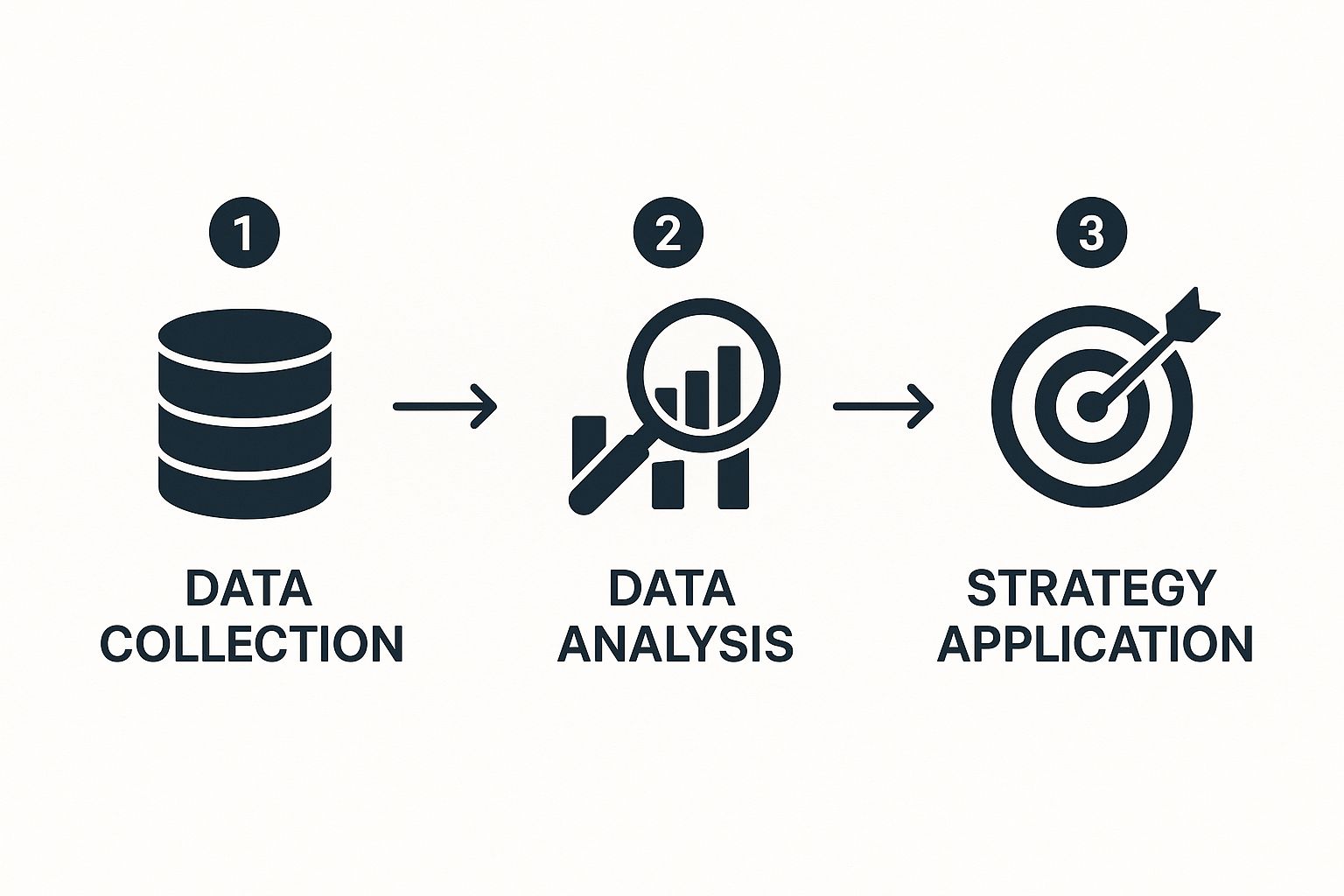
This kind of flow shows that data isn't the finish line; it's the fuel for a continuous cycle of analysis and strategic action.
It's crucial to distinguish between metrics that make you feel good and those that actually grow the business. Here’s a quick breakdown to help your team focus on what matters.
Vanity Metrics vs Actionable Growth KPIs
| Focus Area | Vanity Metric (Avoid) | Actionable KPI (Prioritize) | Why It Matters for Growth |
|---|---|---|---|
| Website Performance | Total Page Views | Conversion Rate by Traffic Source | Reveals which channels are bringing in customers, not just visitors. |
| Content Marketing | Social Media Likes/Shares | Leads Generated per Asset | Directly ties content efforts to pipeline and revenue generation. |
| Email Marketing | Open Rate | Click-to-Conversion Rate | Measures how many subscribers are taking a desired action, not just opening an email. |
| Customer Health | Number of Active Users | Customer Lifetime Value (LTV) | Focuses on long-term profitability and retention over simple activity. |
| Acquisition Efficiency | Cost per Click (CPC) | Customer Acquisition Cost (CAC) | Measures the total cost to acquire a paying customer, not just a click. |
Prioritizing the KPIs in the third column ensures your marketing efforts are directly aligned with financial outcomes, making your strategy defensible and scalable.
From Demographics to Behavioral Segmentation
Demographics are a starting point, but the real gold is in segmenting your audience based on what they do, not just who they are. Behavioral data reveals intent, and that's where the magic happens.
At a previous SaaS company, we moved beyond just segmenting by company size. Instead, we used cohort analysis to group users by their initial actions within the first week of signing up. What we found was astounding: users who integrated our product with a specific third-party tool within their first three days had a 4x higher LTV than any other group.
That single insight was a game-changer. We immediately stopped spending money on broad campaigns and rebuilt our entire onboarding flow and ad targeting to encourage that one critical integration. Our CAC dropped by 30% within a single quarter.
This is the power of behavioral segmentation. It allows for precision targeting and personalization that feels genuinely helpful to the customer because it anticipates their needs before they even voice them.
Using Predictive Analytics to Anticipate Needs
The final layer is moving from reactive analysis (what happened?) to predictive analysis (what will happen?). This is where you can truly get ahead of the market and your competition. By analyzing past purchasing patterns, browsing behavior, and even support ticket data, you can build models that predict which customers are most likely to churn, which are ready for an upsell, and what their next purchase might be.
For example, in a marketplace I worked with, we used predictive analytics to identify sellers whose sales velocity was starting to slow down. We could then proactively reach out with targeted educational content and support before they became inactive. This approach dramatically reduced seller churn.
This proactive strategy turns your data from a rearview mirror into a GPS, guiding your next move with confidence.
Put Your Data to Work: Executing and Optimizing Your Campaigns

Strategy without execution is merely a hallucination. You've laid the groundwork with solid data and clear insights. Now it's time to translate that strategy into reality. From my experience, the delta between a good marketing team and a great one is agility. It's about acting on data now, not waiting for the next quarterly review.
The goal here is to create a continuous loop of optimization across every one of your marketing channels. I've always called this the "test, measure, learn" cycle. It’s a simple concept, but embedding it into your culture requires discipline and a true data-first mindset.
The Continuous Optimization Loop in Action
This isn't a one-off project; it’s the new rhythm of your marketing operations. Every email, every ad, every piece of content becomes an experiment—a chance to learn something new about your audience.
I remember working with a SaaS company whose email onboarding was a generic, one-size-fits-all sequence. We dove into the user behavior data and quickly found two very different groups: "power users" who jumped straight into advanced features, and "standard users" who stuck to the basics.
So, we scrapped the single campaign and created two dynamic ones:
- For Power Users: We sent content highlighting advanced integrations and pro-level shortcuts.
- For Standard Users: We focused on tutorials for core features to help build their confidence and drive deeper engagement.
The outcome? A 25% jump in feature adoption and a noticeable lift in user retention within just 90 days. That’s what data-driven execution looks like.
Personalization That's More Than Just a Name
Real personalization goes way beyond dropping a {{first_name}} tag into an email. It’s about crafting dynamic experiences that adapt to what a person actually does. This is where your unified customer data becomes your biggest competitive advantage.
Think about your website. It shouldn't be a static brochure. When a known user returns to your site, the content they see can—and should—change based on what they've done before.
If someone has read three of your blog posts about a specific product feature, why not greet them with a case study or a special offer for that exact feature on the homepage? This isn’t just clever marketing; it’s a fundamentally better customer experience powered by data.
Today's sharpest marketers are using real-time data to make these kinds of quick, precise decisions. This approach turns marketing from a cost center into a growth engine with tangible business outcomes. By targeting based on actual behavior, brands can boost conversion rates without just throwing more money at the problem.
Get Smarter with Your Ad Spend
The "test, measure, learn" cycle really shines in paid advertising, where every dollar must be accountable. Forget setting a budget and just hoping for the best. With the right data connections, you can make adjustments in real time.
By linking your ad platform data directly to your CRM, you can start optimizing for metrics that actually matter—like qualified leads or real sales—instead of just chasing clicks or impressions.
I once advised a real estate marketplace that was stuck optimizing for cost-per-lead. We made a crucial switch: we started optimizing for cost-per-scheduled-tour. It took some work to integrate their booking system with the ad platforms, but the impact was immediate. We stopped burning cash on leads that went nowhere and doubled down on the keywords and audiences that were driving actual appointments. That simple change improved their return on ad spend by over 40%.
Of course, knowing which metrics to track is half the battle. If you need a refresher, we've put together a guide on measuring success with key metrics every business should track.
Case Study: How We Slashed SaaS Churn with Engagement Data
One of the most powerful examples I've seen of this in action was with a subscription software business trying to tackle churn. Churn is a silent killer for any SaaS company, and we knew we had to get proactive.
We started by digging into user engagement data, searching for patterns that came before a customer canceled. We found a clear signal: a 30-day decline in the use of one particular "sticky" feature was a huge red flag.
With that insight, we built an automated retention campaign. Here’s how it worked:
- The Trigger: Our system automatically flagged accounts where usage of that key feature dropped below a set threshold.
- The Action: This instantly triggered a personalized email from a "customer success manager," offering a one-on-one session to help them get more value from the tool.
- The Result: This proactive, data-triggered intervention cut our voluntary churn by 18% in just six months.
This is what modern data-driven marketing is all about. It’s not about launching massive, complex campaigns. It's about empowering your team to make small, smart, data-informed decisions every single day that add up to significant, measurable growth.
Scale Your Strategy and Prove Marketing ROI
You’ve laid the groundwork, turned raw data into actionable insights, and run some laser-focused campaigns. This is where many marketing teams hit a plateau. But to truly elevate marketing from a line item to a strategic growth engine, you have to make your success both repeatable and easy to defend in the boardroom.
It's about proving your value in the only language that matters to the C-suite: revenue, EBITDA, and of course, ROI. A killer data-driven strategy isn't just about launching better campaigns; it's about building a system that consistently justifies its own budget and steers the entire company in the right direction. This is the final, crucial step from being seen as a cost center to becoming an essential partner in growth.
Moving Beyond Last-Click Attribution
The first major roadblock to proving your worth is almost always attribution. I've personally seen millions in marketing spend go down the drain because a company was stuck in the past, clinging to last-click attribution. It’s like giving all the credit for a Super Bowl win to the player who scored the final touchdown, completely ignoring the months of training, the offensive line, and the quarterback's perfect pass.
Today's customer journey is a winding road, often with dozens of touchpoints across paid ads, social media, email, and organic search. To get an honest read on your impact, you need to adopt a multi-touch attribution model.
- Linear Model: This one’s straightforward—it gives equal credit to every single touchpoint. It’s a great starting point because it’s simple and acknowledges the whole journey.
- Time-Decay Model: This model gives more credit to the touchpoints that happen closer to the sale. It makes a lot of sense, recognizing that those final interactions are often what seal the deal.
- U-Shaped Model: Here, the first touch (what got them interested) and the last touch (what closed them) get the most credit, with the interactions in the middle getting a smaller share.
So which one is right for you? It really depends on your business. If you have a short, quick sales cycle, a linear model might be perfect. But for a longer, more considered purchase, a time-decay approach often tells a more accurate story. The most important thing is to just pick one, stick with it, and use it to figure out which channels are really moving the needle.
Communicating Value to the C-Suite
Okay, you’ve got your attribution sorted. Now for the next challenge: translating your wins into a language executives actually understand. Trust me, nobody wants to see a 20-page report crammed with marketing jargon. You need a clean, high-level dashboard that draws a straight line from your team’s efforts to the company's financial health.
Your executive dashboard needs to be ruthlessly simple. Focus on just a handful of core metrics:
- Marketing Sourced Revenue: The total dollar amount of revenue that came directly from marketing's activities.
- Marketing Influenced Revenue: Revenue from deals where marketing played a significant role, even if sales closed it.
- Customer Acquisition Cost (CAC): The all-in cost of sales and marketing to land one new customer.
- LTV to CAC Ratio: This is the holy grail. It shows the lifetime value of a customer versus the cost to acquire them—a true measure of profitability.
- Payback Period: How many months does it take to recoup the money we spent acquiring a customer?
When you can walk into a budget meeting and say, "For every dollar we invested in this channel, we generated five dollars in lifetime value within 12 months," the conversation changes completely. You're no longer asking for money; you're presenting a profitable investment opportunity.
Fostering a Data-First Culture Organization-Wide
The final frontier for a truly mature data-driven marketing strategy is to tear down the last silo—the one between your department and everyone else. The insights you’re uncovering are far too valuable to keep to yourselves.
This is about a cultural shift, where data becomes the common ground for every team. The intelligence marketing gathers should be the spark for improvements across the entire company. For any entrepreneur looking to scale, understanding why every business needs solid digital marketing from this data-centric view is non-negotiable.
- Inform Product Development: Share data on which features your best, high-LTV customers use the most. This is gold for the product roadmap.
- Refine Sales Strategy: Give the sales team behavioral data that flags accounts showing high purchase intent. This makes their outreach smarter and more effective.
- Improve Customer Service: Use sentiment analysis from social media or email responses to get ahead of customer frustrations before they become big problems.
When marketing's data engine starts fueling decisions in product, sales, and service, you’ve achieved true strategic alignment. At that point, you're not just proving ROI anymore—you’re actively shaping the future of the company, and you have the data to back up every move.
Common Questions About Data-Driven Marketing
Over the years, I've fielded hundreds of questions from executives and marketing leaders about putting a truly effective data-driven marketing strategy into practice. The challenges often feel immense, but the solutions are usually more straightforward than you might think. Here are my answers to the most common questions that pop up in boardrooms and strategy sessions.
These aren't just theoretical concepts; they're practical, road-tested answers from my experience driving growth across multiple industries.
Where Should a Small Company Start with Data-Driven Marketing?
The biggest mistake a smaller company can make is trying to boil the ocean. You don’t need a massive tech stack or a team of data scientists to get started. You just need to start simple, stay focused, and build from there.
Begin with the data you already have. This means digging into Google Analytics, your email marketing platform, and whatever you use for a CRM—even if it's just a well-organized spreadsheet for now. The first, most critical step is to correctly set up conversion tracking. If you can’t measure what a "win" looks like, none of the other data really matters.
My advice is always the same: focus on answering one critical business question first. Don't try to answer everything at once. Pick a question like, 'Where do our most profitable customers actually come from?' or 'Which email subject lines generate the most scheduled demos?'
Mastering these foundational elements provides immediate, tangible value. It also builds the internal momentum and skills you'll need to tackle more complex projects down the line.
How Do You Build a Data-First Culture in a Resistant Team?
Building a data-first culture is a game of psychology, not technology. You can't just mandate it from the top down and expect people to magically change their habits. I've learned that the most effective approach is to start small and create undeniable "quick wins."
Find a specific, nagging problem your team struggles with—for example, high ad spend on a channel that everyone feels is underperforming. Use data to analyze it, and then propose a small, low-risk experiment. Frame it clearly: "Let's shift $5,000 of our budget from Channel A to Channel B for two weeks and measure the impact on qualified leads."
When that experiment produces a tangible result—'We shifted the budget and got 30% more leads for the same cost'—you create internal champions. Celebrate that success publicly. It shifts the entire conversation from "This is just more work" to "This helps us win."
What Are the Most Common Mistakes to Avoid?
Across SaaS, marketplaces, and even real estate, I've seen the same costly mistakes repeated. The most common pitfall is what I call "tool-first thinking"—buying expensive, complex software before having a clear strategy or clean data to power it. The tool quickly becomes a solution desperately searching for a problem, and the investment is completely wasted.
Another major issue is analysis paralysis. I see it all the time. Teams get so caught up in collecting endless data that they never actually make a decision. To combat this, every analysis must begin with a specific business question. If the analysis doesn't lead to a clear 'yes' or 'no' decision, it's not worth the time.
Finally, ignoring data privacy is a critical, and potentially fatal, error. Mishandling customer data isn't just unethical; it can lead to massive fines and completely destroy the trust you've worked so hard to build. You absolutely must prioritize ethical data collection and governance from day one.
How Do You Measure ROI on a Complex Customer Journey?
The old model of "last-click" attribution is dead. It’s an outdated approach that gives 100% of the credit to the final touchpoint and ignores the entire journey that brought the customer to that point. It's like only crediting the player who scored the final goal, ignoring all the assists and teamwork that made it possible.
A far better approach is multi-touch attribution, which assigns value to multiple touchpoints along the customer's path.
- A simple linear model, which gives equal credit to each touchpoint, is an excellent starting point for most businesses.
- More advanced models, like time-decay (giving more credit to recent touchpoints) or U-shaped (crediting the first and last touches most), can provide a more nuanced view as you get more sophisticated.
The key is to choose a model that accurately reflects your typical sales cycle and then use it consistently. This allows you to understand which channels are truly influencing your customer's decision, not just the ones that happen to be there at the very end.
Ready to stop guessing and start building a growth engine powered by data? At MGXGrowth, we partner with ambitious brands to transform their marketing operations and drive measurable revenue growth. We don't just deliver theoretical concepts; we implement proven strategies that connect every action to your bottom line.
Discover how we can architect the next stage of your growth roadmap at https://www.mgxgrowth.com
