


In my decades of driving growth across SaaS, marketplaces, and real estate, I've seen countless buzzwords fade into obscurity. Business Process Automation, however, is not a trend; it's a fundamental operational shift. It’s about leveraging technology to handle the repetitive, rules-based tasks that consume your team's most valuable resource: time. The objective isn't just efficiency; it's about liberating your top talent for the high-impact, strategic work that directly drives revenue and market share.
What Is Business Process Automation, Really?

Let's cut through the technical jargon. At its core, Business Process Automation (BPA) is about architecting a more intelligent operational engine for your business. This is not another line item on the IT budget; it is a core tenet of your growth strategy.
Consider the manual processes that drain productivity daily: data entry, report generation, invoice processing, or new employee onboarding. Each follows a predictable, step-by-step logic that software can execute with far greater speed and precision than any human.
The strategic imperative here is the reallocation of your most critical asset—your people. When you delegate the rote work to technology, your talent can finally concentrate on the activities they were hired for: innovation, strategic planning, and building deeper customer relationships.
The Strategic Value of Automation
From my vantage point as a growth strategist, the true power of BPA lies in its ability to demolish departmental silos. I’ve seen this transformation firsthand. When you weave together disparate systems and teams with automated workflows, you forge a single, cohesive operational unit. Sales, marketing, and finance cease to operate as isolated fiefdoms and begin functioning as a synchronized, high-performance machine. This integration delivers a level of operational visibility and data velocity that is otherwise unattainable.
"True business process automation moves beyond simple task management. It orchestrates complex workflows across your entire organization, creating a resilient and agile operation ready to scale."
The market validates this perspective. The global business process automation market was valued at $14.87 billion in 2024 and is projected to nearly double to $29.59 billion by 2029. This explosive growth is driven by the undeniable need for businesses to enhance efficiency and elevate the customer experience. For a deeper analysis, you can explore more about these market projections and examine the underlying data.
Shifting from Manual to Automated
To fully appreciate the impact of automation, one must contrast the legacy approach with the modern, automated paradigm. This table illustrates the fundamental differences.
Manual Processes vs Automated Processes At a Glance
| Business Aspect | Manual Process (The Old Way) | Automated Process (The New Way) |
|---|---|---|
| Speed & Volume | Limited by human capacity and working hours. Prone to backlogs. | Operates 24/7 at high speed. Processes thousands of tasks in minutes. |
| Accuracy & Consistency | Susceptible to human error, typos, and inconsistent application of rules. | Executes tasks with 100% accuracy and consistency, ensuring quality. |
| Data & Insights | Data is often trapped in spreadsheets or emails, making analysis difficult. | Generates clean, structured data in real-time for immediate insights. |
| Cost to Operate | High labor costs for repetitive tasks. Scales by adding more headcount. | Lowers operational costs. Scales efficiently without proportional hiring. |
| Employee Focus | Staff is bogged down by tedious, low-value administrative work. | Employees are free to focus on strategic, creative, and customer-facing activities. |
| Agility & Scalability | Slow to adapt to change. Scaling operations is a slow, expensive process. | Highly adaptable. New workflows can be deployed quickly to meet market demands. |
As you can see, the shift is profound. It’s the difference between navigating with a static paper map and using a real-time GPS that dynamically reroutes you around obstacles. One is rigid and error-prone; the other is intelligent, agile, and laser-focused on reaching the objective faster.
Adopting business process automation is a strategic decision to build a more resilient, scalable, and intelligent organization—a system designed to empower your people and propel the business forward.
Why Automation Is a Strategic Imperative

Across every industry I’ve operated in—from SaaS to hospitality—the conversation around automation has matured. The question is no longer if a business should automate, but where it must automate to gain a decisive competitive advantage. Treating business process automation as a mere IT project is a critical strategic misstep. It is a foundational component of any credible growth strategy.
This isn't about incremental gains. It's about a fundamental re-architecture of your company's operating model to compete at an entirely new level. When implemented with strategic intent, BPA directly and measurably impacts the metrics that every executive team scrutinizes, connecting day-to-day operational enhancements to top-line financial performance.
Driving Core Executive Metrics
The true power of automation is its direct, tangible link to the P&L statement. I have witnessed firsthand how it moves the needle on the key performance indicators that define success in the boardroom.
-
EBITDA and Cost Reduction: Automation is a systematic approach to reducing operational overhead. By automating error-prone, repetitive tasks like invoice processing or data reconciliation, you directly reduce labor costs and eliminate the expensive rework that invariably follows human error.
-
Revenue and Speed-to-Market: In any competitive landscape, speed is a weapon. Automating workflows—from client onboarding to product deployment—dramatically compresses cycle times. This translates to serving customers faster and accelerating revenue recognition.
-
Risk Mitigation and Compliance: Manual processes are inherently inconsistent. People make mistakes. Automation, conversely, executes rules flawlessly every time, which is mission-critical for maintaining regulatory compliance and averting costly penalties or data breaches.
These are not abstract benefits; they are concrete financial gains. The impact on productivity is substantial, with studies indicating that companies embracing automation realize an average operating cost reduction of 22%. Furthermore, the ROI from robotic process automation can range from 30% to as high as 200% within the first year. You can discover more automation insights and industry data to review the hard numbers.
Breaking Down Silos to Unlock Growth
One of the most potent—and frequently underestimated—benefits of automation is its capacity to demolish the walls between departments. In my experience, the most significant growth opportunities are invariably trapped in the friction between sales, marketing, operations, and finance.
Automation acts as the connective tissue that binds these disparate functions together. It creates a seamless flow of information, ensuring that every team is working from a single source of truth.
Consider the implications: when a salesperson updates a lead in the CRM, marketing can instantly trigger a personalized follow-up sequence. When a support ticket is resolved, finance can automatically process a credit without manual intervention. Achieving this level of synchronized, real-time integration is simply not feasible at scale with manual processes.
This is about more than operational efficiency. It's about architecting a data-driven, customer-centric organization where an insight from one department immediately triggers an intelligent action in another. This cross-functional alignment is the bedrock of sustainable, scalable growth. It transforms a company from a collection of siloed teams into a single, intelligent entity poised to win its market.
How to Find High-Impact Automation Opportunities
I’ve seen it happen time and time again: leaders get excited about a new piece of automation tech and immediately start looking for problems it can solve. This is completely backward, and it's the fastest way to a disappointing return on investment. The real gold isn't in the software; it's buried deep within your day-to-day operations.
Finding the right processes to automate is less about technology and more about becoming a detective within your own organization. You must hunt down the bottlenecks, the mind-numbing repetitive tasks, and the hidden drains on your team's time and energy. The most valuable opportunities are almost always hiding in plain sight, entangled in the daily grind of your frontline staff.
This visual guide breaks down the core principle perfectly. You must begin by identifying the right manual processes before introducing a tool. Only then can you effectively automate, monitor, and optimize for tangible results.
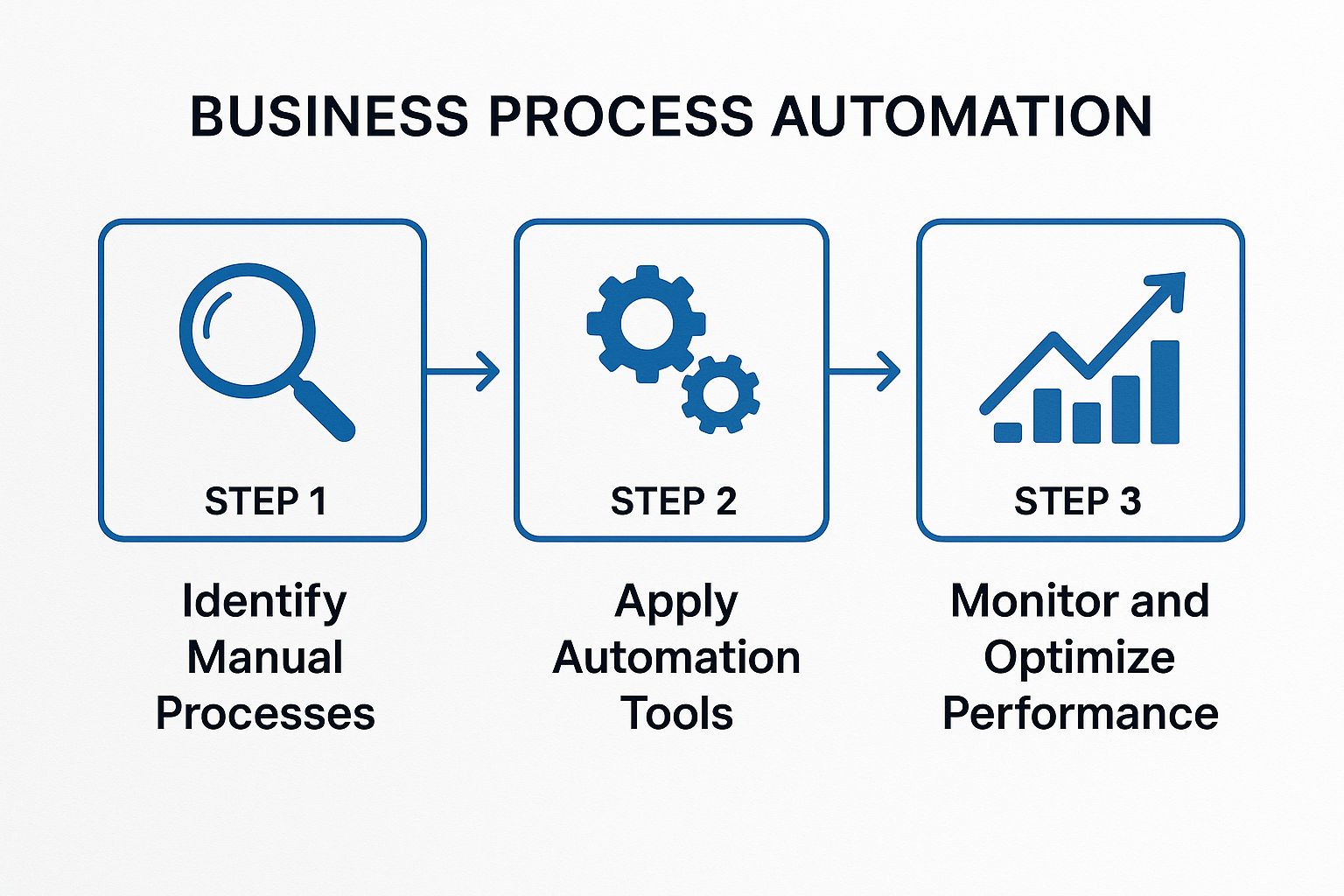
As the flow demonstrates, intelligent automation begins with strategic identification. The objective is to make technology serve a specific business purpose, not the other way around.
Start with a Process Audit
Before you can automate a single task, you need a clear map of how work is actually being done. The only way to get that map is by engaging with the people on the front lines every day. Your teams in finance, HR, and customer support are your greatest source of operational intelligence. They know precisely where the friction lies.
Conduct workshops or one-on-one interviews and ask pointed, data-driven questions:
- What is the single task you perform daily that feels like a complete waste of your expertise?
- Where are you consistently copying and pasting data between systems?
- Which processes generate the most errors that require manual correction?
- If I could reclaim two hours of your day, what high-value, strategic work would you undertake?
Their responses will provide a raw, unfiltered list of high-potential automation targets. This initial step is about human-centric data gathering, not just crunching numbers.
Use the Value vs. Complexity Matrix
Once you have a list of potential initiatives, you need a framework for prioritization. Over the years, I have come to rely on a simple yet incredibly effective tool: the Value vs. Complexity Matrix. It helps you avoid the classic error of tackling a massive, complex project first, which can drain morale and kill momentum before you demonstrate any real progress.
Plot your potential projects on a four-quadrant grid:
- High Value, Low Complexity (Quick Wins): Start here. Always. These are tasks like automating invoice data entry or generating standard weekly reports. They are the "low-hanging fruit" that deliver tangible results quickly, building stakeholder confidence and securing buy-in for more ambitious projects.
- High Value, High Complexity (Strategic Projects): These are the game-changers, like automating your entire customer onboarding ecosystem. They require more significant planning and resources but can deliver a sustainable competitive advantage. You earn the mandate to tackle these after banking a few quick wins.
- Low Value, Low Complexity (Fill-in Tasks): Automate these only if you have spare capacity, but never prioritize them. They may offer minor efficiencies but will not materially impact key business metrics.
- Low Value, High Complexity (Avoid): These are the projects that destroy budgets and team morale. Avoid them at all costs. There is no business case for allocating significant resources to initiatives with minimal payoff.
This matrix provides a clear, logical roadmap. For a more in-depth exploration of this stage, our guide on business process optimization offers additional frameworks for identifying and enhancing these critical workflows.
Focusing on the "Quick Wins" quadrant first is a non-negotiable principle. Early successes create a powerful positive feedback loop; they fund the larger, more strategic initiatives and transform your team from skeptics into advocates for change.
By following this disciplined methodology—starting with your people, prioritizing with a clear framework, and focusing on immediate value—you ensure your automation investments directly contribute to the bottom line. You transition automation from an abstract concept into a powerful engine for real, measurable growth.
Building Your Actionable Automation Roadmap

A vision for an automated enterprise is a starting point, but it's worthless without a disciplined execution plan. I have witnessed too many ambitious business process automation projects collapse under their own weight because they lacked a pragmatic, actionable roadmap. They aimed for a "big bang" revolution and instead achieved a costly implosion.
Success is not achieved by flipping a single giant switch. It is the result of a strategic, phased rollout that builds momentum and delivers measurable value at every stage. This is the blueprint I have personally deployed to de-risk major transformation initiatives and ensure that technology serves the business—not the other way around. This is a practical plan for execution, not a theoretical exercise.
Phase 1: Secure Executive Buy-In and Build Your Team
Your first move has nothing to do with technology. It is about aligning people and securing sponsorship. You must obtain genuine, enthusiastic buy-in from the highest levels of the organization.
This requires translating the benefits of automation into the language of the C-suite: EBITDA growth, reduced operational risk, and accelerated speed-to-market. Leverage the quick wins identified in your process audit to construct a business case that is irrefutable.
Once you have leadership sponsorship, assemble a cross-functional "automation council." This team is your strategic weapon. It must include leaders from IT, finance, operations, and HR, but do not overlook the frontline managers who live these workflows daily. Breaking down silos begins here, with a team that possesses a holistic, end-to-end view of the company.
Phase 2: Define Governance and Set Clear KPIs
With your team established, the next imperative is to define the rules of engagement. Clear governance is not a "nice-to-have"; it is non-negotiable. This framework must codify several key elements:
- Who owns the automation strategy? A single, accountable executive must be designated.
- How are projects prioritized? Adhere strictly to the Value vs. Complexity matrix.
- What are the standards for technology selection? Avoid creating a fragmented, chaotic tech stack at all costs.
- How will you measure success? Define specific, measurable Key Performance Indicators (KPIs) before a single line of code is written.
These KPIs must transcend simple cost savings. You should be tracking metrics like error rate reduction, process cycle time, employee satisfaction scores, and customer response times. This data-driven approach is the only way to prove ROI and inform intelligent future decisions.
The goal of a roadmap isn't just to plan the work; it's to create a system for continuous improvement. A well-defined feedback loop, fueled by clear KPIs, is what turns a one-time project into a sustainable engine for growth.
This is not a niche trend; it's a global movement with significant momentum. The global BPA market is projected to swell from around $15.3 billion in 2025 to an estimated $33.4 billion by 2032. North America is a major driver, expected to command roughly 39.2% of the market share in 2025 as industries like finance and healthcare fully commit to automation. To understand the full scope, you can learn about the business process automation market projections and see the forces driving this growth.
Phase 3: Execute with an Agile Approach
Now, it is time for execution—but not all at once. Begin with the prioritized quick wins. A phased, agile approach is the only rational way to manage risk and learn iteratively.
- Pilot: Select one high-value, low-complexity process. Automate it for a small, controlled group.
- Measure: Relentlessly track your predefined KPIs. Did you achieve the projected results?
- Learn & Refine: Solicit feedback from the pilot group. What worked? What created friction? Tweak both the process and the technology based on this real-world data.
- Scale: Once the pilot is a proven success, you can commence a phased rollout to the broader organization.
This iterative cycle—Pilot, Measure, Learn, Scale—is the engine of a successful automation program. It replaces risky assumptions with hard data, ensuring every step forward is a confident one.
By following this roadmap, you can build a robust automation capability that delivers lasting value. For those looking to align this strategy with broader company objectives, our executive growth solutions provide frameworks for connecting operational tactics to top-level business goals at https://mgxgrowth.com/services/executive-growth-solutions/.
After observing dozens of automation initiatives up close, I can share a hard truth: success is not guaranteed. Many well-intentioned business process automation projects fail to deliver on their promise. It’s rarely because the technology is flawed, but because the strategy is absent. These projects don't die a dramatic death; they wither from a lack of clear purpose, internal resistance, and a failure to demonstrate any real business impact.
Navigating this field of potential landmines requires foresight. The good news is that most of these failures are entirely predictable and, more importantly, avoidable. They almost always boil down to a handful of recurring, fundamental mistakes. From my experience, learning to spot these pitfalls early is the single most important factor in making sure your automation efforts become a success story, not just another statistic.
The Human Element: Resistance to Change
The single greatest obstacle you will face is not technical—it is human. Resistance to change is a powerful force, and if you ignore it, your project is doomed before it begins. I’ve seen teams actively sabotage new systems simply because they felt threatened or were excluded from the process.
This is a test of leadership. You cannot simply impose technology on people; you must enroll them in a vision of a better way of working.
- Reframe the Narrative: The conversation must be about augmentation, not replacement. Frame automation as a tool to eliminate the tedious, low-value parts of their jobs, freeing them to focus on work that requires human intellect and creativity.
- Create Champions: Identify influential team members and involve them from day one. When their peers see them advocating for the change, skepticism transforms into curiosity and, ultimately, support.
- Communicate Relentlessly: You must over-communicate the "why" behind the project. Articulate the benefits, not just for the company's P&L, but for individual teams and the people within them.
Automating a Broken Process
This is a classic and costly error: attempting to automate a fundamentally flawed process. If your current manual workflow is a convoluted mess of redundant steps, automating it will only enable you to execute flawed operations faster. It’s like installing a more powerful engine in a car with misaligned wheels—you’ll just go off the road with greater velocity.
Before a single line of code is written or any software is evaluated, you must first simplify and optimize the process itself.
"Automating chaos only gives you faster chaos. True transformation happens when you first streamline the process and then apply automation as an accelerator. It’s about clarity before code."
This step is non-negotiable. Map the current workflow, challenge every step, and eliminate anything that does not add clear, quantifiable value. Only then should you consider automating what remains.
Technology-First Thinking and Poor Measurement
Another common pitfall is becoming enamored with a piece of technology and then searching for a problem to solve with it. This technology-first approach almost invariably leads to a poor strategic fit and a disappointing ROI. The business need must always dictate the technology choice, never the other way around.
Equally damaging is the failure to measure what truly matters. If your sole success metric is "time saved," you are missing the larger strategic picture. The real value is derived from a combination of tangible and intangible outcomes:
- Error Rate Reduction: How many costly mistakes did the automation eliminate?
- Improved Compliance: Are you now consistently meeting regulatory standards without last-minute fire drills?
- Faster Cycle Times: How much more quickly can you now onboard a customer or close the books?
- Employee Satisfaction: Are your people more engaged and satisfied now that the mind-numbing work has been removed?
By treating automation as a core business initiative, not an IT project, you can successfully navigate these common traps and deliver measurable, sustainable value.
The Future of Automation with AI
We've established that business process automation is a powerful engine for growth, but this is not the end of the journey. In my conversations with high-growth leadership teams, the focus is already shifting to the next frontier: infusing automation with genuine intelligence. We are moving beyond systems that merely follow pre-programmed rules into a new paradigm where they can learn, adapt, and even predict.
This is the convergence of BPA with Artificial Intelligence (AI) and Machine Learning (ML). The combination is so transformative it has been termed hyperautomation. Think of it as upgrading your automation's basic calculator to a strategic advisor. Instead of simply processing an invoice, an intelligent system can analyze enterprise-wide spending patterns to flag a potential cash flow issue weeks in advance.
From Doing to Thinking
The fundamental shift is from a reactive to a proactive posture. Traditional automation is a workhorse—it excels at executing high-volume, repetitive tasks that are already well-defined. It follows the script you provide, flawlessly, every time.
Intelligent automation, by contrast, can begin to write its own scripts based on the data it analyzes.
This enables a level of business agility that was science fiction just a few years ago. It’s the difference between a car's cruise control, which maintains a static speed, and a true self-driving system that can navigate complex traffic, anticipate the actions of other drivers, and dynamically select the optimal route. This concept is central to building an autonomous enterprise. You can dig deeper into this idea with this roadmap for businesses undergoing digital transformation.
Practical Applications of Intelligent Automation
This is not a distant theory; it is happening now and delivering quantifiable results. We are already seeing intelligent automation provide companies with a significant competitive advantage.
Here are a few examples:
- Intelligent Document Processing (IDP): AI can now interpret unstructured documents like legal contracts or free-form customer emails. It comprehends the content, extracts critical information, and initiates the correct workflow—all without relying on a rigid template.
- Predictive Supply Chains: Machine learning models are analyzing vast datasets—from historical sales and weather forecasts to social media sentiment—to predict demand with remarkable accuracy and automatically adjust inventory orders, preventing stockouts and costly oversupplies.
- AI-Driven Customer Service: The era of clunky, first-generation chatbots is over. Modern AI can understand a customer's tone and true intent, resolve complex issues autonomously, or seamlessly escalate the conversation to a human agent with a full summary and recommended next actions.
The goal is no longer just to make processes faster. It's to make them smarter. By embedding AI into our core operations, we're not just optimizing for today; we're building a resilient, self-improving organization that is ready for the challenges of tomorrow.
This evolution is about future-proofing your business. It is about operating with a level of insight and velocity that your competitors cannot replicate. This is how you build a lasting competitive advantage.
Frequently Asked Questions
When I sit down with executives, the conversation really gets interesting when we shift from abstract ideas to concrete possibilities. The moment leaders start asking sharp, specific questions, I know they're seriously thinking about how business process automation could work for them. Here are some of the most common questions that come up, along with the answers I’ve honed over years of real-world experience.
Where Is the Best Place to Start?
This is invariably the first question, and it is the most critical. My counsel is consistent: identify a process that is highly repetitive, high-volume, and a significant source of manual friction. Do not attempt to boil the ocean.
Finance and HR departments are often goldmines for these initial projects. Consider the laborious process of handling accounts payable invoices or the extensive paperwork required for new employee onboarding. These are ideal starting points because they deliver clear, measurable wins quickly. A strong early ROI builds critical momentum and secures the buy-in necessary for larger, more complex initiatives down the line. The first step is always a focused process audit to identify that low-hanging fruit.
How Do I Measure the ROI of a BPA Project?
Measuring the return on an automation investment extends far beyond simple headcount reduction. To truly grasp the strategic impact, you must analyze a broader spectrum of business metrics.
A comprehensive ROI calculation should include:
- Efficiency Gains: The most straightforward metric. This is the time saved per task multiplied by the fully-loaded cost of the employee who was performing it.
- Error Reduction: Quantify the hard costs of fixing human errors—rework, customer credits, compliance penalties. This figure is typically much larger than initially estimated.
- Increased Throughput: How much more can your existing team accomplish without increasing headcount? This is about scaling output, not payroll.
- Satisfaction and Retention: Do not overlook the "softer" but powerful metrics. More engaged employees and satisfied customers have a direct, positive impact on long-term profitability.
The key is to establish these baseline metrics before you begin the project. You cannot demonstrate the value delivered if you do not have a clear picture of the starting point.
How Do We Handle Employee Concerns About Job Replacement?
This is a defining leadership challenge. The narrative must be one of augmentation, not replacement. Be transparent from the outset that the objective is to eliminate monotonous work so your team can focus on what humans do best: critical thinking and complex problem-solving.
Position automation as an investment in your people, not just in technology. Demonstrate how it creates pathways for skill development and career advancement. The single most effective strategy I have employed is to involve employees directly in identifying and designing the automations. When they are co-architects of the solution, they become its most vocal champions.
At MGXGrowth, we help executive teams translate automation theory into a practical execution plan. We partner with you to identify high-impact opportunities and develop a roadmap that aligns directly with your core business objectives. Find out how we can architect your growth at https://www.mgxgrowth.com.
