


In my decades driving growth across SaaS, real estate, and hospitality, I've learned that a digital marketing strategy framework is not a document—it's your company's growth operating system. It’s the master plan that connects every single marketing action—from a single social media post to a multi-million dollar ad campaign—directly to your core business objectives, like revenue and EBITDA.
This isn't a theoretical checklist. It's a battle-tested, repeatable system designed to acquire high-value customers, convert them efficiently, and maximize their lifetime value. This structure ensures every dollar of marketing spend is an investment in measurable, predictable growth.
Why Your Business Needs a Unified Framework
I’ve spent my career in the trenches growing companies, and one truth is universal: marketing efforts executed in silos are destined to fail. They generate noise, not revenue.
What's the value of a brilliant SEO campaign if your sales team is unprepared for the influx of leads? What's the point of a viral video if it doesn't align with your product's core value proposition? This is where companies hemorrhage cash and miss transformative opportunities.
A digital marketing strategy framework acts as the central nervous system for your entire go-to-market engine. It forces alignment between marketing, sales, product, and finance, ensuring they all speak the same language and pursue the same KPIs. Think of it less as a marketing plan and more as the architecture for your company's revenue generation.
Moving Beyond Random Acts of Marketing
Without a robust framework, most teams default to "random acts of marketing." They chase the latest social media trend or launch campaigns based on gut feelings instead of rigorous data. This approach is not just inefficient—it's impossible to scale.
A proper framework replaces that chaos with operational clarity. It provides a structured methodology for executing on what matters:
- Audience Identification: You stop targeting broad demographics and start building deep, data-backed customer personas that dictate every ad creative and content asset.
- Channel Integration: It ensures your message is consistent and synergistic across every touchpoint, whether that’s a Google search, a LinkedIn ad, or a customer support interaction.
- Performance Measurement: You finally connect marketing activities to the metrics the board and the C-suite actually care about: Customer Acquisition Cost (CAC), Lifetime Value (LTV), and bottom-line revenue impact.
A well-architected framework transforms marketing from a perceived cost center into a predictable, revenue-generating engine. It is the bridge between high-level business goals and the day-to-day execution required to achieve them.
The Foundation for Scalable Growth
Ultimately, a digital marketing strategy framework isn't just about organizing your marketing team. It's about building a sustainable competitive advantage.
It gives you a system to identify what’s working, double down on those initiatives, and eliminate what isn't—fast. This constant feedback loop of learning and optimization is the DNA of every high-growth company I’ve helped lead. It removes guesswork from the equation and replaces it with a deliberate, customer-centric machine built for one purpose: driving measurable business growth.
The Three Pillars of a Modern Growth Framework
I've seen countless "brilliant" strategies disintegrate upon contact with reality. The gap between a plan on a whiteboard and a real, revenue-generating machine is its foundation. A resilient growth framework isn't a complex web of tactics; it’s a powerful, streamlined structure built on three core pillars.
These pillars are Data and Insights, Omni-Channel Execution, and Measurement and Iteration. Think of them not as a linear process, but as interconnected gears in a high-performance engine. When they work in concert, they create predictable, sustainable growth. When one fails, you're back to expensive guesswork.
Pillar 1: Data and Insights
Everything starts here. But let's be clear: this isn't about chasing vanity metrics like page views or social media followers. Those numbers might feel good, but they are distractions. Real insight comes from a relentless focus on the why behind customer behavior.
This requires synthesizing disparate data points—CRM notes, website heatmaps, customer service logs, sales call transcripts—into a single, coherent narrative about your customer. What are their primary pain points? What are the key triggers for a purchase decision? Where are the friction points in their journey that are killing conversions?
This is not a task for a siloed analytics team. It demands a company-wide obsession with understanding the customer. In fact, data-driven organizations are 23 times more likely to acquire customers. Why? Because they aren't just collecting data; they’re weaponizing it into the intelligence that fuels every subsequent decision.
The image below perfectly illustrates how a modern growth leader synthesizes multiple data streams to gain a strategic advantage from market trends and customer motivations.
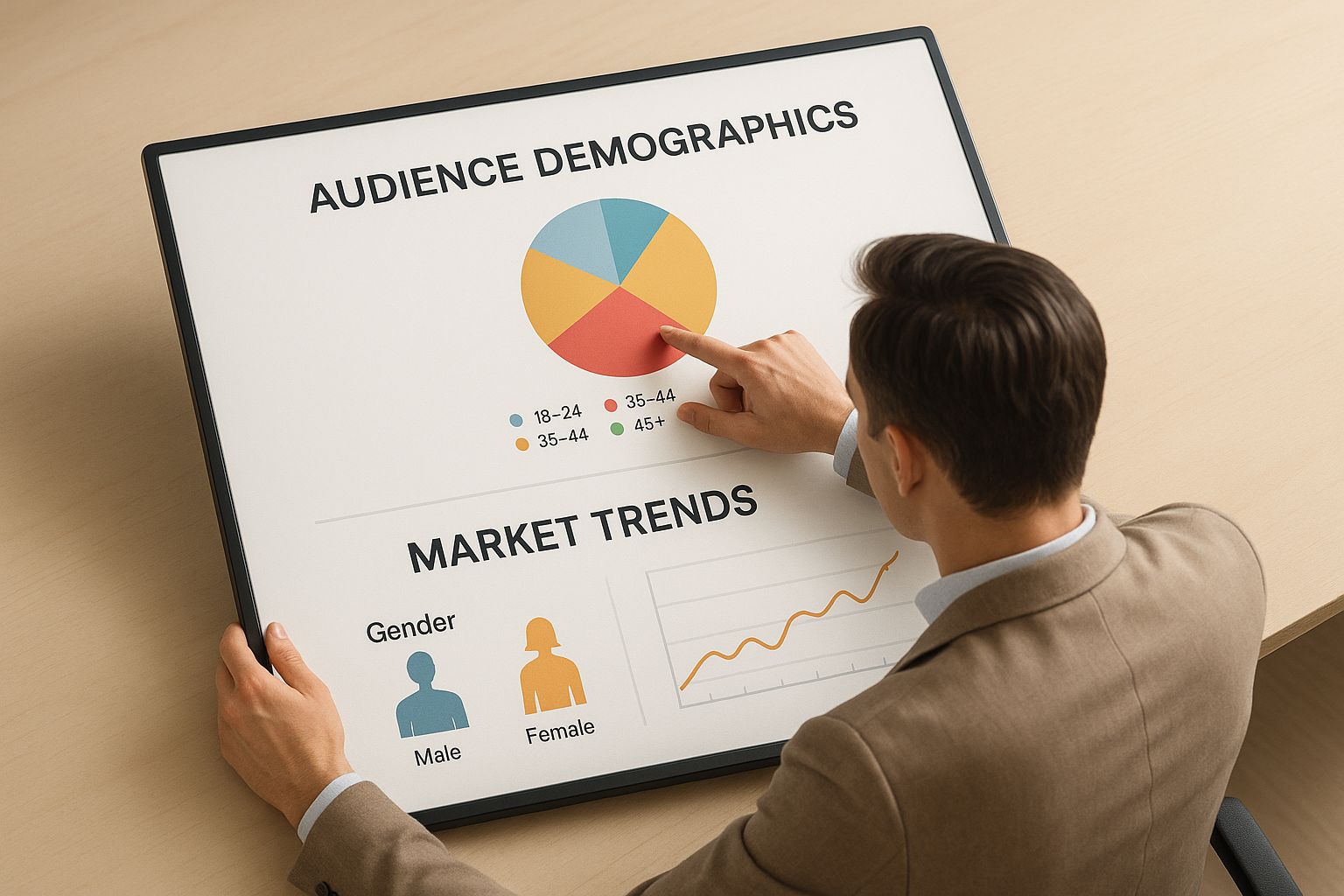
This process—transforming raw, messy data into a strategic view of your customer—is the unshakeable foundation of the insights pillar.
Pillar 2: Omni-Channel Execution
With deep customer insights in hand, it's time to execute. This pillar, Omni-Channel Execution, is where most strategies fail. Too many companies treat their marketing channels—SEO, paid media, email, social—as independent fiefdoms. This is a critical error, because your customer experiences them as one.
Their journey is fluid, non-linear, and unpredictable. They might discover your brand via a Google search, consume your content, see a retargeting ad on Instagram, and finally convert after receiving a targeted email. A true omni-channel strategy ensures this entire experience is coherent, consistent, and frictionless.
An omni-channel strategy is not about being everywhere. It's about being where your customer is, with a consistent message that intelligently guides them from one touchpoint to the next.
To execute this, you must break down the walls between your marketing teams. Your SEO lead needs to be in constant communication with the PPC team about high-converting ad copy. Your social media manager must align their content calendar with the email team's promotional schedule. It must be a coordinated symphony, not a cacophony of individual musicians.
Pillar 3: Measurement and Iteration
The final pillar, Measurement and Iteration, is the intelligence layer of the system. It's the feedback loop that enables the framework to self-optimize over time. But just as with data collection, the key is to focus on metrics that directly correlate to business value.
Stop tracking click-through rates in isolation. We must measure what truly moves the needle:
- Customer Acquisition Cost (CAC): What is the fully-loaded cost to acquire a new customer, broken down by channel?
- Customer Lifetime Value (LTV): What is the projected net profit a customer will generate over their entire relationship with your business?
- Conversion Rate by Funnel Stage: Which channels are most effective at turning prospects into qualified leads, and leads into customers?
- Return on Ad Spend (ROAS): For every dollar invested in advertising, how many dollars of revenue are generated?
This pillar is about relentless, continuous improvement. The outputs of your measurements feed directly back into Pillar 1. Did a new ad campaign attract customers with a significantly higher LTV? It’s time to double down. Is a specific channel generating high-volume but low-quality leads? It’s time to re-evaluate or cut it. This disciplined cycle transforms your marketing framework from a static plan into a living, breathing growth engine.
To help synthesize these concepts, here’s a breakdown of how these three pillars function within a modern growth framework.
The Three Pillars of a Modern Marketing Framework
| Pillar | Core Objective | Key Activities | Primary Success Metrics |
|---|---|---|---|
| Data and Insights | To deeply understand customer behavior, needs, and motivations. | Collecting qualitative & quantitative data, persona development, journey mapping, market research. | Customer LTV, persona accuracy, conversion rates by segment, bounce rate. |
| Omni-Channel Execution | To deliver a seamless and consistent brand experience across all relevant touchpoints. | Content marketing, SEO/SEM, email marketing, social media management, paid advertising. | Channel-specific conversion rates, assisted conversions, overall ROAS, brand recall. |
| Measurement & Iteration | To continuously optimize performance by analyzing results and feeding insights back into the strategy. | A/B testing, performance tracking, attribution modeling, feedback loop creation. | CAC, LTV:CAC ratio, pipeline velocity, lead-to-customer rate. |
By focusing on these core components, you shift from simply "doing marketing" to building a systematic, data-informed engine for growth.
Tracing the Evolution of Digital Strategy
To build a digital marketing strategy framework that endures, you must understand its origins. This isn't an academic exercise; it's about identifying the foundational principles that remain constant, even as the platforms and tools we use evolve at a dizzying pace.
In my experience advising companies across diverse sectors from SaaS to hospitality, the leaders who achieve sustainable, long-term growth are those who can discern the constants among the variables. They see the throughline from the earliest digital experiments to the sophisticated, data-driven systems we operate today. It all boils down to understanding the core human behaviors and business imperatives that have shaped this discipline from its inception.
From Digital Outposts to Central Hubs
The early days of digital marketing were the Wild West. It was an era of pioneers staking claims online, starting with rudimentary email and bulletin boards. Then, in 1994, the game changed when HotWired.com sold the first clickable banner ad, officially launching the era of display advertising. Shortly after, the launch of Google and its AdWords platform in 2000 introduced the pay-per-click model, providing businesses with an unprecedented level of precision and measurability.
These weren't just technological milestones. They represented a fundamental shift in how companies could connect with their audience. For the first time, marketing was moving from a one-to-many broadcast model to a direct, measurable, one-to-one conversation.
The Shift from Tactics to Integrated Frameworks
Initially, each new technology existed in a silo. We had the "email marketer," the "banner ad specialist," and, eventually, the "SEO guy." Each operated in their own lane, optimizing for their own metrics. This fragmented approach was not only inefficient but also created a disjointed and confusing experience for customers.
The real strategic evolution occurred when we started connecting the dots between these disparate activities. We began asking more sophisticated questions:
- How does our organic search visibility support our content marketing objectives?
- Can the data from our social media advertising inform more effective email campaigns?
- Does the on-site experience deliver on the promise made in our PPC ad?
This line of thinking forced a move beyond isolated tactics toward building true frameworks—cohesive systems where each component amplifies the effectiveness of the others.
The evolution of digital marketing is the story of moving from a random box of tools to a finely tuned, strategic engine. The objective was no longer to be good at one channel, but to master the customer's journey across all of them.
This strategic shift is what separates modern growth marketing from the legacy approach. It's about dismantling silos and fostering cross-functional collaboration, all guided by a single framework that places the customer experience at its core. Understanding this history isn't about nostalgia; it’s about recognizing that the core challenge—creating a seamless, data-driven customer journey—has always been the engine of innovation.
Integrating Social and Search in Your Framework

In the early days of digital marketing, organizational charts were simple. You had search teams and social media teams. They operated in different worlds, competed for the same budget, and rarely understood how their work impacted one another. Today, that siloed approach is a recipe for failure.
The explosion of social media was not just the addition of another channel; it fundamentally rewired customer behavior, demanding a deeply connected digital marketing strategy framework.
I've seen it repeatedly in boardrooms: this fragmented thinking kills growth. An exceptional search campaign might drive significant traffic, but if the brand’s social media presence tells a conflicting story, it creates a jarring experience that erodes trust and destroys conversion rates. The modern customer journey is a chaotic, multi-channel web, and it is completely indifferent to our internal team structures.
The Great Unbundling of Customer Attention
The evolution of these platforms forced every strategist to adapt. It began with tools like Google AdWords in 2000, which allowed businesses to capitalize on user intent. But the game truly changed with the maturation of social media.
When Facebook launched in 2004 and Twitter in 2006, they were primarily communication networks. But by the time Facebook deployed its advertising tools in 2007 and Twitter introduced promoted tweets in 2010, they had become advertising powerhouses. By the mid-2010s, any effective framework had to seamlessly integrate search, social, and content to follow the customer across their fragmented journey.
This meant we could no longer think in terms of a "search strategy" and a separate "social strategy." We had to construct a single, unified brand narrative that was consistent across every touchpoint. To a customer, discovering you on Google and seeing your ad on Facebook is part of the same, single conversation.
Creating the Multiplier Effect
The true power of an integrated framework lies in the multiplier effect it creates, where efforts in one channel amplify results in another. This isn't theory; it's the core of every successful growth engine I've helped build. When search and social operate in concert, the whole is far greater than the sum of its parts.
Here are concrete examples of this in action:
- Intent Feeds Engagement: The keyword data from your paid search campaigns—especially the terms that convert at a high rate—is strategic gold. Use this intelligence to inform the targeting and messaging for your social media advertising. You are essentially taking proven buying intent from search and using it to proactively find your ideal customer on social platforms.
- Content Amplification: Your SEO team identifies a topic cluster driving significant organic traffic. That insight should immediately trigger a social media content campaign to drive engagement and build authority, which in turn can boost search rankings through social signals and backlinks.
- Smart Retargeting Loops: A potential customer discovers your solution through an organic search but does not convert. Days later, they are served a compelling case study on LinkedIn or a product demo on Facebook. This re-engages them, bringing them back into your funnel with higher intent.
Your customer lives across channels, and therefore your marketing framework must as well. The moment you view search, social, and content as an interconnected ecosystem rather than competing fiefdoms, you unlock a powerful and sustainable engine for growth.
Executing this requires a disciplined, data-first mindset. It means teams must share data, align on common objectives, and measure success based on the entire customer journey—not on the vanity metrics of their individual channels.
Bringing the Framework to Life: Real-World Examples

Strategy is theory until it generates revenue. In my experience, the true test of any digital marketing strategy framework isn't its elegance on a slide deck, but its ability to deliver measurable financial results under pressure.
This is where we move from theory to execution. I've seen firsthand how a sound framework can be adapted to drive growth in vastly different industries. The tactics and channels may vary, but the core system of data, integration, and measurement remains constant.
Let's examine a few cases I've been directly involved with, from SaaS to real estate, to see how this framework performs in the real world.
SaaS Lead Generation: A Case Study
I worked with a mid-stage SaaS company with a clear objective: accelerate qualified lead generation without inflating their Customer Acquisition Cost (CAC). The core problem was organizational silos. The content team was writing SEO-driven blog posts, while the paid media team was running LinkedIn ads with entirely different messaging. It was a classic case of the left hand not knowing what the right was doing.
We implemented a unified framework to force alignment.
- Data First: We started by analyzing sales call notes from their CRM. This provided the exact language and pain points of their ideal customers. This voice-of-customer data became the bedrock of our entire strategy.
- Coordinated Campaigns: The SEO team developed a content hub addressing these specific customer problems. Simultaneously, the paid media team deployed the exact same messaging in their LinkedIn ads, targeting the precise job titles our data identified.
- Unified Metrics: We shifted the primary KPI from "leads" to "sales-qualified leads" (SQLs). We then measured the cost-per-SQL for the entire integrated campaign, not just for individual channels.
The result? A 40% increase in SQLs within six months, accompanied by a reduction in the overall CAC. The framework didn't just align marketing efforts; it created a direct, measurable throughline from a LinkedIn ad to a closed-won deal.
Real Estate: Hyper-Local Marketplace Engagement
Next, a national real estate marketplace. They possessed strong brand recognition but were losing market share to smaller, local competitors in key neighborhoods. Their marketing was too broad and failed to resonate at a community level.
Here, the framework guided a hyper-local strategy, atomizing their national market into hundreds of micro-markets.
- Local SEO: We developed dedicated landing pages for individual neighborhoods, populated with content on local schools, amenities, and market trends. This captured extremely specific, high-intent search queries.
- Targeted Social Proof: We used geofenced social media ads to show users in a specific neighborhood ads featuring recently sold homes and agent reviews from their own community, creating powerful social proof.
- Community Integration: We established partnerships with local businesses for cross-promotions, embedding the brand into the community fabric.
This hyper-focused approach, driven by the framework's data-first principle, resulted in a significant increase in user engagement and time on site. It demonstrated that a scalable framework can be robust enough for a national brand yet agile enough to win on a street-by-street basis.
The key takeaway is that an effective framework is not a rigid set of rules; it's an adaptable system that guides strategic thinking.
The most effective frameworks are not rigid prescriptions. They are adaptable systems that guide strategic decisions, ensuring every tactic serves the primary business objective.
Framework Application Across Industries
The power of a strong framework lies in its versatility. While objectives and tactics differ dramatically between industries, the underlying strategic principles remain constant. This table illustrates how the same core framework can be applied to vastly different business models.
| Industry | Primary Business Goal | Key Channels in Framework | Example Tactic | Metric of Success |
|---|---|---|---|---|
| B2B SaaS | Generate High-Quality Leads | SEO, Content Marketing, LinkedIn | Gated whitepaper on "Solving X Problem" promoted via LinkedIn ads to specific job titles. | Cost Per Sales-Qualified Lead (SQL) |
| eCommerce | Increase Customer Lifetime Value (LTV) | Email Marketing, Social Media Ads | Personalized email campaign offering a discount on products complementary to a recent purchase. | Repeat Purchase Rate |
| Local Service (e.g., Plumber) | Drive Inbound Phone Calls & Bookings | Local SEO, Google Ads, Google Business Profile | Highly targeted Google Ad campaign for "emergency plumber near me" with click-to-call functionality. | Number of Qualified Phone Leads |
| Hospitality (Hotel) | Increase Direct Bookings | Social Media, Influencer Marketing, SEO | Partner with travel influencers to showcase the hotel experience, driving traffic to a direct booking page. | Direct Booking Conversion Rate |
As you can see, whether you're selling enterprise software or hotel stays, the framework provides the essential structure. It forces you to define the right goal, select the appropriate channels, and measure what truly drives business value.
In every case, success was not the result of a secret marketing tactic. It was achieved by applying a disciplined digital marketing strategy framework that broke down silos, maintained a relentless focus on the customer, and measured what mattered. That is how you transform marketing from a cost center into a predictable engine for growth.
Measuring the Financial Impact of Your Framework
In the executive suite and the boardroom, opinions are fleeting, but data is permanent. A properly executed digital marketing strategy framework transcends theoretical marketing-speak and becomes a predictable, revenue-generating machine. Its true value is not measured in clicks or likes, but in tangible financial outcomes that impact the P&L. This is how we elevate the conversation from marketing metrics to business results.
The most compelling argument for a unified framework is its direct correlation to financial growth. The market has already spoken on this matter. The seismic shift in spending toward digital channels is not accidental; it is a direct response to superior performance and measurability. When marketing, sales, and product teams are aligned and pulling in the same direction, the result is a clear, quantifiable lift in financial performance.
This is where your framework proves its ROI. By 2024–2025, over 60% of global marketing budgets were allocated to digital channels, with global digital ad spend surpassing $500 billion. Companies with integrated strategies—where SEO, PPC, and social advertising work in concert—report conversion rate increases of 20–30%. Furthermore, approximately 73% of marketers confirm that their digital efforts directly contribute to lead generation. These are not abstract statistics; they are hard evidence that a systematic approach delivers. You can find more insights about the evolution of digital marketing and witness this trend in action.
Translating Metrics into C-Suite Language
To demonstrate the framework’s value, you must speak the language of the business. Vanity metrics have no place in a board meeting. Instead, we must connect every marketing action back to the key performance indicators that define the financial health and strategic direction of the company.
Focus on these three core financial indicators:
- Customer Acquisition Cost (CAC): An effective framework should systematically drive down the cost to acquire a new customer. By optimizing channel mix and relentlessly iterating on conversion rates, you can demonstrate a clear, sustained reduction in CAC.
- Customer Lifetime Value (LTV): An integrated approach that not only acquires customers but also nurtures and retains them will directly increase the total revenue each customer generates. A rising LTV is concrete proof of a healthy, sustainable growth engine.
- Return on Investment (ROI): This is the ultimate bottom line. For every dollar invested into the marketing activities guided by the framework, how many dollars of profit are returned? A positive and growing ROI is the clearest signal that your strategy is a financial success.
A successful digital marketing framework isn't just about creating campaigns. It's about engineering a system that predictably turns investment into measurable profit and enterprise value.
Presenting Your Framework’s Success
When presenting these results to stakeholders, the narrative is critical. Do not simply present a chart of website traffic. You must construct a story that connects your strategic initiatives to the financial outcomes.
For example, demonstrate how a content marketing initiative, driven by the framework, not only increased organic search rankings but also reduced the blended CAC by 15% compared to paid-only acquisition models. That is how you translate your team's tactical execution into a language that the C-suite understands and values: efficiency, profitability, and scalable growth. This is how you prove the undeniable financial power of your framework.
Common Questions I Get About Marketing Frameworks
After hundreds of C-level conversations about implementing a true digital marketing strategy framework, the same high-stakes questions invariably arise. These are the practical concerns that keep executives up at night. Here are the direct answers I provide.
How Long Does It Take to See Results?
This is always the first question from a CEO, and the only honest answer is, "it depends." You can secure early wins within a single quarter, particularly by optimizing paid media channels. However, the real, compounding value of a truly integrated framework takes time to materialize. We're talking about the kind of results where organic search becomes your primary source of high-quality leads. That does not happen overnight.
Think of it less as launching a campaign and more as re-architecting your company's growth engine. I advise leadership teams to look for leading indicators within 90 days—such as improved lead quality or a reduction in customer acquisition costs. The significant, bottom-line impact typically becomes evident within six to twelve months. Patience is a prerequisite, but it must be paired with clear, incremental milestones.
What Is the Biggest Mistake Companies Make?
By a wide margin, the single greatest mistake is treating the framework as a one-time project. I have seen countless companies spend months developing the "perfect" plan, only to let it languish on a server. A framework is not a static document; it is a living, dynamic system that demands constant iteration and optimization.
The companies that truly succeed don't just build a framework—they weave it into their culture. It becomes the operating system for how they think, plan, and execute, from the C-suite all the way down to the newest marketing intern.
This is where most initiatives fail: the inability to drive a cultural shift. It requires dismantling silos, incentivizing collaboration, and making data-driven decision-making a daily operational habit, not just a topic for an annual review.
How Do I Get Buy-In from Other Departments?
Securing alignment from sales, product, and finance is not optional—it's mission-critical. You cannot execute this in a vacuum. The key is to stop talking about marketing and start talking about their problems.
- For the Sales Team: Don't talk about funnels; talk about pipeline and revenue. Show them precisely how this framework will deliver a higher volume of sales-ready leads that will shorten their sales cycle and increase their commissions.
- For the Product Team: Position marketing as their primary source of customer intelligence. Explain how the insights we gather can directly inform the product roadmap, de-risking development and ensuring they build features customers will actually pay for.
- For the Finance Team: Speak their language: ROI. Build a clear financial model demonstrating how the framework will systematically lower Customer Acquisition Cost (CAC), increase Customer Lifetime Value (LTV), and deliver a predictable return on investment.
When you frame the framework as a solution that makes the entire business more efficient and profitable, the dynamic of the conversation changes. You are no longer a marketer asking for a budget; you are a business leader building a cross-functional coalition. It ceases to be a "marketing initiative" and becomes a core business strategy.
At MGXGrowth, we don't just talk about frameworks. We partner with you to build, implement, and scale them for measurable financial impact, transforming marketing departments into predictable revenue engines. Discover how we can architect your company's next stage of growth.
