


Across my career driving growth in SaaS, marketplaces, and even hospitality, I've learned a fundamental truth: technology only delivers transformative value when it moves from being a peripheral tool to the central nervous system of the operation. This is precisely the shift happening today with AI for flight operations and dispatch. This isn't a speculative, long-term bet; it's a strategic imperative for any airline focused on winning market share and boosting its bottom line.
Your New Co-Pilot: AI in Flight Operations
From my vantage point, the most significant barriers to growth are almost always the silos between departments. Flight operations, dispatch, maintenance, and crew scheduling have historically functioned as independent fiefdoms, each with its own data and its own KPIs. This fragmentation creates operational friction and squanders immense resources.
AI is the strategic lever that finally shatters those silos, integrating a patchwork of disparate systems into a single, intelligent, data-driven operation.
Think of it less as a replacement for your seasoned dispatchers and more as the ultimate analytical co-pilot. It processes millions of data points in real-time—from dynamic weather patterns and evolving airspace restrictions to crew duty limitations and aircraft health telemetry. It surfaces critical insights that are simply beyond the scope of human analysis in a live operational environment.
The Business Case for AI Integration
The executive conversation around AI must pivot from "What does it do?" to "What does it deliver for our P&L?" Integrating these systems is a cornerstone of any serious digital transformation best practices. This isn't about chasing technological novelty; it's about building a more resilient, agile, and profitable airline.
The benefits are concrete and measurable:
- Improved Asset Utilization: AI-driven predictive maintenance identifies potential component failures before they ground an aircraft, directly reducing costly Aircraft on Ground (AOG) situations and maximizing fleet availability.
- Reduced Operational Costs: Intelligent algorithms continuously optimize flight paths against real-time conditions, identifying the most fuel-efficient routes and directly attacking one of your largest variable expenses.
- Enhanced On-Time Performance: Instead of reacting to disruptions, AI enables dispatchers to anticipate them. This allows for proactive rerouting around inclement weather or congestion, preserving schedule integrity and protecting the customer experience.
For any senior executive, the "why" always trumps the "how." AI in flight operations is a big deal because it directly boosts the numbers that matter most: revenue, EBITDA, and market share. It flips the script from a reactive operational model to a predictive one.
This isn't just theory; the market is moving fast. The AI in aviation sector is projected to surge from USD 1.75 billion in 2025 to USD 4.86 billion by 2030, driven by exactly these kinds of applications in flight operations and air traffic management.
Before we dive into the specific ways AI is being used, the table below gives a quick executive summary of the core impact areas.
Core AI Impact Areas in Flight Operations
This table breaks down the primary domains within flight operations and dispatch that are being fundamentally reshaped by AI, highlighting the key business benefit for each.
| Operational Area | Primary AI Application | Key Business Outcome |
|---|---|---|
| Flight Planning & Routing | Dynamic route optimization | Reduced fuel burn and operational costs |
| Disruption Management | Predictive delay analysis and automated rerouting | Improved on-time performance and passenger satisfaction |
| Aircraft Maintenance | Predictive maintenance and component failure forecasting | Increased aircraft availability (less AOG) |
| Crew Scheduling | Optimized crew pairing and rostering | Reduced crew costs and improved utilization |
| Turnaround Management | Real-time ground operations monitoring and prediction | Faster turnaround times and better gate usage |
Ultimately, AI is becoming a critical lever for sustainable growth and a more resilient airline. Now, let's look at how these applications work in the real world.
How AI Breaks Down Aviation’s Data Silos
In every industry I’ve worked in, from software to hospitality, the biggest anchor dragging on growth is internal silos. This problem is magnified tenfold in aviation. Flight operations, maintenance, dispatch, and crew scheduling have long functioned as separate entities, each with its own data, priorities, and communication channels. This fragmentation creates operational drag, slows down critical decision-making, and directly impacts the bottom line.
The core issue is that these disconnected data streams make a single, coherent view of the entire operation impossible. This is precisely where AI provides its greatest strategic value—not as another tool, but as the central nervous system that finally connects every moving part.
A traditional airline operation is like an orchestra where the strings, brass, and percussion are all playing from different sheet music. The result is operational cacophony. AI is the conductor, integrating these disparate inputs and orchestrating a cohesive, optimized performance.
Weaving Data into a Single Operational Picture
AI doesn't just aggregate data; it synthesizes it into actionable intelligence. It ingests a constant flood of information that would overwhelm any human team and identifies the crucial interdependencies.
- Real-Time Weather Patterns: AI models move beyond simple forecasts to predict turbulence and convective activity with a high degree of probabilistic accuracy.
- NOTAMs and Airspace Changes: The system automatically ingests, filters, and flags relevant Notices to Airmen, cutting through the noise to present dispatchers only with information pertinent to their flights.
- Crew Availability and Duty Times: It tracks crew legality in real-time against flight schedules, identifying potential compliance issues hours or even days in advance.
- Maintenance Schedules and Aircraft Health: By analyzing streams of sensor data, predictive models can forecast potential component failures, shifting maintenance from a reactive to a proactive function.
- Passenger Loads and Connections: The system understands the downstream impact of a delay, identifying which flights carry passengers with tight connections and enabling teams to prioritize accordingly.
By processing this multi-domain information simultaneously, AI for flight operations and dispatch creates a single, dynamic, and holistic view of the network. This is the foundation for shifting from a reactive "firefighting" model to a predictive, strategic one.
The diagram below illustrates how this centralized AI hub directly drives the key business metrics that every airline executive is measured against.
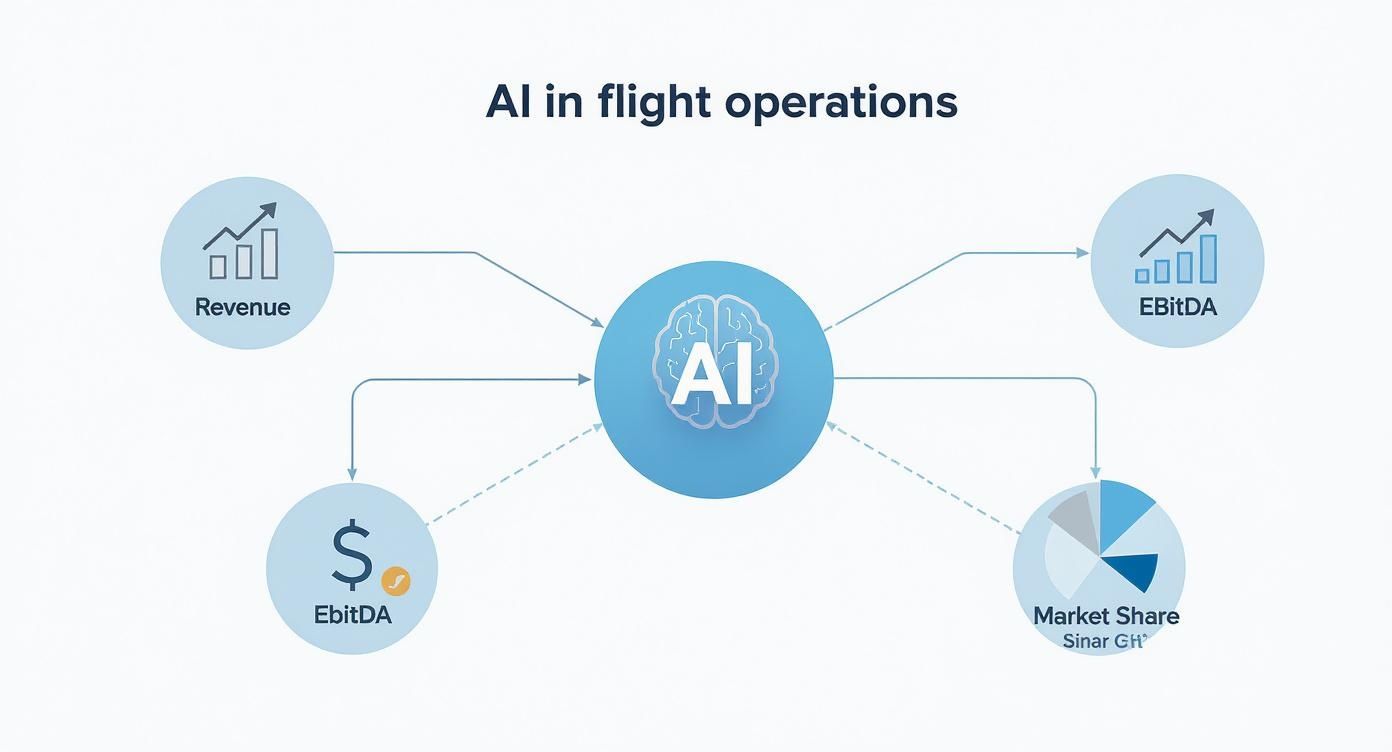
As you can see, the AI system is not merely an operational tool. It is a core strategic asset that directly drives revenue growth, EBITDA margin expansion, and market share gains.
From Reactive Firefighting to Proactive Strategy
The true strategic advantage lies in how this unified data model transforms an airline's response to disruptions. Instead of dispatchers scrambling when an unforeseen weather event closes an airport, the AI has already modeled the cascading impact across the network.
The biggest shift is cultural. When data is unified and accessible, you break down the 'us vs. them' mentality between departments. Everyone is working from the same playbook, focused on the same goal: creating a more resilient and agile airline.
For example, an AI system might detect an approaching weather front and instantly present the dispatch team with several optimized mitigation strategies. It could recommend rerouting five specific aircraft, delaying two others by just 15 minutes to avoid the worst of the impact, and automatically notifying ground crews at the affected destinations.
This isn't about replacing the dispatcher’s expertise. It’s about elevating it. It removes the tedious, manual data-gathering burden and empowers them to make faster, more informed strategic decisions. The end result is an operation that anticipates problems, mitigates their impact, and delivers a more reliable product to passengers—which is the ultimate driver of market share.
Putting AI to Work in Flight Operations
Possessing a unified data stream is a prerequisite, but the real value is unlocked when that data is put to work to drive operational outcomes. This is where AI directly impacts your revenue and profitability—where we move beyond concepts and into the specific applications that are delivering a competitive edge in flight operations and dispatch today.
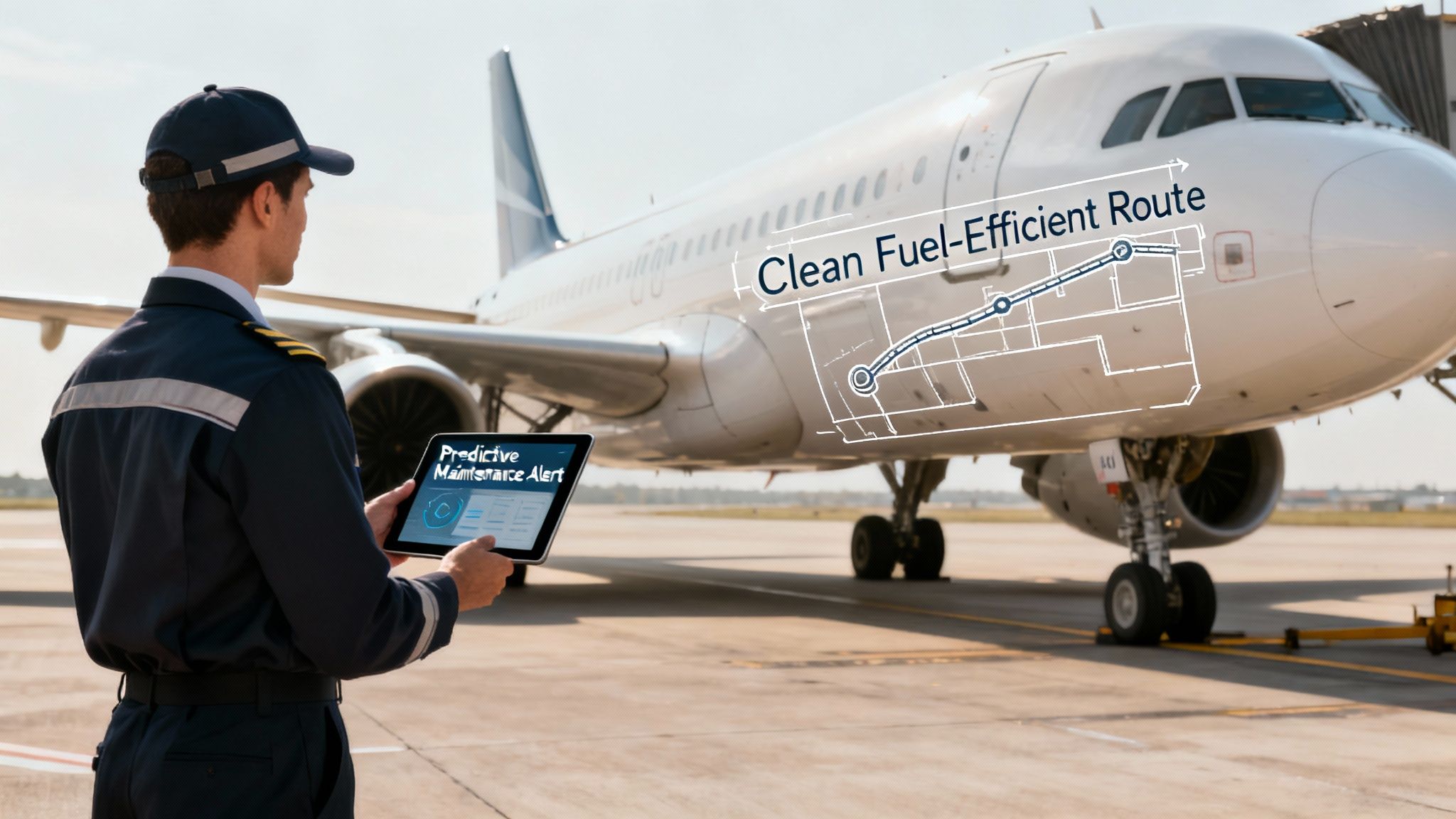
Throughout my career, I've seen countless companies invest in technology without a clear line of sight to ROI. Aviation is a business of numbers. Every single decision made in an operations center has a direct cost or benefit associated with it. AI simply provides a sharper, more data-driven edge to every one of those decisions.
From Reactive Repairs to Predictive Maintenance
In the airline industry, few acronyms carry the financial sting of "AOG"—Aircraft on Ground. An unscheduled maintenance event is not just a repair bill; it's a cascade of canceled flights, complex crew rescheduling, and passenger compensation that directly erodes profitability.
Traditionally, maintenance has been either reactive (fixing what breaks) or based on a static, calendar-driven schedule. AI completely upends this model with predictive maintenance.
By continuously analyzing data from thousands of onboard sensors, machine learning algorithms detect subtle anomalies that precede component failure. This foresight enables maintenance to be scheduled during planned downtime, dramatically reducing AOG incidents and maximizing the revenue-generating potential of each airframe.
Dynamic Flight Path and Fuel Optimization
For any airline, fuel is consistently one of the top two operating expenses. A mere 1-2% reduction in annual fuel consumption can translate into tens of millions of dollars in direct savings to the bottom line. AI makes this level of optimization consistently achievable.
Forget static, pre-filed flight plans. AI algorithms are perpetually re-evaluating the most efficient route from takeoff to touchdown, even while the aircraft is en route.
Think of it as a highly sophisticated, multi-variable GPS for an aircraft. It looks beyond a simple destination, analyzing real-time weather data—wind, temperature, turbulence—at every possible flight level to continuously chart the most fuel-efficient trajectory.
This is not a one-time calculation. It is a dynamic process that adapts to changing conditions, delivering compounding fuel savings on every single flight segment.
Intelligent Crew Scheduling and Disruption Management
Crew costs represent the other major line item on an airline's P&L. Inefficient scheduling results in everything from costly overstaffing to the logistical chaos of disruption recovery. AI-powered systems can master this complex optimization challenge.
These tools move far beyond basic rostering. They are designed to manage a massive number of variables simultaneously:
- Regulatory Compliance: They automatically generate schedules that adhere to complex flight and duty time regulations, mitigating the risk of costly violations.
- Crew Well-being: By optimizing pairings and rotations, they can help reduce fatigue and improve work-life balance—a critical factor in retaining experienced, high-value crews.
- Disruption Recovery: When a flight is delayed, the AI can instantly model the downstream impact and propose the most efficient, cost-effective crew swaps to maintain network integrity.
The outcome is a more resilient operation with tighter control over a primary cost driver. Smarter resource management is a fundamental principle of business growth, applicable across every industry.
Empowering Dispatchers with Automated Advisory
The objective of AI in the dispatch office is not to replace the decades of operational experience a human dispatcher possesses. It is to amplify it. AI-driven advisory systems function as a co-pilot, automating the laborious data analysis so dispatchers can focus on their highest-value function: exercising critical judgment.
These systems can automate routine flight monitoring, flag potential conflicts before they escalate, and model optimal solutions for complex scenarios like airport congestion or weather diversions. By providing clear, data-backed recommendations, AI gives dispatchers the confidence to make better, faster decisions, particularly under high-pressure conditions.
This shift is happening now. Artificial intelligence is automating everything from scheduling to air traffic management by analyzing huge datasets to find the best flight paths, cut fuel burn, and boost on-time performance. The global AI in aviation market was valued at an estimated $7.4 billion in 2025 and is projected to soar to $26.9 billion by 2032.
The Real-World Hurdles of AI Implementation
As a growth strategist, I've seen countless promising initiatives fail to deliver. The vision is often compelling, but the real-world implementation challenges are frequently underestimated. Integrating AI into flight operations and dispatch is a game-changer, but it is not a simple plug-and-play solution. Acknowledging the hurdles head-on is the only path to success.
Ignoring these obstacles is a recipe for a stalled project and significant capital waste. The airlines that will win with AI are those that anticipate these friction points and architect a plan to navigate them from day one.
Integrating with Legacy Systems
For most established airlines, the first major barrier is their existing IT infrastructure. We're talking about systems that are often decades old—incredibly reliable, but not designed for seamless integration with modern AI platforms. Attempting to bolt a new AI tool onto aging, monolithic architecture is like putting a Formula 1 engine in a family sedan. The performance will inevitably disappoint.
The solution isn't a "rip and replace" strategy; that invites operational chaos. The intelligent approach is to build robust bridges—APIs and middleware that allow new AI tools to communicate with trusted legacy systems. This facilitates a phased modernization, minimizing disruption while delivering incremental value. This is a classic challenge, and you can learn more about navigating these issues in our guide on digital transformation challenges.
The Critical Role of Data Governance
AI is only as good as the data it's trained on. I have seen this principle play out across every industry: poor data quality is the silent killer of analytics initiatives. For an airline, this means the data flowing from maintenance logs, flight plans, crew schedules, and weather feeds must be clean, consistent, and accessible.
Without a rigorous data governance framework, you are building a sophisticated model on a foundation of sand. This "garbage in, garbage out" problem leads to flawed predictions, undermines trust in the technology, and can result in genuinely poor operational decisions. Establishing data integrity is not an IT task; it is a fundamental business prerequisite for any successful AI strategy.
Clearing Regulatory and Compliance Hurdles
Aviation is, for sound reasons, one of the most heavily regulated industries in the world. Any new technology that touches flight operations must undergo intense scrutiny from regulatory bodies like the FAA in the U.S. and EASA in Europe. AI is no exception.
Demonstrating that an AI system is reliable, safe, and secure is a long and complex process. Airlines must be prepared to engage with regulators transparently, providing clear explanations of how their models function and what safety redundancies are in place.
Executive buy-in is non-negotiable. Securing the necessary investment and organizational support requires a rock-solid business case that clearly connects AI implementation to measurable improvements in on-time performance, cost reduction, and passenger satisfaction.
The regulatory landscape itself is evolving to keep pace. AI adoption is picking up speed, with the broader aviation AI market projected to grow at a CAGR of 22.6% over the next five years from 2025. This rapid growth is sparking serious conversations within agencies like the FAA about the future of the pilot workforce and even the possibility of reduced crew requirements on some flights.
The Human Element of AI Adoption
Finally, and most critically, is the human element. You can deploy the most advanced AI system in the world, but if your dispatchers, pilots, and planners don't trust it or understand how to use it effectively, the entire investment is wasted. Overcoming this cultural resistance requires a deliberate and well-executed change management strategy.
This goes far beyond simple training sessions. It's about reframing the narrative. AI must not be perceived as an opaque "black box" threatening jobs, but as a collaborative tool that enhances human expertise. Your teams need to understand the 'why' behind the system's recommendations, see the tangible benefits in their daily workflow, and feel empowered by its insights. Earning that trust is the final, essential piece of a successful implementation.
A Glimpse into Tomorrow's Airline Operations
In any business, and particularly in aviation, sustainable leadership means looking beyond the next quarter. You have to anticipate the next strategic wave and position yourself to ride it. The current applications of AI for flight operations and dispatch are merely the beginning. The advancements of the next decade will fundamentally reshape the industry, and the time to build the foundation for that future is now.
This isn't a distant, theoretical prediction; it's a strategic reality. The airlines that invest in the right data infrastructure and operational capabilities today will be the market leaders of tomorrow.
The Rise of the Fleet-Wide Digital Twin
Today, we talk about AI optimizing a single flight or predicting a maintenance issue on one aircraft. The next quantum leap is the creation of a digital twin of the entire airline network.
Imagine a perfect, live, virtual replica of your entire operation—every aircraft, every crew member, every flight plan, and every maintenance slot, all simulated in real-time.
This digital twin would be far more than a sophisticated dashboard. It would be a predictive powerhouse, running millions of "what-if" scenarios every minute. What is the network-wide impact if a major hub airport experiences a sudden ground stop? The model could instantly simulate the cascading effects and recommend a globally optimized recovery plan in seconds—a task that is physically impossible for a human team to perform at that speed and scale.
This takes us from reactive disruption management to proactive network resilience. A digital twin lets an airline pressure-test its entire operation against future possibilities, uncovering weak points and optimizing the whole system before a crisis ever unfolds.
The Evolution Toward Autonomous Systems
The trajectory toward increased autonomy in the cockpit is slow, methodical, and inevitable. While fully pilotless commercial aircraft are still a distant prospect, the operational and crewing implications are much closer. AI is already capable of managing significant portions of the in-flight workload, a trend that will only accelerate.
This progression will fundamentally alter the business model:
- Crew Training and Skillsets: The pilot's role is evolving from a hands-on operator to a manager of complex, automated systems. Training paradigms will need a complete overhaul to reflect this new reality.
- Operational Models: As AI assumes more cognitive tasks, airlines can rethink everything from crew pairing to rostering, unlocking significant efficiencies and reducing major operational costs.
- Safety and Redundancy: An advanced AI co-pilot serves as the ultimate backup system, capable of responding to emergencies with a speed and precision that complements human expertise, adding a robust new layer of safety.
This isn't about replacing pilots. It's about elevating their role, enabling them to focus on strategic oversight and exception handling while the machine manages routine functions.
Integrating with the Future of Urban Air Mobility
The airspace is about to become far more complex, particularly at low altitudes. The emergence of Urban Air Mobility (UAM)—air taxis, delivery drones, and personal aerial vehicles—is on the horizon. This will introduce an entirely new layer of traffic, especially in and around major metropolitan areas.
Managing this intricate, low-altitude airspace with human air traffic controllers alone would be untenable. This is a problem tailor-made for AI.
AI-driven traffic management systems will be essential for safely integrating UAM operations with existing commercial air traffic. For airlines, this means their operational AI will need to interface with this broader ecosystem, coordinating arrivals and departures in a much more crowded and dynamic environment. The airlines that master this integration first will not just adapt—they will discover new strategic opportunities in the next era of aviation.
The Final Briefing on Your AI Strategy
I have spent my career driving growth across diverse industries, from SaaS to hospitality, and I can tell you that the fundamentals are universal. You identify your core value drivers, you make targeted investments, and you execute with unwavering focus.
Viewing AI for flight operations and dispatch through any other lens is a strategic error. This is not another IT project. This is a fundamental business transformation initiative.
When you integrate these systems, you are making a direct investment in the metrics that define your success. The link is unequivocal. Giving your teams AI tools is not about acquiring novel software; it is about buying superior on-time performance, greater fuel efficiency, and a significant reduction in maintenance-related costs.
From Pilot Project to Profit Center
I've seen it happen too many times. A promising new technology gets stuck in "pilot project" purgatory and never scales to deliver enterprise-wide value.
To avoid this fate, the C-suite must lead with a different mindset. AI cannot be a peripheral experiment managed by the IT department. It must be treated as a core component of the airline's profitability strategy, with explicit executive sponsorship and clear, measurable KPIs.
Consider the direct P&L impact of each application:
- Predictive Maintenance isn't just about preventing an AOG. It's about protecting revenue by maximizing aircraft availability.
- Dynamic Route Optimization doesn't just reduce fuel consumption. It fundamentally improves your cost structure and expands your EBITDA margin.
- Intelligent Crew Scheduling does more than manage rosters. It optimizes one of your largest operational expense categories.
Here’s the bottom line: It's time to move past isolated tests. You need a complete, data-driven strategy. The airlines that manage to weave AI into the very fabric of their operations won't just survive the chaos of this industry—they will be the ones shaping its future.
Leading the Next Era of Aviation
A performance gap is already emerging. It separates the airlines that are merely experimenting with AI from those that are scaling it as a core business capability.
In an industry defined by razor-thin margins, the winners will be the operators who can make smarter, faster, data-driven decisions at every moment of the day. That is precisely the competitive advantage that AI delivers.
The airlines that execute this transformation effectively will not just be more efficient. They will build a durable competitive advantage, capture greater market share, and lead the industry into its next generation. The question is no longer if you should invest in AI. The question is how quickly you can make it the engine of your entire operation.
Answering the Tough Questions About AI in Flight Operations
Even with a compelling business case, integrating a transformative technology like AI into a mission-critical environment always raises important questions. In my role advising leadership teams, my job is to cut through the hype and provide direct answers grounded in real-world business outcomes. Here are the most common and critical questions I receive from airline executives.
How Does AI Actually Make Dispatchers More Efficient?
The most persistent myth is that AI for flight operations and dispatch is about replacing people. It is not. The true value lies in augmenting your existing experts, turning them from reactive problem-solvers into proactive strategists.
A dispatcher is a highly skilled professional managing immense complexity. AI serves as a force multiplier by automating the time-consuming, low-value task of sifting through millions of data points: continuous weather updates, new NOTAMs, aircraft telemetry, crew legality, and more. Instead of manually collating this information, the dispatcher is presented with a synthesized, prioritized view of potential issues along with optimized recommendations. This frees their cognitive capacity to focus on what humans do best: applying experience and exercising judgment in high-stakes situations.
We're not aiming for automation for its own sake. The goal is to reduce cognitive load. When AI handles the heavy data lifting, dispatchers can make faster, more confident decisions that directly boost on-time performance and cut operational costs.
What’s the Smartest First Step for an Airline to Get Started with AI?
The most common mistake is attempting to boil the ocean. A massive, enterprise-wide AI overhaul is a recipe for budget overruns and project failure. In my experience, the only successful approach is to start with a focused, high-impact use case, prove its value quickly, and then scale from that success.
Identify a specific, known pain point that has a clear financial cost. For most airlines, predictive maintenance is the ideal starting point. The business case is unambiguous. Preventing even a handful of Aircraft on Ground (AOG) events per year generates millions of dollars in direct savings and protected revenue. This delivers a powerful, quantifiable ROI that builds the momentum and executive buy-in needed for the next phase.
Once that initial win is secured, you can leverage that success to expand into adjacent areas like fuel optimization or crew scheduling, building institutional capability and expertise with each step.
Is AI Going to Replace Pilots and Dispatchers?
Let me be direct: no. For the foreseeable future, AI in aviation is about augmenting human expertise, not rendering critical roles obsolete. The global airspace is too complex and dynamic for a machine to manage autonomously. The experience, intuition, and ultimate decision-making authority of a pilot or dispatcher are, and will remain, indispensable.
AI is exceptionally good at pattern recognition and high-speed computation. What it lacks is the ability to apply context, think creatively, or solve novel problems it has never encountered. That is where human expertise is irreplaceable. The optimal model is a human-machine partnership, where the expert is armed with AI-driven insights. This collaborative team is safer, more efficient, and more resilient than either could ever be alone.
At MGXGrowth, we help businesses build practical, AI-driven strategies that deliver measurable results. Find out how we can help you create your operational roadmap at https://www.mgxrowth.com.
