


Across my career driving growth in SaaS, hospitality, and marketplaces, I've learned to distinguish between fleeting trends and foundational shifts. Agentic AI for private aviation is unequivocally the latter. This isn't just another buzzword for a board meeting; it's a strategic imperative that will redefine operational leverage and competitive advantage in this high-stakes industry.
The Next Strategic Imperative for Private Aviation
Time and again, I've seen the most significant growth unlocked by breaking down the silos between sales, operations, and client services. Historically, aligning these functions has been a manual, often painful, process. Agentic AI fundamentally changes this dynamic. It creates an intelligent, autonomous layer that doesn't just connect these functions but directs them in concert toward core business objectives: revenue, efficiency, and customer lifetime value.
In an industry where precision, safety, and the client experience are non-negotiable, this is far more than an incremental upgrade. It's a full-stack operational transformation. We are moving beyond basic automation, which merely executes pre-defined scripts, into the realm of intelligent agency, where the system reasons, strategizes, and acts.
From Automation to True Autonomy: The Bottom-Line Difference
Let's quantify the distinction. Traditional automation is like cruise control; it maintains a set state under stable conditions but lacks situational awareness. It cannot react to an unforeseen traffic jam ahead.
Agentic AI, conversely, operates like a seasoned chauffeur and logistics expert combined. It doesn't just maintain speed. It constantly scans the entire operational environment—weather, TFRs, crew availability, asset health—anticipates disruptions, models optimal solutions, and executes decisively to protect the mission's objectives.
This distinction is already bifurcating the market into leaders and laggards. The global agentic AI market is projected to skyrocket from $5.2 billion to nearly $200 billion in the next decade. Operators who are early adopters are reporting tangible, data-driven results: up to a 25% reduction in operational costs and a 30% improvement in on-time performance. These are not marginal gains; they are decisive competitive moats. You can find more data on the business aviation boom and its technological drivers happening now.
My experience has proven that sustainable growth isn't about working harder—it's about building smarter systems. Agentic AI is that system. It's a digital nervous system that maximizes asset utilization, anticipates operational needs, and executes with a precision and scale that a human team, no matter how skilled, cannot match.
I've structured this guide for executives, cutting through the technical jargon to focus on the P&L impact. We will examine the real-world applications already driving revenue, fortifying safety, and unlocking new levels of operational efficiency.
The question is no longer if your operation should adopt agentic AI. The only question is how quickly you can integrate it as a core strategic asset to secure your market leadership.
How Agentic AI Actually Works in Aviation
To capitalize on any new technology, one must look past the buzzwords and understand its mechanics from a business process perspective. Legacy automation is fundamentally a checklist—it executes a rigid, pre-programmed sequence of rules. Agentic AI for private aviation, by contrast, is a goal-oriented system. It doesn't just follow a script; it perceives, reasons, and acts to achieve specific business outcomes.
The most effective mental model I use is to think of it as deploying a team of hyper-competent digital specialists—an 'ops director,' a 'maintenance foreman,' a 'client concierge'—all working in perfect sync, 24/7. They are not mindless bots; they form a cohesive, intelligent workforce.
The Three Pillars of Agentic Action
At its core, every agentic system operates on a powerful three-step loop. Understanding this cycle is key to seeing how this technology translates from a concept into a tangible, value-driving asset. It is a continuous cycle of perception, planning, and action.
This process is what elevates an AI from a reactive tool to a proactive partner. Let's deconstruct each component within the context of a private jet operation:
-
Perception (See): An agent begins by ingesting and contextualizing vast amounts of data. It doesn't just see a single data point; it synthesizes thousands of inputs in real time: dynamic weather patterns, airspace restrictions, crew duty regulations, aircraft sensor telemetry, and even unstructured data from client communications.
-
Planning (Think): Armed with this comprehensive picture, the agent evaluates the data against a defined business goal, such as "maximize fleet utilization" or "ensure zero-friction journey for VIP Client X." It models multiple scenarios, weighs the potential outcomes of various actions, and formulates the optimal strategy. This is complex problem-solving, not simple if-then logic.
-
Action (Do): Finally, the agent executes the plan autonomously. This could mean automatically rerouting a flight to circumvent a developing storm, proactively scheduling maintenance based on a predictive sensor flag, or orchestrating a client's ground transportation without any human intervention.
This diagram illustrates precisely how that cycle translates into measurable business outcomes for a private aviation enterprise.
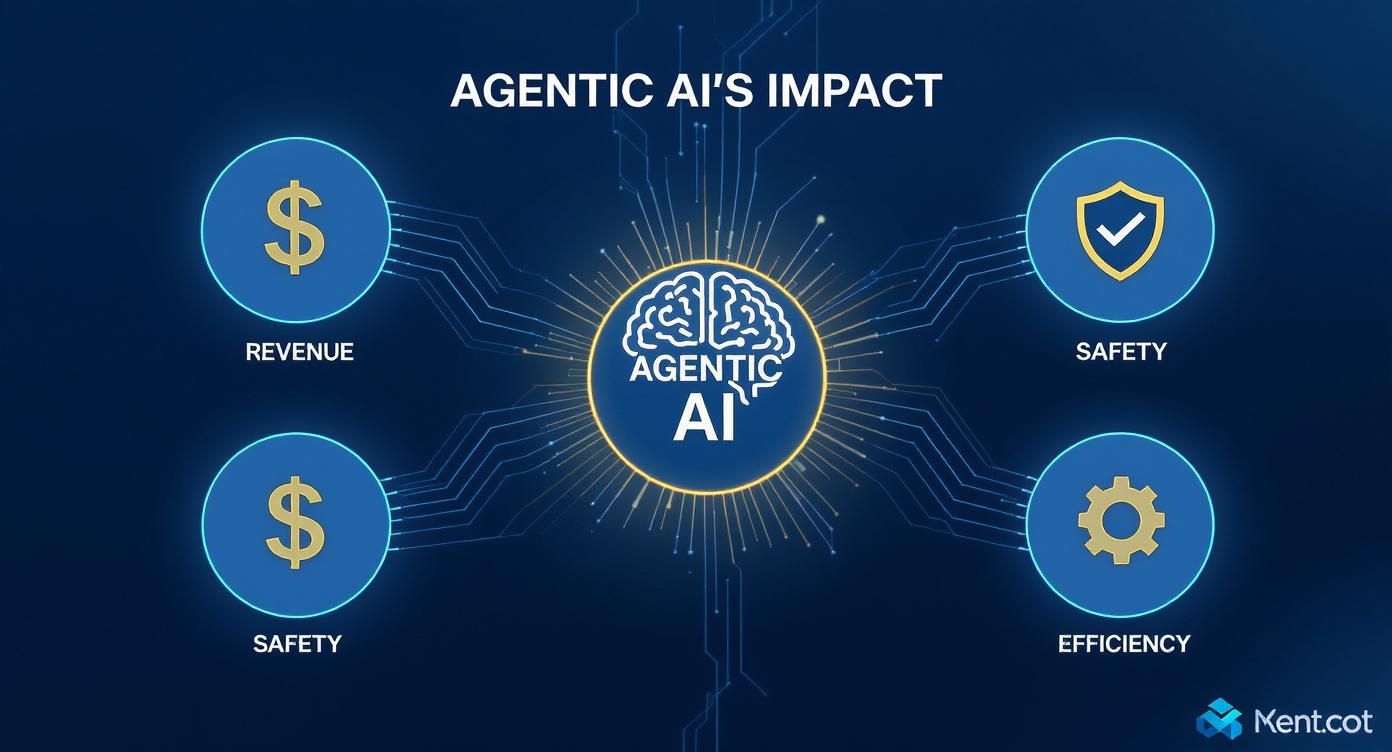
As you can see, the core functions of agentic AI directly map to material improvements in revenue generation, safety assurance, and operational efficiency.
From Single Agents to a Coordinated Team
The exponential value is unlocked when these individual agents begin to collaborate. In my experience, the greatest breakthroughs always emerge from bridging the gaps between functional silos. Agentic AI achieves this by design, creating a network of specialized agents that communicate and coordinate their actions in real time.
Imagine the operations agent 'perceives' a pop-up TFR that threatens a delay. It 'plans' multiple alternative routes and 'acts' by filing the optimal new flight plan. Simultaneously, it signals the client-facing agent, which proactively messages the passenger about a minor, non-impactful route adjustment to ensure their on-time arrival. The passenger experience remains seamless and proactive.
This multi-agent collaboration is the true paradigm shift. You are no longer automating a single task; you are orchestrating an intelligent, self-correcting end-to-end workflow. The maintenance agent doesn't operate in isolation; it communicates with the scheduling agent to ground an aircraft for service only after its highest-revenue trips are completed, optimizing for both asset health and profitability.
This is how you build a resilient, efficient, and customer-centric operation—not by forcing disparate teams to collaborate better, but by architecting a system where intelligent collaboration is the default state.
Moving Aviation Operations From Reactive to Proactive
Throughout my career, I've observed a consistent pattern across industries from SaaS to hospitality: the most significant performance gains come from transitioning operations from a reactive to a proactive posture. In private aviation, where every moment an aircraft is on the ground represents a direct hit to revenue, this shift is a financial imperative. Agentic AI for private aviation is the catalyst that makes this transition achievable at scale.
For decades, aviation operations have been defined by reactive problem-solving. A sudden weather event, an unexpected maintenance flag, a last-minute crew shortage—each triggers a cascade of manual interventions. Agentic AI inverts this model. It builds an operational ecosystem that anticipates and neutralizes problems before they can impact your schedule, your clients, or your bottom line.

A New Era for Flight and Fleet Planning
Flight planning and fleet scheduling are the heart of an operator's business, yet they are often managed with staggering inefficiency. An agentic system doesn't merely plot a route from A to B. It performs a continuous, multi-variable analysis to ensure every flight is optimized for maximum profitability.
Consider these agent-driven functions operating autonomously, 24/7:
-
Dynamic Route Optimization: One agent constantly monitors shifting weather, emerging TFRs, and air traffic congestion. Its objective is not simply the shortest path but the most fuel-efficient route that guarantees on-time arrival, dynamically re-calibrating in-flight as conditions change.
-
Intelligent Fleet Scheduling: Another agent manages your entire fleet as a portfolio of high-value assets. It maintains a real-time state of each aircraft's maintenance status, crew positioning, and availability. When a new charter request is received, the agent instantly identifies the optimal aircraft-and-crew pairing to maximize revenue hours while minimizing costly deadhead flights.
This is a quantum leap beyond legacy software. To fully grasp the value proposition, operators must analyze how to improve operational efficiency at its core.
The Power of Predictive Maintenance
Nothing destroys profitability faster than an Aircraft on Ground (AOG) event. These are not mere logistical challenges; they are financial crises. A single AOG incident can easily result in losses exceeding $150,000 when factoring in lost revenue, repair costs, and reputational damage.
Agentic AI provides the ultimate defense: predictive maintenance. Instead of reacting to failures, AI agents act as digital mechanics, tirelessly monitoring thousands of telemetry points from every aircraft sensor.
An agent can track engine vibration signatures, oil temperature fluctuations, and hydraulic pressure trends, correlating them against massive historical datasets. When it identifies a subtle pattern that predicts future component degradation, it acts. The agent can proactively schedule a maintenance window, pre-order the necessary part, and even book a technician at the destination FBO—all before a fault occurs.
This strategy transforms maintenance from an unpredictable cost center into a planned, managed operational activity. It drastically reduces AOG events, preserves asset value, and keeps your fleet in the air, generating revenue. That is the tangible, bottom-line impact of a truly proactive strategy.
Agentic AI vs Traditional Automation in Aviation Operations
To crystallize the difference, let's compare how agentic systems perform against the traditional automation tools prevalent today. The table below illustrates the capability gap.
| Operational Area | Traditional Automation | Agentic AI Capability |
|---|---|---|
| Flight Planning | Follows pre-set rules (e.g., shortest route). | Dynamically re-routes based on live weather, fuel cost, and ATC data to optimize for profitability. |
| Crew Scheduling | Assigns available crew based on simple rules (e.g., duty hours, location). | Predicts crew fatigue, optimizes pairings for complex multi-leg trips, and auto-manages assignments to reduce costs. |
| Maintenance | Triggers alerts based on fixed flight-hour intervals or when a part fails. | Predicts component failure by analyzing real-time sensor data, scheduling maintenance proactively to prevent AOGs. |
| Ground Operations | Manages basic tasks like FBO selection based on static pricing. | Autonomously negotiates fuel prices, coordinates ground handling, and books slots to minimize turnaround time. |
| Customer Service | Uses chatbots for basic FAQs. | Manages the entire client journey, from personalized quoting to proactive trip updates and preference management. |
The takeaway is clear: traditional systems follow instructions. Agentic AI makes decisions and takes ownership, functioning less like a tool and more like a highly effective member of your operations team.
Delivering an Unforgettable Client Experience
In every premium market I've operated in—from five-star hospitality to luxury real estate—a single truth prevails: the only sustainable competitive advantage is obsessive customer-centricity. In private aviation, you are not selling a flight; you are selling time, precision, and a bespoke experience. Agentic AI for private aviation is the enabling technology that allows you to deliver this promise at scale, transforming exceptional service from an art into a system.
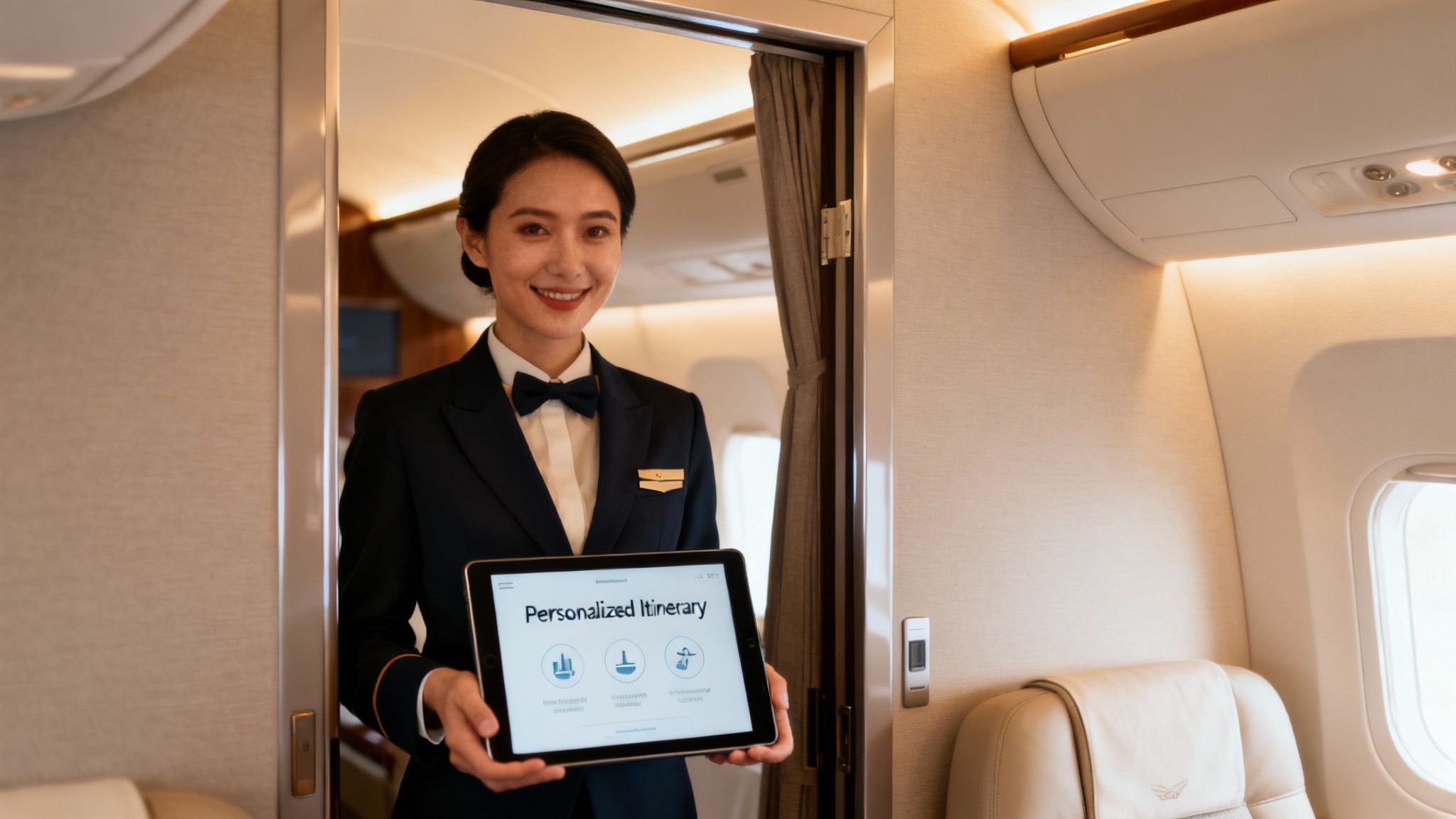
The traditional model relies on client managers juggling countless requests, preferences, and last-minute changes—a model inherently limited by human bandwidth. Agentic AI removes this constraint by deploying a team of digital concierges, perpetually active and capable of managing every detail of a client's journey with flawless precision.
The 24/7 Digital Concierge in Action
Imagine an AI agent assigned to each of your top-tier clients. This is not a passive chatbot; it is an active system that anticipates needs. By analyzing a client's complete travel history, it learns their patterns and preferences with granular detail.
What does this proactive service look like in practice?
- Anticipatory Itinerary Management: The agent knows a client habitually travels to their Aspen residence for the holidays. Weeks in advance, it can proactively propose flight options and provisionally hold an aircraft, with their preferred black car service already factored into the itinerary.
- Seamless In-Flight Personalization: The system has learned the client's family prefers a specific brand of sparkling water and that a child has a nut allergy. It automatically updates the catering manifest and flags the dietary restriction for the crew, requiring zero manual input.
- Complex Trip Coordination: For a multi-leg international journey, the agent acts as the central coordinator. It arranges ground transport in each city, secures reservations at their preferred restaurants, and can dynamically adjust the entire itinerary if a guest's connecting commercial flight is delayed.
This level of deep, predictive personalization forges unwavering client loyalty. It is about making your clients feel profoundly understood at every touchpoint. For a deeper dive into the mechanics, explore our guide on predictive personalization for VIP travelers.
In the luxury sector, value is created not by meeting expectations, but by consistently exceeding them without being asked. Agentic AI systematizes this proactive care, turning every client interaction into an opportunity to reinforce your commitment to excellence.
Augmenting the Human Touch, Not Replacing It
This is a critical point that is often misunderstood. The strategic goal of agentic AI for private aviation is not to eliminate your client relations team. It is to elevate them. The objective is to free your best people from the mundane, repetitive tasks that consume their time, allowing them to focus on what humans do uniquely well: building genuine relationships and managing the high-stakes, nuanced situations that require empathy and creative problem-solving.
When AI agents handle 90% of routine logistics, your team is liberated to make a personal call to a client about a significant life event or to architect a solution for a truly unique travel challenge. You are not replacing your top performers; you are supercharging them.
The data validates this approach. Leading private jet charter companies report that over 70% of customer interactions are now managed by AI agents handling bookings, itinerary adjustments, and service recommendations. The impact is profound: one major U.S. operator documented a 40% increase in customer satisfaction scores after implementing these systems. This data-driven strategy allows you to scale a world-class experience, driving retention and increasing lifetime value across your entire client base.
Fortifying Safety and Simplifying Compliance
In any high-stakes business, certain pillars are non-negotiable. In private aviation, safety is the absolute foundation. It is more than a set of protocols; it is the bedrock of your brand, your reputation, and your clients' trust. In this domain, "good enough" is a catastrophic failure. Agentic AI introduces a powerful new layer of defense, serving as a tireless digital co-pilot that reinforces this foundation.
This technology is not about replacing the hard-won judgment of experienced pilots. It's about augmenting their expertise with a system capable of detecting patterns and assessing risk at a speed and scale beyond human capacity. It's about mitigating the potential for human error, which, despite rigorous training, remains a contributing factor in a significant percentage of aviation incidents.
A Vigilant Digital Co-Pilot
Conceptualize an agentic AI system as a safety officer that never sleeps. It is perpetually connected to the aircraft's data streams, monitoring thousands of parameters every second. Its sole mandate is to identify subtle anomalies that could elude human perception until they become critical.
This vigilant oversight has a direct, measurable impact on safety outcomes. More than 50% of private aviation operators have already implemented AI-driven safety monitoring, using autonomous agents to analyze flight data and proactively identify risk. One leading European operator reported a 35% reduction in safety-related incidents after deploying agentic AI for real-time risk assessment. You can explore more insights on the state of AI adoption in aviation to understand the broader industry momentum.
In my experience guiding growth, the most resilient organizations are those that convert their greatest risks into their strongest competitive advantages. Agentic AI transforms safety from a reactive, compliance-driven function into a proactive, data-fortified asset.
This continuous analysis enables the system to predict potential issues before they escalate, providing pilots and ground crews with invaluable early warnings. This elevates situational awareness for the entire operational team, creating a more defensible and safer flight envelope from takeoff to landing.
Automating the Burden of Compliance
Beyond the cockpit, operators face the relentless challenge of regulatory compliance. The administrative burden of adhering to complex, evolving FAA and EASA regulations is immense. It is a manual, resource-intensive process prone to human error, draining valuable bandwidth from your team.
Here, agentic AI delivers another decisive operational win, breaking down the silo between operations and compliance. An agent can automate the entire reporting lifecycle with machine-level accuracy.
The process is systematic:
- Continuous Data Collection: The agent automatically ingests all required safety and operational data from every flight, ensuring complete capture.
- Intelligent Analysis: It analyzes this data against specific regulatory frameworks, flagging any deviations or areas requiring documentation.
- Automated Reporting: The agent then compiles and formats the information into perfectly compliant reports, ready for submission to regulatory bodies.
This automated workflow not only saves thousands of man-hours but also ensures a flawless record of adherence. By streamlining compliance, agentic AI for private aviation liberates your team to focus on higher-value activities while providing complete assurance that your regulatory obligations are met without fail.
A Strategic Roadmap for AI Integration
Having led numerous digital transformations, I can state with certainty that success is born from a pragmatic, phased approach, not a monolithic overhaul. Technology is merely a tool; its value is unlocked through disciplined execution. This is particularly true when integrating a system as powerful as agentic AI for private aviation into a high-stakes operational environment.
Do not start with the technology. Start with the business case. Identify the one or two areas where operational friction creates the most significant drag on your P&L. Is it the sales cycle time lost to manual charter quoting? Or the inefficiency of last-minute crew scheduling that leads to costly deadhead flights?
Starting with Measurable Pilot Projects
Select a pilot project with a clear, quantifiable return on investment. Automating the charter quoting process is a prime candidate. An AI agent can instantaneously analyze aircraft availability, positioning, and operational costs to generate a precise, profitable quote. This reduces response time from hours to minutes, directly impacting your conversion rate.
Achieving this first win accomplishes two critical objectives: it validates the technology's value with hard data and builds the internal momentum necessary for broader adoption.
In my experience, the greatest obstacle to transformation is not technology; it's organizational inertia. A successful pilot project is the most powerful tool to dismantle resistance and demonstrate tangible value, converting skeptics into champions.
With a successful pilot complete, the next phase is expansion. This step, however, requires a fundamental shift in inter-departmental collaboration. Too often, I see IT, operations, and sales functioning in isolated silos. For agentic AI to deliver its full potential, those walls must be dismantled.
The system's intelligence is derived from its ability to connect data points across the entire business lifecycle—from a client's initial inquiry to the final compliance filing. You can delve deeper into the methodologies behind this with our guide on business process improvement methods.
This necessitates a culture of data-driven decision-making, where every department understands its role within a larger, interconnected system. Agentic AI is not an IT expenditure. It is a strategic investment in the future growth, resilience, and market leadership of your entire operation. It is the engine that will power the next generation of efficient, customer-centric private aviation.
Answering the Tough Questions on Agentic AI
Whenever a transformative technology emerges, it's the executive team's responsibility to challenge the hype and focus on the business case. From my experience, three questions consistently surface when discussing agentic AI for private aviation with leadership.
Will Agentic AI Replace Our Pilots or Staff?
Let's be unequivocal: no. This is the most common misconception. Agentic AI is not a replacement for human expertise; it's a force multiplier.
Think of it as augmenting your best people. It is designed to automate the high-volume, repetitive, data-intensive tasks that currently consume their bandwidth. Your pilots are expert aviators, not data analysts. An AI agent serves as a digital co-pilot, processing thousands of variables in real time so the human crew can maintain focus on the mission-critical task of safely operating the aircraft. Likewise, it handles the logistical backend, freeing your ground staff to manage high-touch client relationships and solve unique, complex problems.
How Is This Different from the Machine Learning We Already Use?
This is a critical distinction. Standard machine learning (ML) is fundamentally a predictive tool. It analyzes historical data to forecast future events, such as identifying a potential maintenance issue or projecting charter demand. It provides insights, but its function stops there. It cannot act on those insights.
Agentic AI, in contrast, is an action-oriented system. It doesn't just predict a potential AOG event from sensor data. It perceives the issue, formulates a multi-step plan to resolve it—ordering the part, scheduling the maintenance crew, and notifying operations—and then autonomously executes that plan. It closes the loop from passive analysis to active resolution.
What's the First Step to Get Started?
The strategy is to start small and target a quick, measurable victory. The most common mistake is attempting a "boil the ocean" approach. Instead, identify a single, specific process that is a known operational bottleneck and has a clear success metric.
Automating your charter quoting process is an ideal starting point. This is likely a manual, time-consuming task that creates sales friction and lost opportunities. By deploying an agent to manage quoting, you can provide instant, accurate pricing to potential clients. This delivers an immediate, quantifiable ROI, proves the technology's value to the organization, and creates the political capital needed for a broader, more ambitious rollout.
Ready to build a more resilient, efficient, and profitable aviation operation? At MGXGrowth, we specialize in implementing AI-powered strategies that deliver measurable business results. Let’s architect the next stage of your growth together.
