


An AI concierge for jet charter clients is not merely a technological add-on; it's a strategic overhaul of the client acquisition and service delivery model. In my experience across multiple high-growth sectors, I've seen that success hinges on eliminating friction. This system transforms the high-touch, yet often sluggish, booking process into an immediate, data-driven transaction. Consider it your top broker's intellect, digitized and available 24/7, capable of delivering perfectly matched options and quotes on demand. This isn't about incremental improvement; it's a fundamental restructuring to meet the expectations of a clientele whose most valuable asset is time.
The Operational Drag Holding Private Aviation Back

Throughout my career advising companies from SaaS to hospitality, a consistent pattern emerges: market leaders are defined not just by their product, but by their operational velocity. In private aviation, this has become the central challenge. The demand is robust, yet the most critical client touchpoint—the booking process—remains a significant bottleneck.
This operational drag creates a critical disconnect. High-net-worth individuals operate in a world of immediacy, yet the legacy system of phone calls, manual availability checks, and delayed quotes introduces friction precisely when a seamless experience is paramount. Every hour a client waits for a quote is an opportunity for a more agile competitor to win their business.
The Hidden Costs of Inefficiency
This is not a customer service issue; it's a direct impediment to revenue growth and scalability. The manual model is riddled with hidden costs that quietly erode your bottom line.
- Bloated Client Acquisition Costs (CAC): When quoting takes hours, the sales cycle extends. This directly inflates the time and capital required to acquire each new client.
- Capped Scalability: Growth becomes linearly dependent on the number of brokers you can hire and train—an expensive and inefficient path to expansion.
- Competitive Disadvantage: In a market where time is the ultimate luxury, slow response times are a profound liability. It exposes your flank to nimble, tech-forward competitors.
This friction is particularly dangerous in the current market. The U.S. private jet charter market is projected to hit $28.9 billion in 2025, a significant leap from $21.24 billion in 2024, fueled by a client base that demands speed. This explosive growth will only amplify existing operational weaknesses. Data from sources like SherpaReport.com confirm this trajectory.
As a growth strategist, I view this as a fundamental flaw in the business model, not just a service gap. Persisting with a slow, human-powered system in a market defined by high expectations and rapid growth is akin to entering a Formula 1 race with a horse-drawn carriage.
Ultimately, your service delivery must mirror the core promise of private aviation: speed and exclusivity. It is imperative to improve operational efficiency not just to meet expectations, but to construct a sustainable, scalable business. An AI concierge for jet charter clients is engineered to resolve this precise problem.
So, how does this system function from a strategic standpoint?
An AI concierge for jet charter clients is not a chatbot. It is the digital embodiment of your most seasoned broker—the one with an encyclopedic memory of client preferences, fleet nuances, and the ability to quote complex trips instantly. Except this asset operates 24/7, processes thousands of variables simultaneously, and refines its performance with every transaction.
I frame it as a master sommelier for private aviation. A skilled sommelier doesn’t present an exhaustive wine list. They inquire about the meal, palate preferences, and the occasion to recommend the perfect bottle. The AI functions on the same principle, but with aircraft. It doesn't generate a raw list of available jets; it curates and presents options based on a deep, data-driven understanding of the client.
The Core Engine of Instant Service
The primary objective of this system is to eliminate latency. The delay between a client's request and the delivery of a quote is where deals die and momentum is lost. The AI neutralizes this by integrating multiple live data streams in real-time.
- Aircraft Availability: It maintains a direct, real-time connection to operator fleets, providing precise data on which jets are available, their location, and readiness.
- Dynamic Pricing Factors: It continuously analyzes fluctuating variables that impact charter costs—fuel prices, landing fees, and crew expenses.
- Client Profile Data: The system interfaces directly with your CRM, accessing a client’s travel history, aircraft preferences, and typical routes.
Synthesizing this information in a fraction of a second is where the strategic value lies. By processing these variables instantly, the AI delivers a complete, accurate, and actionable quote. This transforms the client experience from one of frustrating delay to immediate resolution.
For the client, the difference is stark. It's the contrast between asking a question and receiving an answer tomorrow versus receiving a concrete, executable plan the moment you ask. From their perspective, that speed isn't a feature—it is the service itself.
The true power of an AI concierge for jet charter clients is its capacity to instantly distill vast amounts of complex data into actionable intelligence. This transition from manual labor to automated, intelligent curation is a decisive advantage for any operator focused on scalable growth. The same logic applies across industries; you can explore other AI tools for business on our blog. This technology liberates your human capital to focus on closing high-value deals and cultivating the strategic relationships that underpin long-term success.
Connecting AI Features to Revenue and Efficiency
In my decades of driving growth, I operate on a simple principle: any technology investment must yield a direct, measurable impact on revenue and EBITDA. An AI concierge is not a vanity project; it is a strategic asset engineered to break operational bottlenecks and deliver tangible financial returns. Let's move from theory to practical application and examine how this system drives top-line and bottom-line growth.
The most immediate impact is on sales velocity. In a market where a client's purchasing intent is perishable, speed is paramount. By delivering instant, accurate quotes, the AI engages prospects at the peak of their interest. This dramatically compresses the sales cycle and drives a significant uplift in conversion rates. Hot leads are no longer lost to the friction of waiting.
Driving Personalization and Productivity
Beyond the initial quote, the AI provides a level of personalization that is impossible for a human team to execute at scale. It analyzes a client's entire history—preferred aircraft, frequent destinations, even past catering requests—to anticipate their needs. This enables the system to proactively recommend tailored itineraries or intelligent aircraft upgrades that add real value, directly increasing customer lifetime value (CLV).
Consider this scenario: a client regularly charters a midsize jet for a specific route. Ahead of their next trip, the AI identifies a newly available, more fuel-efficient super-midsize jet. It presents this as a superior option for a marginal cost increase. This is not a simple upsell; it's a sophisticated demonstration of client understanding that builds enduring loyalty.
This workflow illustrates how the AI ingests disparate data points and synthesizes them into an intelligent, client-facing output.
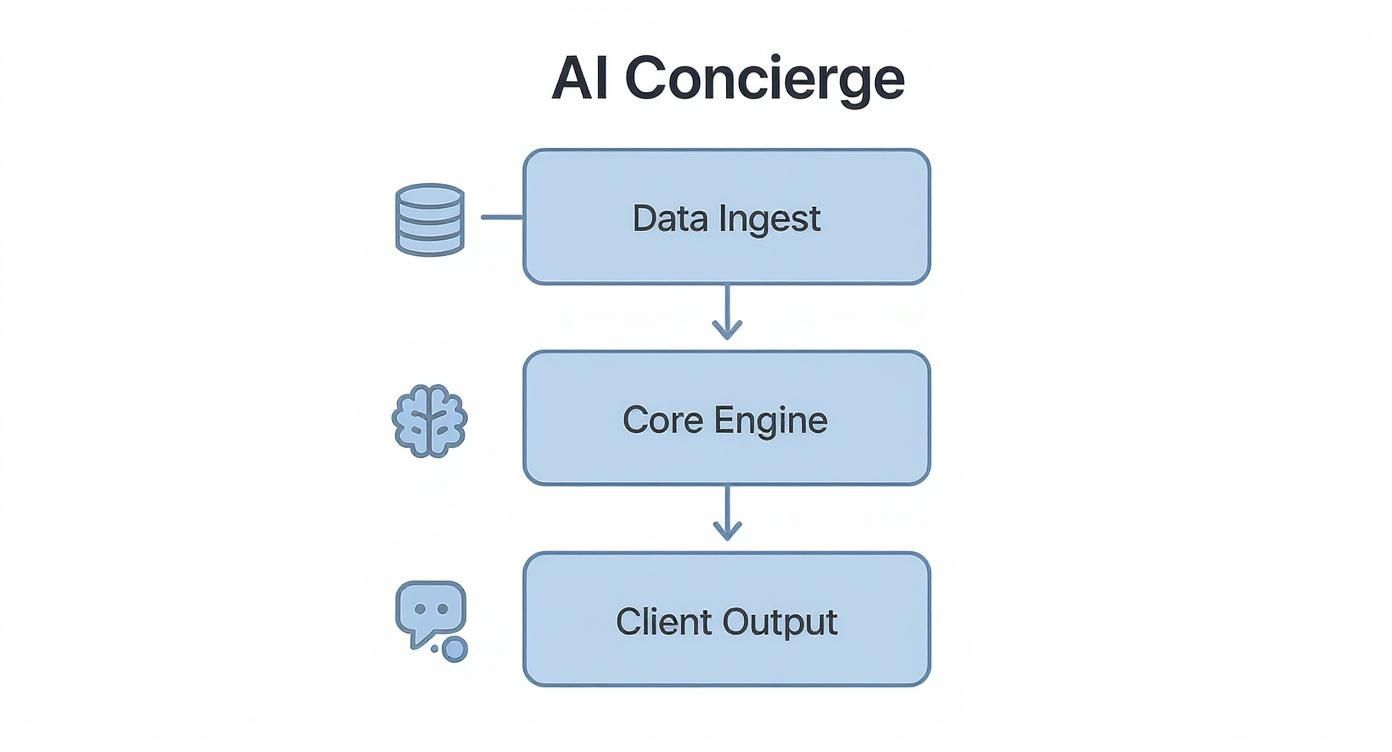
The diagram outlines a powerful process: raw data is ingested, processed by the AI engine, and converted into a strategic, client-ready solution.
Unlocking Your Team's True Potential
Now, let's address your most valuable asset: your people. The automation provided by an AI concierge is a catalyst for your team's productivity. It absorbs the high-volume, repetitive tasks, liberating your brokers to focus on activities that require their strategic expertise.
By automating routine processes, you empower your expert brokers to transition into strategic advisors. Their time is reallocated from data entry to cultivating relationships, managing complex multi-leg journeys, and closing the most significant deals in your pipeline.
This operational transformation is what distinguishes stagnant businesses from those architected for scalable growth. The table below quantifies this strategic shift.
Operational Shift From Manual Brokers to an AI Concierge
The transition from a traditional brokerage model to an AI-driven workflow is not an upgrade; it is a fundamental redefinition of your team's value contribution. This comparison highlights the strategic move from reactive, manual work to proactive, high-impact growth activities.
| Operational Task | Traditional Manual Process (The Bottleneck) | AI Concierge Process (The Growth Engine) |
|---|---|---|
| Initial Quoting | Hours of manual data sourcing and calculation. Slow response times lose high-intent leads. | Instant, algorithm-driven quotes delivered in seconds. Captures client interest at its peak. |
| Client Personalization | Relies on broker's memory or siloed CRM notes. Often inconsistent and surface-level. | Deep analysis of travel history, preferences, and behavior to proactively suggest tailored options. |
| Aircraft Sourcing | Manual searches across multiple platforms. Time-consuming and prone to missing optimal options. | Automated, real-time market scan for best availability, positioning, and pricing. |
| Broker Focus | Overwhelmed by administrative tasks, data entry, and repetitive low-value inquiries. | Focused on complex trip planning, high-value client relationships, and closing major deals. |
| Business Scalability | Growth is limited by broker headcount. Hiring is the only way to increase capacity. | Capacity scales dynamically. The system handles unlimited inquiries, enabling exponential growth. |
This transition enables your business to operate with greater velocity and intelligence, fostering deeper client relationships without the constraints of legacy processes.
AI-powered systems are revolutionizing the booking experience by providing instant, data-driven quotes. By analyzing vast datasets on aircraft availability, fuel prices, and airport fees, they deliver real-time pricing that once took brokers hours to compile. This directly addresses the primary pain point in the charter process: the wait. You can learn more about how AI is powering charter quotes and what that means for the industry. This is not about replacing your team; it's about amplifying their expertise to multiply their productivity and, ultimately, your revenue.
Putting the AI Concierge to Work in the Real World
From my experience, the true measure of any technology is not its theoretical elegance, but its performance under real-world pressure. An AI concierge for jet charter clients is compelling on paper, but its strategic value is proven in high-stakes scenarios where every second impacts the outcome. This is where technology transitions from a cost center to a decisive competitive advantage.
Let's analyze three common business scenarios where an AI-powered system doesn't just accelerate a process—it fundamentally redefines the client relationship and drives measurable growth. These are not hypotheticals; they are direct applications of speed and intelligence to capture revenue.
Use Case 1: The Last-Minute Business Trip
A CEO in New York must be in London for an emergency board meeting. The request arrives at 2 p.m. for a 6 p.m. departure. The legacy model initiates a frantic scramble: brokers making calls, checking availability—a process that consumes an hour or more of valuable time.
With an AI concierge, the CEO’s assistant inputs the request. The system instantly scans real-time fleet availability, crew positioning, and flight-ready aircraft. In under 60 seconds, it generates a complete, bookable quote with three vetted aircraft options.
While your competitors are still gathering data, you have already delivered a concrete solution. This is not merely about speed; it's about demonstrating a level of operational capability that secures urgent, high-value business. Acting with this certainty creates significant competitive separation.
Use Case 2: The Complex Leisure Itinerary
A family is planning a multi-stop European vacation, from the Amalfi Coast to the Swiss Alps, concluding in Paris. This is not a simple point-to-point charter. It involves variable passenger counts, significant luggage, and short-runway constraints.
Manually quoting this itinerary would require days of complex logistical planning. An AI concierge, however, can architect the entire journey in moments. It calculates the most efficient routing, selects the optimal aircraft for each leg, and can even integrate ground transport and accommodation preferences from the client's profile.
This transforms your value proposition. You are no longer just a flight broker; you become a sophisticated travel strategist. The AI performs the heavy computational work, freeing your team to focus on curating a flawless client experience. This is how you deepen relationships and win complex, high-margin business.
Use Case 3: The Proactive Service Upgrade
This final use case demonstrates how AI can transition from a reactive tool to a proactive growth engine. A loyal client books their standard light jet for an annual trip from Miami to Aspen. The AI, analyzing their travel history, notes they consistently maximize capacity and have previously inquired about an extra guest.
Instead of a simple confirmation, the system identifies a strategic opportunity. It issues a proactive alert suggesting an upgrade to a specific midsize jet, highlighting the enhanced baggage capacity and cabin comfort for a marginal price increase. The client, appreciating the foresight, accepts. They receive a superior experience, and you secure an upsell.
This is the essence of customer-centric growth. The system anticipates needs before the client articulates them, adding value and building powerful loyalty. It is the practical application of agentic AI for luxury brands—using technology to deliver a hyper-personalized, predictive level of service. An AI concierge for jet charter clients operationalizes this concept, creating a system that doesn't just serve the business, but actively grows it.
A Phased Approach to AI Implementation
Deploying an AI concierge for jet charter clients is not an overnight event. Having overseen numerous large-scale technology integrations, I know that a "big bang" approach inevitably leads to operational chaos. The key to success is a disciplined, phased implementation that integrates the technology into your workflow, enhancing—not disrupting—the high-touch service your clients expect.
The methodology is to integrate, measure, and then scale. You don't overhaul your entire operation on day one. You begin with a focused, intelligent pilot program.
Begin with a Strategic Pilot
First, identify a specific, high-volume segment of your client base—for instance, frequent domestic business travelers. By deploying the AI concierge exclusively to this group, you establish a controlled environment to measure its real-world performance.
This allows you to collect clean data and quantify the immediate impact on metrics like quote speed and conversion rates without risking your entire client portfolio. A successful pilot validates the business case and secures team buy-in. It shifts the internal conversation from "what if" to "what's next," supported by hard data.
Connect the Critical Data Points
For the AI to function as an intelligent co-pilot, it requires seamless access to cross-functional data. Breaking down information silos is non-negotiable for success. The critical integrations are:
- Fleet Management System: The single source of truth for real-time aircraft availability, positioning, and maintenance schedules.
- Customer Relationship Management (CRM): Integrating with your CRM provides the AI with deep context on client history, travel patterns, and preferences.
- Real-Time Market Data: Live feeds for fuel costs, airport fees, and weather patterns are essential to ensure every quote is both accurate and competitive.
These connections form the central nervous system of your AI concierge, enabling it to process thousands of variables in seconds.
Empower Your Brokers as Co-Pilots
Finally, and most critically, is the human element. The AI is not intended to replace your experienced brokers; it's designed to amplify their effectiveness. It is a powerful force multiplier. The objective is to train your team to leverage the system as a co-pilot, allowing it to handle the administrative groundwork so they can focus on their core competencies.
This strategic shift elevates your brokers from quote generators to high-value travel advisors. They can manage a larger client portfolio with a higher degree of personalization, dedicating their expertise to complex itineraries and building the strategic relationships that create lifetime customers.
This methodical approach ensures a smooth rollout, mitigates risk, and positions your team to deliver a superior client experience, maximizing your return on investment from the outset.
Measuring the KPIs That Actually Matter
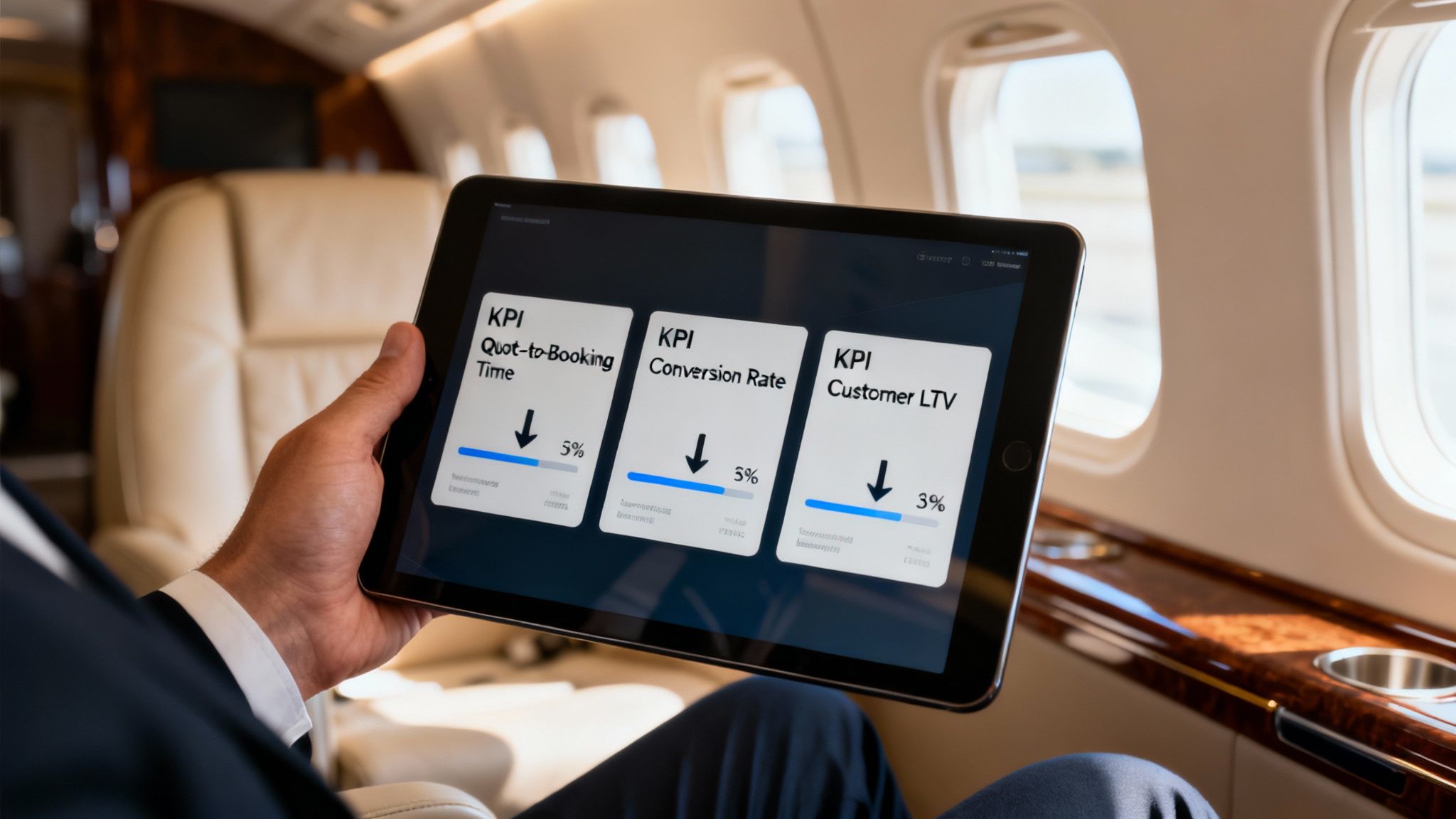
As a leader who operates based on data, I adhere to a strict principle: if you can't measure it, you can't manage it. Any significant capital investment, especially in a transformative technology like an AI concierge for jet charter clients, must be validated by clear, growth-oriented key performance indicators (KPIs). It's essential to move beyond vanity metrics and focus on the numbers that directly impact EBITDA and market share.
This is not about tracking system activity; it's about measuring business outcomes. Your dashboard must provide a real-time pulse on the health of the business, demonstrating precisely how this technology is removing friction and generating tangible value.
Your Core Growth Dashboard
There are four essential KPIs that I insist on tracking. Together, they provide a holistic view, connecting operational velocity to sales effectiveness and long-term client loyalty.
-
Reduction in Quote-to-Booking Time: This is the foundational efficiency metric. When the average quote turnaround drops from hours to minutes, you have fundamentally altered your sales velocity and the client experience. Targeting a 75% reduction post-implementation is an aggressive but achievable goal.
-
Increase in Booking Conversion Rate: Speed and relevance have a direct, causal relationship with revenue. By tracking the percentage of quotes that convert to confirmed bookings, you can precisely measure how effectively the AI is capturing client intent. An initial lift of 15-20% delivers an immediate and significant ROI.
The real power is realized when you establish a feedback loop. Data from these KPIs must continuously inform the system, refining the AI's performance and converting raw insights into a compounding competitive advantage.
-
Growth in Customer Lifetime Value (CLV): This is your metric for loyalty. By analyzing repeat business, add-on services, and upsells driven by the AI's personalized recommendations, you can assign a quantitative value to the system's ability to build deeper, more profitable client relationships.
-
Decrease in Customer Acquisition Cost (CAC): Higher conversion rates and automated, intelligent outreach increase the efficiency of every marketing dollar spent. A lower CAC signifies that you are not just acquiring clients, but doing so more profitably, freeing up capital for reinvestment into growth initiatives.
Answering Your Key Questions
As a strategist, I understand that the most astute investments begin with rigorous scrutiny. Executives must have absolute clarity on the operational and financial implications. Let's address the most common questions I encounter from operators evaluating an AI concierge for their jet charter clients.
Will AI Replace My Experienced Brokers?
No. Viewing this technology as a replacement is a fundamental misinterpretation of its strategic purpose. The AI concierge is a force multiplier for your team. It is engineered to automate the high-volume, repetitive work of initial quoting, thereby liberating your expert brokers to focus on high-value activities that drive significant revenue.
Your top performers are now equipped with a tool that manages the administrative burden. This allows them to manage a larger book of business more effectively. Their time is reallocated to cultivating strategic relationships, structuring complex multi-leg journeys, and closing the high-value deals that will always require human expertise.
How Does It Handle Complex Requests?
The AI is designed to instantly handle the vast majority of standard to moderately complex trip requests. This is critical for capturing client interest at the moment of inquiry.
For truly unique, multi-leg international itineraries that require creative problem-solving, the system functions as an intelligent assistant. It gathers all preliminary data, identifies viable aircraft options, and then escalates the request to a human broker, presenting them with a comprehensive, pre-vetted brief.
This hybrid model delivers the immediate response clients demand while providing your team with a consolidated file to begin their strategic work. It is the optimal synthesis of machine speed and human expertise—eliminating redundant effort.
What Is the Typical Integration Timeline?
A disciplined, phased rollout is essential to avoid operational disruption. A focused pilot program can be operational in as little as 4-6 weeks.
Initial deployment requires integrating key data sources: your CRM for client history, your fleet availability data, and real-time market pricing feeds. The objective is to deliver measurable value quickly, then scale the system based on data-driven results.
Ready to architect the next stage of your growth? At MGXGrowth, we specialize in implementing AI-powered solutions that drive measurable revenue and efficiency gains. Learn how we can build your competitive advantage.
