


When the topic of "automation" arises in luxury hospitality, the immediate image is often one of sterile, robotic interactions. That's a fundamental misunderstanding of its strategic value. As a growth strategist who has spent decades driving revenue and EBITDA across multiple industries, including hospitality, I see luxury resort guest experience automation not as a replacement for human touch, but as its most powerful amplifier.
The true objective isn't to remove people from the equation; it's to remove the friction that prevents them from delivering exceptional, high-value service. Automation is the engine that handles the complex, behind-the-scenes logistics, empowering your team to focus on the nuanced, memorable interactions that define true luxury.
Redefining Luxury With Smart Automation
After decades leading growth in hospitality, real estate, and SaaS, I’ve witnessed the definition of 'luxury' evolve. Today's discerning traveler isn't merely purchasing a room; they are investing in their most finite asset: time. They expect flawless design, but what truly differentiates a brand is effortless, anticipatory service.
This shift renders the old 'high-tech vs. high-touch' debate obsolete. My work across various sectors has consistently shown that the most profitable brands don't see these as conflicting forces. They are two sides of the same coin. High-tech automation manages operational complexity, thereby creating the capacity for high-touch service to forge unforgettable moments.
The New Standard of Guest Personalization
From a strategic standpoint, the single greatest barrier to a seamless guest experience is the operational silo. I’ve seen it time and again: a simple preference mentioned at check-in gets lost on its way to the concierge, creating friction and eroding value. This is precisely where luxury resort guest experience automation delivers its highest ROI.
Think of it as the central nervous system for your property. It integrates disparate departments—front desk, F&B, spa, housekeeping—into a single, data-coherent ecosystem. This ensures a fluid experience from booking through to post-stay engagement. Imagine a returning guest’s room preferences being automatically configured upon check-in while their preferred welcome beverage is dispatched—all without a single request.
The strategic goal is to transition from a reactive service model to a predictive one. Automation provides the data infrastructure to make this possible, transforming a pleasant stay into a deeply personalized, high-margin experience.
Fusing Operational Excellence with Unforgettable Experiences
This synthesis of technology and service is no longer a "nice-to-have"; it is a competitive necessity and the new benchmark for operational excellence. By automating routine administrative tasks, you liberate your most valuable asset—your people—to focus on what machines cannot replicate: building genuine rapport, demonstrating empathy, and applying creative problem-solving.
This strategic reallocation of human capital yields two critical business outcomes:
- An Elevated Guest Journey: Operational friction points are eliminated, needs are anticipated, and every interaction feels bespoke and effortless.
- A More Effective Staff: Your team is no longer consumed by low-value administrative work. They are empowered to engage in the meaningful, high-impact interactions that drive loyalty and positive reviews.
Ultimately, this is about more than efficiency. It is about architecting a superior experience that cultivates the deep brand loyalty that is the ultimate currency in luxury hospitality. The following sections will detail the tactical execution of this strategy.
So, How Does Guest Experience Automation Actually Work?
Let's demystify a common misconception. This is not about replacing your world-class concierge with a chatbot. In my experience, the most effective automation doesn't replace your top performers—it equips them with superior tools to elevate their game.
I view a well-automated resort as a world-class orchestra. Your teams—front desk, housekeeping, F&B, spa—are the virtuoso musicians. The automation platform is the conductor. It doesn't play a single note, but it ensures every section is synchronized, playing from the same sheet music, and hitting every cue with precision. The result is a symphony of service where every guest interaction feels perfectly orchestrated.
The Conductor in Action: A Guest’s Journey
To understand the mechanics, let's trace a guest journey and observe the "conductor" operating behind the scenes. It's a continuous feedback loop of data-driven actions designed to eliminate friction.
- Pre-Arrival: The experience begins before the guest arrives. The system analyzes booking data, historical stay information, and CRM notes to begin personalizing the visit. The pre-arrival email is no longer a generic confirmation; it's a curated invitation featuring experiences aligned with past behavior.
- A Seamless Welcome: Upon arrival, a series of automated workflows is triggered. Geofencing can notify the front desk of a VIP's approach. A mobile key can be issued directly to their phone, bypassing the check-in queue. Simultaneously, alerts are sent to housekeeping for a final room inspection and to F&B to prepare their preferred welcome amenity.
- An Effortless Stay: Throughout their stay, guests interact with the resort via a branded app or in-room tablet. A request for extra towels is routed directly to the nearest housekeeper, not a central operator. A dinner reservation automatically pulls in dietary restrictions from their master profile. Each interaction enriches their data profile, enabling even deeper personalization on subsequent visits.
Tearing Down the Silos
At its core, automation is a strategy for breaking down the departmental silos that create service failures. Traditionally, the spa, restaurant, and front desk operate on disparate systems, leading to data fragmentation and a disjointed guest experience.
Automation integrates these systems into a unified, intelligent platform. Now, every department accesses the same real-time guest data, creating a holistic view that enables proactive, anticipatory service. This is rapidly becoming the industry standard. Data shows that 96% of hoteliers are now investing in contactless technologies. Furthermore, 77% of guests prefer automated messaging for service requests, and 82% of consumers believe this approach actually improves the human touch by freeing staff for more significant interactions. You can find more details in these hospitality industry statistics that highlight the future of luxury travel.
Think of it this way: automation builds the pristine stage, sets the lighting, and tunes the instruments. This allows your team—the star performers—to step into the spotlight and deliver an unforgettable performance.
The Core Technologies Driving Modern Luxury
To execute the seamless experience we're discussing, you need the right technology stack. Having led numerous digital transformation projects, I can attest that technology selection is a critical success factor. This isn't about acquiring the latest "shiny object"; it's about making strategic investments in tools that solve specific operational problems and unlock a higher tier of service delivery.
The foundation of modern luxury resort guest experience automation is built on three pillars. While each serves a distinct function, their real power is unlocked when they are integrated, eliminating the operational disconnects that degrade the guest experience.
Artificial Intelligence: The Predictive Brain
Think of Artificial Intelligence (AI) as the predictive engine that converts vast datasets into actionable intelligence. It is the core component that shifts your service model from reactive to proactive, allowing you to anticipate guest needs before they are articulated. This is not a theoretical concept; it is a practical tool for delivering personalization at scale.
For example, an AI algorithm can analyze a guest's entire history—room service orders, spa treatments, activity bookings—to construct a highly accurate preference profile.
Here is what that looks like in practice:
- Proactive Room Customization: The system identifies that a guest consistently orders a specific Chilean Sauvignon Blanc and ensures a chilled bottle is pre-stocked in their minibar upon arrival.
- Curated Itineraries: Based on a history of booking early-morning tee times, the AI can prompt the concierge to proactively offer available slots for their upcoming stay.
This is what makes a guest feel truly understood. It is the digital equivalent of the legendary general manager who remembers every regular's name and preferences. To delve deeper into the mechanics, you can explore how predictive analysis and machine learning are revolutionizing customer-centric industries.
The Internet of Things: The Sensory Network
If AI is the brain, the Internet of Things (IoT) is the resort's central nervous system. This network of smart sensors and connected devices bridges the physical environment with your digital systems, enabling real-time adjustments that create an intelligent, responsive space.
With IoT, the guest room transforms from a static space into an active participant in the experience. A smart thermostat learns a guest's temperature preferences and maintains them automatically. Connected lighting can be programmed for a gentle, sunrise-simulating wake-up experience.
A truly luxurious environment is one that adapts effortlessly to the individual. IoT is the key that unlocks this capability, making the physical space feel intuitive and personalized without a single guest request.
The diagram below illustrates how these systems interconnect, with automation acting as the central hub for all key resort operations.
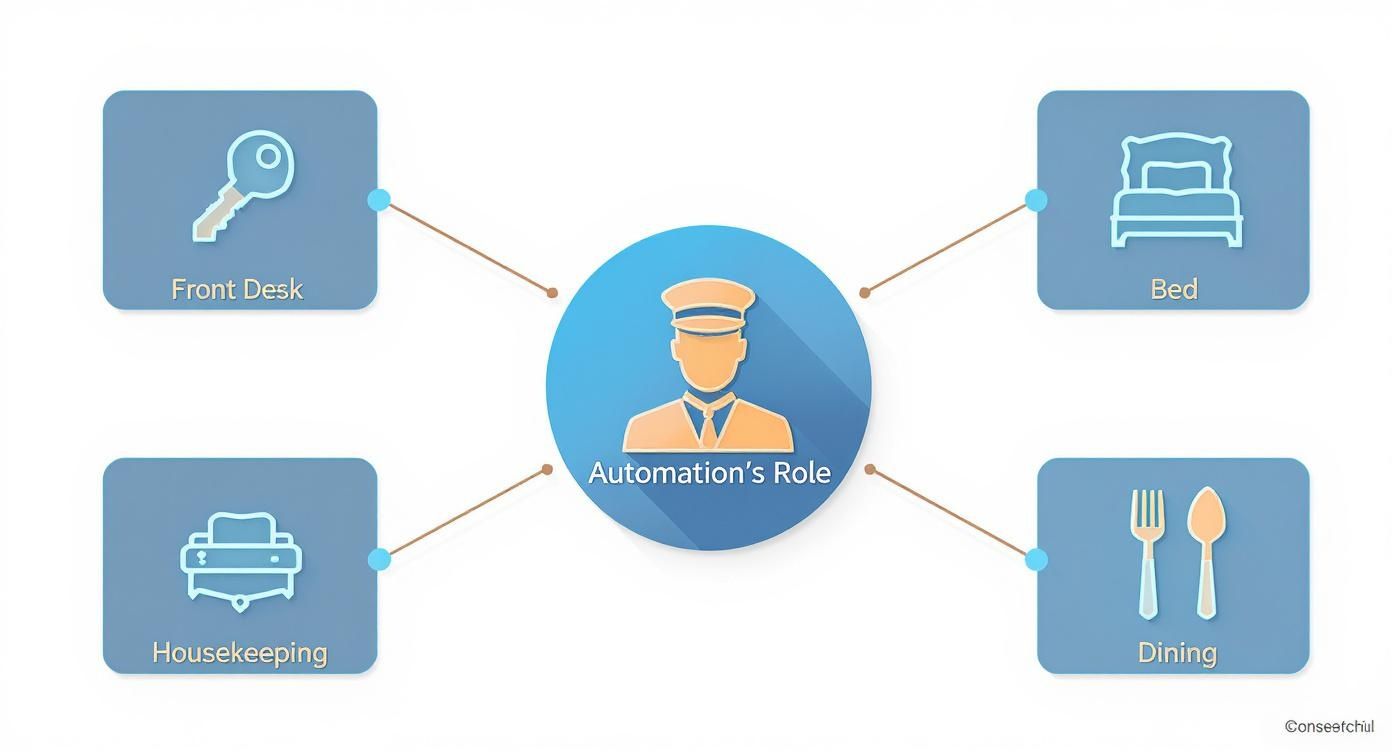
As the image shows, automation is not a departmental tool; it is the connective tissue that ensures guest data and requests flow seamlessly between the front desk, housekeeping, and F&B, creating a single, unified service standard.
Unified CRM Platforms: The Single Source of Truth
The final, and perhaps most critical, component is a unified Customer Relationship Management (CRM) platform. In my experience, the number one cause of service failure is a fragmented view of the guest. A modern, hospitality-focused CRM eradicates this by serving as the single source of truth, consolidating every guest interaction into a comprehensive 360-degree profile.
This system integrates data from your PMS, point-of-sale systems, spa software, and all digital communications. It provides a central repository for the insights generated by your AI, making them accessible to every team member. When a guest makes a dinner reservation, the host sees the same allergy notes the front desk agent recorded at check-in. This data continuity is the bedrock of flawless service execution.
The following table summarizes how these technologies converge to elevate the guest experience.
Key Automation Technologies and Their Impact
| Technology | Primary Function | Guest Experience Enhancement |
|---|---|---|
| Artificial Intelligence (AI) | Analyzes guest data to predict needs and preferences. | Proactive service, hyper-personalized recommendations, and anticipating requests before they are made. |
| Internet of Things (IoT) | Connects and controls physical devices within the resort (e.g., lighting, thermostats, locks). | An intelligent room that adapts to guest preferences automatically, offering seamless comfort and convenience. |
| Unified CRM | Consolidates all guest data and interactions from various touchpoints into a single profile. | Ensures consistent, informed service across all departments, making the guest feel known and valued. |
Ultimately, it's the synergistic combination of this predictive brain (AI), sensory network (IoT), and central memory (CRM) that enables a resort to deliver on the promise of truly personalized luxury at scale.
The Business Case For Automation
As a growth strategist, I operate on a core principle that holds true across every sector, from SaaS to luxury hospitality: a great idea must be validated by the numbers it generates. Any significant capital expenditure must answer the fundamental question: what is the return on investment? For luxury resort guest experience automation, the answer is found in hard metrics that directly impact your P&L.
We must look beyond guest satisfaction scores, which are often lagging indicators. The real business case is built on tangible outcomes that resonate with operators, investors, and stakeholders. It's time to reframe automation not as a cost center, but as a powerful engine for sustainable revenue and EBITDA growth.
Driving Operational Efficiency
The most immediate financial impact is realized through gains in operational efficiency. By automating routine, repetitive tasks, you reallocate your most valuable asset—your human capital—to high-value, guest-facing interactions that define the luxury experience. Let technology manage logistics so your team can deliver excellence.
This translates directly to the bottom line in several key ways:
- Optimizing Labor Costs: Automating processes like mobile check-in, room service ordering, and amenity requests reduces the administrative burden on your staff.
- Improving Resource Allocation: Data from automated systems enables predictive modeling for peak demand, leading to smarter, more cost-effective staff scheduling.
- Minimizing Service Errors: Manual data entry and inter-departmental handoffs are primary sources of error. Automation ensures seamless, accurate communication, reducing the frequency of costly service recovery events.
The principle is simple: shift human capital from low-value, repetitive work to high-impact, revenue-generating activities. This isn't about staff reduction; it's about staff optimization.
This strategic shift creates a leaner, more agile operation capable of delivering a superior service standard, often with the same or even fewer resources.
Unlocking New Revenue Streams
Beyond cost savings, automation is a potent tool for revenue generation. By creating a unified data ecosystem, you gain an unprecedented understanding of guest behavior and preferences. This unlocks opportunities for hyper-personalized upselling and dynamic pricing that are impossible to execute manually at scale.
The data confirms this. Recent 2025 figures show that hotel automation provides a significant lift to key financial metrics. One luxury hotel group reported a 15% increase in room occupancy and an 18% revenue uplift after implementing AI-driven systems. This was achieved through dynamic pricing models that adjust in real-time, while operational efficiency improved by 20% through automated workflows like mobile key access and AI-assisted housekeeping. You can find more insights on the benefits of hotel automation.
This data-driven approach allows you to present targeted offers that feel like thoughtful recommendations, not generic sales pitches. Imagine an automated system identifying a guest's interest in gastronomy and proactively sending a curated menu from your Michelin-starred restaurant, signed by the chef. That is not just good service; it is a direct path to increased ancillary revenue.
The business case is unequivocal. Automating the guest experience creates a virtuous cycle: it reduces operational costs, elevates service quality to justify premium pricing, and unlocks new, personalized revenue streams. It is a strategic investment that delivers a quantifiable return across the entire P&L.
A Strategic Roadmap For Implementation
Adopting sophisticated technology is not a simple "plug-and-play" activity. I've witnessed countless promising projects fail, not due to faulty technology, but due to a lack of strategic planning. After years spent breaking down inter-departmental silos, I can state with certainty that a successful automation initiative is 90% change management and 10% technology. It demands a phased, strategic approach that respects your existing operations and empowers your team.
Purchasing a best-in-class platform without a clear implementation strategy is like handing a world-class orchestra a complex new symphony without sheet music—the result is chaos, not harmony. A structured roadmap is non-negotiable to ensure your investment in luxury resort guest experience automation enhances, rather than disrupts, your operations.
Start With A Thorough Systems Audit
Before engaging with any vendors, you must first gain a deep, objective understanding of your own operational landscape. The initial step is always a comprehensive audit of your existing systems and the current guest journey. Map every touchpoint, from initial website interaction to post-stay communication.
The objective is to identify friction. Where are the bottlenecks? Which manual, repetitive tasks are consuming staff time? Where do communication breakdowns occur between the front desk, housekeeping, and F&B? This audit is not about finding technology gaps; it's about uncovering the operational pain points that impact both guests and staff.
The data from this audit becomes your North Star. It allows you to move beyond assumptions and pinpoint the specific areas where automation will deliver the greatest and most immediate impact.
Define Clear And Measurable Objectives
With a clear understanding of your friction points, you can establish data-driven objectives. A vague goal like "improve the guest experience" is not a strategy; it's a wish. A robust objective is specific, measurable, and tied directly to a business outcome.
Your objectives should be framed as quantifiable KPIs:
- Are we targeting a 30% reduction in guest check-in time?
- Is the goal a 15% increase in ancillary revenue from personalized offers?
- Do we need to improve guest satisfaction scores for room service speed by 10 points?
Defining these KPIs upfront is critical. They not only guide your technology selection but also provide the benchmarks against which you will measure success and ROI. This process is fundamental to any major systems upgrade, a principle we explore further in our guide to a successful business intelligence implementation.
Select Partners, Not Just Vendors
The market is saturated with technology providers. Your objective is to identify a strategic partner, not simply a vendor. A true partner invests the time to understand your unique operational challenges and your specific objectives. They should be able to demonstrate precisely how their solution addresses the friction points identified in your audit.
When evaluating potential partners, focus on three key criteria:
- Proven Integration Capabilities: The system must integrate seamlessly with your existing Property Management System (PMS), Point of Sale (POS), and other core platforms. This is non-negotiable.
- Scalability: The solution must be able to scale with your business, whether you are adding properties or expanding services.
- Dedicated Support and Training: Implementation is only the beginning. A strong partner provides robust training and ongoing support to ensure user adoption and mastery of the new tools.
Launch A Focused Pilot Program
Finally, resist the temptation of a "big bang" rollout across the entire property. I am a firm advocate for a focused pilot program. Select a specific operational area—such as VIP arrivals or in-room dining—and deploy the new system on a limited, controlled scale.
This approach allows you to identify and resolve issues, gather real-world feedback from staff and guests, and secure early wins. A successful pilot builds momentum and creates internal champions for change, making the full-scale rollout significantly smoother. It is a low-risk, high-reward strategy that enables you to test, learn, and refine, guaranteeing a successful enterprise-wide launch.
Where Data Meets Intuition: The Future of Hyper-Personalization

Ultimately, the goal of this technology is not simply operational efficiency. The strategic endgame is to create a guest experience so intuitive it borders on precognition. This is the future of luxury: using data to understand your guests so profoundly that you can anticipate needs they haven't yet considered. This is hyper-personalization.
In my experience, the most valuable insights are not found in structured booking histories. They are latent within the vast, unstructured datasets most properties ignore: online reviews, social media sentiment, and subtle on-property behavioral cues. This is where you uncover the "why" behind guest preferences.
Moving from Reactive to Predictive Service
True luxury is defined by "wow" moments that are both unexpected and perfectly appropriate. Data analytics unlocks this capability, transitioning your service model from reactive fulfillment to proactive anticipation. An intelligent automation platform is not merely a tool for fetching amenities; it is a mechanism for engineering moments that build deep, lasting brand affinity.
Consider this scenario: a smart platform analyzes a guest's public social media activity and identifies a passion for modern art. Instead of waiting for a concierge inquiry, the system could proactively suggest a private tour of a local gallery, complete with a personalized itinerary. This is how data transcends analytics and becomes a tool for building the emotional connection that defines a world-class brand.
Hyper-personalization is the use of data to choreograph moments of delight. It is the difference between giving guests what they ask for and giving them something they never thought to ask for but will never forget.
Mining for Gold in Unstructured Data
The ability to analyze unstructured guest feedback at scale is a game-changer for luxury resort guest experience automation. Recent academic studies that analyzed millions of guest reviews confirm what seasoned hoteliers have long known: guest satisfaction is directly correlated with the perceived responsiveness and personalization of service. By automating text analysis, resorts can extract actionable intelligence from the thousands of online comments and surveys generated annually.
Consider a property like Marina Bay Sands, which generates over 80,000 surveys a year. This is a goldmine of unstructured data. You can learn more about how data analytics uncovers guest insights from recent hospitality studies. It's about moving beyond knowing a guest prefers a corner suite to understanding the nuanced reasons why, based on sentiment clues left across the digital landscape. This same data-centric thinking is reshaping other high-touch industries, as seen in the world of casino AI guest personalization, where understanding individual behavior is paramount to success.
The All-Important Ethics of Using Guest Data
Of course, with great data comes great responsibility. Any initiative toward hyper-personalization must be built on a foundation of trust and transparency. Guests are generally willing to share information in exchange for a superior experience. However, the data collected must be used exclusively to enhance their stay, not for intrusive marketing.
This requires clear communication about what data is being collected and for what purpose. It is about ensuring every personalized action feels like a thoughtful gesture, not an invasion of privacy. When executed correctly, a data-driven approach does not feel cold or transactional. It feels like classic, high-touch hospitality, delivered with modern precision and scale—the art of making every guest feel like they are your only one.
Frequently Asked Questions
After guiding numerous luxury brands through significant operational transformations, I've found that even the most compelling strategies are met with rigorous, practical questions. When discussing luxury resort guest experience automation, clarity on these key points is what builds the executive confidence needed to proceed. Here are my answers to the questions I hear most frequently from leadership teams.
Does Automation Replace The Human Touch?
No. This is the single most critical point to understand. In the luxury sector, automation's role is not replacement, but empowerment. The strategic objective is to delegate repetitive, low-value tasks—check-ins, routine amenity fulfillment, simple scheduling—to technology.
This reallocation of work frees your high-value staff to focus on what they do best: forging genuine human connections and delivering the bespoke, memorable service that commands a premium. It's about enabling your concierge to spend more time crafting a surprise anniversary experience, not more time processing paperwork. Technology handles the routine so your team can deliver the remarkable.
What Is The First Step For A Resort?
Before any discussion of software or vendors, the first step is an internal deep dive. Conduct a rigorous audit of your current guest journey and internal workflows to identify points of friction. Where do guests experience delays? What manual processes consume the most staff hours?
By mapping these pain points first, you build an unassailable business case for investment. This ensures you are acquiring technology to solve a quantifiable problem—one that is costing you time, money, or guest loyalty—not merely adopting the latest trend.
This is a core principle I apply to all growth initiatives: solve a real, measurable problem first.
How Is The ROI Of Automation Measured?
Measuring the return on this investment requires a dual-focus approach, analyzing both quantitative financial metrics and qualitative guest sentiment indicators. A successful automation strategy should generate a measurable lift across the entire business, proving the direct correlation between a superior guest experience and a healthier P&L.
Quantitative Metrics to Track:
- Operational Efficiency: Measure improvements in key performance indicators like check-in time, room turnover speed, and labor cost per occupied room.
- Revenue Growth: Track the increase in ancillary revenue from automated, personalized upselling and the lift in RevPAR from dynamic pricing models.
Qualitative Metrics to Monitor:
- Guest Satisfaction: Closely monitor your Net Promoter Score (NPS) and other direct feedback channels for positive trends.
- Brand Reputation: Employ sentiment analysis to gauge the tone and content of online reviews and social media mentions.
- Guest Loyalty: Measure increases in repeat booking rates and the overall lifetime value (LTV) of your guests.
When you observe positive movement across both quantitative and qualitative metrics, you have definitive proof that your strategic investment is delivering its intended return.
At MGXGrowth, we architect data-driven growth strategies that fuse operational excellence with unforgettable guest experiences. If you are ready to build a clear, actionable roadmap for your brand's future, let's connect at https://www.mgxgrowth.com.
