


Pricing isn't about plucking a number out of thin air. It's about drawing a straight line from the value you deliver to the price you charge. In my experience across multiple industries, the most effective pricing strategies have nothing to do with your internal costs and everything to do with the tangible, quantifiable results your customers achieve.
When you get this right, pricing stops being an accounting task and becomes your most powerful tool for growth.
Your Pricing Model Is Your Most Powerful Growth Lever
I’ve seen it time and time again. Companies will pour fortunes into slick marketing campaigns and beef up their sales teams, completely ignoring the single biggest growth lever they have: their pricing. It’s often treated as an afterthought—a quick cost-plus calculation that the finance team handles in a silo. Frankly, that’s a massive strategic blunder.
Your price isn't just a number on an invoice. It is a direct signal to the market about your value, your confidence, and where you position yourself in the competitive landscape. It is also the fastest way to drive immediate, material impact on your revenue and EBITDA.
The whole game changes when you shift from asking, "How much does this cost us to deliver?" to "What is this outcome really worth to our client?"
This isn't just a minor tweak in thinking; it's a fundamental operational shift. When your price reflects the customer's perceived value, it creates a virtuous cycle throughout your entire business.
Pricing is the moment of truth—it’s where your sales pitch, marketing message, and product development all must converge. If those teams aren't aligned on the value you're delivering, you're quietly bleeding profit.
Getting everyone aligned doesn’t happen by chance. It demands a conscious effort to break down the organizational silos that typically stand between departments. When sales, marketing, and product can all articulate the same compelling value story, your pricing strategy becomes a unified engine for growth.
And the stakes are only getting higher. The global services market, which was valued at around $12.48 trillion in 2021, is on track to hit $17.46 trillion by 2025. This explosion means more competition and smarter customers with more options. A sharp pricing strategy is no longer just a nice-to-have; it’s a non-negotiable for survival. You can dig into more data on the global services market to see just how fast things are moving.
This guide will walk you through moving from simple price-setting to strategic value capture. We'll ditch the outdated models and give you a clear framework for building a service pricing strategy that fuels real, sustainable growth.
Let's move from high-level strategy to the tactical playbook.
How you architect your pricing is one of the most critical decisions you'll make. It’s not just about numbers on an invoice; it sets the tone for your customer relationships, dictates your operational focus, and has a direct line to your bottom line.
Over my career, I've seen countless pricing models in action, from scrappy startups to established enterprises. The successful ones almost always boil down to a variation of five core strategies. Each sends a very different message to the market and demands something different from your team.
Let's break them down.
1. Cost-Plus Pricing: Your Foundational Floor
This is pricing in its most basic form. You calculate your cost to deliver a service—labor, tools, overhead, the whole P&L—and then you add your desired profit margin on top. It's simple math. If your all-in cost is $500 and you want a 30% margin, you charge the client $650.
Think of this as your safety net. It ensures you’re not losing money on a project, which is the bare minimum for survival. It's common and often makes sense in fields where costs are predictable and repeatable, like a basic IT support package or a straightforward construction job.
But its simplicity is its greatest flaw. Cost-plus pricing is completely inward-looking. It never asks the most important question: what is this worth to the customer? By tethering your price to your costs, you're capping your own earning potential. You could be leaving a mountain of cash on the table.
2. Value-Based Pricing: The Ultimate Growth Engine
This brings us to the most powerful of all pricing strategies for services: value-based pricing. Here, you flip the script entirely. You don't start with your costs; you start with the customer's gain. The only question that matters is, "How much quantifiable value will my client realize from this solution?"
Here’s an analogy: Cost-plus is selling flour, sugar, and eggs. Value-based is selling a finished, beautifully decorated wedding cake. The price of the cake isn’t determined by the cost of the ingredients; it's based on the skill, the artistry, and the incredible value it brings to a once-in-a-lifetime event.
If your service saves a client $100,000 a year, charging $20,000 for it feels like a bargain. It doesn't matter if it took you 10 hours or 100.
Value-based pricing isn't just a pricing model; it's an organizational mindset. It forces everyone, from marketing and sales to the delivery team, to become obsessed with customer success. Your revenue becomes directly tied to the impact you create.
Getting this right requires a deep, almost intimate, understanding of your customers' P&L. You have to be able to quantify the ROI you deliver, whether that's through increased revenue, reduced costs, or mitigated risk. It means your sales team can't just sell features; they have to sell business outcomes.
This infographic really nails the mindset shift required, showing how you move from a cost-first to a value-first approach.
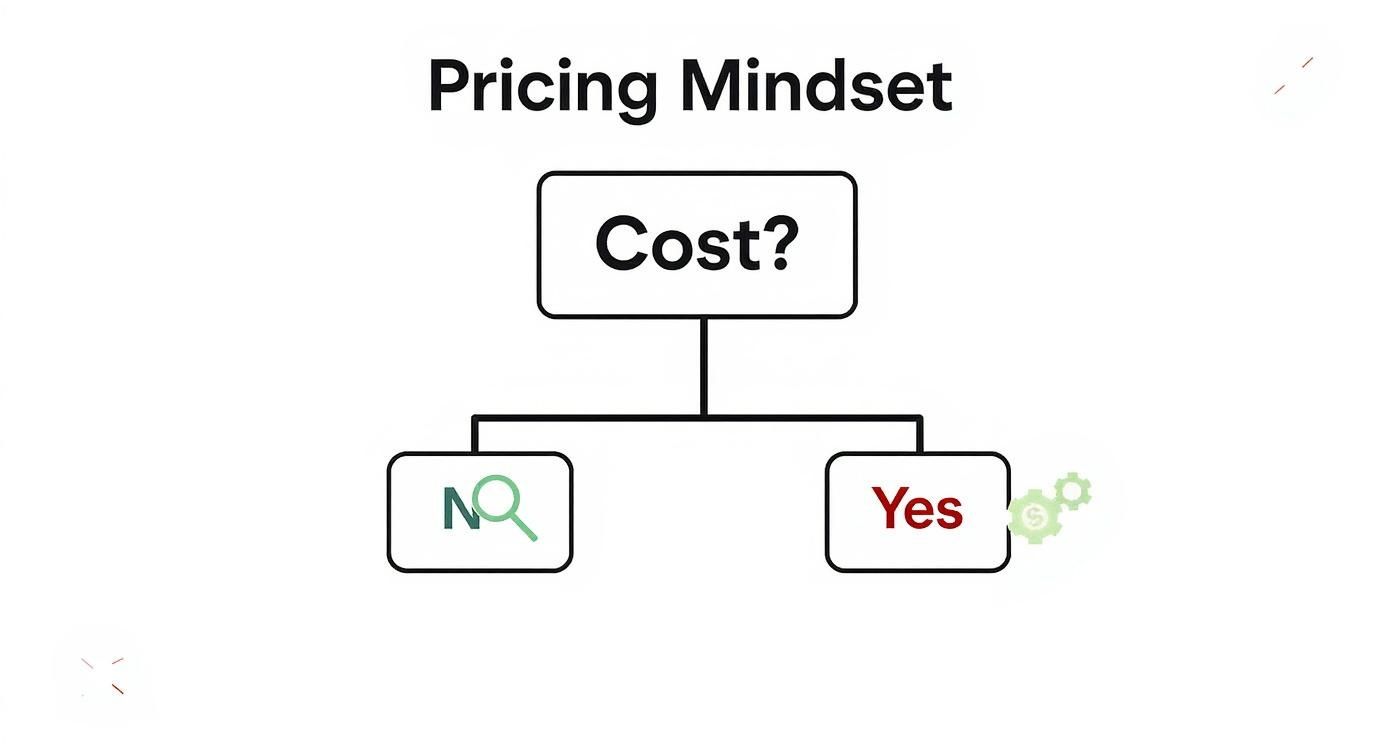
As you can see, a true growth strategy starts by asking about value, not just cost. That's how you unlock higher margins and become a leader in your market.
3. Tiered Pricing: The Path to the Upsell
You’ve seen this everywhere—the classic "Good, Better, Best" model. Tiered pricing is all about packaging your services into distinct bundles at different price points. It works wonders for SaaS companies and any other service business that can scale. Why? Because it lets you sell to different customer segments simultaneously.
The psychology at play here is brilliant. You're not asking for a simple "yes" or "no." You're asking, "Which one of these is right for you?" That simple reframe can dramatically boost conversion rates. The trick is to design your tiers to create an obvious and compelling upgrade path.
A great tiered structure accomplishes three things:
- It lowers the barrier to entry. A budget-friendly "Good" tier gets new customers in the door.
- It anchors value. The high-end "Best" tier makes the middle "Better" tier look like a fantastic deal, even if very few people buy the top one. It's a classic psychological anchor.
- It automates expansion revenue. As a client's business grows, they naturally graduate to the next tier, increasing their lifetime value without requiring a full re-sell.
To pull this off, you have to know which features your customers value most at each stage of their journey. A solid customer segmentation strategy isn't just a nice-to-have here; it's an absolute must.
4. Retainer Pricing: For Predictability and Partnership
With a retainer, a client pays you a fixed fee every month for ongoing access to your expertise. This is the bread and butter for many marketing agencies, law firms, and consultants. It’s a powerful way to shift the dynamic from a one-off transaction to a genuine long-term partnership.
The biggest win for you is predictable revenue. That stability is gold. It makes it so much easier to forecast your finances, plan your staffing, and make smart strategic bets. For the client, it offers budget certainty and the peace of mind that comes from having an expert in their corner.
The danger, however, is scope creep. If you don't have an iron-clad service level agreement (SLA), you’ll find that some clients will treat the retainer like an all-you-can-eat buffet. That will absolutely crush your profitability. Success with retainers demands disciplined account management and brutally clear communication about what’s included—and what isn’t.
5. Performance-Based Pricing: The High-Risk, High-Reward Play
Last but not least, we have performance-based pricing. This is where you put your money where your mouth is. Your compensation is tied directly to the results you generate—a percentage of new sales, a cut of the money you save them, or a bonus for hitting a specific KPI.
This model is the ultimate alignment of interests.
When you offer to get paid on performance, you’re signaling supreme confidence in your abilities. It can be an incredibly effective way to close a deal, especially with a skeptical client who's been burned by big retainers with little to show for them in the past.
Of course, the risk is glaringly obvious: if you don't deliver, you don't get paid. This model works best for services where the outcome is crystal clear and easily measured, like lead generation campaigns or e-commerce conversion rate optimization. It's not for the faint of heart and requires a rock-solid process and an unwavering focus on execution.
Navigating Price Realization and Market Pressure
Setting a price in a spreadsheet is the easy part. The real test—the real battle—begins the moment that price meets the open market. This is the world of price realization, which is simply the difference between the price you want to get and the price a customer actually pays.
From what I’ve seen over the years, this is precisely where even the most carefully crafted pricing strategies start to fall apart.

There’s often a huge, and frankly dangerous, gap between the price tag and the final invoice. It's not just a rounding error; it’s a slow, steady erosion of your profit margins that happens one deal, one discount, and one negotiation at a time.
So, why is this happening? We're all operating in a market squeezed by two massive forces: hyper-competition and incredibly empowered buyers. Customers today have more information, more options, and more power than ever before. This dynamic puts intense downward pressure on your prices, turning what should be a value conversation into a race to the bottom.
The Silo Effect on Profitability
Ironically, one of the biggest threats to your pricing power often comes from inside your own walls. I’ve spent a good chunk of my career trying to break down the silos between sales, marketing, and finance because when they’re disconnected, your bottom line is the first casualty.
When these teams operate in vacuums, you get chaos. Marketing might be running a brilliant campaign that builds immense value, but then the sales team, chasing a quarterly quota, immediately offers a 20% discount just to get the deal signed. All the while, the finance team is just looking at the final, lower number on the invoice, scratching their heads and wondering why revenue is down even though the "strategy" looks solid on paper.
This misalignment creates a culture of discounting that becomes incredibly hard to reverse. Sales incentives that reward raw volume over actual profitability just pour fuel on the fire. Every department might be hitting its individual KPIs, but the company as a whole is bleeding profit.
Price realization isn't a finance problem; it's a cross-functional execution problem. Your list price is a hypothesis. The invoiced price is the hard data that tells you if your value proposition, sales process, and market position are truly aligned.
Recent data paints a pretty stark picture here. A comprehensive study found that the average price realization rate has plummeted by 5 percentage points in just two years, now sitting at a mere 43%. That points to a serious gap between strategy and execution, with 64% of companies reporting that pricing pressure is getting worse. The main culprits? You guessed it: customer resistance and cutthroat competition. You can dive into the full findings on price realization challenges to see just how widespread this issue is.
Strengthening Your Price Integrity
Defending your price requires more than a great service; it demands a unified front and real strategic discipline. The goal is to consistently shift the conversation away from price and toward value, and you need to arm your sales team to win that argument.
Here are a few practical ways to bolster your price integrity:
- Develop a Value-Based Sales Toolkit: Don't send your sales team into negotiations empty-handed. Give them the ammunition they need: compelling case studies, ROI calculators, and hard data that clearly shows the financial impact of your service. This helps them justify the price with tangible business outcomes, not just features.
- Establish a Clear Discounting Policy: Put a structured framework in place for any and all discounts. It should clearly define who has the authority to approve them, under what specific circumstances they can be offered, and what the absolute limits are. This simple step removes the guesswork and stops rogue discounting in its tracks.
- Align Incentives with Profitability: Take a hard look at your sales compensation plans. Are you rewarding pure revenue or profitable deals? Tying commissions to gross margin instead of just the top-line number can fundamentally change your team’s behavior in a negotiation. This shift ensures the sales team is just as invested in protecting your margins as the finance team is. It also has a positive effect on your cost of customer acquisition, which you can learn more about in our guide on how to properly calculate this critical metric.
How to Implement and Test Your New Pricing Strategy
A strategy on a slide deck is worthless. It's the execution that separates the winners from the wishful thinkers. Once you've picked the right pricing model, the real work begins—rolling it out in a way that minimizes risk and maximizes buy-in from your team and, most importantly, your customers.
Let's be clear: a new pricing strategy isn't just a number change. It’s a fundamental shift in how you relate to the market. You absolutely have to handle this transition with surgical precision.

This process isn’t about flipping a switch overnight. It's a phased, deliberate sequence of actions designed to gather data, manage expectations, and build momentum. I’ve led this process across multiple industries, and a disciplined approach is the only way to avoid chaos.
Start with an Internal Alignment Audit
Before a single customer hears about your new pricing, your own house has to be in order. The biggest implementation failures I’ve seen all boil down to internal misalignment. If your teams aren’t on the same page, your customers will sense the confusion and exploit it.
Your first step is to conduct a thorough internal audit. Get your sales, marketing, finance, and customer success leaders in a room, and don’t leave until you have solid answers to these questions:
- Sales Readiness: Does the sales team truly understand the why behind the change? Can they articulate the new value proposition with confidence, or will they default to discounting at the first sign of pushback?
- Marketing Messaging: How will marketing communicate this? Is the messaging focused on added value and benefits, or does it sound like a sterile corporate announcement nobody will read?
- Operational Impact: Can your billing system even handle tiered pricing or a retainer model? Is finance able to track the new metrics you’ll need to measure success?
Getting this alignment isn't about sending a memo. It’s about training, role-playing, and equipping your teams with the tools and talking points they need to execute flawlessly. Your pricing strategy is only as strong as the people who have to defend it on the front lines.
Communicate with Confidence and Clarity
How you talk about this change, especially to existing customers, will define its success. This is where so many companies stumble, either by being too apologetic or too aggressive. You need a balanced approach, one that’s rooted in transparency and value.
A key decision here is how to handle your loyal, existing customers. A common and highly effective strategy is grandfathering, where you let current clients stay on their old plan for a set period. This move acknowledges their loyalty and gives them time to adjust. Considering that acquiring a new customer can be five times more expensive than keeping an existing one, this is a smart investment in your relationships.
When you do announce the change, frame it around the "what's in it for them."
Never lead a pricing conversation with what you need. Always lead with what the customer gains. Your new price should be a direct reflection of the enhanced value, improved service, or better outcomes they will now receive.
This means your communication should highlight new features, better support, or the investments you're making back into the service to benefit them directly. Prepare your team to handle objections not by caving on price, but by circling back to the value equation every single time.
Validate Your Strategy with Data
Finally, you have to treat your new pricing as a hypothesis—one that needs to be proven with hard data. Never assume you got it perfect on the first try. A structured plan for testing and monitoring is essential.
I recommend launching your new pricing with a specific pilot group or in a new market segment first. This lets you collect real-world data in a controlled environment before going all-in. From there, you need to track the right metrics obsessively.
Here’s a simple framework for monitoring your pricing success:
- A/B Test Key Elements: Don't just test the price point. Test the packaging of your tiers, the call-to-action on your pricing page, and the messaging you use. You'd be surprised how small tweaks can lead to significant lifts in conversion.
- Monitor Core Growth Metrics: Keep a close eye on your Customer Lifetime Value (CLV) and Churn Rate. If CLV is climbing while churn stays stable or even drops, your new pricing is likely creating more value for the right customers.
- Track Adoption Rates: For tiered models, watch the adoption rate of each tier. Is your "Better" tier the most popular, as you intended? If everyone flocks to the cheapest option, your tiers probably aren't structured correctly to incentivize upgrades.
By following this disciplined, data-driven approach, you turn pricing from a high-stakes gamble into a calculated, strategic move that fuels sustainable growth.
Real-World Pricing Models in Action
Theory is one thing, but seeing how these pricing strategies play out in the real world is where the rubber really meets the road. I’ve had a front-row seat to countless pricing overhauls, and the ones that truly succeeded were never just about changing a number. They were about fundamentally rewiring how a company connected its value to its revenue.
So, let's step away from the abstract. These aren't just hypothetical scenarios; they are stories from the trenches, showing the challenges, the strategic thinking, and the impact on the bottom line.
SaaS: From Flat-Rate to Value-Based Tiers
One of the most dramatic turnarounds I ever helped orchestrate was with a mid-stage SaaS company. They were trapped by a simple, flat-rate monthly fee—a relic from their startup days. Their problem was a classic one: their largest enterprise clients, who were getting a massive amount of value, paid the exact same price as a small business just dipping its toes in the platform. It was a huge revenue leak.
The fix was to move to a tiered, value-based model. We started by mapping out their customer base, identifying three distinct segments. Then, we built packages that gave each segment exactly what they valued most.
- The "Before": A single, one-size-fits-all price of $299/month.
- The "After": A three-tiered system—$199 for startups, $599 for growing businesses, and a custom enterprise plan starting at $2,500/month.
- The Result: It was a game-changer. The company boosted its average revenue per user (ARPU) by a staggering 40% in just six months. Even better, churn among their best customers dropped because they finally felt the package was built specifically for them.
This worked because we stopped selling software features and started selling business outcomes. The tiers weren't random; they directly mirrored the increasing value our platform delivered as a client's own business scaled.
Making this kind of shift demands a deep dive into what truly drives value in your product. For any software company, this is a cornerstone of building real, lasting growth. You can see how this fits into the bigger picture in our guide to effective SaaS growth strategies.
A Marketing Agency's Hybrid Model
Next up, a digital marketing agency was constantly hitting a wall. Clients loved their results but balked at the high monthly retainers. Committing to a big fixed fee without a guaranteed return made them nervous, and the agency’s growth had completely stalled. Their pricing felt disconnected from client success.
We introduced a hybrid model that blended a more modest retainer with a performance-based kicker. It was the perfect solution, balancing the agency's need for predictable income with the client's hunger for ROI-driven spending.
The new structure had a base retainer to cover strategy and account management, plus a commission tied directly to the revenue generated from the campaigns. This instantly changed the entire sales conversation. It was no longer about cost; it was about a shared growth partnership.
This kind of aligned incentive is incredibly powerful. The agency was no longer just another vendor—they were a partner with real skin in the game. This model works especially well in fields where results are easy to measure, creating a true win-win.
Pricing Localization in Financial Services
Finally, it’s critical to remember that a one-size-fits-all price will almost certainly fail on a global scale. The financial services industry is a fantastic example of this. The payments subsector, which pulls in about $2.5 trillion in global revenue, is shifting away from simple transaction fees. Instead, companies are building more complex, value-driven models, often by monetizing AI-driven insights.
But you can't price the same way everywhere. Market maturity is everything. While the payments sector in Latin America grew by 11% and in Europe by 8%, the Asia-Pacific region actually saw a slight dip. This demands completely different pricing approaches for each region. It’s a clear lesson on the need to localize your pricing to fit the local economy and what customers are willing to pay. You can dig into these global trends by discovering more insights about the evolution of payment services on mckinsey.com.
The following table offers a quick look at the kind of impact a well-executed pricing shift can have across different industries.
Case Study Snapshot: Pricing Model Impact
| Industry | Old Model | New Model | Key Result |
|---|---|---|---|
| SaaS | Flat-Rate Subscription | Tiered, Value-Based | 40% increase in Average Revenue Per User (ARPU). |
| Marketing Agency | High Monthly Retainer | Hybrid (Base Retainer + Performance) | Shorter sales cycles and 25% increase in client lifetime value. |
| Financial Services | Standardized Global Fees | Localized, Value-Driven | Captured 15% more market share in emerging regions. |
These examples drive home a simple truth: the right pricing strategy isn’t just a number. It’s a story about your value, your confidence, and your partnership with the people you serve.
Common Questions About Service Pricing
After decades of driving growth, I've seen the same questions pop up time and again whenever a company gets serious about revamping its pricing. It’s easy to talk strategy in a boardroom, but it's much harder to deal with the real-world challenges that come with making a change. Here are my direct answers to the questions I hear most often.
How Often Should I Review My Service Pricing?
Pricing isn’t something you can set and forget. Based on my experience, you absolutely need to conduct a full pricing review at least annually. On top of that, you should be keeping a close eye on your key metrics every single quarter. A static price in a dynamic market is a surefire way to leave money on the table or, even worse, get left behind.
That said, certain events should trigger an immediate review, regardless of your calendar:
- A major market shift, like a new technology that fundamentally changes the game.
- A significant competitor move, like a new service launch or a shift in their pricing.
- Consistent feedback from your sales team that you're losing solid deals primarily on price.
The name of the game is agility. Your pricing must reflect the value you deliver and the market you're operating in, right now.
What Is the Best Way to Announce a Price Increase?
This is where your customer relationships are truly tested. Getting this right comes down to three things: transparency, justification, and plenty of advance notice. The fastest way to destroy trust is to spring a price hike on a loyal customer out of the blue.
Give them a heads-up at least 60-90 days before the new price takes effect. When you do, make the conversation all about the value they’re getting, not the cost you’re adding. Be specific. Explain exactly how you're reinvesting that extra revenue back into the service to improve their outcomes. Tying the increase to upcoming features or service upgrades is a powerfully effective move.
For your best, long-term customers, consider offering them a chance to renew early at their current rate. It’s a small gesture, but it goes a long way toward rewarding their loyalty and softening the blow.
How Do I Price a Completely New Service?
Launching something brand new is the perfect opportunity to anchor your price directly to value from day one. When you don’t have direct competitors, your price isn't just a number—it’s a statement about the problem you’re solving.
When you're first to market, your price isn't a comparison—it's a declaration of the problem's magnitude. Your primary job is to quantify the value of your solution, not the cost of your labor.
Start by getting out there and talking to potential customers. You need to dig deep with questions that uncover the real financial pain they’re feeling. Ask things like, "What is this issue really costing your business every month it goes unsolved?" or "What would you be thrilled to pay for a solution that just made this go away?"
Use what you learn to build a simple ROI model for your target client. I often suggest starting with a paid pilot program at a special introductory rate. This lets you collect incredible testimonials and hard data, which you can then use to justify your full-market price when you launch officially. It’s an excellent way to de-risk the launch and build a solid foundation of proof for your pricing.
Ready to move beyond theory and build a pricing strategy that actually grows your business? At MGXGrowth, we work with ambitious brands to find hidden pricing opportunities and drive real, measurable growth. Learn how we can architect the next stage of your growth roadmap.
