


My name is Mikhail Gaushkin. Across my career driving growth in SaaS, marketplaces, and hospitality, I've seen a universal truth: complacency is the silent killer of market share and EBITDA. A restaurant sales improvement consultant is not a quick fix; they are a strategic partner who re-architects your business around data, customer obsession, and profitability. They function as the critical link between your culinary passion and sustainable financial performance, transforming your restaurant into a scalable, data-driven enterprise.
Why Even Successful Restaurants Need a Growth Partner

In the hyper-competitive hospitality sector, operating on intuition and past performance is a high-risk strategy. Even the most profitable and popular restaurants eventually hit a performance ceiling. When you're immersed in the daily execution of managing staff, operations, and inventory, it’s inevitable that strategic blind spots will develop. Those blind spots are precisely where your next wave of growth is hiding.
I've witnessed this pattern repeatedly. Success codifies processes, and those processes can mask deep-seated inefficiencies. You might see a full dining room nightly but question why your profit margins are eroding. For many full-service restaurants, those margins are already razor-thin, often hovering between a slim 2% and 6%. An external expert provides the objective, data-backed perspective required to see what you cannot.
The Plateau of "Good Enough"
"Good enough" is where scalable potential stagnates. It's the invisible barrier preventing a successful local restaurant from evolving into a thriving multi-location brand. A restaurant sales improvement consultant is engaged specifically to shatter that barrier. They bring a fresh, objective lens and a rigorous, data-driven methodology that is nearly impossible for an in-house team, consumed by daily operations, to maintain.
They will dissect every facet of your business to unlock hidden revenue streams and plug operational leaks:
- Menu Engineering: Is your highest-volume dish actually profitable? Or is it a low-margin "hero" item that drives traffic but quietly compresses your bottom line?
- Customer Journey Mapping: From the initial online booking attempt to the final payment, where are the friction points that inhibit repeat business and reduce lifetime value?
- Marketing & Sales Alignment: Are your marketing campaigns and front-of-house execution truly synchronized? Or is marketing making brand promises that your service delivery cannot consistently fulfill?
Think of it this way: A chef meticulously refines a recipe, tasting and adjusting until it achieves perfection. A consultant applies that same iterative, rigorous process to your entire business model. They optimize pricing, marketing, and service delivery to engineer a formula for predictable, scalable growth.
This isn't about identifying flaws; it's about building a more resilient, high-performance operation. By breaking down the silos between your kitchen, front-of-house, and marketing teams, a consultant helps you construct a powerful, unified growth engine. They connect your culinary vision directly to a healthier EBITDA and increased market share, ensuring your passion generates substantial financial returns.
What a Top-Tier Consultant Actually Delivers
What is the tangible output when you engage a top-flight restaurant sales consultant? Let's move beyond the jargon. You are not simply hiring an advisor for generic recommendations. You are bringing in a hands-on strategic partner who will dive deep into the operational and financial mechanics of your business to drive measurable, bottom-line impact. This is not about surface-level feedback; it's about fundamentally retooling your operation for maximum profitability.
Their first and most critical action is a comprehensive, 360-degree audit of your entire enterprise. In my experience, you cannot optimize what you do not fundamentally understand. This extends far beyond a cursory review of your P&L statements. It involves a granular dissection of everything—from menu engineering and supply chain logistics to mapping the customer journey from their initial Google search to the final transaction.
Breaking Down Silos for Unified Growth
One of the most significant—and common—impediments to growth I encounter is internal friction. Your front-of-house, back-of-house, and marketing teams often function as disparate units, each with siloed objectives and metrics. A high-impact consultant's primary role is to act as a unifying force, dismantling these silos.
They align the entire organization around a single, shared mission: profitable sales growth. This ensures marketing campaigns are designed to be supported by kitchen capacity, and the invaluable qualitative data your servers collect from customers directly informs menu development. It is this cultural shift—from departmental KPIs to a unified growth objective—where transformative breakthroughs occur.
I often describe this process as transforming a collection of talented musicians, each playing their own tune, into a symphony orchestra. The consultant is the conductor, ensuring every section works in harmony to create a powerful, unified performance that captivates the audience—your customers.
This holistic view is essential for identifying hidden opportunities and threats. For example, a marketing campaign driving high traffic for a low-margin "hero" dish might appear successful in a silo but could be systematically eroding your profitability. A consultant connects these dots, ensuring promotional spend is laser-focused on high-contribution items. Every marketing dollar must directly impact the bottom line. To dig deeper into this, check out our guide on building a powerful, data-driven marketing strategy.
Here's a look at the key areas a consultant will typically focus on.
Core Focus Areas for a Restaurant Sales Improvement Consultant
A breakdown of the key domains a consultant analyzes to drive sustainable revenue growth and operational excellence.
| Focus Area | Objective | Key Activities |
|---|---|---|
| Menu Engineering | Maximize profitability and guest satisfaction. | Analyze item profitability (food cost vs. sales price), redesign menu layout to highlight high-margin items, and optimize item mix. |
| Operational Efficiency | Reduce waste and streamline workflows. | Audit kitchen processes, analyze labor scheduling, optimize inventory management, and assess front-of-house service flow. |
| Digital Presence & Marketing | Increase online visibility and drive direct bookings. | Evaluate SEO/local search performance, audit social media engagement, analyze online review management, and optimize third-party delivery platform strategy. |
| Customer Experience | Boost guest loyalty and repeat business. | Map the end-to-end customer journey, gather and analyze feedback (surveys, reviews), and implement staff training programs. |
| Financial Analysis | Improve cash flow and overall financial health. | Conduct a deep-dive analysis of P&L statements, scrutinize COGS and labor costs, and establish key performance indicators (KPIs) for tracking. |
Ultimately, the consultant's job is to synthesize these disparate elements into a single, cohesive growth strategy.
From Insight to an Actionable Strategy
Following the deep-dive audit, the real work begins. All that raw data is translated into a clear, actionable roadmap. This is not a 100-page theoretical report destined to gather dust; it's a prioritized execution plan designed for immediate implementation.
This is especially critical in the current market. The industry is poised for significant expansion, with forecasts predicting restaurant sales will reach $1.5 trillion by 2025—a growth of 4.1% year-over-year. This represents a massive opportunity, but only for operators prepared to capitalize on it. A great consultant delivers the concrete, measurable plan that converts insight into profit and positions you to capture that growth.
The Consultant Engagement: From Diagnosis to Results
Engaging a restaurant sales improvement consultant should not be an act of faith. It is a methodical partnership, a structured process with distinct phases designed to deliver a tangible return on investment. My time in both hospitality and tech has taught me that the most effective growth strategies are not based on guesswork; they follow a predictable, data-backed methodology. It is about systematically deconstructing your business to rebuild it with greater strength and profitability.
Think of it as a clinical diagnosis. You would not accept a prescription without a comprehensive diagnostic workup. The same logic applies here. We progress from broad investigation to surgical, targeted interventions that drive results.
Discovery and Diagnosis: The Deep Dive
Every engagement begins with total immersion in your business. This is the Discovery and Diagnosis phase. An effective consultant does not arrive with a pre-packaged solution; they arrive with a diagnostic toolkit to uncover the unique mechanics of your operation. The objective is to gather the unvarnished truth from every part of your organization.
This goes far beyond your P&L statement. This is a much deeper analysis:
- Quantitative Analysis: We dive into your POS data to understand actual sales trends, item-level profitability, and performance by daypart. This is where we uncover hidden patterns—like which menu items are true profit drivers versus those that are popular but barely break even.
- Qualitative Insights: This means engaging directly with your team. I conduct one-on-one interviews with everyone from the GM and executive chef to the servers and hosts. The operational roadblocks and untapped opportunities revealed in these conversations are invaluable—insights that never appear on a spreadsheet.
- Process Mapping: We observe a live service, mapping the end-to-end flow from guest arrival to payment. This allows us to pinpoint the bottlenecks and friction points that degrade both operational efficiency and the customer experience.
Strategy and Roadmap Development
With the raw data and qualitative insights gathered, we transition to Strategy and Roadmap Development. Here, we translate findings into a concrete, prioritized plan of attack. We synthesize all inputs from the discovery phase into a straightforward growth strategy with specific, measurable objectives.
The output here is not a 100-page theoretical document. It is a focused roadmap that clearly articulates, "Here are the three most impactful levers we can pull in the next 90 days to increase sales by 15%, and here is the exact execution plan to achieve it."
This roadmap outlines key initiatives, assigns clear ownership, establishes timelines, and defines the Key Performance Indicators (KPIs) we will use to measure progress. It is a blueprint for growth that aligns your entire organization toward a common goal.
Implementation and Execution
This is where strategy becomes action. The Implementation and Execution phase is the most critical part of the process. A true consultant does not simply deliver a plan and depart. They integrate with your team, working shoulder-to-shoulder to drive execution.
We are actively deploying the strategy. This could involve launching a targeted digital marketing campaign to increase traffic during off-peak hours, retraining staff on consultative upselling techniques, or re-engineering your online ordering flow to increase the average ticket size by 10-15%. This hands-on partnership ensures the changes are adopted and that your team feels empowered, not disrupted.
The infographic below illustrates the simple but powerful data-to-action cycle that governs this phase.
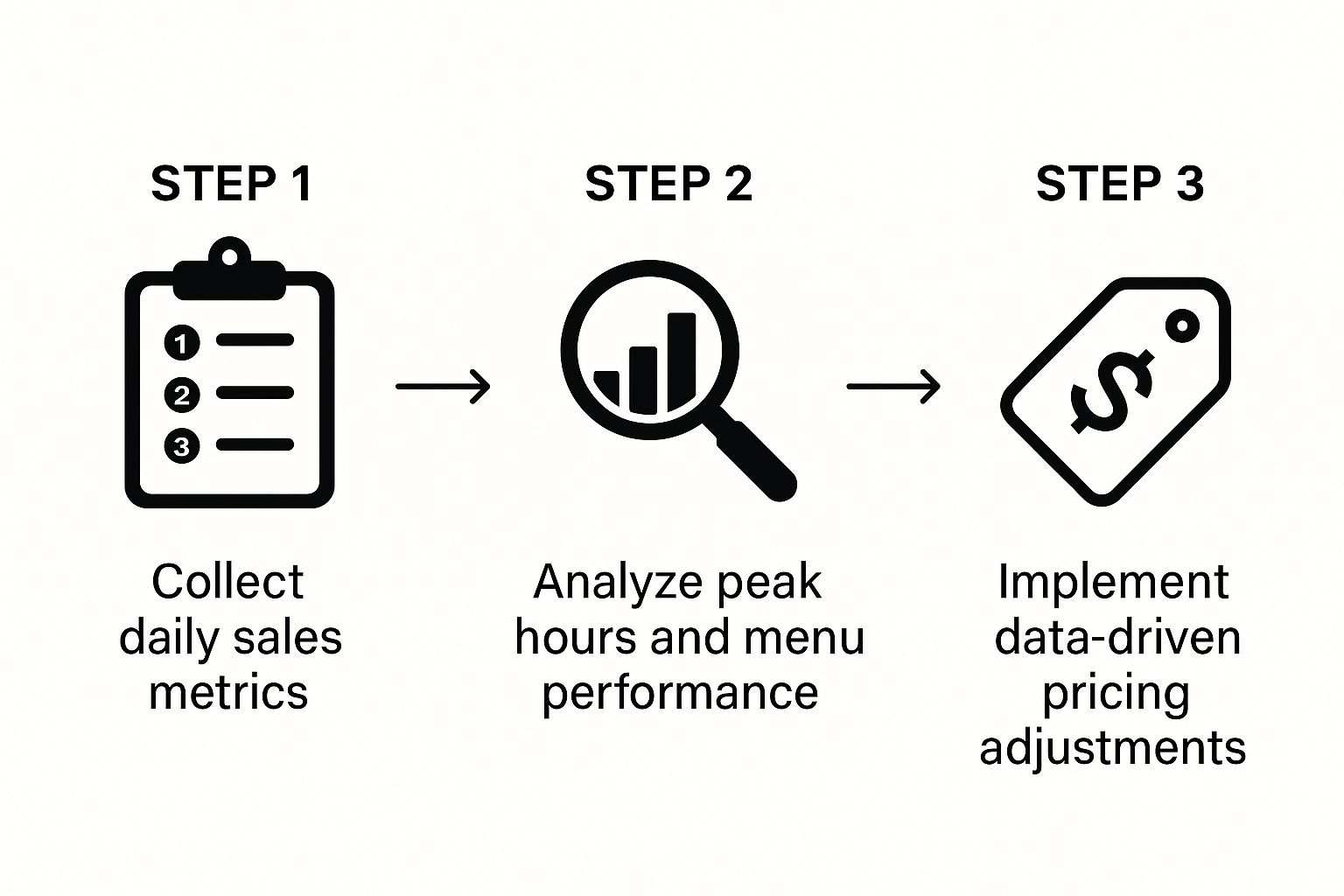
This visual captures the core of our methodology: leveraging data to drive actions that directly impact your bottom line.
Measurement and Iteration
Finally, we enter the Measurement and Iteration stage. Growth is not a static event; it's a continuous process. We rigorously track progress against the KPIs defined in the roadmap, identifying what is driving results and—just as importantly—what is not.
This constant feedback loop enables agility. We can double down on successful strategies and pivot quickly from those that are underperforming. The objective is not merely to complete a project; it is to embed a permanent, data-driven growth capability and a culture of continuous improvement within your organization that persists long after the engagement concludes.
Turning Market Trends Into Your Competitive Edge

A consultant's true value extends beyond optimizing internal processes. From my work across diverse industries, I've seen that the most significant growth occurs when a business learns to harness powerful market currents rather than be overwhelmed by them. A top-tier restaurant sales consultant acts as your market intelligence analyst—translating broad industry shifts into a tangible competitive advantage for your specific operation.
This is not about chasing fleeting food fads on social media. It is a disciplined, data-first approach to understanding the fundamental drivers of consumer behavior. The job is to cut through the noise and identify the specific, actionable trends that align with your brand's core competencies.
From Big-Picture Data to On-the-Ground Strategy
A seasoned consultant connects high-level economic indicators to your daily operational decisions. They analyze an industry-wide forecast and immediately ask, "How does this create a strategic opening for this specific restaurant?" This is how abstract data becomes real revenue. It is the difference between reacting to change and proactively shaping your future.
For example, while the overall industry projects modest growth, specific segments are experiencing explosive expansion. Technomic's 2025 forecast anticipates a 2.8% sales increase for top chains, yet categories like chicken and Mexican are projected to grow by 6.9% and 6.2%, respectively. A skilled consultant views these figures not as trivia, but as a strategic roadmap for your menu, marketing, or even concept development. You can learn more about how to interpret these restaurant industry sales forecasts to your advantage.
A restaurant without a market-aware strategy is like a ship without a rudder. It might have a powerful engine—great food, great service—but without clear direction, it's just drifting at the mercy of the currents. A consultant provides the navigation, using market data as their map and compass.
This guidance ensures that every strategic decision is a calculated move designed to meet demonstrated market demand.
Putting Trends to Work for Real Growth
Converting a trend into profit is not magic; it requires ensuring your menu, marketing, and operations are all aligned and telling the same story. A skilled consultant orchestrates this strategic harmony.
Here’s how they translate insight into action:
- Smart Menu and Concept Tweaks: If data indicates a sustained demand for plant-based comfort food, they won't simply recommend adding a token vegan burger. They will help you develop an offering that is authentic to your brand, integrates seamlessly with your kitchen workflow, and allows you to capture that niche.
- Laser-Focused Marketing: Forget generic "come try our new dish" campaigns. They use data to target the precise audience. For instance, they might execute a digital campaign targeting users actively searching for high-growth cuisines, delivering messaging that perfectly aligns with your offerings.
- Shrewd Operational Pivots: They might identify a growing demand for high-quality, quick-service lunch options in your area. This insight could lead to developing an express lunch menu or a hyper-efficient takeout system, enabling you to capture a new customer segment without disrupting your core dinner service.
Ultimately, an effective restaurant sales consultant distills industry noise into a clear signal for your business. They ensure you are not just reacting to the market, but actively positioning your restaurant to lead it.
Solving Operational Drag to Boost Your Bottom Line

In every business I’ve scaled, one principle is immutable: sales growth without profitability is a high-stakes hobby. You can fill every seat, every night, but if operational drag is quietly eroding your margins, you are merely treading water. In restaurants, the most significant anchor on profitability is often operational inefficiency, particularly within the team.
An astute restaurant sales improvement consultant understands this. Their initial focus is not just on driving top-line revenue; it is on ensuring your current operation is a lean, efficient machine capable of converting that revenue into profit. This begins with a rigorous analysis of your entire workflow, from order entry to kitchen execution and service delivery.
From Cost Center to Growth Asset
We analyze scheduling, role clarity, and communication protocols to ensure every team member is deployed for maximum impact. This is not about indiscriminately cutting labor costs—it’s about optimizing your labor investment. The objective is to transform your team from a line item on the P&L into a proactive engine for growth.
This hands-on approach directly addresses the most persistent challenge in the industry: staffing. The data is unequivocal. Recent reports show that 40% of brands are chronically understaffed in the front-of-house, with 54% facing the same challenge in the back-of-house. This is more than an inconvenience; it is a direct threat to your revenue, service quality, and brand equity. You can learn more about these critical staffing and restaurant industry trends from Black Box Intelligence.
I view a restaurant team like a high-performance engine. If any part—be it the kitchen line or the front-of-house—is misaligned or underpowered, the entire vehicle sputters. A consultant acts as the master mechanic, fine-tuning each component to ensure the whole system runs smoothly and powerfully, maximizing its output.
Building a Resilient Workforce
An experienced consultant does more than just fill shifts. They architect robust recruitment and retention systems designed to attract and retain top-tier talent. This is not outsourced HR; it is a core profitability strategy integrated into your business model. By systematically addressing the root causes of the industry’s 26% average employee turnover rate, we can significantly reduce the immense costs associated with constant hiring and training.
Here are key strategies we implement to fortify your team:
- Data-Driven Scheduling: We leverage your sales data to create schedules that precisely align staffing levels with customer flow, preventing costly overstaffing during lulls and service-degrading understaffing during peak hours.
- Clear Role Definition and Training: We ensure every role has clearly defined responsibilities and provide the training necessary for your team to excel, boosting both confidence and competence.
- Retention-Focused Culture: We help you establish feedback loops, recognition programs, and clear career progression paths that position your restaurant as an employer of choice where top performers build careers.
By eliminating these operational frictions, a consultant directly improves service velocity, increases check averages through a more engaged team, and significantly enhances guest satisfaction. This operational excellence is the foundation upon which all sustainable sales growth is built, converting daily efficiency directly into a healthier bottom line.
How to Choose the Right Growth Partner
Selecting a restaurant sales improvement consultant is arguably the most critical decision in this entire process. I cannot overstate this. You are not merely hiring a vendor to complete a task list; you are integrating a strategic partner into the core of your business. The wrong choice will consume time, capital, and team morale. The right one can fundamentally alter your growth trajectory for years.
Having scaled businesses across multiple sectors, I've learned that the most polished presentation often conceals the weakest strategy. You must look beyond the pitch and vet potential partners with rigorous discipline. This is about finding an individual who will be as relentlessly focused on your success as you are.
Evaluate Their Track Record and Specialization
Your initial filter must be sharp: demand empirical evidence. A true growth partner will have a portfolio of case studies with hard metrics, not just laudatory testimonials. Ask for specifics. How, precisely, did they increase revenue, expand EBITDA, or reduce customer acquisition costs for an operation similar to yours?
This leads to my next point: you require a specialist, not a generalist. The restaurant industry operates on its own unique rhythm—with specific cost structures, operational challenges, and consumer behaviors that a generic business consultant will not grasp.
I always use the analogy of choosing a surgeon. You would not consult a general practitioner for complex cardiac surgery; you would seek out a leading cardiac specialist. The same principle applies. Your business's financial health is on the operating table.
Probe their expertise. Can they speak with authority on menu engineering, the intricate dynamics of FOH and BOH workflows, or the complex realities of third-party delivery platforms? Fluency in your operational language from the first conversation is a significant positive indicator.
Assess Their Methodology and Cultural Fit
Once you have validated their credentials, deconstruct their process. A top-tier consultant operates from a data-first, customer-centric playbook. They should be eager to analyze your data and understand your guest feedback. If their initial conversations are filled with high-level theories instead of specific questions about your POS data, that is a red flag.
Equally critical is their cultural fit with your team. A brilliant strategy is worthless if your staff resists its implementation. The consultant must be a leader capable of building trust, breaking down established barriers, and achieving buy-in from the dishwasher to the general manager. I have seen sound strategies fail simply because the consultant could not connect with the people responsible for execution. Before you decide, our guide on finding restaurant marketing services near me can also help you see how local knowledge fits into the picture.
The Litmus Test Questions to Ask
To penetrate the sales pitch, you must ask incisive questions that reveal their operational approach. These are the questions I rely on to vet any potential partner:
- How do you define and measure a successful engagement with us? You are listening for answers anchored in concrete KPIs—revenue growth, profit margin expansion, guest satisfaction scores—not just "project completion."
- Walk me through your process for identifying our most significant growth levers. They should be able to outline a clear discovery phase that involves both quantitative data analysis and qualitative engagement with your team.
- How do you manage resistance to change from long-tenured employees? Their response reveals their leadership capabilities and whether they understand that change management is a human challenge, not just a spreadsheet exercise.
- What does the communication and reporting cadence look like during an engagement? You are looking for a partner who commits to regular, transparent, data-backed updates, not one who operates in a black box.
Selecting your growth partner is the foundational decision. Be methodical, be demanding, and use this framework to identify the true strategic partner your restaurant deserves.
Answering Your Top Questions About Restaurant Consulting
Making the decision to engage an external expert is significant, and you will naturally have questions. After decades of helping businesses, including restaurants, unlock their next phase of growth, I've encountered most of them. Let's address the most common inquiries from owners with direct, transparent answers to help you determine if this is the right strategic move for your business.
How Long Does This Actually Take?
This is the most frequent question, and the honest answer is, "it depends on the strategic objective." A focused, tactical engagement—such as a complete menu re-engineering to optimize food costs and profitability—might be completed in a matter of weeks.
However, a more fundamental transformation—addressing long-standing operational inefficiencies, building a marketing engine from the ground up, and retraining the entire front-of-house team—is a deeper partnership. These comprehensive engagements typically span several months.
The objective is not a temporary fix; it is to build durable systems that drive sustained growth. View it less as a project with a defined endpoint and more as a phased journey where we achieve specific milestones, validate results, and then target the next strategic objective.
Can You Help With Just One Specific Problem?
Absolutely. In fact, some of the highest-impact engagements are those laser-focused on a single, critical issue that has been constraining your growth. While some consultants are generalists, many specialize in solving specific, high-stakes challenges.
Common examples include:
- Menu Engineering for Profit: A consultant can perform a deep analysis of your sales data and cost of goods sold (COGS) to completely restructure your menu. This is not about arbitrary price increases; it's about strategically positioning your highest-contribution items.
- Upselling and Staff Training: They can develop and implement hands-on training that equips your servers with the skills and confidence to become effective sales assets, directly increasing your average check size.
- Digital Presence Optimization: Many experts focus exclusively on optimizing your digital footprint—from streamlining your online ordering system to mastering local SEO and reputation management to attract more high-margin customers.
What’s the difference between a restaurant consultant and a marketing agency? The distinction is strategic. An agency focuses on brand awareness and campaign execution. A consultant ensures that marketing efforts are fully integrated with operational capacity and financial targets, guaranteeing that every dollar of marketing spend contributes directly to the bottom line.
How Do I Know if It's Worth the Money?
This is the essential question, and it's one I insist every potential client asks. Any consultant worth engaging will demand that success is defined by clear, quantifiable metrics before the project begins. We will establish a precise baseline by tracking key performance indicators (KPIs) such as total revenue, profit margins, labor cost percentage, and customer satisfaction scores.
The return on your investment (ROI) is measured by the tangible, documented lift in those metrics. We will review progress against these KPIs weekly and monthly, ensuring every action we take positively impacts your P&L. A successful engagement does not just pay for itself; it delivers a substantial multiple on your investment, leaving you with a more resilient and profitable restaurant for years to come.
At MGXGrowth, we bypass theoretical advice and focus exclusively on what drives the business forward: measurable results. We partner with restaurant leadership to dismantle internal silos and instill a culture obsessed with data and sustainable growth. To explore how we can help you architect the next chapter of your restaurant's success, visit us at https://www.mgxgrowth.com.
