


The era of one-size-fits-all aviation memberships is over. To secure market share and drive real growth, airlines must deliver an AI customer experience for aviation memberships that is hyper-personal, predictive, and respects the loyalty of their most valuable customers. In my experience across multiple high-growth sectors, this isn't a "nice-to-have" technology—it's the core engine for unlocking revenue and building an unbreachable competitive moat.
AI: Your New Co-Pilot for Driving Membership Value
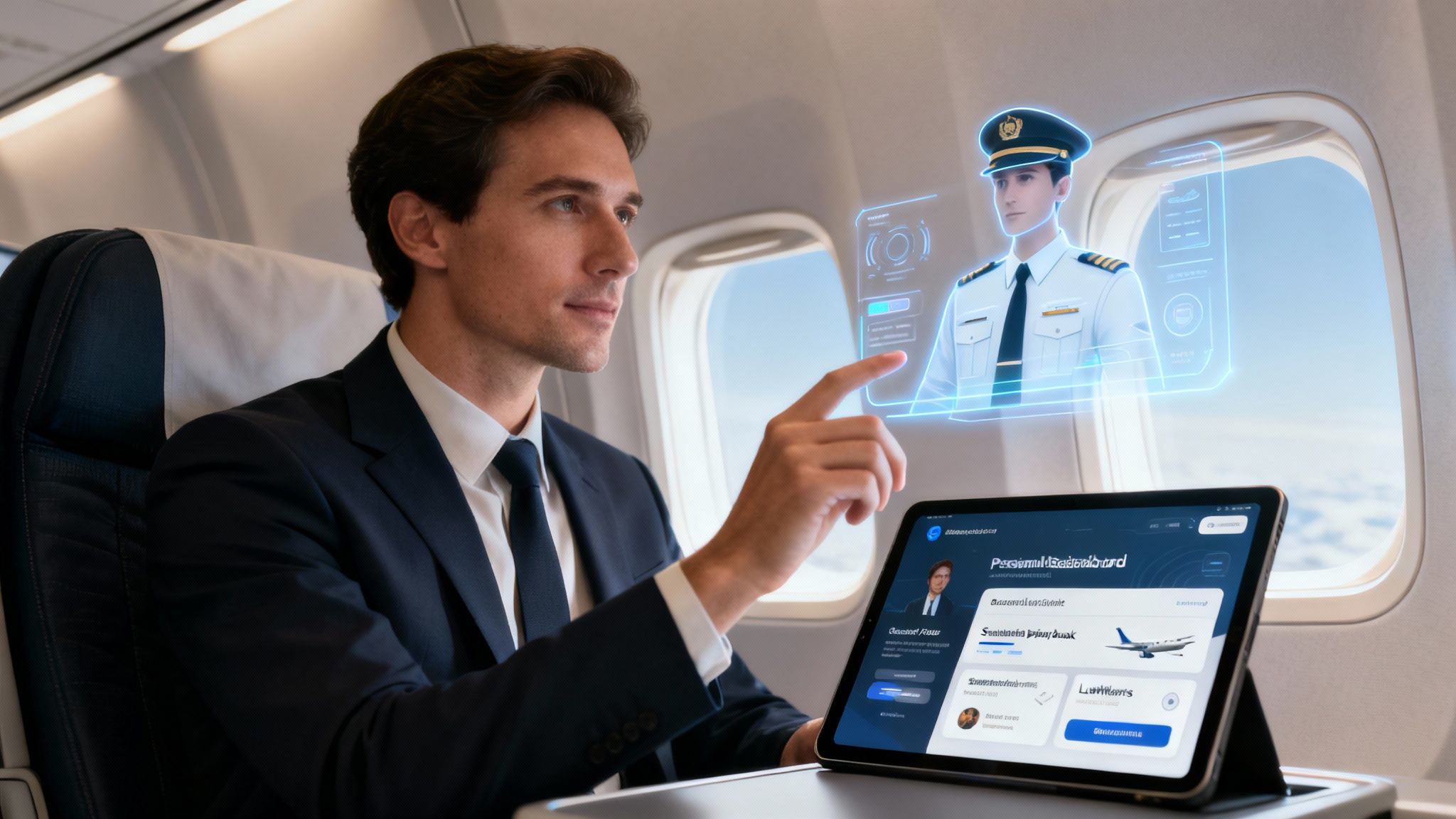
Throughout my career driving growth, I've consistently seen that unlocking exponential value happens at the intersection of technology and customer-centricity. This has never been more critical than in aviation today. Frequent flyers aren't just collecting points; they demand recognition and a seamless experience tailored to them.
They expect to be known, understood, and valued at every touchpoint. This is where AI transitions from a boardroom buzzword to an essential co-pilot for your entire growth strategy. This isn't about automating rote replies—it’s about a fundamental re-architecture of the member journey, grounded in data, to drive tangible business outcomes.
Redefining the Member Journey With Actionable Data
The strategic power of AI lies in its ability to process vast, disparate datasets and distill them into actionable, single-customer insights. The paradigm shift is profound: we move from broadcasting one message to millions, to orchestrating millions of concurrent, one-to-one dialogues. This is how we pivot from reactive problem-solving to proactive value delivery.
An effective AI system must synthesize data from a member's:
- Travel History: Identifying patterns in destinations, travel frequency, and booking windows to predict future behavior.
- In-Flight Preferences: Systematically logging and recalling preferred seats, meal choices, or entertainment genres.
- Service Interactions: Analyzing past issues and resolutions to inform future support and pre-empt frustration.
- Ancillary Purchases: Understanding which add-ons, like lounge access or priority boarding, drive value for specific segments.
By connecting these data points, AI constructs a dynamic, evolving profile of each member. This empowers you to proactively offer a business traveler a crucial seat upgrade on a red-eye or suggest a family-friendly travel package during school holidays. Every interaction becomes precisely relevant.
This isn't theoretical; it delivers measurable ROI. When Singapore Airlines deployed an AI platform integrating data from 28 touchpoints, the results were immediate and substantial. Within the first year, they reported a 23% increase in member satisfaction and a 17.5% lift in ancillary revenue from these personalized offers. The data draws a straight line from intelligent personalization to bottom-line growth.
This is the playbook for converting loyalty members into staunch advocates. You transcend a transactional relationship built on points and miles to forge strategic partnerships that lock in market share and drive long-term profitability.
Core Strategies for AI-Powered Member Journeys
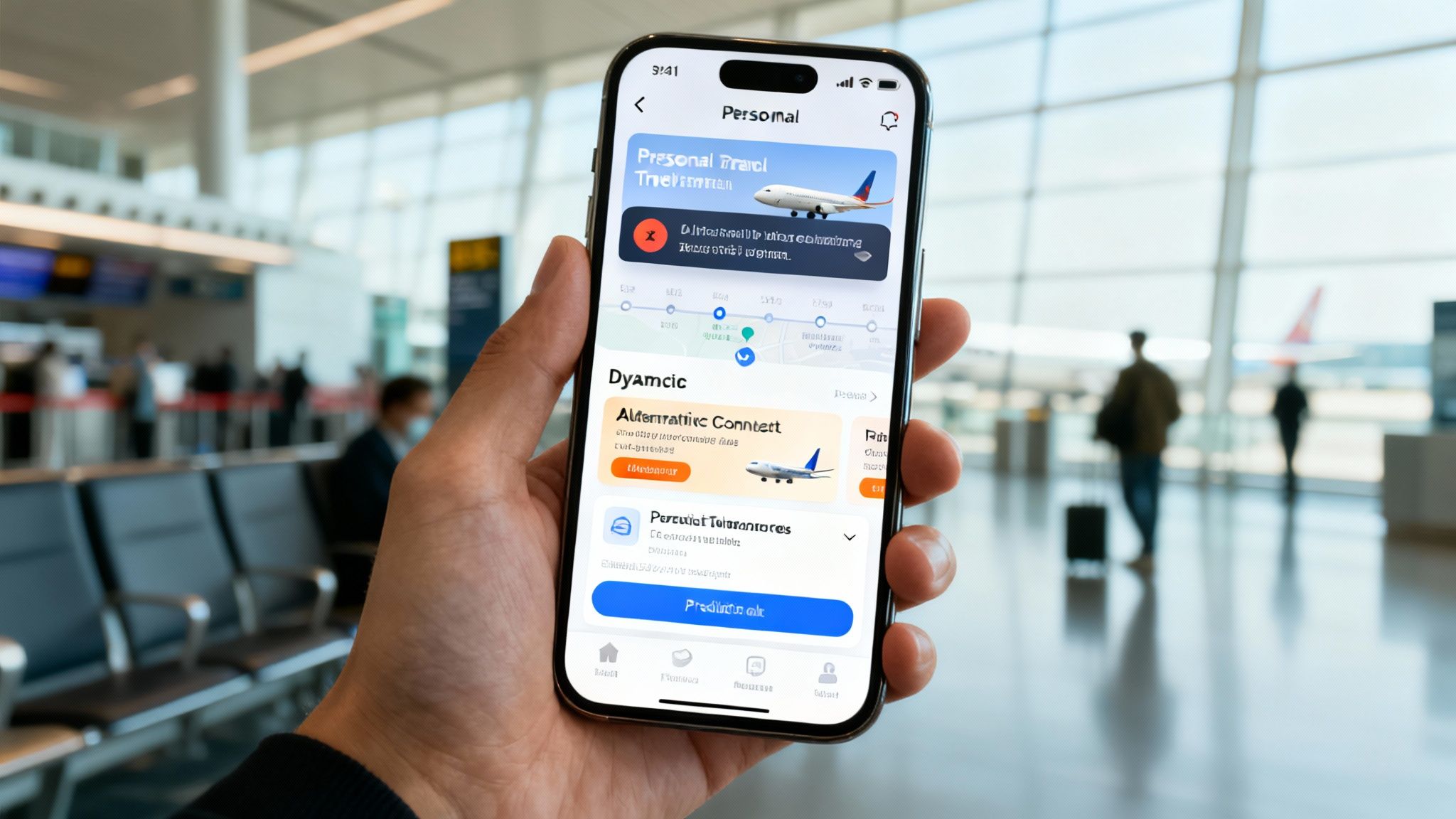
To leverage AI as a genuine growth engine, you must think beyond tactical feature implementation. In my experience, the initiatives that move the P&L are built on a robust strategic framework, not just novel technology. A truly exceptional AI customer experience for aviation memberships is underpinned by three core pillars that work in concert to build unbreakable loyalty.
These are not siloed functions. They form an interconnected system designed to make every member feel recognized and valued. The pillars are hyper-personalization at scale, predictive service delivery, and seamless channel engagement. Executing these flawlessly transforms your program from a simple utility into an indispensable travel partner.
Hyper-Personalization at Scale
True personalization is more than inserting a first name into a mass email. It is demonstrating a deep, data-driven understanding of an individual's unique needs and travel behaviors. This is where machine learning excels, enabling a shift from rigid, rule-based promotions to genuinely one-to-one interactions that drive conversion.
The objective is to analyze immense datasets—booking history, travel patterns, ancillary purchases, in-flight preferences—to deliver offers that feel less like a marketing push and more like a strategic recommendation from a trusted advisor.
- The Business Traveler: AI identifies a pattern of last-minute, single-day trips to a specific city. Instead of a generic fare sale, it proactively offers a flexible booking package for that route, complete with lounge access and priority boarding.
- The Leisure Traveler: An algorithm detects a member books family vacations annually in July. It then delivers a curated offer for a family-friendly destination months in advance, bundled with relevant deals on extra baggage and seat selections.
Achieving this requires breaking down the data silos that typically separate commercial, operations, and marketing teams—a challenge I've tackled repeatedly. The foundational step is always knowing your customer. To delve into that critical groundwork, you can explore effective customer segmentation strategies that enable this level of precision.
Predictive Service Delivery
This second pillar is about fundamentally shifting your service posture from reactive to proactive. A world-class AI customer experience for aviation memberships doesn't wait for a service failure; it anticipates it and deploys a solution before the member is even aware of the problem. This is how you convert a potential point of friction into a powerful moment of trust-building.
Think of AI as a vigilant co-pilot for your member's journey, constantly scanning for indicators of disruption.
A tight connection is a classic travel stress point. Instead of leaving the member to worry, an AI system flags the risk. It can automatically hold the connecting flight or pre-book them on the next available one. A simple, proactive notification—"We've noted your connection in Denver is tight. We have arranged for cart transport to meet you at gate B52."—is immensely powerful.
This proactive capability extends to other areas, such as alerting a member to a last-minute gate change or pushing a meal voucher to their app the moment a delay is confirmed. Every intervention reinforces the message that you are actively managing their journey, which is the essence of a premium membership experience.
Seamless Channel Engagement
Finally, the entire experience must be cohesive, regardless of how or where the member interacts with your brand. Consistency is paramount. A conversation initiated with a chatbot on the mobile app must be instantly accessible to the lounge agent or the call center representative. It must be a single, continuous dialogue.
This omni-channel strategy ensures members never have to repeat themselves. The intelligence gathered in one channel informs and enhances the next touchpoint. Whether they are using the app, browsing the website, or standing at a check-in desk, the context of their journey and past interactions must follow them.
This unified customer view is what elevates the experience from a series of disjointed transactions to a cohesive, intelligent relationship that builds durable loyalty.
Applying AI Strategies Across the Aviation Member Lifecycle
To operationalize these pillars, it is crucial to map them across the entire member journey. From acquisition to post-flight feedback, AI must play a specific, value-adding role. This table illustrates how targeted AI strategies drive key business outcomes at each stage.
| Member Journey Stage | AI Strategy Applied | Example Application | Key Business Outcome |
|---|---|---|---|
| Awareness & Acquisition | Hyper-Personalization | AI-powered ad targeting presents benefits relevant to a user's travel searches (e.g., family vs. business perks). | Higher conversion rates and lower cost-per-acquisition. |
| Onboarding | Seamless Channel Engagement | An AI chatbot guides new members through profile and preference setup, personalizing their initial brand experience. | Improved initial engagement and accelerated time-to-value for the member. |
| Booking & Pre-Flight | Hyper-Personalization | The booking engine suggests ancillary services (upgrades, baggage) based on the member's past behavior and lookalike modeling. | Increased ancillary revenue per booking and enhanced member convenience. |
| Day of Travel | Predictive Service Delivery | AI monitors flight status and connection times, proactively sending gate change alerts or rebooking options. | Reduced operational strain and significantly higher member satisfaction during disruptions. |
| In-Flight & Post-Flight | Seamless Channel Engagement | AI analyzes post-flight survey sentiment, flagging negative experiences for immediate follow-up by a human agent. | Improved service recovery and increased long-term loyalty. |
| Loyalty & Retention | Hyper-Personalization | A recommendation engine offers personalized rewards, such as a partner lounge pass in a frequently visited city. | Higher member retention and a deeper perception of program value. |
The ultimate goal is to integrate these AI-driven interactions so seamlessly that they feel intuitive, not technological. When executed correctly, AI doesn't feel like an algorithm; it feels like impeccable service, delivered consistently at scale.
The Real-World ROI of AI in Airline Loyalty
As a growth strategist, I've seen countless pitches for new technology. My focus always comes back to a single question: what is the measurable return on investment? Theory is interesting, but my world is defined by tangible business outcomes. When we talk about leveraging AI to improve the customer experience for aviation memberships, we are talking about a direct, quantifiable impact on growth.
This is not about intangible benefits; it's about moving the KPIs that leadership and shareholders scrutinize. We must connect the dots between a smarter, AI-driven experience and core metrics like ancillary revenue, member retention, and operational cost reduction.
Boosting Revenue and Member Lifetime Value
The most immediate financial impact is typically seen in ancillary revenue. When AI algorithms analyze a member’s travel history, past purchases, and real-time behavior, the personalized offers become exponentially more effective. We move beyond generic "upgrade your seat" blasts into highly specific, timely suggestions that convert.
Consider this: an AI can identify a business traveler who consistently books red-eye flights and offer them a lie-flat seat upgrade at a dynamic price point just before check-in. This surgical approach has been shown to lift offer conversion rates by over 30% in some implementations.
These incremental wins compound, directly impacting the most critical metric: Customer Lifetime Value (CLV). When members feel understood and receive consistently relevant offers, they are far more likely to remain loyal and increase their spend over time. This is how a loyalty program transitions from a cost center into a predictable revenue engine.
An investment in AI is not an IT expense; it is a direct investment in your most valuable asset—your customer relationships. Using data to make every interaction smarter and more personal builds loyalty that competitors cannot easily replicate.
The industry is taking note. The global market for AI in aviation is expanding rapidly, with airlines projected to increase spending on AI-driven CX projects by 35% annually through 2030. This is not speculation; it is a strategic imperative based on proven results. For a deeper dive into this trend, you can find valuable insights on the future of the airline CX data playbook on kasmodigital.com.
Streamlining Operations for Better Efficiency
Beyond revenue generation, AI delivers significant operational efficiencies. AI-powered support systems, such as intelligent chatbots and automated service agents, can handle a high volume of common member inquiries—point balances, flight confirmations, basic policies—without human intervention.
This automation achieves two crucial objectives simultaneously:
- Lower Cost-to-Serve: It liberates human agents to focus on complex, high-value interactions that require empathy and sophisticated problem-solving. This dramatically reduces the cost of servicing the member base.
- Enhanced Member Satisfaction: Members receive instant, 24/7 answers to their queries. This perception of efficiency and responsiveness is a major driver of overall satisfaction.
Ultimately, a well-executed AI strategy creates a virtuous cycle. Improved member satisfaction leads to higher retention and CLV, which can be tracked with robust client satisfaction measurement frameworks. Concurrently, operational efficiencies reduce costs and strengthen the bottom line. Impacting both the top and bottom lines is what makes AI an indispensable tool for any airline committed to winning market share.
Building Your AI Implementation Flight Plan
A brilliant strategy without a clear execution plan is merely a theory. In my experience advising high-growth companies, successful initiatives are always underpinned by a disciplined, phased roadmap. Deploying a world-class AI customer experience for aviation memberships is no exception. A structured flight plan is required to build momentum, demonstrate value, and align the organization.
Attempting to implement complex predictive models without a solid data foundation is like trying to take flight without an airframe—it's destined to fail. The key is to build capabilities progressively, ensuring each phase enables the next. This de-risks the initiative, delivers early wins that build organizational buy-in, and unites teams around a shared vision.
Phase 1: Unify Your Data and Break Down Silos
Before any meaningful AI work can begin, you must solve the pervasive problem of data silos. Your member data is likely fragmented across booking systems, marketing platforms, loyalty databases, and customer service logs. The first and most critical phase is to aggregate these disparate sources into a single, cohesive view of each member.
This is not a technology project; it is a strategic business imperative. Breaking down these walls requires executive-mandated collaboration between IT, marketing, operations, and commercial teams. The objective is to create a clean, accessible data pipeline that provides a complete history of every member interaction. For leaders embarking on this, understanding the mechanics of a successful business intelligence implementation is a crucial starting point.
Phase 2: Launch Foundational AI Applications
With a unified member view established, you can begin deploying foundational AI tools to secure quick, high-impact wins. These initial applications focus on improving efficiency and delivering immediate value, which builds crucial confidence in the broader AI program.
Focus on tools that address common pain points:
- Intelligent Chatbots: Deploy AI-powered chatbots on your app and website to handle routine inquiries like point balances, flight status, and baggage policies, freeing up human agents for complex issues.
- Personalized Campaigns: Use machine learning to segment members based on actual behavior. Launch targeted email and app campaigns with relevant offers, moving beyond generic, one-size-fits-all promotions.
- Sentiment Analysis: Implement tools to analyze feedback from surveys and social media, providing a real-time pulse on member sentiment and enabling rapid response to emerging issues.
Phase 3: Move to Advanced Predictive Modeling
With a solid data foundation and foundational AI tools delivering value, you are ready for more advanced applications. This phase is about transitioning from a reactive model to a proactive one. Here, you leverage predictive analytics to anticipate member needs and resolve potential issues before they occur. This is where you create true competitive differentiation.
The following chart illustrates how AI's impact evolves, starting with direct revenue and retention and expanding to drive holistic operational efficiency.
As your AI maturity increases, the business benefits compound, creating a powerful cycle of growth and loyalty.
Sophisticated use cases in this phase include:
- Proactive Disruption Management: AI algorithms can predict members at high risk of missing a connection. The system can then automatically rebook them and transmit an updated itinerary before they even deplane.
- Dynamic Reward Pricing: Instead of static reward charts, AI can adjust the point value of flights based on demand, member tier, and travel history, making rewards feel more valuable and personalized.
Phase 4: Embrace Continuous Optimization and Experimentation
This final phase is not an endpoint but a continuous operating model. A world-class AI-driven experience requires a culture of relentless, data-driven experimentation. You must create a permanent feedback loop where insights from AI models are used to constantly refine strategies, test new offers, and perfect the member journey.
An AI implementation is never "done." It is a living system that must be nurtured, tested, and optimized. The goal is to build an organizational muscle for constant learning, where every interaction provides data to make the next one even better.
This entails A/B testing personalized offers, measuring the impact of proactive service alerts on member satisfaction, and feeding all results back into the system. This commitment to ongoing optimization ensures your program remains a competitive advantage and continues to deliver increasing value to both members and the bottom line.
Navigating Turbulence: Common Challenges in AI Implementation
Let's be pragmatic. Deploying any transformative technology will encounter turbulence. In my experience, the organizations that succeed are not those that ignore challenges, but those that anticipate them and build a plan to navigate them. For creating a premier AI customer experience for aviation memberships, the potential hurdles are predictable, but they demand a proactive, cross-functional strategy.
Ignoring these issues is not a viable strategy. The only path forward is to address them directly, converting potential roadblocks into opportunities to build a more resilient and effective program. We will focus on the three most common challenges: data privacy, the balance of automation and human touch, and the persistent problem of internal silos.
Earning Member Trust Through Smart Data Governance
The moment you discuss "personalization," the conversation rightly shifts to data privacy. Your members entrust you with their personal information, and a single misstep can irrevocably damage that trust. The objective is not mere compliance; it's to become a transparent and trustworthy steward of their data.
This requires a robust data governance framework built around the member's perspective. You must be unequivocally clear about what data is collected, why it is needed, and how it directly benefits their travel experience.
Trust is the true currency of loyalty. When you use data to proactively solve a travel problem for a member, you earn that trust. If you're vague or intrusive, you lose it—and getting it back is next to impossible.
Here is the playbook for building that trust:
- Be Radically Transparent: Use plain language to explain how AI utilizes their data to improve their journey—from finding better flight connections to suggesting relevant rewards.
- Give Members Control: Provide a simple, accessible dashboard where members can manage their data preferences and opt out of specific types of personalization.
- Prioritize Security: Your AI budget must include significant investment in best-in-class security to protect member data from breaches. This is non-negotiable.
Balancing Automation With a Genuine Human Touch
A common executive fear is that AI will render their premium brand cold and robotic. This is a valid concern if AI is implemented thoughtlessly. The strategic goal is not to replace the human element of hospitality, but to supercharge it by making your teams smarter and more effective.
AI should handle the high-volume, repetitive tasks. This liberates your people to focus on the high-value, empathetic interactions that build lasting relationships. For example, an AI chatbot can answer "What's my points balance?" at 3 AM, allowing a human agent to focus on assisting a distressed family with a complex rebooking after a missed flight.
Think of AI as the ultimate co-pilot for your frontline staff. It can provide a lounge agent with key member details—their favorite drink, an upcoming anniversary—creating an opportunity for a genuine, personal connection. This is how technology amplifies the human touch, rather than erasing it.
Breaking Down Silos for a Unified Experience
Finally, the most significant obstacle is almost always internal. An AI-powered customer experience is doomed if your marketing, IT, and operations departments function as independent fiefdoms. AI thrives on unified data and a shared vision. Organizational silos are the single greatest threat to success.
From my experience breaking down these barriers, success requires a clear mandate from leadership for cross-functional collaboration. This means establishing shared goals and KPIs that compel teams to work together. Marketing's success metrics must be tied to operational efficiency, and IT's performance must be measured by the impact of their work on member satisfaction.
When these teams are aligned and incentivized to collaborate, you begin to build a powerful, data-first culture. This alignment ensures your AI initiative becomes woven into the operational fabric of the airline, delivering value and driving sustainable growth.
Looking ahead, AI's role in aviation memberships will not be a mere feature; it will be foundational to the entire travel experience. As a strategist focused on growth, I see the next decade as a complete reimagining of the relationship between airlines and their most valuable customers. We are evolving beyond basic personalization to something far more potent: predictive journey orchestration.
The emerging trends point to a future where the AI customer experience for aviation memberships is so seamless it becomes invisible, yet it is perpetually working in the background. Imagine generative AI not just recommending a destination, but constructing a complete, bookable itinerary based on a member's travel style, budget, and even calendar availability. This is how an airline transforms from a simple transportation provider into an indispensable travel partner.
The Seamless AI-Powered Journey
We will also witness the convergence of AI with other technologies to eliminate friction points in the airport. Consider the integration of AI and biometrics, allowing elite members to move from curb to gate without ever presenting a passport or phone. Your face becomes your boarding pass, merging security and boarding into a single, fluid motion.
Onboard, the Internet of Things (IoT) will sync with AI to create a uniquely personalized in-flight environment.
- Intelligent Seating: Your seat could automatically adjust to your saved preferences for recline, lighting, and even temperature the moment you are seated.
- Proactive Service: Instead of a call button, flight attendants could receive a discreet notification on their device, prompted by AI, to offer a member's favorite drink or provide reassurance during turbulence.
The strategic end-goal is an experience so precisely calibrated to the individual that it feels less like commercial travel and more like a private charter. The airline will not just know where you have been; it will anticipate your needs with remarkable accuracy, making the entire journey feel bespoke.
For aviation leaders, the mandate is clear: you must build your AI strategy now. The airlines that develop these intelligent, predictive systems will not only command fierce member loyalty but will also define the future standard for air travel. The ultimate competitive advantage will belong to those who master the ability to see the entire journey through the eyes of their customers.
Common Questions About AI in Aviation Customer Experience
When introducing a powerful new capability like AI, questions are inevitable and necessary. In my work advising airlines through this transformation, I've found that addressing these questions directly is the most effective way to achieve alignment and drive progress.
Here are the most common questions I receive from aviation executives, along with my direct, business-focused answers. This is about making strategic decisions that deliver a competitive edge in a demanding market.
Where Do We Even Start with AI in Our Loyalty Program?
Before you consider algorithms or predictive models, you must solve your data problem. The absolute first step—the one you cannot bypass—is data unification. I have seen numerous promising AI projects fail because they were built on a foundation of fragmented, unreliable data.
Your booking systems, loyalty database, marketing platforms, and customer service logs currently operate in silos. You must break down these walls to create a single, clean view of each member. This unified profile is the non-negotiable bedrock; without it, any personalization effort is merely a shot in the dark.
How Do We Use AI Without Creeping Out Our Members?
The line between helpful and intrusive is defined by value and transparency. The key is to deploy AI to solve a genuine traveler problem, not simply to create another sales channel.
For example, when a flight is delayed, AI can proactively rebook a member and notify them of the solution. That is a high-value interaction that builds immense loyalty. Conversely, relentlessly pushing rental car offers after a single flight search is an annoyance that erodes trust.
The simple rule I instill in every team is this: Use data to serve, not just to sell. Be explicit in your privacy policy about how data improves the member experience, and always provide clear, accessible controls. In this industry, trust is your most valuable asset.
What’s the Biggest Financial Win We Can Expect from AI?
While automating routine tasks delivers immediate cost savings, the true, game-changing ROI comes from the long-term increase in Customer Lifetime Value (CLV). This is the ultimate metric that validates your strategy.
When you leverage AI to create experiences that are personal, proactive, and seamless, satisfaction increases dramatically. Satisfied members remain loyal longer, book more frequently, and have a higher propensity to purchase ancillary services. There is a direct causal link between a superior experience and increased revenue per customer.
An AI-driven approach transforms your loyalty program from a cost center into a powerful engine for building durable customer relationships and driving sustainable, profitable growth.
At MGXGrowth, we partner with aviation leaders to architect and execute AI-powered strategies that convert customer data into a decisive competitive advantage. We work within your organization to break down data silos, cultivate a data-first culture, and deliver measurable growth. See how we can help you design your flight plan at https://www.mgxrowth.com.
